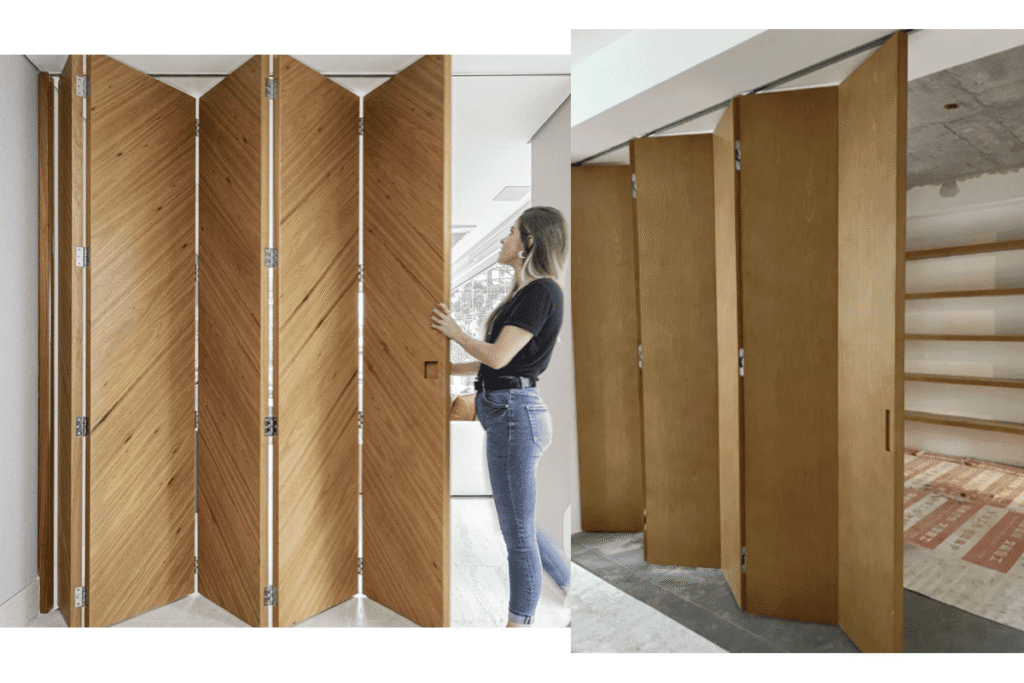
5 Best Bifold Door Hinges by Application?
Bifold door hinges can create a smooth folding door system, but the wrong hinge choice quickly causes sagging, noise, uneven gaps, and after-sales complaints1. I have seen buyers lose time because they compared hinge prices before confirming the door structure. The better solution is to match the hinge type to the door material, panel size, weight, and installation method2.
The 5 best bifold door hinges are surface-mounted folding hinges, standard butt or non-mortise hinges, pivot systems, glass bifold hinge systems, and concealed hidden folding hinges. The “best” option depends on door weight, panel dimensions, material, opening angle, visible or hidden installation preference, machining accuracy, and long-term procurement consistency.
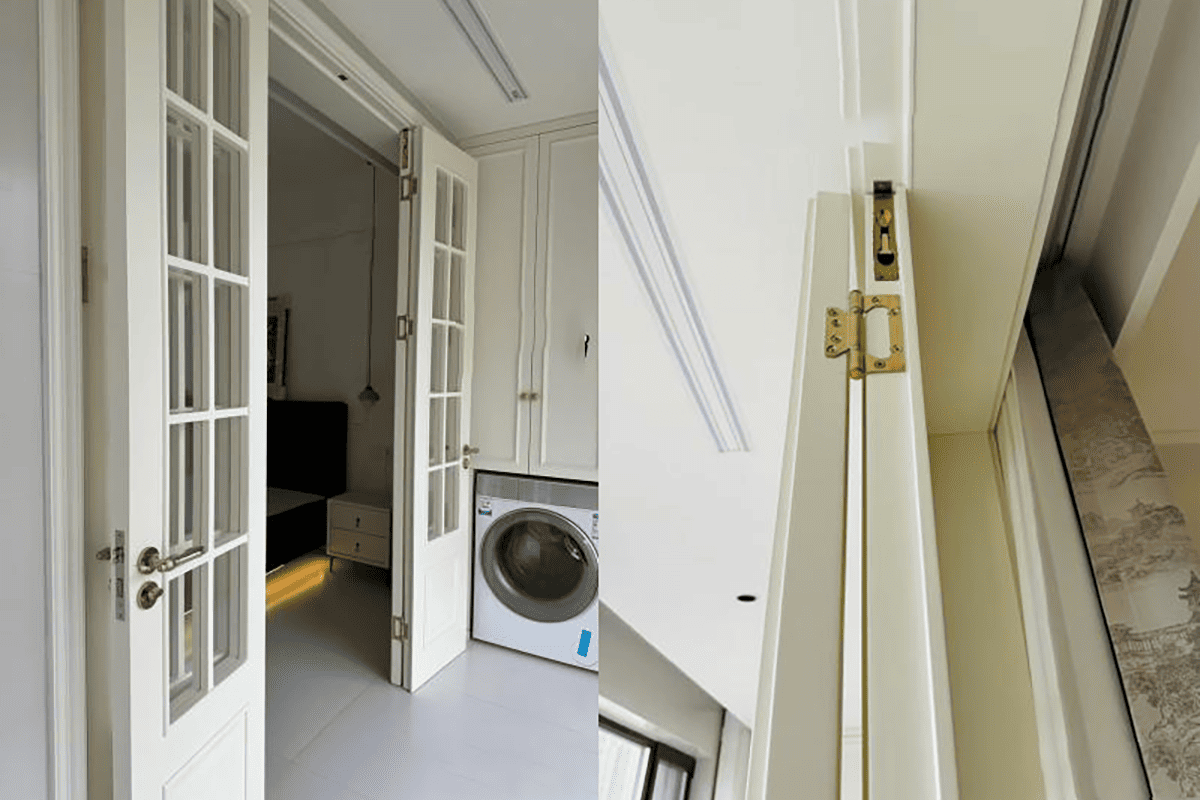
I do not treat bifold hardware as a one-size-fits-all item. In factory production and bulk supply, the hinge is only one part of the door movement system. The real question is simple: which hinge reduces installation risk, performance risk, and procurement risk for your door line?
Which bifold door hinges work best for economical wood or aluminum folding doors?
Many buyers start with surface-mounted hinges because they look simple and cost-effective. That can be a good choice, but only when the door weight, panel width, screw holding strength3, and finish requirements are clear. If these details are ignored, a simple hinge can become the source of unstable movement.
Surface-mounted bifold door hinges work best for light to medium wood doors, aluminum-frame folding doors, wardrobe doors, partition doors, and simple interior folding systems.4 They are easy to install, economical for bulk orders, and suitable when visible hardware is acceptable and accurate mortising is not required.
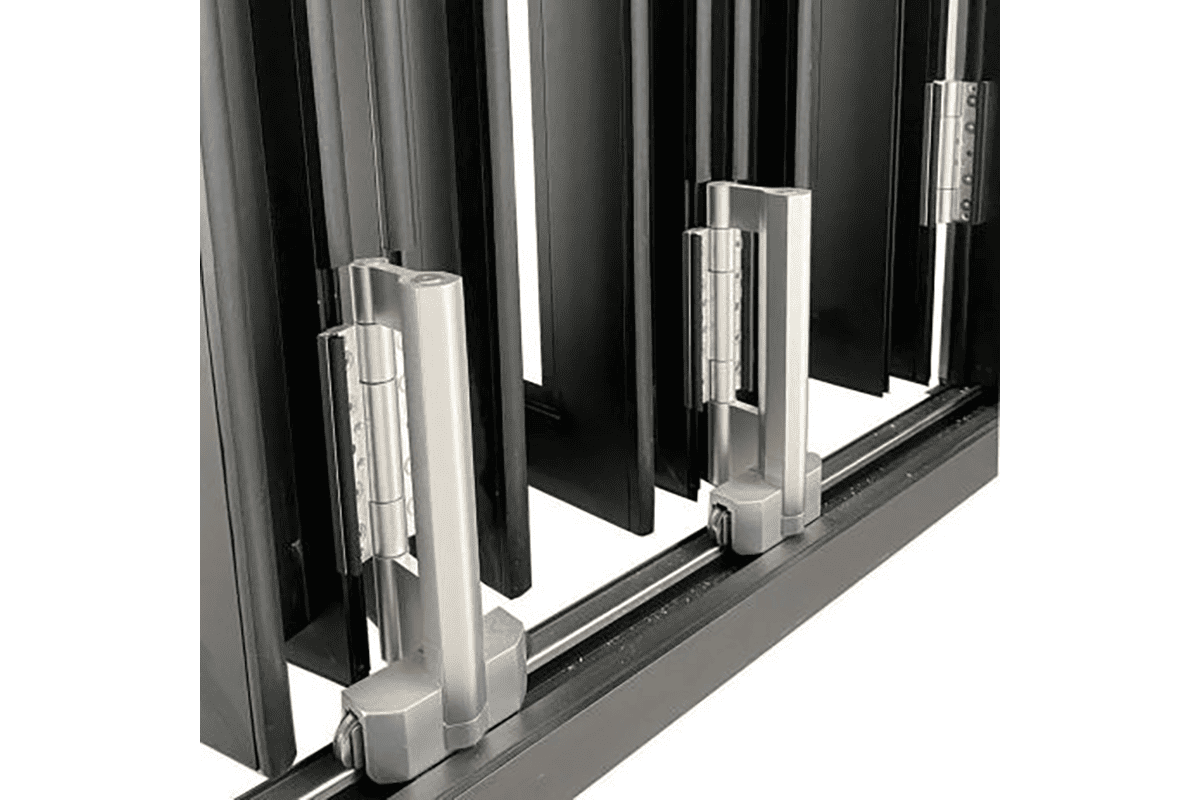
Surface-mounted folding hinges are often the first option I discuss with door factory buyers because they solve many practical problems at once. They do not require deep machining.5 They are easy to inspect before packing. They can be produced with common finishes, such as satin stainless steel, polished stainless steel, black, brass, bronze, or customized electroplated finishes.
However, I always remind buyers that “easy” does not mean “universal.”
Where surface-mounted folding hinges fit best
Surface-mounted hinges are usually suitable for:
- Wooden bifold doors
- MDF wardrobe folding doors
- Light interior partition doors
- Aluminum-frame folding panels
- Cabinet-style folding door systems
- Cost-sensitive wholesale hardware ranges
They are especially useful when a buyer needs a practical product line for general interior use. The installation team can align the hinge on the door face and fasten it with screws. This reduces machining complexity and helps factories maintain production speed.
Main advantages for B2B buyers
From a procurement view, surface-mounted bifold door hinges offer several clear advantages:
| Evaluation point | Buyer benefit |
|---|---|
| Installation | Simple fixing, no deep mortise required |
| Cost | Usually more economical than concealed or pivot systems |
| Production | Easy to manufacture in stable batches |
| Finish | Many surface finish options are available |
| Inspection | Dimensions, hole position, and rotation can be checked quickly |
| Replacement | Easier for after-sales service teams |
In bulk orders, these details matter. A buyer does not only purchase one hinge. A buyer purchases repeatability. If 10,000 pieces arrive with uneven hole positions or inconsistent finish color, the unit price no longer looks attractive.
Limitations to confirm before ordering
Surface-mounted hinges have limits. Buyers should confirm:
- Door weight per panel
- Panel width and height
- Door thickness
- Screw holding strength
- Gap between folding panels
- Required opening angle
- Indoor or humid environment
- Finish consistency for batch supply
A lightweight wardrobe door may work well with a simple folding hinge. A taller and heavier solid wood panel may need a stronger hinge structure or a pivot-assisted system.
My practical procurement advice
When I review a surface-mounted bifold hinge sample, I look at four things first:
- Leaf thickness
- Pin stability
- Knuckle alignment
- Rotation smoothness
Then I check surface quality. A hinge can look fine from far away but show weak polishing, sharp edges, or color variation under closer inspection. For hardware brand buyers and wholesalers, these small defects can affect customer perception quickly.
Surface-mounted hinges are often the best economical choice, but they should be selected with real door information, not only by catalog size.
When are butt or non-mortise bifold door hinges the right choice?
Some buyers ask whether ordinary butt hinges can be used on folding doors. The answer is sometimes yes, but the door system must be simple and light enough. If the hinge geometry is wrong, the folding movement can feel tight, noisy, or misaligned.
Butt or non-mortise bifold door hinges are suitable for simple interior folding doors where the panels are light, the opening demand is moderate, and the buyer wants a familiar hinge structure. Non-mortise types reduce machining work, while butt hinges may provide a cleaner traditional installation when mortising is acceptable.6
Butt hinges are familiar to almost every door factory. They are stable, easy to understand, and available in many materials. Non-mortise hinges are also popular because they can reduce cutting work. Still, when these hinges are used in bifold doors, the buyer must think about movement differently.
A normal swing door usually rotates on one side. A bifold door folds between panels and may also connect to a track, pivot, or jamb side. This creates different stress points.7
Butt hinges vs. non-mortise hinges
| Hinge type | Best use | Key advantage | Main limitation |
|---|---|---|---|
| Butt hinge | Wood folding panels with mortising | Stronger traditional fixing | Requires accurate cutting |
| Non-mortise hinge | Light interior folding panels | Faster installation | Lower structural tolerance for heavy panels |
| Loose pin butt hinge | Serviceable interior doors | Easier removal | Pin fit must be stable |
| Ball bearing butt hinge | Smoother swing movement | Better rotation feel | May not suit all folding geometries |
For simple wood bifold doors, butt hinges can work well when the hinge size, screw position, and mortise depth are controlled. Non-mortise hinges can help buyers reduce labor cost, but they should not be selected only for convenience.
What buyers should confirm
Before ordering butt or non-mortise bifold door hinges, I suggest confirming:
- Is the door solid wood, MDF, plywood, or aluminum-frame?
- How many hinge points will each panel connection use?
- Will the door use a top track, bottom guide, or pivot support?
- Does the hinge need ball bearings or plain washers?
- What is the expected user frequency?
- Will the hinge be visible after installation?
These questions prevent common mismatch problems.
Quality control points in bulk production
For butt and non-mortise hinges, stable batch quality is very important. In factory inspection, I usually pay attention to:
Leaf flatness
If the hinge leaf is twisted, the door panel may not sit flat.Hole position consistency
Door factories need repeatable drilling and assembly.Pin diameter and fit
A loose pin can create noise and shaking.Edge finishing
Sharp edges can damage packaging, installers, or finished door surfaces.Plating or stainless finish
Uneven color creates problems for hardware brands and wholesalers.
When this option is not enough
Butt or non-mortise hinges are not the best solution for every folding door. They may not be suitable for:
- Heavy solid wood folding doors
- Oversized panels
- Frameless glass doors
- Premium concealed design projects
- High-traffic commercial openings
- Doors requiring advanced soft-close or anti-sag functions
In these cases, I would move the discussion toward pivot systems, glass hinge systems, or concealed folding hinges.
For B2B buyers, the main value of butt and non-mortise hinges is familiarity and cost control. They are best when the door design is simple and the buyer wants stable, easy-to-source hardware.
Are pivot systems the best bifold door hinges for heavy or large panels?
Heavy panels create a different problem. A normal hinge may rotate, but it may not carry the load well over time. If the weight is not transferred properly, doors can sag, rub, or create uneven gaps. This is where buyers should consider a pivot-based folding system.
Pivot systems are often the best bifold door hinge solution for heavier, taller, or wider panels because they transfer load through top and bottom pivot points instead of relying only on side hinge leaves.8 They are suitable for larger wood, aluminum-frame, and partition doors when stability matters more than the lowest hardware cost.
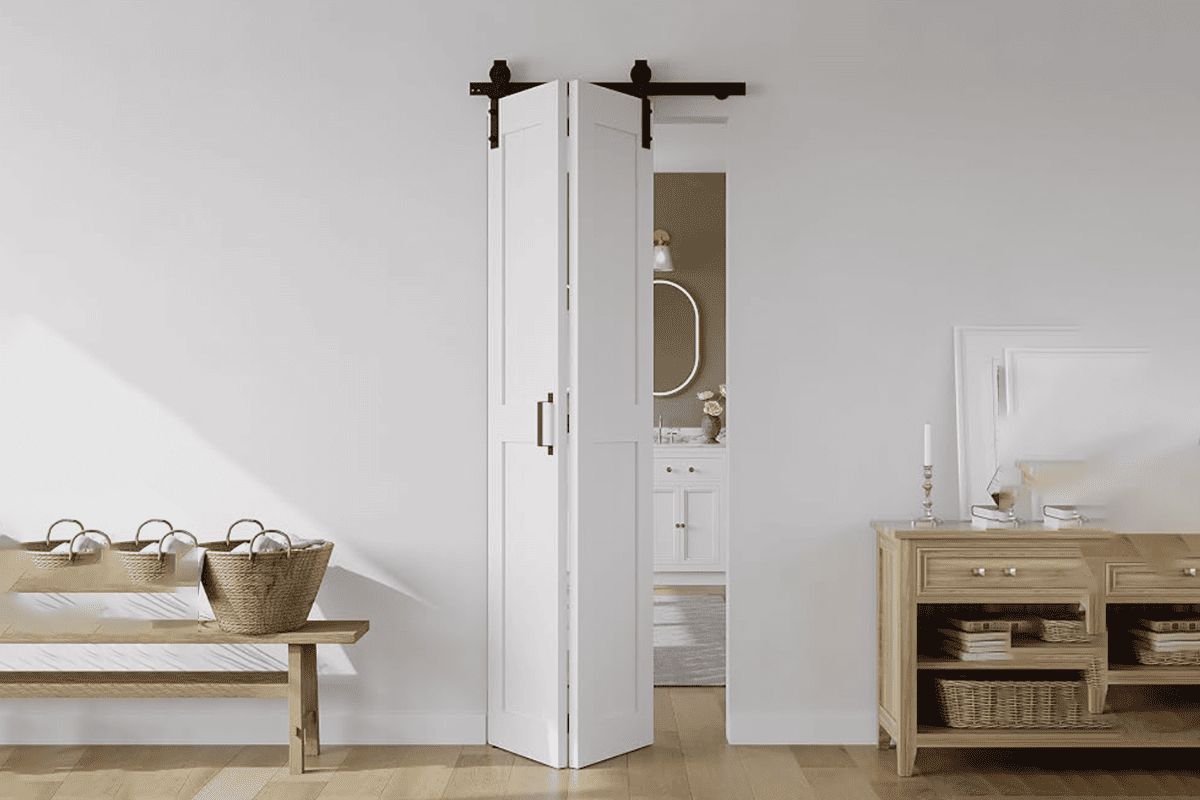
Pivot systems are not always called “hinges” in catalogs, but they often perform the most important hinge function in a folding door system. They support rotation, guide movement, and improve weight distribution. For heavier bifold doors, this can be more reliable than only using multiple side hinges.
I often tell buyers that pivot systems should be evaluated as a complete movement solution, not as a single small component.
Where pivot systems perform well
Pivot systems are commonly considered for:
- Large interior folding partitions
- Heavier wood bifold doors
- Aluminum-frame folding doors
- Commercial-style room dividers
- Tall panels with higher sagging risk
- Doors requiring better movement guidance
They may include top pivots, bottom pivots, guide rollers, floor guides, brackets, and sometimes track accessories. Because the system has more components, selection and installation accuracy become more important.
Why pivot systems improve stability
A pivot system can improve performance because it changes how the door load is carried.
| Factor | Normal side hinge | Pivot system |
|---|---|---|
| Load path | Mainly through hinge screws and side frame | Through top/bottom pivot points and guides |
| Sagging control | Depends heavily on screw holding strength | Better support for larger panels |
| Movement | Simple rotation | Guided folding and rotation |
| Installation | Usually easier | Requires more accurate alignment |
| Cost | Lower | Higher |
| Best fit | Light to medium doors | Medium to heavy or larger doors |
This does not mean pivot systems are always better. It means they are better when the door demands support and movement control.
Important buyer checks
Before sourcing pivot-based bifold door hinges or systems, buyers should provide complete door data:
- Panel weight
- Panel height and width
- Door thickness
- Frame material
- Number of panels
- Track type, if any
- Floor condition
- Opening direction
- Required adjustment range
- Finish and corrosion resistance requirement
If the door is installed in a project with uneven floors or frames, a pivot system with adjustment features may reduce after-sales risk.9 However, the buyer should still ask a qualified installer or project engineer to confirm the final application.
Functional upgrades to consider
Some pivot systems include additional functions. These features can be useful, but they should match the actual door and market need.
Possible upgrades include:
- 3D adjustment
- Anti-sag structure
- Soft close or damping
- Positioning function
- Automatic closing
- Anti-slam design
- Finger protection accessories
I do not recommend choosing these functions only because they sound premium. Each function adds cost and may add installation requirements. For example, soft close may improve user experience in a high-end interior door, but it may not be necessary for a basic wholesale product line.
Procurement risk for pivot systems
Pivot systems have more components than ordinary hinges. This means buyers should check:
- Are all accessories included in the packing list?
- Are left-hand and right-hand versions clearly marked?
- Are installation instructions clear?
- Are adjustment screws stable?
- Are plastic or nylon parts strong enough for the target market?
- Can the supplier maintain the same component design in repeat orders?
For heavy or large panels, pivot systems can be the best choice. But buyers should source them with full door drawings, real installation conditions, and clear quality inspection standards.
Which bifold door hinges are suitable for glass doors?
Glass doors create higher risk because the hinge cannot be selected by appearance alone. The glass thickness, drilling method, clamp structure, gasket material, and pivot position all affect safety and movement.10 A wrong match can cause glass stress, poor alignment, or installation failure.
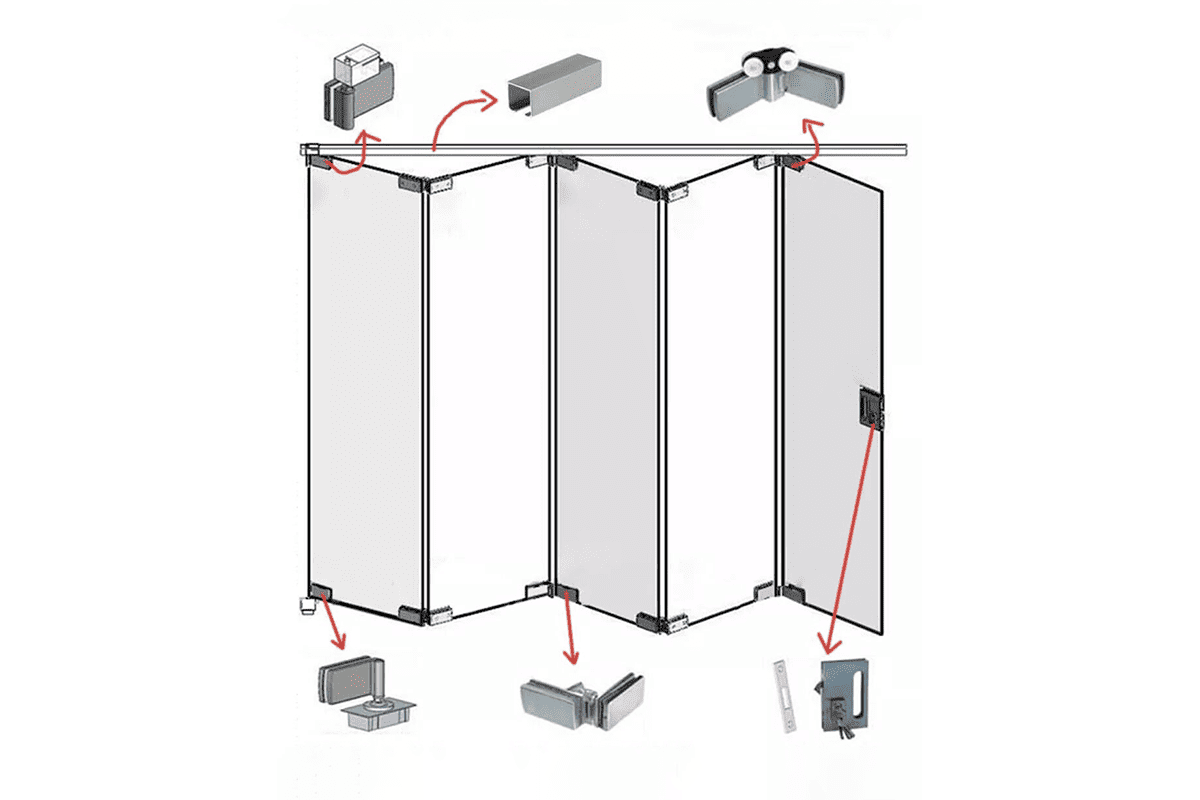
Glass bifold door hinge systems are suitable for frameless or framed glass folding doors when the hinge system is matched to glass thickness, door weight, clamp type, pivot hardware, and required opening movement. Buyers must confirm glass specifications and should use qualified professional evaluation for project-specific applications.
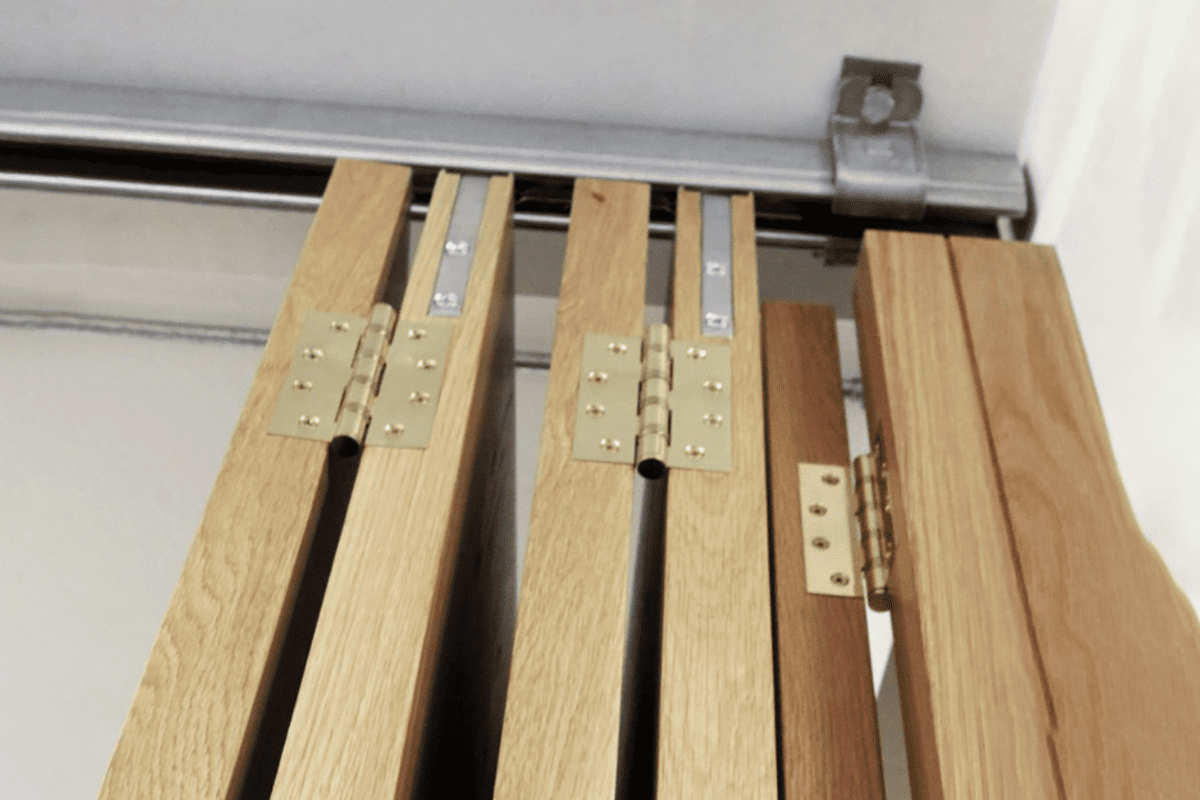
Glass bifold doors need a system approach. A simple metal hinge is not enough. The hardware may include glass clamps, pivots, tracks, guide parts, gaskets, screws, and covers. Each part must match the glass type and door layout.
In my experience with architectural door hardware buyers, glass hardware discussions require more technical confirmation than wood door hinge discussions. This is because glass does not forgive wrong pressure points.
Key specifications for glass bifold hardware
Buyers should confirm at least the following:
| Item to confirm | Why it matters |
|---|---|
| Glass thickness | Hardware must match thickness range |
| [Glass type | Tempered glass, laminated glass, or framed glass affects selection](https://prlglass.com/blog/laminated-glass-vs-tempered-glass/)%%%FOOTNOTE_REF_11%%% |
| Door weight | Load determines hinge and pivot strength |
| Panel size | Large panels increase stress and movement demand |
| Drilling or no-drilling | Clamp design depends on installation method |
| Opening angle | Hardware geometry must support the movement |
| Finish | Visible hardware affects final design value |
| Gasket material | Protects glass and improves grip |
| Project standard | Safety and compliance requirements may apply |
I avoid giving one universal recommendation for glass bifold door hinges because the risk is too high. A system that works for one glass thickness may not be suitable for another.
Common glass bifold hinge system types
Glass bifold doors may use:
- Glass-to-glass hinges
- Glass-to-wall hinges
- Top and bottom pivot sets
- Glass clamps with track systems
- Patch fittings
- Framed aluminum glass folding systems
- Floor guide or top guide accessories
Framed glass doors are often easier to support because the frame carries part of the mechanical load. Frameless glass doors require more careful hardware matching.
Practical advantages
A properly selected glass bifold system can offer:
- Clean appearance
- Wide light transmission
- Premium interior design value
- Smooth folding movement
- Strong market appeal for commercial and residential interiors
For wholesalers and brand buyers, glass systems can support higher-value product lines. However, they also require better documentation, stricter packing, and more careful after-sales support.
Important limitations
Glass hardware has limits that buyers should not ignore:
- Hardware must match glass thickness exactly.
- Clamping force must not damage the glass.
- Gaskets must be stable and correctly sized.
- Door weight must stay within the verified system range.
- Installation must be handled by qualified professionals.
- Project standards and local regulations should be checked.
If certifications or compliance documents are required, buyers should verify the actual documents from the supplier and confirm whether they apply to the specific product and project use. I recommend professional evaluation for any glass door project with safety or code requirements.
B2B quality control points
For glass bifold door hinges, bulk buyers should inspect:
- Surface finishing of visible covers
- Clamp machining accuracy
- Screw thread quality
- Rubber or gasket consistency
- Edge smoothness
- Packing protection
- Accessory completeness
- Batch color consistency
Glass hardware often has a higher perceived value. That also means defects are more visible. A small scratch on a polished clamp can create a customer complaint even if the function is acceptable.
Glass bifold hinge systems are best when the buyer treats them as engineered hardware packages, not as loose decorative fittings.
When should buyers choose concealed bifold door hinges?
Concealed hinges attract buyers because they create a clean and premium door appearance. However, hidden hardware requires accurate machining and installation. If the door factory cannot control cutting, alignment, and tolerances, the hidden design can create more problems than a visible hinge.
Concealed bifold door hinges are best for premium wood, interior, wardrobe, and partition doors where a clean appearance is required and the factory can control machining accuracy. They are not always the lowest-cost option, but they can improve design value when installation tolerances and load requirements are properly matched.
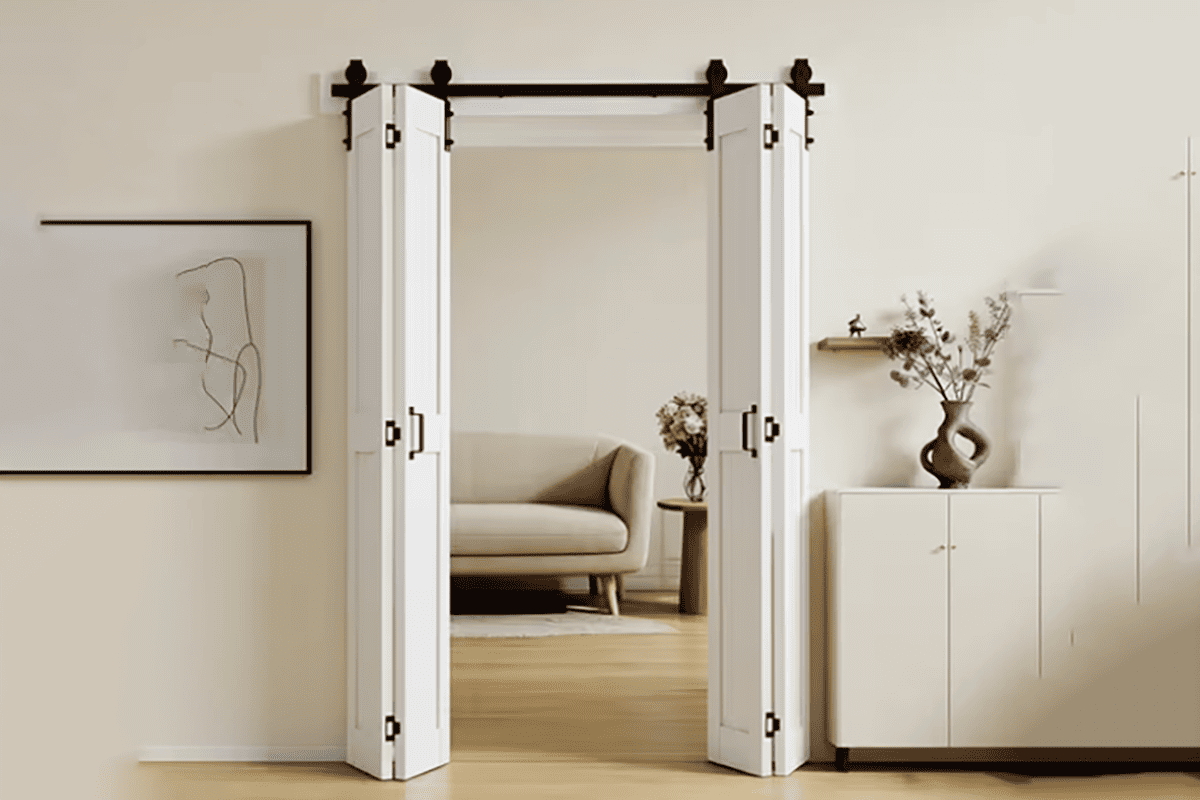
Concealed or SOSS-style hidden folding hinges are chosen when appearance matters. After installation, the hinge body is mostly hidden inside the door edge or panel connection area. This creates a clean visual line, which is useful for modern interior doors, premium wardrobes, and minimalist partition systems.
But concealed hardware is less forgiving than surface-mounted hardware.
Where concealed folding hinges work best
Concealed bifold door hinges are often used for:
- Premium interior folding doors
- High-end wardrobe systems
- Minimalist wood doors
- Flush door designs
- Partition doors with hidden hardware
- Brand product lines focused on design value
They can help a door manufacturer differentiate a product line. They also allow hardware brand buyers to offer a more premium solution to distributors or project clients.
Advantages and trade-offs
| Factor | Concealed bifold hinge | Surface-mounted hinge |
|---|---|---|
| Appearance | Hidden and clean | Visible hardware |
| Machining | Requires accurate routing | Easier installation |
| Cost | Usually higher | Usually lower |
| Adjustment | Depends on model | Often simpler |
| Repair | More complex | Easier replacement |
| Best market | Premium interiors | General interior use |
The main advantage is appearance. The main challenge is accuracy.
What buyers must confirm
Before selecting concealed bifold door hinges, buyers should confirm:
- Door thickness
- Minimum routing depth
- Hinge body size
- Load capacity suitability
- Opening angle
- Panel gap after installation
- Installation tools available at the door factory
- Finish and visible cover requirements
- Required adjustment functions
- Batch tolerance standard
If the door is too thin, the concealed hinge may weaken the door edge.12 If the routing is not accurate, the hinge may bind or create uneven gaps.
Functional upgrades for concealed systems
Some concealed folding hinges offer advanced features, such as:
- 3D adjustment
- Damping
- Self-closing
- Position holding
- Anti-sag support
- Finger protection design
These functions can improve user experience. Still, buyers should treat them as decision variables, not marketing decorations. A hinge with adjustment may reduce installation difficulty, but it may also require more careful production and inspection.
Production and inspection concerns
As a manufacturer, I focus on the hidden parts as much as the visible parts. Concealed hinges depend on precise structure. A small tolerance issue can affect rotation.
For bulk inspection, buyers should pay attention to:
- Body machining accuracy
- Pin or link movement
- Screw hole consistency
- Opening smoothness
- Surface treatment of visible parts
- Packaging protection
- Installation template availability
- Repeat-order consistency
A concealed hinge may look excellent in a showroom sample. The real test for a B2B buyer is whether the supplier can repeat that quality across multiple batches.
When concealed hinges are not the best choice
Concealed bifold door hinges may not be suitable when:
- The door factory lacks routing equipment
- The project requires fast low-cost installation
- The door panels are too thin
- The application is heavy-duty but the hinge is not designed for that load
- The market prefers easy replacement and maintenance
In those cases, surface-mounted hinges or pivot systems may be more practical.
Concealed hinges are best when the buyer values appearance and can control the full production process.
How should B2B buyers compare the 5 best bifold door hinges before ordering?
Many sourcing problems happen because the buyer compares hinge samples without comparing door systems. A low-price hinge can look attractive on a desk, but it may fail in the assembled door. A better comparison starts with door data, then checks hinge structure, finish, function, and supplier consistency.
B2B buyers should compare bifold door hinges by application, load support, door material compatibility, machining needs, opening movement, finish quality, adjustment function, packing completeness, certification documents if required, and supplier batch stability. The best hinge is the one that reduces total procurement and after-sales risk.
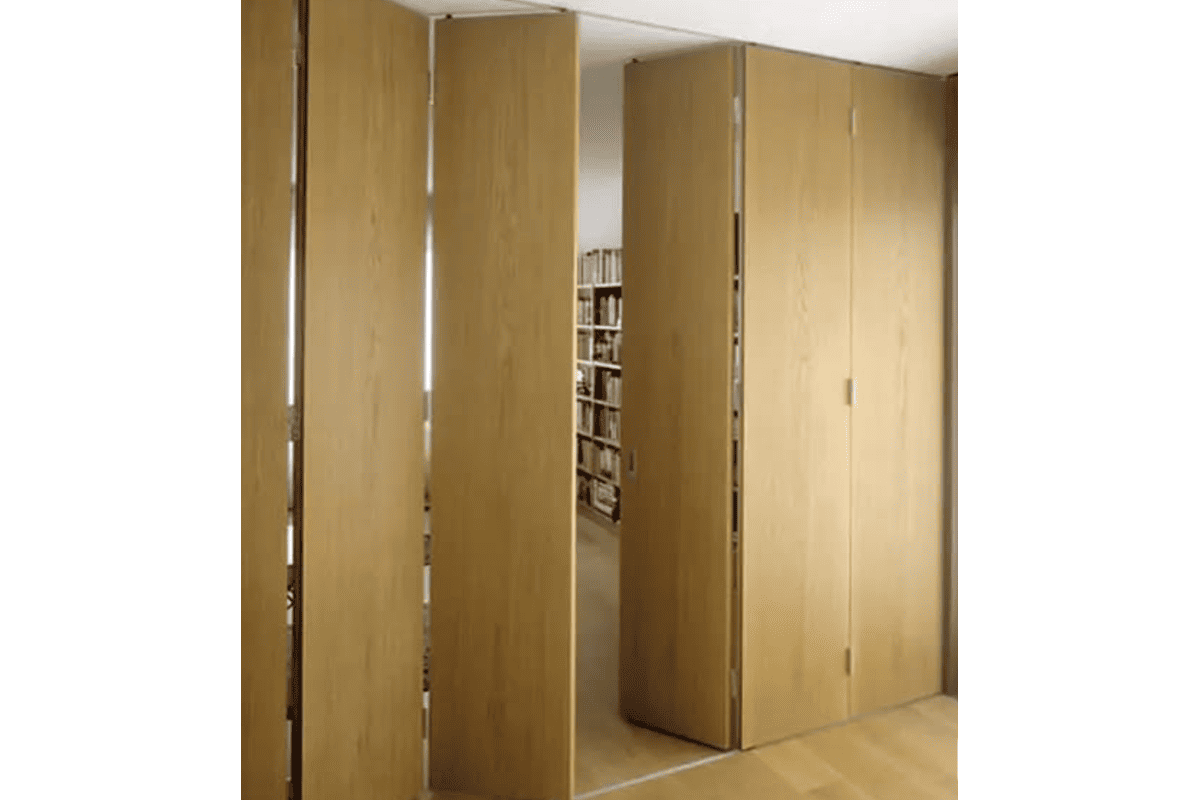
I prefer a structured comparison because it makes purchasing decisions easier. It also helps technical, purchasing, and sales teams speak the same language.
Conclusion
The 5 best bifold door hinges are best understood by application, not by a universal ranking. Surface-mounted hinges support economical folding doors. Butt and non-mortise hinges suit simple interior systems. Pivot systems help heavier panels. Glass hinge systems require exact matching. Concealed hinges serve premium hidden designs. If you need a suitable recommendation, send us your door material, weight, panel size, thickness, panel quantity, opening angle, finish, required functions, and order quantity, and I can help you evaluate the right bifold door hinges for bulk supply.
"How to Fix a Sagging Door that Won't Close or is Rubbing - YouTube",
. A building-hardware standard or technical guide supports that hinge capacity, alignment, fastening, and installation quality influence door sag, clearances, and operating performance; this evidence is contextual rather than a direct test of the specific hinges discussed here. Evidence role: general_support; source type: institution. Supports: Hinge selection and installation affect door alignment, sagging, operating smoothness, and service performance.. Scope note: Contextual support; it would not directly prove after-sales complaint rates for this article’s products. ↩"How to Choose a Commercial Door Hinge | McKinney", https://www.mckinneyhinge.com/en/resource-library/knowledge-center/blog/blog-post.aehdynamic-how-to-choose-a-commercial-door-hinge-633c8974d5c7b1003db5d8e9_mckinney.html. Architectural hardware guidance identifies door weight, dimensions, material, usage, and mounting conditions as relevant variables in hinge selection; the source supports the selection framework generally, not any single product ranking. Evidence role: expert_consensus; source type: institution. Supports: Door-hardware selection commonly considers door size, weight, material, use conditions, and installation configuration.. Scope note: Contextual support for the selection criteria, not direct validation of the five-category list. ↩
"Screw Withdrawal Resistance from WPC Profiles Used ...", https://pubmed.ncbi.nlm.nih.gov/41976639/. Wood-engineering references describe screw withdrawal resistance as dependent on wood properties, fastener dimensions, and loading conditions, supporting the relevance of screw holding strength in hinge-mounted door assemblies. Evidence role: mechanism; source type: government. Supports: Fastener withdrawal and holding strength vary by material and affect the ability of screws to resist hinge loads.. Scope note: The evidence explains the fastening mechanism generally and does not test a complete bifold door system. ↩
"How to Install an Interior Door", https://www.stevesdoors.com/how-to-install-an-interior-door/. Architectural hardware guidance supports the use of surface-mounted hinges for applications where exposed fixing and simplified installation are acceptable; this supports the general application category but does not establish a universal weight rating. Evidence role: general_support; source type: institution. Supports: Surface-mounted hinges are commonly used where visible mounting and simple fastening are acceptable, especially in lighter interior door applications.. Scope note: Contextual support; individual hinge models still require manufacturer load data. ↩
"Full Mortise vs Non Mortise Hinge: Key Differences & When ...", https://watersonusa.com/solutions/full-mortise-vs-non-mortise-hinge. Technical installation references define surface-mounted hinges as hardware fastened to the face or edge surface rather than recessed into a mortise, supporting the claim that deep machining is generally not required. Evidence role: definition; source type: education. Supports: Surface-mounted hinges are fixed to the surface rather than recessed into a routed mortise.. Scope note: The statement is generally true by hinge type, although some installations may still require drilling, pilot holes, or shallow preparation. ↩
"Full Mortise vs Non Mortise Hinge: Key Differences & When ...", https://watersonusa.com/solutions/full-mortise-vs-non-mortise-hinge. Door-hardware installation references distinguish non-mortise hinges, which interleave without a full recess, from conventional butt hinges, which are commonly mortised for a flush traditional installation. Evidence role: definition; source type: education. Supports: Non-mortise hinges are designed to avoid recessed mortises, while butt hinges are commonly installed in mortised recesses for a flush fit.. Scope note: This supports the installation distinction, not the suitability of any specific hinge for a given load. ↩
"How Bifold Door Hardware Works | Track Systems & ...", https://www.lovethatdoor.com/how-bifold-door-hardware-works/. Architectural hardware references describe bifold doors as multi-panel systems operating through panel hinges, pivots, and guide tracks, supporting the statement that their movement and load points differ from ordinary side-hinged swing doors. Evidence role: mechanism; source type: institution. Supports: Bifold door systems use panel-to-panel hinges together with pivots, tracks, or guides, creating load and movement conditions different from a single swing door.. Scope note: The source would describe the mechanism generally rather than quantify stress for the article’s example doors. ↩
"Pivot Hinges for Heavy Doors", https://www.betterbuildinghardware.com/heavy-door-pivot-hinges. Architectural hardware guidance explains that pivot systems support door rotation through top and bottom pivots rather than only through side-mounted hinge leaves, supporting the load-path rationale for larger or heavier panels. Evidence role: mechanism; source type: institution. Supports: Pivot door hardware can carry and locate door loads through top and bottom pivot points, which can be advantageous for heavier or larger panels.. Scope note: The evidence supports the mechanical principle; project-specific suitability still depends on rated capacity and installation conditions. ↩
"Learn how to reinforce the floor framing beneath a pivot ...", https://www.facebook.com/FineHomebuildingMagazine/posts/learn-how-to-reinforce-the-floor-framing-beneath-a-pivot-door-for-proper-support/1342069257965101/. Installation and construction-tolerance guidance supports that adjustable door hardware can help correct alignment variations caused by frame or floor conditions; this supports the practical rationale but not a measured reduction in after-sales claims. Evidence role: general_support; source type: institution. Supports: Adjustable door hardware can assist alignment where site tolerances, floors, or frames are imperfect.. Scope note: Contextual support; it does not directly quantify after-sales risk reduction. ↩
"How Do Glass Clamps Work? The Mechanics of Safety & ...", https://www.aleader-china.com/blog/how-do-glass-clamps-work-mechanism-guide/. Glazing and architectural hardware guidance supports that glass thickness, glass type, drilled or clamped fixing, gasket interface, and pivot location are material factors in safe glass-door hardware selection. Evidence role: expert_consensus; source type: institution. Supports: Glass door hardware must be selected according to glass type, thickness, fixing method, and load-bearing details to avoid stress and safety problems.. Scope note: The support is general to glass door hardware and may not directly address every bifold configuration. ↩
"Laminated vs Tempered Glass | Ultimate Guide for Security", https://prlglass.com/blog/laminated-glass-vs-tempered-glass/. Building-code and safety-glazing references distinguish tempered and laminated safety glass by breakage behavior, construction, and permitted applications, supporting the claim that glass type is relevant to hardware selection. Evidence role: definition; source type: government. Supports: Different safety glazing types have distinct properties and code uses that can affect door and hardware design.. Scope note: This supports the importance of glass type generally, not a specific hinge model or clamp design. ↩
"Common Concealed Hinge Installation Mistakes and How ...", https://www.tambee.com/blogs/news/common-concealed-hinge-installation-mistakes-and-how-diy-users-can-avoid-them. Woodworking and door-hardware installation references support that concealed hinges require routed pockets and minimum door thicknesses, indicating that excessive routing in thin door edges can compromise strength or fit. Evidence role: mechanism; source type: education. Supports: Concealed hinges require recesses in the door edge, and removing material from thin sections can reduce remaining structural capacity.. Scope note: The support is based on general material-removal principles and installation requirements, not a finite-element analysis of the article’s hinge examples. ↩