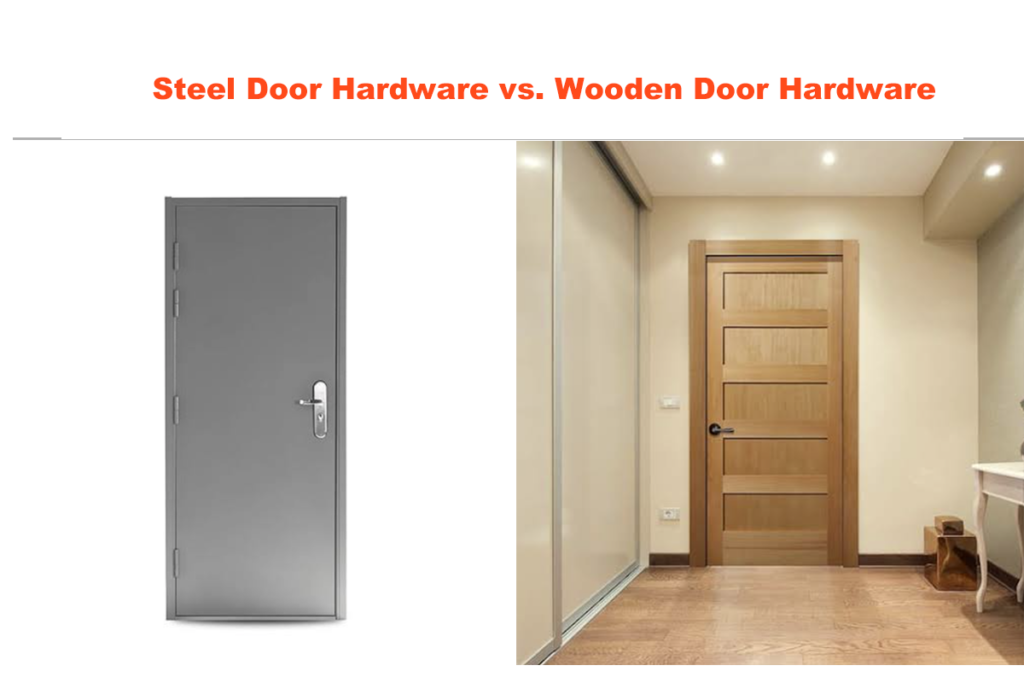
Steel Door Hardware vs. Wooden Door Hardware: What’s the Difference?
Steel Door Hardware vs. Wooden Door Hardware can look similar in a catalog, but the wrong match can create installation problems, weak performance, noisy operation, or a poor visual result. I see this often when buyers compare only price or finish. The better solution is to compare door structure, usage scenario, performance needs, and installation logic first.
Steel door hardware usually prioritizes strength, durability, fire-related requirements1, and simple maintenance, while wooden door hardware often prioritizes appearance, quiet operation, concealed installation, and decoration matching. The difference is not only material. It is about how the hardware supports the door’s structure, function, and final use environment.

I manufacture and configure architectural door hardware for different door systems, so I prefer to start with the actual door application rather than the product name. A steel fire-rated door, a hotel room wooden door, and a residential interior door may all need locks and hinges, but they rarely need the same selection logic.
How does Steel Door Hardware vs. Wooden Door Hardware differ in selection priorities?
Many buyers start with a simple question: “Which hardware is better?” That question can lead to a poor decision because it ignores the door body, installation structure, and end-user expectation. I usually guide customers to compare the performance target first.
Steel door hardware is usually selected for practical structure, durability, fire-rated compatibility, and straightforward installation. Wooden door hardware is usually selected for design matching, quiet use, precise adjustment, and interior decoration value. Neither category is automatically better. Each one supports a different door system and usage scenario.
Why steel doors are usually function-first
Steel doors are often used in entrances, utility rooms, public buildings, commercial projects, and fire-rated openings.2 Because of this, the hardware tends to follow a practical logic.
Common steel door configurations include:
- Stainless steel mortise locks
- U-shaped pull handles
- Stainless steel butt hinges
- Door closers and accessories
- Fire-rated hardware sets where the project requires them
I do not treat every steel door as a fire-rated door. That would be inaccurate. However, many steel door projects do involve fire-resistance requirements3, and buyers should verify fire-rated performance through the complete door system, the hardware specification, and the applicable project standard.
In my experience, steel door buyers often care about:
Load capacity
The hardware must support a heavier door leaf and repeated operation.Installation tolerance
Steel frames and leaves may have fixed cutouts or welded structures. The hardware must match these dimensions.Maintenance simplicity
Simple shapes, visible fixing, and durable surfaces are preferred in many public or industrial applications.Certification documents
CE documents, fire-related certificates, and test reports should be checked by the buyer or project consultant.4
Why wooden doors are usually design-sensitive
Wooden doors are often used as interior doors in apartments, hotels, villas, offices, and residential projects. The hardware is visible to the end user every day. Because of this, appearance matters more.
Wooden door hardware often includes:
- Zinc alloy lever handles
- Magnetic locks
- 3D adjustable concealed hinges
- Decorative rosettes or plates
- Matching privacy, passage, or cylinder functions
Zinc alloy is common for interior lever handles because it allows more flexible shapes, colors, and surface treatments.5 This does not mean zinc alloy is “better” than stainless steel. It means zinc alloy can be a strong fit when the project needs decorative styles, curves, and finish variety.
Basic comparison table
| Evaluation Point | Steel Door Hardware | Wooden Door Hardware |
|---|---|---|
| Main priority | Strength, durability, function | Appearance, silence, adjustment |
| Common locks | Stainless steel mortise locks | Magnetic locks, mortise locks |
| Common hinges | Stainless steel butt hinges | 3D adjustable concealed hinges, butt hinges |
| Common handles | U-shaped pull handles, stainless handles | Zinc alloy lever handles |
| Typical use | Fire doors, service doors, commercial doors | Interior residential, hotel, office doors |
| Buyer risk | Wrong dimensions, weak load capacity, unverified fire documents | Poor style match, noisy lock, alignment issues |
When I review hardware drawings with door factories, I always ask for the door thickness, frame structure, cutout dimensions, and expected door function. That short step prevents many mismatches before sampling.
What locks work best for steel doors and wooden doors?
Lock selection can create major problems when buyers assume one lock body fits every door. A lock must match the door structure, backset, center distance, faceplate size, latch type, and usage expectation. If one point is wrong, installation becomes difficult.
Steel doors often use robust mortise locks with practical faceplates and durable internal structures. Wooden interior doors may use magnetic locks or decorative mortise locks to reduce noise and improve the user experience. The best lock depends on door thickness, frame design, required function, and project standard.
Mortise locks for steel doors
For steel doors, I often see stainless steel mortise locks used because they offer a practical balance of durability, structure, and installation compatibility. Many steel doors are prepared with fixed lock pockets, so the lock body must match the cutout accurately.
Important dimensions include:
- Backset
- Center distance
- Lock body depth
- Faceplate width and length
- Follower size
- Cylinder hole position
- Latch and deadbolt projection
A small mismatch can delay assembly. For example, a lock body that is too deep may conflict with the inner reinforcement of a steel door leaf. A faceplate that is too wide may not sit cleanly on a narrow edge profile. These details matter more than many buyers expect.
Magnetic locks for wooden interior doors
For wooden doors, especially interior doors, magnetic locks are popular because they can reduce mechanical noise6. The latch stays hidden or controlled by magnetic action until the door closes. This gives a cleaner feeling and a quieter closing sound.
I have seen hotel and residential projects choose magnetic locks because the end user notices every sound in a bedroom, bathroom, or office. In that situation, a strong industrial lock may not be the most suitable choice, even if it looks durable on paper.
Lock comparison for procurement teams
| Lock Type | Common Door Type | Main Benefit | Main Checkpoint |
|---|---|---|---|
| Stainless steel mortise lock | Steel doors, heavy-duty doors | Strong structure and practical operation | Door cutout and project requirement |
| Magnetic lock | Wooden interior doors | Quiet closing and clean appearance | Door gap, strike alignment, installation accuracy |
| Standard interior mortise lock | Wooden doors | Cost-effective and familiar | Handle compatibility and latch quality |
| Fire-rated lock set | Fire-rated door systems | Supports tested door assemblies | Verify certificates and full system compliance |
What I check before recommending a lock
I usually ask buyers for:
Door material and thickness
Steel and wooden doors have different internal structures.Frame type
A steel frame, wooden frame, or aluminum frame affects the strike plate.Usage frequency
A public corridor door needs different durability from a bedroom door.Required function
Passage, privacy, classroom, entrance, or cylinder lock functions all change the hardware set.Applicable standard
CE, fire-rated, or local project requirements must be verified through proper documentation.
Steel Door Hardware vs. Wooden Door Hardware becomes much easier to evaluate when the lock is treated as part of a full door opening, not as a separate product.
How does Steel Door Hardware vs. Wooden Door Hardware affect hinge choice?
Hinges carry the door’s weight, control movement, and influence long-term alignment.7 A beautiful handle cannot solve a sagging door. I have seen projects focus too much on the visible finish and not enough on hinge structure.
Steel doors often use stainless steel butt hinges because they are strong, visible, simple to install, and suitable for many heavy-duty applications. Wooden interior doors may use 3D adjustable concealed hinges because they improve appearance and allow fine adjustment after installation.
Butt hinges for steel doors
Stainless steel butt hinges are common on steel doors because they offer reliable load support and straightforward installation.8 They are visible, but visibility is not always a problem. In many commercial or utility applications, a visible hinge is acceptable because the priority is function.
Key advantages include:
- Strong load-bearing capacity
- Simple maintenance
- Clear installation method
- Good compatibility with steel frames
- Durable material options
For heavy or fire-rated doors, hinge selection must be checked carefully. Buyers should review hinge size, thickness, bearing structure, screw specification, and certificate documents where required. Fire-related performance should never be assumed from material alone.
Concealed hinges for wooden doors
Wooden interior doors often benefit from concealed hinges because they create a cleaner visual effect. When the door is closed, the hinge is hidden. This makes the door look more integrated with the wall, frame, and decoration style.
Many premium wooden doors use 3D adjustable concealed hinges. These hinges allow adjustment in three directions, usually:
- Height adjustment
- Side adjustment
- Depth adjustment
This is useful because wooden doors and frames can be affected by installation tolerance, humidity, and finishing layers.9 A small adjustment can improve gaps, reveal lines, and closing comfort.
Hinge comparison table
| Hinge Feature | Stainless Steel Butt Hinge | 3D Adjustable Concealed Hinge |
|---|---|---|
| Visibility | Visible | Hidden when door is closed |
| Common use | Steel doors, utility doors, fire-rated doors | Wooden interior doors, design-focused doors |
| Adjustment | Limited after installation | Multi-direction adjustment |
| Installation difficulty | Usually simpler | Requires accurate routing |
| Appearance | Practical | Clean and decorative |
| Main risk | Under-spec load capacity | Poor milling accuracy or weak frame support |
How many hinges does a door need?
There is no universal answer. Door height, weight, thickness, usage frequency, and project standard all matter. Many standard interior doors use two or three hinges. Heavier steel doors may require three or more, depending on door size and hinge rating.
I recommend that buyers confirm:
- Door leaf weight
- Door height and width
- Hinge load rating
- Frame reinforcement
- Screw or bolt fixing method
- Required opening angle
- Fire-rated or smoke-control requirements, if applicable
A hinge is a small component, but it carries a large responsibility. In Steel Door Hardware vs. Wooden Door Hardware evaluation, hinge choice is one of the clearest examples of how structure and design priorities separate the two categories.
Which handle materials and finishes fit steel doors and wooden doors?
Handles are easy to compare by appearance, but appearance is only one part of the decision. A handle also needs the right strength, fixing method, corrosion resistance, grip comfort, and market style. A poor handle match can make a good door feel cheap.
Steel doors often use stainless steel pull handles or lever handles because they are durable, simple, and easy to maintain. Wooden interior doors often use zinc alloy lever handles because they offer more decorative shapes, colors, and finish options for interior design matching.
Stainless steel handles for steel doors
Steel doors often use U-shaped pull handles, stainless lever handles, or plate handles. The shape is usually simple because the door itself may be practical, commercial, or fire-rated.
Stainless steel handles are popular because they can provide:10
- Good corrosion resistance
- Simple cleaning
- Modern appearance
- Strong structure
- Compatibility with high-traffic use
For B2B buyers, stainless steel grade and surface finish should be confirmed. A handle described as “stainless steel” still needs specification details. Buyers may need to check whether the product is made from SS201, SS304, or another grade11, depending on target market, climate, and price position.
Zinc alloy handles for wooden doors
Zinc alloy lever handles are common for wooden interior doors because the material is suitable for die-casting. This allows more complex shapes and decorative designs.
Common finish options include:
- Satin nickel
- Matte black
- Antique bronze
- Polished chrome
- Brushed gold
- Coffee, grey, or custom colors
In residential and hotel projects, the handle must match the door skin, wall color, lighting, furniture style, and brand positioning. A matte black handle may suit a modern apartment. A brushed gold handle may suit a hotel room. A classic curved handle may fit a traditional wooden door better than a straight stainless pull handle.
Material selection is not a ranking
I avoid saying stainless steel is always better than zinc alloy. That statement is too simple. Stainless steel can be better for durability and corrosion resistance in many public or exposed environments. Zinc alloy can be better for decorative interior handle designs where shape variety and finish matching matter more.
| Handle Material | Common Strength | Common Limitation | Best Fit |
|---|---|---|---|
| Stainless steel | Durable, clean, corrosion-resistant | Fewer decorative shapes | Steel doors, public doors, modern doors |
| Zinc alloy | Decorative, flexible shapes, many finishes | Needs good plating and QC | Wooden interior doors, residential and hotel doors |
| Aluminum alloy | Lightweight, modern | May feel less premium depending on design | Interior and commercial applications |
| Brass | Premium feel, classic style | Higher cost | High-end projects and specialty doors |
Quality control points for handles
From a manufacturing and inspection view, I pay attention to:
Surface finish consistency
Color differences can be obvious on large orders.Grip comfort
A handle should not have sharp edges or awkward proportions.Spring strength
Lever handles should return smoothly.Fixing stability
Loose handles create complaints after installation.Packaging protection
Decorative finishes need careful packing to avoid scratches during shipping.
At SDH Hardware, we often support logo stamping, laser marking, and custom color packaging for B2B orders. I still recommend that buyers approve samples before mass production, especially when the finish must match a specific door design or market style.
Can steel door hardware and wooden door hardware be interchangeable?
Some buyers assume the two categories are completely separate. Others assume everything is interchangeable if the size looks close. Both assumptions can create problems. The truth sits in the middle, and the final decision depends on dimensions and performance needs.
Steel door hardware and wooden door hardware can sometimes be interchangeable if the dimensions, fixing structure, door thickness, frame design, and performance requirements match. However, buyers should not assume compatibility. Lock pockets, hinge routing, handle fixing, and fire-related requirements must be checked before substitution.
When interchangeability may work
Some hardware can overlap between steel and wooden doors. For example, a lever handle may work on both door types if the spindle size, rose or plate dimensions, fixing screws, and lock body compatibility match. A mortise lock may also work in different doors if the cutout and installation depth are suitable.
Interchangeability may be possible when:
- The door thickness is within the hardware range.
- The lock backset and center distance match.
- The faceplate fits the door edge.
- The handle spindle and fixing screws align.
- The hinge load rating is sufficient.
- The frame can accept the strike plate or hinge fixing.
- The project has no special fire-rated or acoustic requirement.
When interchangeability is risky
Problems occur when buyers focus only on one dimension. A lock may fit the door thickness but not the internal pocket. A hinge may look strong but lack the right fixing method. A handle may fit mechanically but look wrong on the final door.
Common risks include:
Steel door reinforcement conflict
Internal ribs or lock boxes may block the lock body.Wooden door milling inaccuracy
Concealed hinges need precise routing and enough material strength.Fire-rated door compliance risk
Hardware changes may affect the tested door assembly.12 Buyers should verify documents with the door supplier, hardware supplier, and project authority.Poor visual consistency
A heavy industrial handle may not suit a decorative wooden interior door.Noise and comfort issues
A practical latch may feel too loud for a hotel or residential interior door.
Procurement checklist before substitution
I suggest using this checklist before approving a hardware substitution:
| Checkpoint | Why it matters |
|---|---|
| Door material and thickness | Confirms basic fit |
| Door edge construction | Affects lock and hinge installation |
| Frame material | Affects strike plate and hinge fixing |
| Lock cutout drawing | Prevents machining mismatch |
| Handle spindle size | Ensures operation compatibility |
| Hinge load rating | Prevents sagging |
| Finish requirement | Matches design and market expectation |
| Certification need | Avoids compliance risk |
| Sample testing | Confirms real installation before bulk order |
My practical recommendation
I usually tell buyers to treat hardware as a door system component, not a loose accessory. If a door factory wants to use one hardware set across multiple door lines, I recommend sample installation on each door type before full purchasing.
This is especially important for OEM and ODM projects. Custom door thickness, special frames, private-label packaging, and local market standards can all change the final configuration. A drawing review and sample test are much cheaper than correcting a container of mismatched hardware.
Frequently Asked Questions
Is steel door hardware stronger than wooden door hardware?
Steel door hardware is often designed for strength, durability, and heavy-duty use, but it is not automatically better for every project. Wooden door hardware may be more suitable for interior doors that need quiet operation, concealed hinges, and decorative finishes. Suitability depends on the door type and application.
Can I use a wooden door handle on a steel door?
You may use a wooden door handle on a steel door if the spindle, fixing screws, lock body, door thickness, and performance requirements match. However, decorative zinc alloy handles may not suit high-traffic or heavy-duty steel door applications. I recommend sample installation before bulk purchasing.
Are magnetic locks only for wooden doors?
Magnetic locks are not only for wooden doors, but they are especially common on wooden interior doors because they support quiet closing and a clean user experience. The door gap, strike plate alignment, and installation accuracy are important. Buyers should confirm compatibility with the door and frame.
Do fire-rated steel doors need special hardware?
Fire-rated steel doors usually need hardware that matches the tested door assembly and project standard. Buyers should verify fire-rated certificates, test reports, and installation requirements with qualified professionals. A stainless steel product is not automatically fire-rated just because of its material.
Which hinge is better: butt hinge or concealed hinge?
A butt hinge is often better for practical, heavy-duty, or steel door applications. A concealed hinge is often better for wooden interior doors where appearance and adjustment matter. The better choice depends on door weight, frame structure, installation skill, visual requirements, and performance standard.
Conclusion
Steel Door Hardware vs. Wooden Door Hardware is really a comparison of selection priorities. Steel doors usually need practical, durable, and structure-focused hardware. Wooden interior doors often need decorative, quiet, and adjustable hardware. I recommend checking the door type, lock dimensions, hinge structure, handle material, finish, and certification needs before ordering. If you are sourcing hardware for steel or wooden door projects, SDH Hardware can help you review specifications, samples, OEM options, and complete door hardware configurations.
"Fire Doors and NFPA 80 FAQs", https://www.nfpa.org/news-blogs-and-articles/blogs/2025/04/11/fire-doors-faqs. Fire-door standards and listing guidance treat locks, hinges, closers, and related items as components of a rated opening, supporting the claim that fire-related requirements can shape steel-door hardware selection; this evidence is contextual because it applies specifically to rated assemblies rather than to all steel doors. Evidence role: general_support; source type: institution. Supports: Fire-rated door openings are treated as assemblies, and hardware must be compatible with the rating and listing of the assembly.. Scope note: The source would support fire-rated use cases, not the broader claim that all steel door hardware has fire-related requirements. ↩
"Fire door", https://en.wikipedia.org/wiki/Fire_door. Architectural guidance on hollow-metal or steel doors identifies commercial, institutional, service, entrance, and rated openings as common applications, supporting the article’s description of typical steel-door use cases. Evidence role: general_support; source type: institution. Supports: Steel doors are commonly specified for commercial, institutional, service, entrance, and fire-rated openings.. Scope note: Application patterns vary by region, building type, and code requirements. ↩
"Hollow Metal Doors and Frames Fire Rating Checklist", https://naamm.org/news/hollow-metal-doors-and-frames-fire-rating-checklist/. Fire-door standards and hollow-metal door guidance show that steel doors are frequently used in rated openings, which supports the statement that many steel-door projects involve fire-resistance requirements; the source would not quantify the share of all steel-door projects. Evidence role: historical_context; source type: institution. Supports: Steel or hollow-metal doors are frequently used in rated openings where fire-resistance and assembly compliance are required.. Scope note: The evidence is contextual unless it provides market data quantifying how many steel-door projects are fire-rated. ↩
"Declaration of Performance and conformity - CE Marking", https://single-market-economy.ec.europa.eu/sectors/construction/construction-products-regulation-cpr/ce-marking-and-declaration-performance-and-conformity_en. Government and conformity-assessment guidance explains that regulated construction products are supported by declarations, certification, or test evidence, supporting the article’s statement that CE documents, fire-related certificates, and test reports should be checked when they are applicable. Evidence role: general_support; source type: government. Supports: Regulated construction products and fire-rated assemblies are commonly verified through declarations, certificates, listings, and test evidence.. Scope note: The exact documentation required depends on jurisdiction, product category, and project specification. ↩
"The Practical Ultimate Guide to Zinc Die Casting", https://www.ptsmake.com/the-practical-ultimate-guide-to-zinc-die-casting/. Materials-engineering sources describe zinc alloys as suitable for die casting with good dimensional detail and finishability, supporting the claim that zinc alloy can be used for decorative lever-handle designs with varied shapes and surface treatments. Evidence role: mechanism; source type: education. Supports: Zinc alloys are well suited to die casting, which enables complex shapes and decorative finishes.. Scope note: The source would support the material mechanism, not necessarily the market prevalence of zinc handles in every region. ↩
"Acoustic Door Latch Detector (Smart Latch™)", https://www.srnl.gov/tech_briefs/acoustic-door-latch-detector-smart-latch/. Technical or acoustic sources on magnetic latching mechanisms can support that magnetic engagement reduces some mechanical impact or latch noise during door closing; this supports the article’s claim in mechanism rather than proving universal noise reduction in all installations. Evidence role: mechanism; source type: research. Supports: Magnetic latch mechanisms can reduce audible mechanical contact during closing by changing how the latch engages the strike.. Scope note: Actual noise depends on door gap, strike alignment, frame material, seals, and installation quality. ↩
"A156.1 - 2025 Butts and Hinges", https://buildershardware.com/ANSI-BHMA-Standards/Hardware-Highlights/A1561-2025-Butts-and-Hinges. Architectural hardware standards define hinges as load-bearing devices that connect the door to the frame and permit controlled rotation, supporting the article’s statement that hinges affect weight support, movement, and alignment. Evidence role: definition; source type: institution. Supports: Door hinges support the door leaf, permit rotation, and must be selected with regard to load and performance.. ↩
"Types, Uses, Features and Benefits of Butt Hinges", https://www.iqsdirectory.com/articles/hinges/butt-hinges.html. Architectural hardware guidance identifies butt hinges as common load-bearing hardware for swinging door assemblies, including hollow-metal doors, supporting the article’s description of their practical role on steel doors. Evidence role: general_support; source type: institution. Supports: Butt hinges are standard hardware for many swinging doors, including steel or hollow-metal door assemblies, and are selected according to load and use.. Scope note: The source may not establish that stainless steel is the most common material in all markets. ↩
"The Shrinking and Swelling of Wood and Its Effect on Furniture", https://www.extension.purdue.edu/extmedia/fnr/fnr-163.pdf. Wood-science sources explain that wood expands and contracts with changes in moisture content, supporting the article’s claim that wooden doors and frames can be affected by humidity and related installation tolerances. Evidence role: mechanism; source type: education. Supports: Wood changes dimension with moisture content, which can affect doors, frames, gaps, and alignment.. Scope note: The source supports moisture-related movement generally and may not address every finishing-layer or routing-tolerance issue directly. ↩
"Stainless steel", https://en.wikipedia.org/wiki/Stainless_steel. Materials references describe stainless steel as corrosion-resistant and readily cleanable, supporting the article’s explanation of why stainless steel is often selected for practical door-handle applications. Evidence role: general_support; source type: research. Supports: Stainless steel is known for corrosion resistance and cleanability, properties that help explain its use in door handles.. Scope note: The source supports material properties, not the popularity of specific handle designs or grades in a particular market. ↩
"18-8 Stainless Steel vs 201: Differences, Corrosion ...", https://www.ryerson.com/metal-resources/metal-market-intelligence/18-8-stainless-steel-vs-201. Metallurgical references comparing austenitic stainless grades show that alloy composition affects corrosion resistance, supporting the article’s point that SS201, SS304, or other grades should be specified with the use environment in mind. Evidence role: mechanism; source type: research. Supports: Stainless steel grades differ in composition and corrosion resistance, affecting their suitability for different environments.. Scope note: The source would not determine which grade is best for a specific door handle without exposure and cost requirements. ↩
"NFPA 80 Fire Door Requirements: Code Guide", https://www.cdfdistributors.com/blog/post/nfpa-80-fire-door-requirements. Fire-door standards and certification guidance state that rated doors are evaluated as assemblies and that hardware changes must comply with the listing or applicable standard, directly supporting the claim that hardware changes may affect a tested door assembly. Evidence role: expert_consensus; source type: institution. Supports: Fire-rated doors are evaluated as assemblies, and hardware substitutions or modifications must remain within the listing, label, or standard requirements.. ↩