
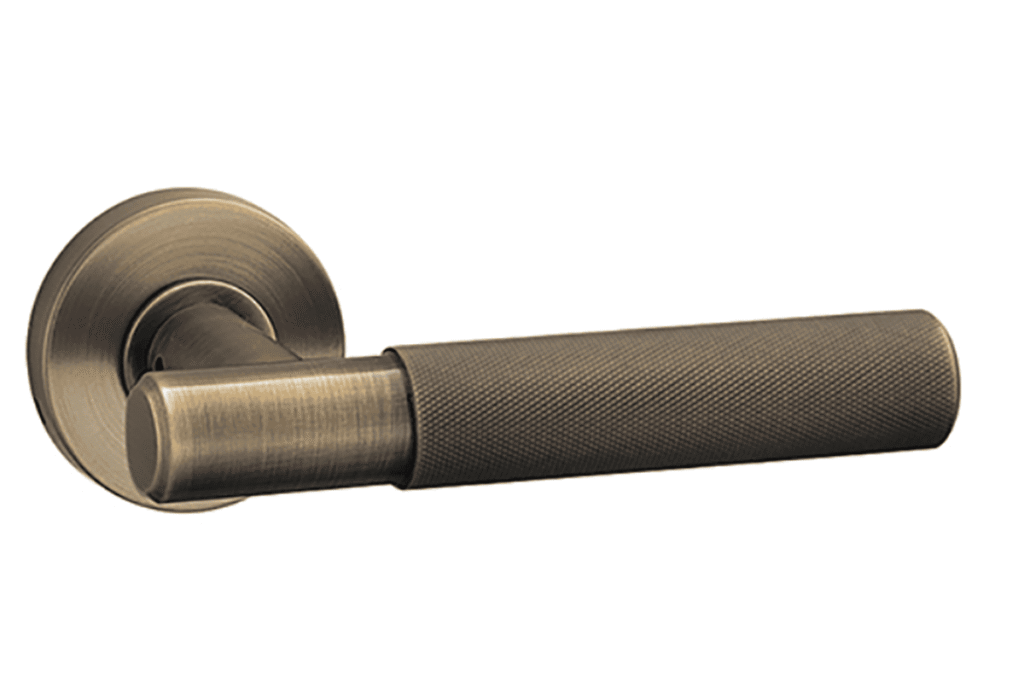
Knurled Door Handles on Round Rose: How Should Buyers Specify Them?
Knurled door handles on round rose can look premium, but poor specification often leads to slippery grip, finish complaints, loose roses, or lever sagging after installation. I have seen buyers choose only by color and texture, then face returns later. A better approach starts with grip, environment, and compatibility.
Knurled door handles on round rose should be specified by checking knurl geometry, finish performance, base material, spindle size, through-bolt centers, door thickness range, and spring/torque matching. Buyers should confirm physical samples, review engineering drawings, and verify test evidence such as EN 1906 cycle tests, salt-spray results, and torque checks before bulk orders.

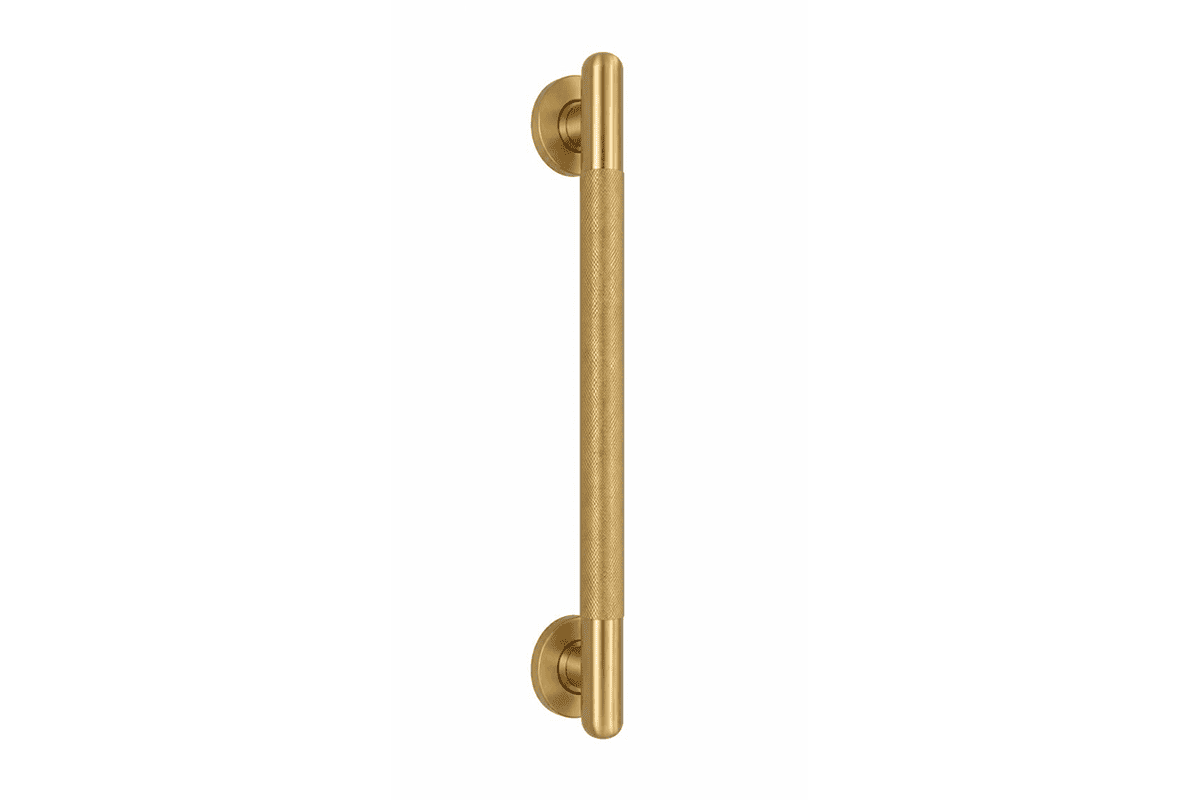
The round rose makes the lever set look clean and modern. The knurling adds texture and visual depth. However, the technical details behind that simple look matter a lot. Below, I will explain how I evaluate these handles from a factory-side R&D and QC point of view.
Why Are Knurled Door Handles on Round Rose More Than a Decorative Choice?
Knurled door handles on round rose often attract buyers because they look refined, especially in satin gunmetal, matte black, or brushed stainless finishes. The problem starts when the texture is treated as decoration only. If the knurl is too sharp, too shallow, or hard to clean, the handle can disappoint users quickly.
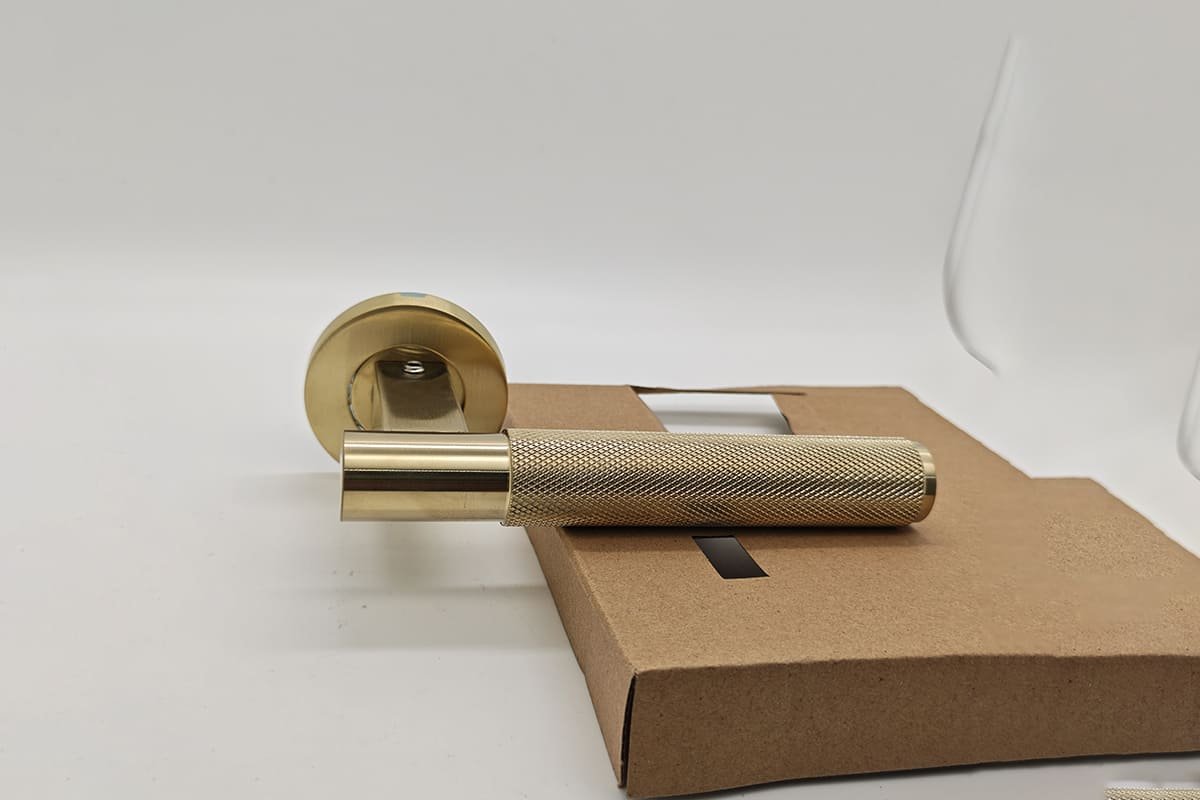
Knurling is an engineered grip surface.1 Diamond knurling, straight knurling, pitch, and depth all affect handfeel, slip resistance, cleaning, and perceived quality.2 Buyers should not approve mass production from photos alone. I always recommend checking physical samples with bare hands and gloves before finalizing a volume order.
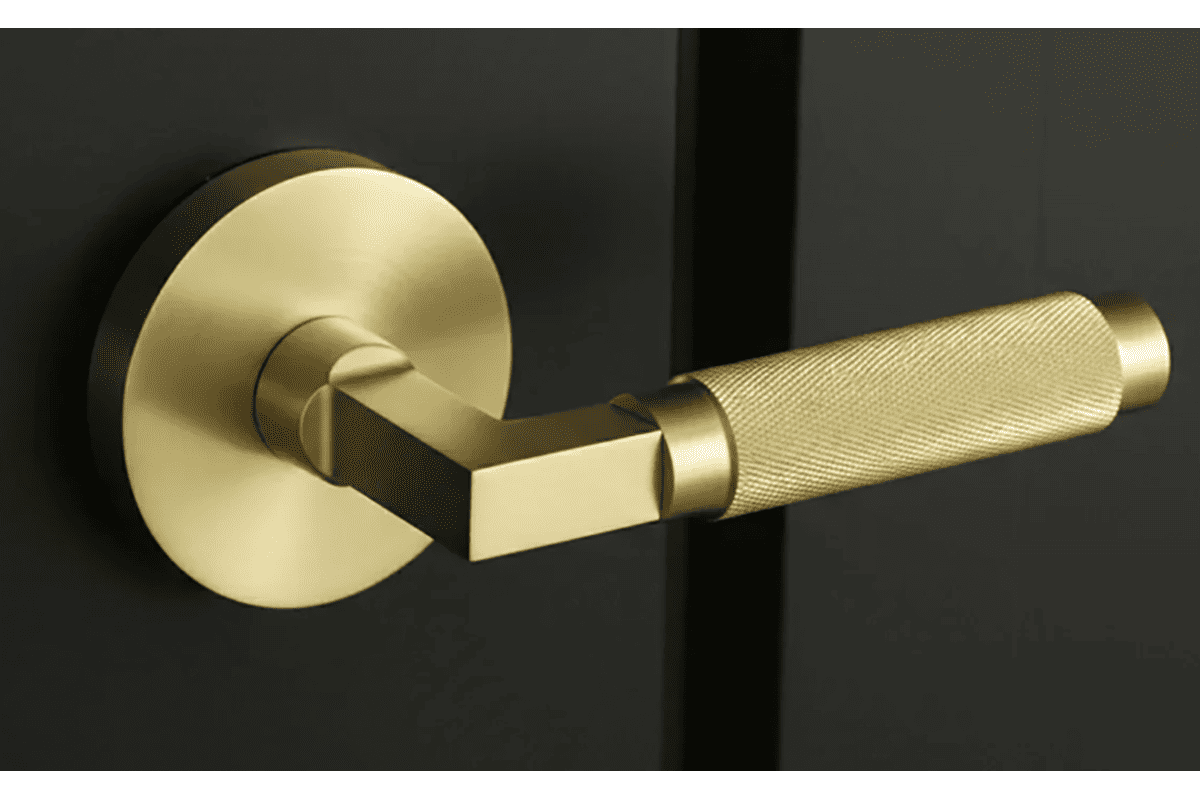
Diamond Knurl vs Straight Knurl
In production discussions, I often separate knurling into two common types:
| Knurl Type | Surface Pattern | Grip Feel | Cleaning | Common Use Case |
|---|---|---|---|---|
| Diamond knurl | Cross-cut pattern | Stronger grip, more tactile | Medium to harder | Premium residential, boutique commercial |
| Straight knurl | Parallel lines | Softer directional grip | Easier | Minimalist projects, light commercial |
| Fine knurl | Smaller pitch, shallow depth | More refined feel | Easier | High-end interiors |
| Coarse knurl | Wider pitch, deeper cut | Stronger anti-slip | Harder | Glove use, high-touch areas |
A diamond knurl usually gives more anti-slip confidence because the cross-cut pattern gives the fingers more edges to engage. However, a very aggressive diamond knurl can feel sharp. It can also collect dust, finishing residue, or hand oils more easily.
Straight knurling feels cleaner and more linear. It works well for projects that want a lighter tactile feel. However, its grip direction matters. If the lines run along the lever length, the surface may feel smooth in certain hand movements. So the buyer should not judge it only by appearance.
Pitch and Depth Change Everything
I pay close attention to pitch and depth during sample review.
- Pitch means the spacing between knurl lines.
- Depth means how deeply the pattern is cut or formed.
- Edge sharpness affects comfort and cleaning.
- Surface finish thickness can soften the knurl after coating.
For example, a deep knurl before finishing may feel correct in raw stainless steel. But after electroplating, polishing, or PVD processing, the texture can feel different. A matte black electroplated surface can also slightly change the perceived edge feel.
I Prefer Sample-Backed Decisions
When I handle a new knurled lever sample, I usually test it in three simple ways before moving deeper into engineering review:
- Bare hand test: I check whether the grip feels premium or sharp.
- Glove test: I check whether the texture still offers control.
- Cleaning test: I wipe the knurl with a cloth to see if dirt stays in the pattern.
This is not a laboratory standard. It is practical screening. For a door factory or hardware brand, it helps avoid a common mistake: approving a beautiful photo that later feels uncomfortable in real use.
My practical rule is simple: if the buyer cannot feel the knurl, the buyer has not finished the specification.
For wholesalers, I also suggest limiting the number of knurl variants. Too many pitch and depth options can make SKU control harder. A useful standard range could include one diamond knurl and one straight knurl, each in two or three core finishes.
Which Finish Works Best for Knurled Door Handles on Round Rose?
Knurled door handles on round rose are popular in light-luxury interiors, but the wrong finish can create early complaints. A finish that works in a dry apartment may fail faster in coastal, humid, or high-touch commercial conditions.3 Buyers should connect finish selection to environment, not only to trend.
For 2026 demand, I see strong interest in satin gunmetal, PVD dark tones, electroplated matte black, and brushed stainless steel. PVD on SS304 or SS316 is usually a stronger choice for humid or coastal projects4, while SS201 and decorative black finishes need clearer indoor-use boundaries.5
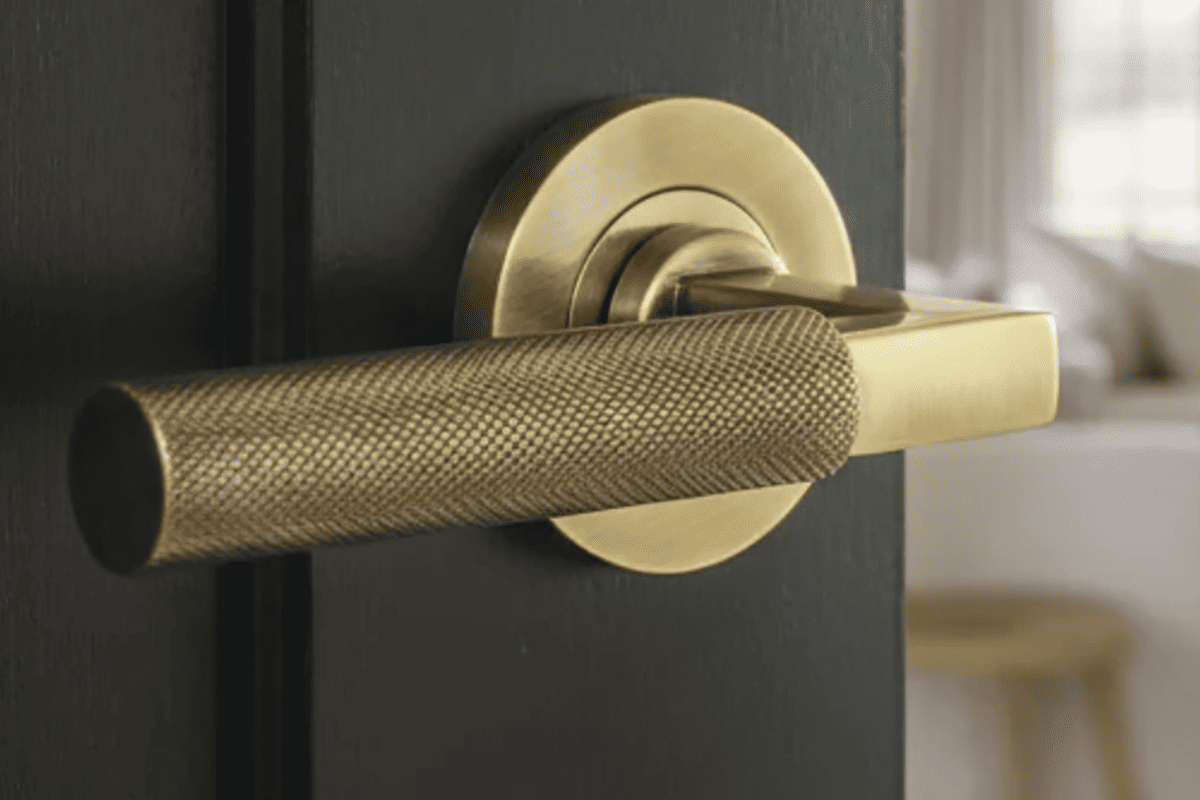
Finish Options Compared
Different finishes can look similar in a catalog. They do not perform the same in the field.
| Finish / Material Combination | Visual Effect | Abrasion Resistance | Corrosion Resistance | Best Fit |
|---|---|---|---|---|
| SS304 + PVD | Stable dark metallic tones | High | High | Humid indoor, premium projects |
| SS316 + PVD | Premium tone, strong base metal | High | Very high | Coastal or high-humidity projects |
| SS304 brushed SSS | Natural stainless satin | Medium to high | High | General commercial and residential |
| SS201 brushed SSS | Similar look at lower cost | Medium | Lower than SS304/316 | Dry indoor, budget projects |
| Electroplated matte black | Deep decorative black | Medium, depends on process | Medium to low in harsh areas | Indoor decorative use |
| Powder-coated black | Thick color layer | Medium | Depends on pre-treatment | Indoor, selected commercial use |
PVD, Electroplating, and Brushed Stainless Are Not Equal
I often remind customers that “black” is not a technical specification. A black lever can be electroplated, PVD coated, powder coated, or painted. Each process has different performance limits.
PVD finishes usually offer better abrasion resistance and color stability when the process is well controlled. PVD dark tones, such as gunmetal, graphite, and black titanium, are popular because they give a premium metallic look instead of a flat painted appearance. On SS304 or SS316, PVD can be a strong option for higher-demand projects.
Electroplated matte black can look very elegant. It is also cost-effective for many indoor applications. However, buyers should confirm salt-spray hours, adhesion, and abrasion performance. Some decorative black finishes can show edge wear faster on high-touch levers, especially where rings, keys, or cleaning chemicals contact the surface.
Brushed stainless steel, often called SSS, remains a practical finish. It is not just a trend. It hides light scratches better than mirror finishes and fits many architectural door packages. SS304 is a common choice for better corrosion resistance. SS316 is more suitable where chloride exposure is a concern, such as coastal regions.6
Environmental Matching Matters
A simple environment checklist helps a buyer avoid over- or under-specifying:
- Dry indoor residential: SS201 or SS304 may be acceptable, depending on budget and expected service level.
- High-end indoor residential: SS304 with PVD, brushed SSS, or controlled matte black is safer.
- Hotel or commercial interior: SS304 base material with tested coating is more reliable.
- Coastal or high-humidity project: SS316 or SS304 with verified PVD and corrosion test evidence should be considered.
- Outdoor exposure: The full door system, cleaning method, and local atmosphere need professional evaluation.
At SDH Hardware, I treat salt-spray data as useful evidence, not a universal guarantee. Internal salt-spray results can help compare samples under controlled conditions.7 However, real environments include cleaning chemicals, hand sweat, air pollution, and installation damage. Buyers should verify test reports, sample performance, and warranty boundaries before committing.
2026 Style Direction
The strongest visual trend I see is quiet luxury. Buyers want texture, but they do not want overly shiny hardware. That is why satin gunmetal, dark bronze, black titanium, and soft matte black are growing.
For hardware brands, this creates a useful product strategy:
- Keep brushed stainless steel as the safe core SKU.
- Add satin gunmetal PVD as the premium SKU.
- Offer matte black with clear indoor-use instructions.
- Use diamond knurling for stronger visual impact.
- Use straight knurling for minimalist projects.
This approach gives distributors enough range without making inventory too complex.
What Compatibility Checks Prevent Knurled Door Handles on Round Rose Installation Failures?
Knurled door handles on round rose are heavier than many plain tubular levers. If the spindle, fixing centers, door thickness, lockcase spring, or rose construction do not match, the handle may loosen, droop, or feel unstable. These failures often look like quality problems, but they may start with poor compatibility.
Buyers should confirm spindle size, through-bolt center distance, door thickness range, rose diameter, fixing method, lever projection, and spring torque matching. For heavier knurled levers, I recommend reviewing teardown drawings, assembly videos, and lockcase compatibility before approving bulk production.
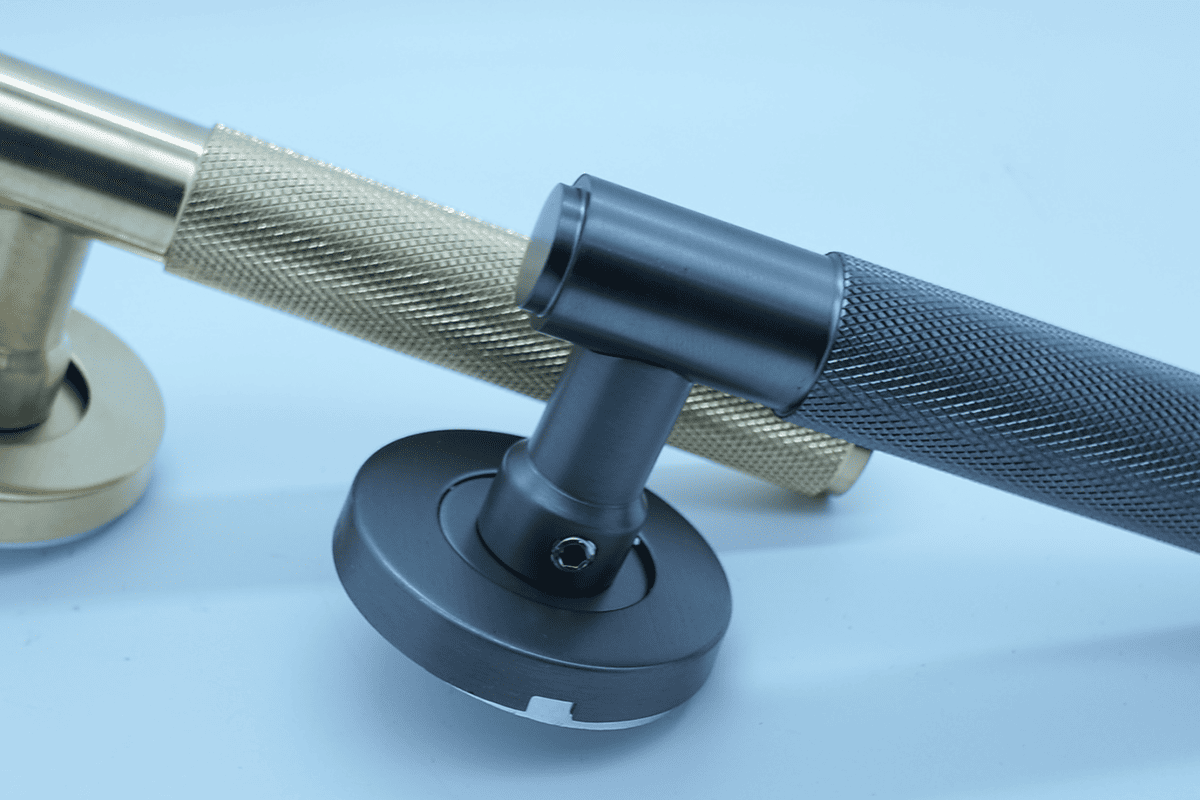
Core Compatibility Checklist
Before placing an OEM or ODM order, I suggest confirming these points in writing:
| Item | What to Confirm | Why It Matters |
|---|---|---|
| Spindle size | Common sizes include 8 mm, but market standards vary | Wrong spindle causes poor engagement |
| Spindle length | Match door thickness and lockcase hub | Short spindle causes weak operation |
| Through-bolt centers | Center-to-center distance on rose fixing holes | Wrong centers prevent installation |
| Door thickness range | Example: 35–45 mm, 40–55 mm, or project-specific | Screws and spindle must fit properly |
| Rose diameter | Often 50–55 mm, depending on design | Affects coverage and appearance |
| Lever return spring | Built-in rose spring or lockcase spring support | Prevents lever droop |
| Lockcase compatibility | Latch follower, spring strength, backset | Affects operation and return |
| Fixing screw type | Wood screws, through bolts, concealed fixing | Affects strength and serviceability |
Heavier Lever Means Higher Torque Demand
Knurling itself does not always make a lever much heavier, but many knurled designs use solid stainless steel or thicker sections to achieve a premium feel. The heavier lever creates more torque on the rose and spindle.8 If the lockcase spring is weak, the lever may not return fully to horizontal.9
I have handled complaint samples where the lever was blamed first. After teardown, the main issue was mismatched spring force between the lockcase and the lever set. In other cases, the fixing screws were too short for the door construction, or the through-bolt positions did not match the prepared holes.
Why Teardown Diagrams Help
A good supplier should be able to provide more than a beauty photo. For a door factory, I recommend requesting:
- Exploded assembly drawing
- 2D engineering drawing with dimensions
- Spindle and screw specification
- Door thickness range
- Rose fixing method
- Assembly video
- Installation instruction sheet
- Compatible lockcase references
These documents help the buyer’s engineering team confirm whether the handle fits existing door preparation. They also help installers avoid guesswork.
Common Failure Modes and Root Causes
| Field Complaint | Possible Root Cause | Practical Fix |
|---|---|---|
| Lever droops after use | Weak return spring or heavy lever mismatch | Add stronger rose spring module or match lockcase |
| Rose loosens | Incorrect screws, weak door core, no through-bolts | Use through-bolt fixing and correct screw length |
| Handle feels shaky | Spindle tolerance issue or poor grub screw engagement | Tighten tolerance and improve fixing structure |
| Latch does not retract fully | Spindle too short or lockcase mismatch | Correct spindle length and hub compatibility |
| Installation holes do not match | Wrong through-bolt center distance | Confirm drawings before production |
OEM and ODM Buyers Need Dimensional Discipline
For OEM orders, I ask customers to confirm the receiving market standard early. European lockcases, Middle East project doors, and Southeast Asian residential doors may use different habits. The visual design may be the same, but the installation system is not always interchangeable.
At SDH Hardware, we usually support custom specifications after order confirmation, including drawings, surface treatment details, accessory configurations, and packaging. However, customization works best when the buyer shares target lockcase information, door thickness, and installation method at the beginning.
A round rose looks universal from the outside. It is not universal on the inside.
That sentence has saved me from many avoidable disputes.
What QC Evidence Should Buyers Request for Knurled Door Handles on Round Rose?
Knurled door handles on round rose should be evaluated with sample inspection and practical test evidence before mass production. The main risk is not one single defect. It is the combination of grip feel, finish durability, lever return, screw holding, and dimensional consistency across batches.
Buyers should request internal cycle test summaries, salt-spray results, coating checks, torque checks, material confirmation, and final inspection criteria. EN 1906-related ratings can guide evaluation10, but buyers should verify documents and confirm whether the tested configuration matches their actual application and environment.
Practical QC Documents to Review
For factory evaluation, I recommend asking for these documents or summaries:
- Material declaration
- SS201, SS304, SS316, zinc alloy, brass, or aluminum should be clearly stated.
- Finish process description
- PVD, electroplating, powder coating, or brushing should be identified.
- Salt-spray test summary
- Buyers should check hours, standard used, sample condition, and rating method.
- Cycle test summary
- EN 1906-related cycle testing is useful when the handle configuration is comparable.
- Torque and return test
- The lever should return consistently with the selected lockcase or spring module.
- Dimensional inspection report
- Spindle hole, rose holes, lever length, projection, and screw centers should be checked.
- AQL or final inspection standard11
- Surface defects, color variation, burrs, and assembly looseness need clear limits.
Internal Testing Is Useful, But It Has Boundaries
As a factory-side practitioner, I value internal testing because it helps us catch problems before shipment. However, I do not present internal tests as universal proof for every project. A handle tested in one configuration may perform differently with another lockcase, door thickness, installation method, or environment.
For example, a lever may pass a cycle test with a strong return spring module. The same lever may droop if paired with a weak latch spring. A finish may pass a salt-spray comparison, but fail early if harsh cleaning agents are used daily.
That is why buyers should ask one important question:
“Does this test evidence match the product configuration I will actually buy?”
If the answer is unclear, the buyer should request sample testing or third-party evaluation for the specific application.
Complaint-to-Improvement Loop
The best suppliers do not hide complaints. They convert complaints into engineering changes. In my experience, the most common complaints for knurled lever handles include:
| Complaint | Factory Investigation Point | Targeted Improvement |
|---|---|---|
| Lever sagging | Spring strength, lever weight, spindle fit | Return spring module upgrade |
| Rose loosening | Screw length, through-bolt design, door core | Revised fixing kit |
| Finish fading | Coating thickness, process control, cleaning exposure | PVD upgrade or clearer use boundary |
| Color variation | Batch control, polishing base, coating parameters | Master sample and batch approval |
| Sharp handfeel | Knurl depth, burr removal, edge finishing | Adjust knurl pitch/depth and polishing |
| Dirt trapped in texture | Knurl geometry and finish roughness | Finer pitch or straight knurl option |
What I Like to See During Pre-Shipment Inspection
A good pre-shipment inspection should not only count cartons. It should check the product as a user will experience it.
I prefer an inspection flow like this:
- Open cartons from different pallets.
- Check color consistency under stable lighting.
- Touch the knurl surface for burrs or sharp points.
- Operate the lever repeatedly on a test fixture.
- Check lever return angle.
- Verify spindle, screws, and accessories.
- Measure key dimensions against drawings.
- Review logo, packaging, and labels.
- Record defects with photos and quantities.
For B2B buyers, this process reduces arguments later. It also helps both sides improve the next order.
How SDH Hardware Supports Buyer Evaluation
At SDH Hardware, our role is to support door manufacturers, hardware brands, and wholesalers with factory-direct production and practical documentation. For knurled handle projects, the most useful resources usually include:
- Sample kit: diamond knurl, straight knurl, and core finish options.
- Engineering drawings: lever, rose, spindle, screw, and installation dimensions.
- Assembly video: fixing method and part relationship.
- Test summaries: internal cycle, salt-spray, and torque checks where available.
- Customization support: logo, packaging, finish, and accessory configurations.
Buyers should still verify certifications and test documents for their project requirements. CE certification, fire-rated documentation, and EN 1906 references are important procurement records, but they should be reviewed against the exact product, door set, and application.
How Should Buyers Build a Practical SKU Strategy for Knurled Door Handles on Round Rose?
Knurled door handles on round rose can become difficult to manage if every finish, knurl type, and accessory option becomes a separate SKU. Buyers may win on appearance but lose on inventory control, installation consistency, and after-sales support. A disciplined SKU strategy keeps the range attractive and manageable.
A practical SKU strategy should include one or two knurl patterns, two or three proven finishes, standardized spindle and fixing kits, and clear use boundaries. Door factories and wholesalers should prioritize repeatable specifications over excessive visual variation, especially when they want fewer returns and faster installation.
Recommended Starter Range
For many B2B customers, I would start with a focused range like this:
| SKU Group | Knurl Type | Finish | Base Material | Target Market |
|---|---|---|---|---|
| Core 1 | Straight knurl | Brushed SSS | SS304 | General residential and commercial |
| Core 2 | Diamond knurl | Satin gunmetal PVD | SS304 | Premium residential |
| Core 3 | Diamond knurl | Matte black | SS304 or project-specific | Decorative indoor |
| Premium | Fine diamond knurl | PVD dark bronze / black titanium | SS304/316 | High-end and humid areas |
| Economy | Straight knurl | Brushed SSS | SS201 | Dry indoor budget projects |
This type of range gives sales teams enough variety. It also keeps purchasing, QC, packaging, and spare parts under control.
Standardize the Hidden Parts
The visible finish sells the product. The hidden parts protect the margin.
I suggest standardizing:
- Spindle size and material
- Screw pack
- Through-bolt centers
- Rose fixing plate
- Spring module
- Installation instruction
- Carton label format
- Spare grub screws
- Allen key size
When hidden parts vary too much, warehouse mistakes increase. Installers may receive the wrong screw pack. Distributors may struggle to provide after-sales support. A simple handle range can become expensive to manage.
Match SKU to Customer Type
Different buyers need different priorities.
Door factories usually care about installation speed and dimensional stability. They need drawings, fixed accessories, and predictable supply.
Hardware brands care about differentiation. They may need special finishes, logo marking, custom packaging, and exclusive designs.
Wholesalers care about low return rates and easy explanation. They need stable SKUs, clear use cases, and simple installation instructions.
At SDH Hardware, I have seen the best results when buyers separate “showroom products” from “volume products.” The showroom range can include more colors and textures. The volume range should be simpler, tested, and easier to replenish.
Use Samples Before Marketing Launch
Before printing catalogs or launching an online listing, I recommend a small physical sample review with the buyer’s sales, technical, and after-sales teams. Each team sees a different risk.
- The sales team checks appearance and story.
- The technical team checks dimensions and compatibility.
- The after-sales team checks likely complaints.
- The purchasing team checks cost and MOQ.
- The warehouse team checks labeling and accessories.
This small review can prevent expensive product changes after launch.
Conclusion
Knurled door handles on round rose should be specified as engineered hardware, not only as a design trend. The right choice starts with grip geometry, then moves to material, finish, compatibility, and QC evidence. I recommend confirming physical samples, drawings, assembly details, and test summaries before volume orders. If you are developing a new lever handle series, SDH Hardware can support you with sample kits, OEM/ODM customization, engineering drawings, assembly videos, and factory-direct production consultation.
"Knurling", https://en.wikipedia.org/wiki/Knurling. A general engineering reference defines knurling as a manufacturing process that creates a patterned surface, commonly to improve grip on handled components. Evidence role: definition; source type: encyclopedia. Supports: A neutral source should define knurling and explain that it is commonly used to provide a gripping surface on parts handled by users.. Scope note: This supports the functional definition of knurling generally, not the performance of any specific door-handle pattern. ↩
"Finger pad friction and its role in grip and touch - PMC - NIH", https://pmc.ncbi.nlm.nih.gov/articles/PMC3565724/. Experimental studies of tactile perception and hand-surface friction show that surface texture parameters can influence perceived roughness and grip-related friction. Evidence role: mechanism; source type: paper. Supports: A research source should support that surface texture parameters such as roughness, spacing, or pattern can affect friction, grip perception, and tactile response.. Scope note: The evidence is contextual because it concerns textured surfaces and tactile mechanics generally, rather than knurled architectural door handles specifically. ↩
"Marine Atmospheric Corrosion of Carbon Steel: A Review - PMC", https://pmc.ncbi.nlm.nih.gov/articles/PMC5506973/. Corrosion guidance from standards and corrosion institutions identifies humidity, chloride deposition, and service exposure as major factors affecting metal corrosion and coating performance. Evidence role: mechanism; source type: institution. Supports: A neutral corrosion or standards source should explain that moisture, chlorides, and exposure conditions influence corrosion and coating durability.. Scope note: This supports the environmental mechanism broadly and does not predict the service life of a particular finish. ↩
"Corrosion and wear behavior of TiN PVD coated 304 ...", https://www.academia.edu/43817078/Corrosion_and_wear_behavior_of_TiN_PVD_coated_304_stainless_steel. Studies of physical vapor deposition coatings on stainless steel report improved surface hardness, wear resistance, and corrosion-related performance under specified test conditions. Evidence role: general_support; source type: paper. Supports: A peer-reviewed source should support that PVD coatings can improve wear and corrosion-related surface performance on stainless steel substrates under controlled conditions.. Scope note: The support is conditional because PVD performance depends on coating composition, process control, substrate preparation, and exposure environment. ↩
"Stainless steel", https://en.wikipedia.org/wiki/Stainless_steel. Materials references comparing stainless steel grades note that alloy composition affects corrosion resistance, with grade 201 generally offering lower corrosion resistance than 304 or 316 in many service environments. Evidence role: general_support; source type: education. Supports: A university or materials reference should support that stainless steel grades differ in composition and corrosion resistance, with 201 generally less corrosion-resistant than 304 or 316 in many environments.. Scope note: This supports grade-level expectations, not the performance of a specific supplier’s SS201 handle or black finish. ↩
"Studies on the Cooperative Influence of Cr and Mo on ... - PMC", https://pmc.ncbi.nlm.nih.gov/articles/PMC10707140/. Materials references note that type 316 stainless steel contains molybdenum and is commonly selected for improved resistance to chloride-induced pitting in marine or coastal environments. Evidence role: mechanism; source type: education. Supports: A materials science source should explain that 316 stainless steel contains molybdenum and is commonly selected for improved resistance to chloride-induced pitting compared with 304.. Scope note: This does not mean 316 is immune to corrosion; performance still depends on exposure severity, cleaning, surface finish, and design. ↩
"Salt spray test", https://en.wikipedia.org/wiki/Salt_spray_test. Salt-spray standards such as ASTM B117 and ISO 9227 define controlled exposure methods for comparative corrosion assessment, but technical guidance cautions that results do not directly predict service life in all real environments. Evidence role: expert_consensus; source type: institution. Supports: A standards or corrosion-testing source should state that neutral salt-spray testing is a controlled comparative test and that results should not be directly equated with service-life predictions.. Scope note: This supports the interpretation of salt-spray data, not the performance of any particular handle finish. ↩
"Torque and Equilibrium", http://hyperphysics.phy-astr.gsu.edu/hbase/torq2.html. Introductory mechanics texts define torque as the product of force and lever arm distance, explaining why increased lever weight can raise moment loading on the supporting spindle and rose. Evidence role: mechanism; source type: education. Supports: An educational physics or engineering source should support that torque equals force multiplied by perpendicular distance from the pivot, so added weight can increase moment loading.. Scope note: This establishes the mechanical principle, not the failure threshold of a specific handle assembly. ↩
"How to Fix Drooping Door Handles | Repair Guide", https://www.suffolklatchcompany.com/blogs/news/how-to-fix-drooping-door-handles?srsltid=AU7gw4UZNdZc8x85K_R1RHzB-3HlxHXBzWyyGCxQscj4wvvae7HCmDjs. Door-hardware standards and technical references treat lever return as an operational performance characteristic, reflecting the need for adequate spring force in the handle or lock mechanism. Evidence role: mechanism; source type: institution. Supports: A door-hardware standard or technical reference should support that lever handles rely on spring mechanisms and must meet return or operational performance requirements.. Scope note: This supports the mechanism generally and does not diagnose any individual installation. ↩
"BS EN 1906 – Lever Handle and Knob Furniture", https://www.hoppe.com/gb-en/contacts-service/standards/bs-en-1906/. EN 1906 is a European standard for lever handles and knob furniture that classifies products by performance characteristics including category of use, durability, safety, corrosion resistance, and security-related attributes. Evidence role: expert_consensus; source type: institution. Supports: A standards body or institutional summary should support that EN 1906 classifies lever handles and knob furniture by performance characteristics such as durability, corrosion resistance, and category of use.. Scope note: The standard supports how ratings guide evaluation, but only a test report for the exact configuration can show compliance for a specific product. ↩
"ISO 2859-1", https://chemistry.unt.edu/~tgolden/courses/iso2859-1.pdf. ISO 2859-1 and related sampling standards define acceptance quality limit procedures for lot-by-lot inspection, providing a structured basis for final inspection sampling. Evidence role: definition; source type: institution. Supports: A standards source should define acceptance quality limit sampling inspection and its role in lot-by-lot inspection.. Scope note: AQL sampling manages inspection risk statistically and does not guarantee that every unit in a lot is defect-free. ↩
