
Electric Power Transfer Hinge Wiring Guide: Conductor Count, Door Movement and Access Control
An electric power transfer hinge can solve wiring problems on doors with electronic locks, smart peepholes, sensors, and access control devices. The problem starts when buyers choose only by conductor count. That can cause cable fatigue, exposed wiring, poor appearance, or rework. I usually start by matching the door, hinge structure, and powered hardware first.
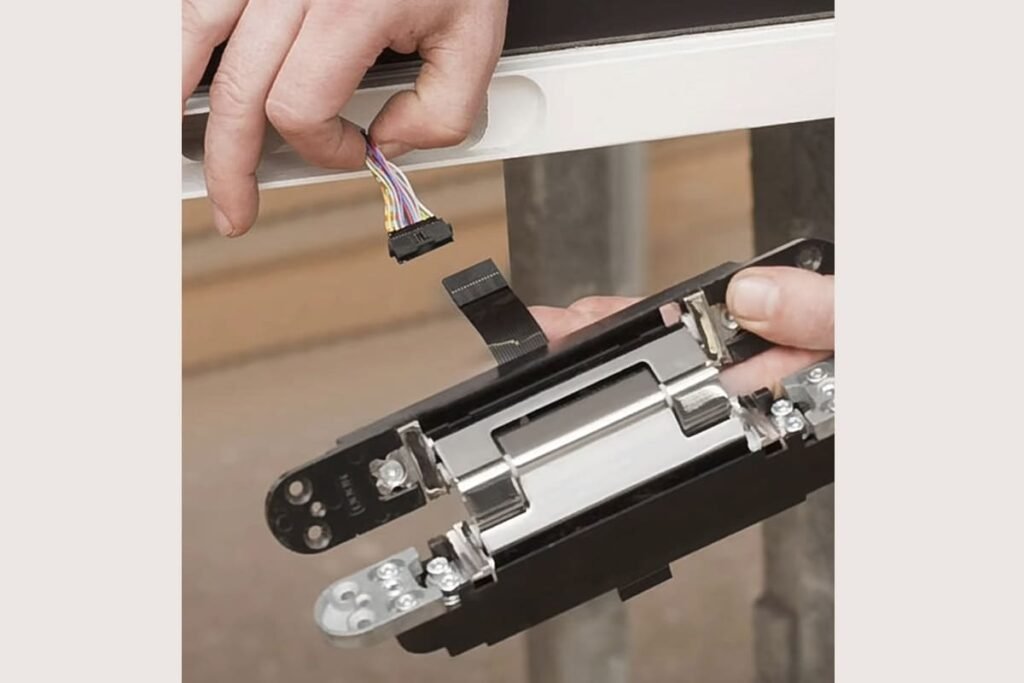
An electric power transfer hinge is used to route power and signal wires from the door frame into the moving door leaf while keeping wiring protected and concealed1. The right choice depends on the door type, hinge system, access control device list, opening movement, aesthetics, and certification requirements—not conductor count alone.

Many customers ask me, “Should I use 4 wires or 8 wires?” I understand why they ask that first. However, the better question is: What is installed inside the door leaf, and what is the safest route for wires to move with the door?
Which doors need an electric power transfer hinge or another power transfer solution?
A powered door leaf creates a simple but serious challenge. The frame is fixed, but the door moves every day. If I run wiring without protection, the cable can bend, pinch, rub, or remain visible2. A proper power transfer solution prevents those problems before installation begins.
A door needs an electric power transfer hinge or another power transfer device when the door leaf contains powered hardware. This includes electric locks, smart peepholes, readers, door contacts, sensors, request-to-exit devices, or access control wiring. The goal is protected movement, stable connection, and a cleaner appearance.
I first check what is powered inside the door leaf
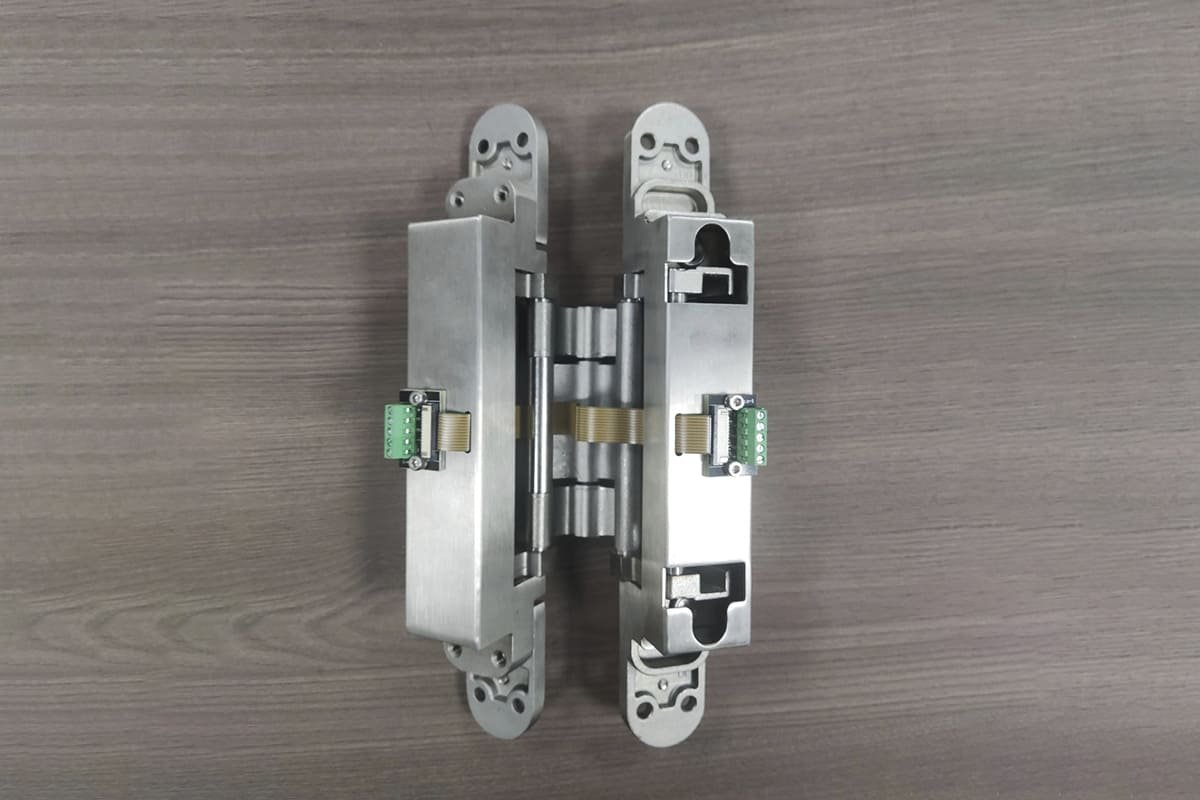
In hardware selection, I usually ask the buyer to list every electrical item installed on or inside the door leaf. This step sounds basic, but it avoids many mistakes. A door with only a simple electric lock is very different from a door with a lock, smart peephole, sensor, indicator light, and internal control module.
Common powered door-leaf devices include:
- Electric mortise locks
- Electric strikes installed with door-leaf wiring requirements
- Magnetic lock accessories
- Smart peepholes or video viewers
- Door position sensors
- Access control readers mounted on the moving leaf
- Request-to-exit buttons
- Alarm contacts
- Low-voltage lighting or indicators
- Hotel lock or apartment lock wiring
The power transfer product does not make the access control system work by itself. It only creates a protected route for the cable between the frame and the door leaf. I always remind buyers that the lock supplier, access control supplier, electrician, or project engineer must confirm the actual wiring diagram.
I separate electrical need from hardware routing
A door may need power transfer, but that does not automatically mean it needs an electrified hinge. I normally separate the decision into two parts:
Electrical requirement
The door leaf needs power, signal, or both.Mechanical routing requirement
The door structure must allow safe cable movement without crushing, twisting, or excessive bending.
This distinction matters because some doors cannot route wiring through the hinge body. Heavy steel doors, copper doors, armored doors, and doors with three-knuckle heavy-duty hinges often need another route.3 In these cases, I may consider a door cord or power transfer loop instead.
I also check appearance expectations
Some projects accept a visible protective conduit. Other projects require fully hidden hardware. A hotel suite door, luxury villa entrance, or invisible door usually needs a cleaner appearance than a service door or equipment room door.
I often use this simple evaluation:
| Door requirement | Typical concern | Possible power transfer route |
|---|---|---|
| Strong protection on heavy door | Durability and cable shielding | Door cord / power transfer loop |
| Standard door with butt hinges | Practical hidden wiring | Electrified butt hinge |
| High-end concealed hardware | Aesthetics and concealed movement | Electrified concealed hinge |
| Fire-rated project | Certification and compliance | Verify per project and document set |
| Access control door | Power and signal routing | Confirm device wiring first |
A good power transfer solution should reduce risk. It should not create new risk through poor hinge selection, tight cable bending, weak routing, or mismatched certification.
How should I choose between a door cord, electrified butt hinge, and electrified concealed hinge?
A buyer can waste time if they compare only product names. The door type should lead the selection. I have seen projects change hardware late because the first choice looked neat on paper but did not fit the actual hinge, door thickness, or internal cavity.
I choose between a door cord, electrified butt hinge, and electrified concealed hinge by checking door construction, hinge type, available internal space, appearance target, opening movement, and durability needs. Heavy doors often need a door cord, standard wood or steel doors may use electrified butt hinges, and high-end concealed doors may use electrified concealed hinges.
Option 1: Door cord or power transfer loop
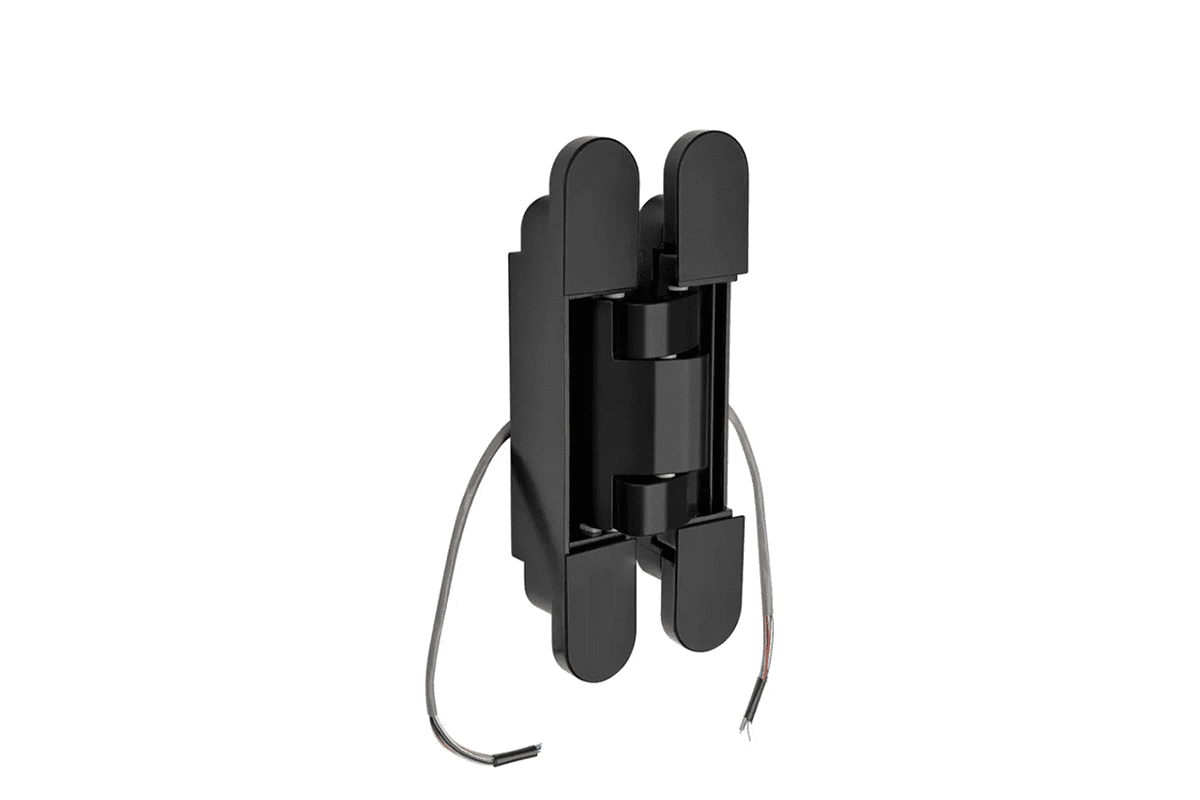
A door cord, also called a power transfer loop, is often considered when the hinge cannot route wires internally. I usually see this choice on:
- Copper doors
- Heavy steel doors
- Armored doors
- Security doors
- Doors with three-knuckle heavy-duty hinges
- Doors where hinge drilling is not practical
- Doors where cable protection matters more than complete concealment
A typical door cord system uses two junction boxes and a flexible metal protective conduit.4 One box is mounted on the frame side, and the other is mounted on the door side. When the door closes, the flexible conduit moves with the door and may retract into the frame or door-side box depending on the design.
The main advantage is robust external protection. The conduit helps protect the internal cable from impact, bending damage, and casual pulling.5 I often consider this route for heavy-use or heavy-door applications, but I still ask the buyer to verify installation space and appearance acceptance.
A door cord is not always the most beautiful option. It is visible when the door is open and sometimes visible when the door is closed. However, for certain heavy or reinforced doors, it may be more realistic than forcing wires through a hinge that was never designed for wiring.
Option 2: Electrified butt hinge
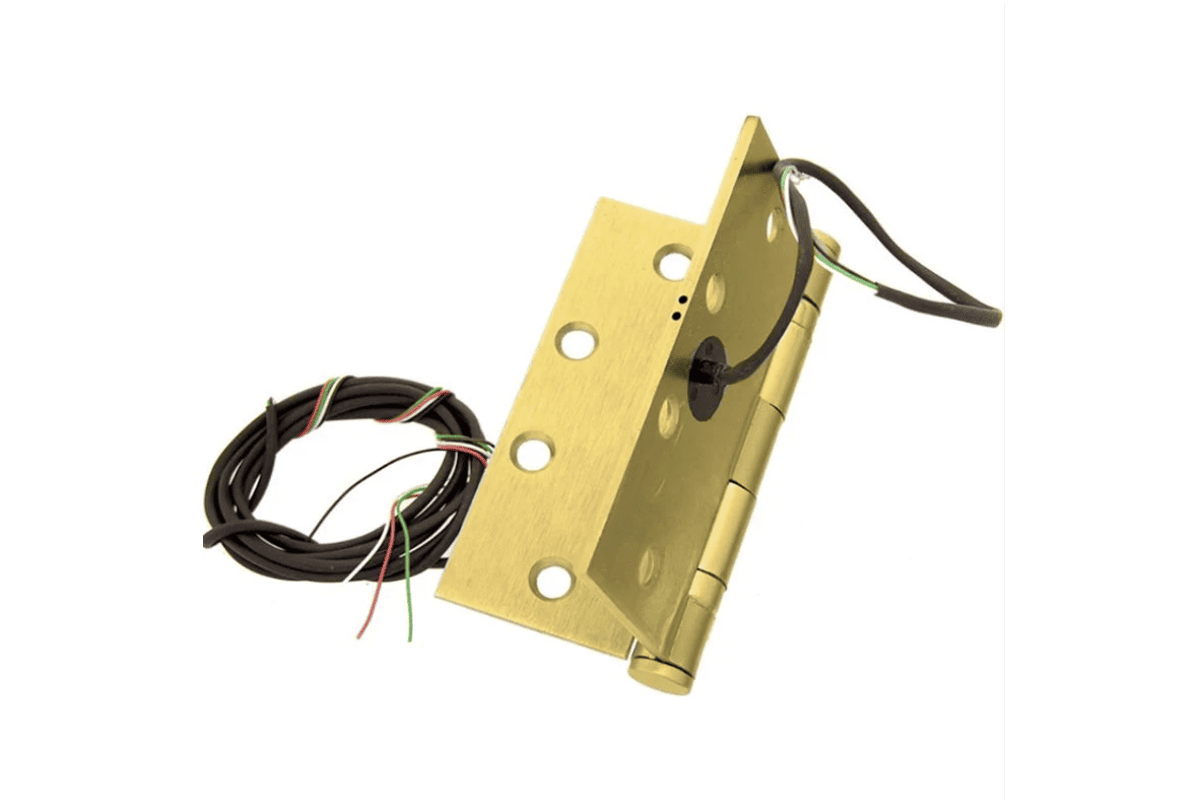
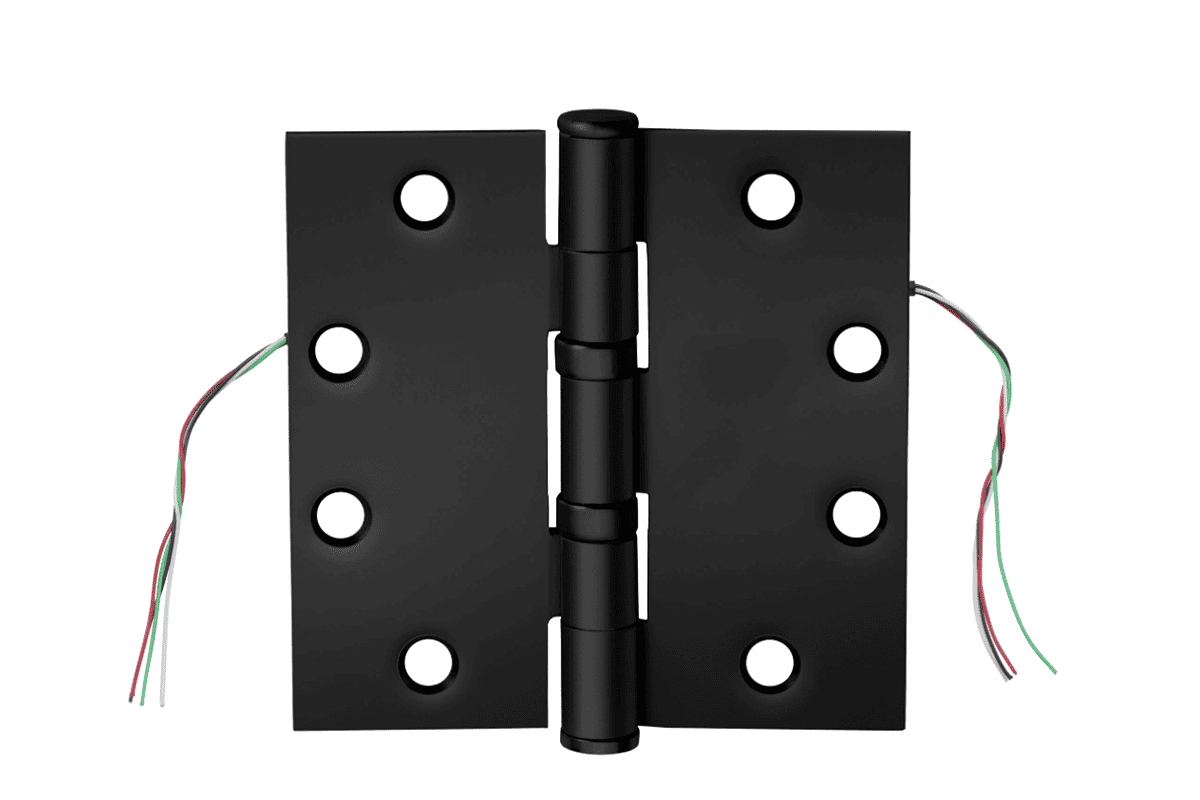
An electrified butt hinge is suitable for many standard wood doors and steel fire-rated doors when the hinge can be drilled internally and fitted with flexible cable. This is the product many buyers first think of when they ask for an electric power transfer hinge.
The hinge body looks similar to a normal butt hinge from the outside, but it carries wires through the hinge area. Good versions use high-flex, fatigue-resistant, multi-strand cable designed for repeated door movement. The cable route must be protected inside the hinge and door preparation.
This option works well when:
- The door uses standard butt hinges.
- The door thickness supports mortising and drilling.
- The hinge size matches the door weight and usage.
- The required conductor count fits inside the hinge design.
- The project accepts the hinge appearance.
- Fire-rated or CE-related documents are verified for the project.
I avoid saying that an electrified butt hinge is universally compatible with every fire-rated door. Fire-rated doors are system products.6 The door leaf, frame, hardware, seals, lock, hinge, and installation method all affect compliance. I recommend buyers verify fire-rated requirements with the door manufacturer, certification document, and local authority.
Option 3: Electrified concealed hinge
An electrified concealed hinge is often chosen when the project has a higher budget and stronger aesthetic requirements. When the door is closed, both the hinge and wiring can be hidden. This is attractive for high-end wooden doors, frameless doors, invisible doors, and slim-profile design projects.
A concealed hinge often has more internal space than a small butt hinge. This can help cable routing and may improve bending conditions, depending on the hinge structure. However, the door and frame must be prepared accurately. The hinge pocket, opening angle, door thickness, and frame profile all matter.
I normally check these points before recommending an electrified concealed hinge:
| Check point | Why I check it |
|---|---|
| Door thickness | The hinge body needs enough depth |
| Frame profile | Slim frames may limit hinge space |
| Opening angle | Cable movement changes with angle |
| Door weight | The hinge must support the door safely |
| Cable quantity | More wires need more internal room |
| Finish requirement | Concealed projects often demand premium appearance |
| Installation skill | Mortising accuracy is critical |
This option is not automatically better for every project. It is better when the door system supports it. I prefer to review door drawings before confirming concealed hinge wiring, especially when the door is frameless, flush, or custom-made.
How many conductors should an electric power transfer hinge have?
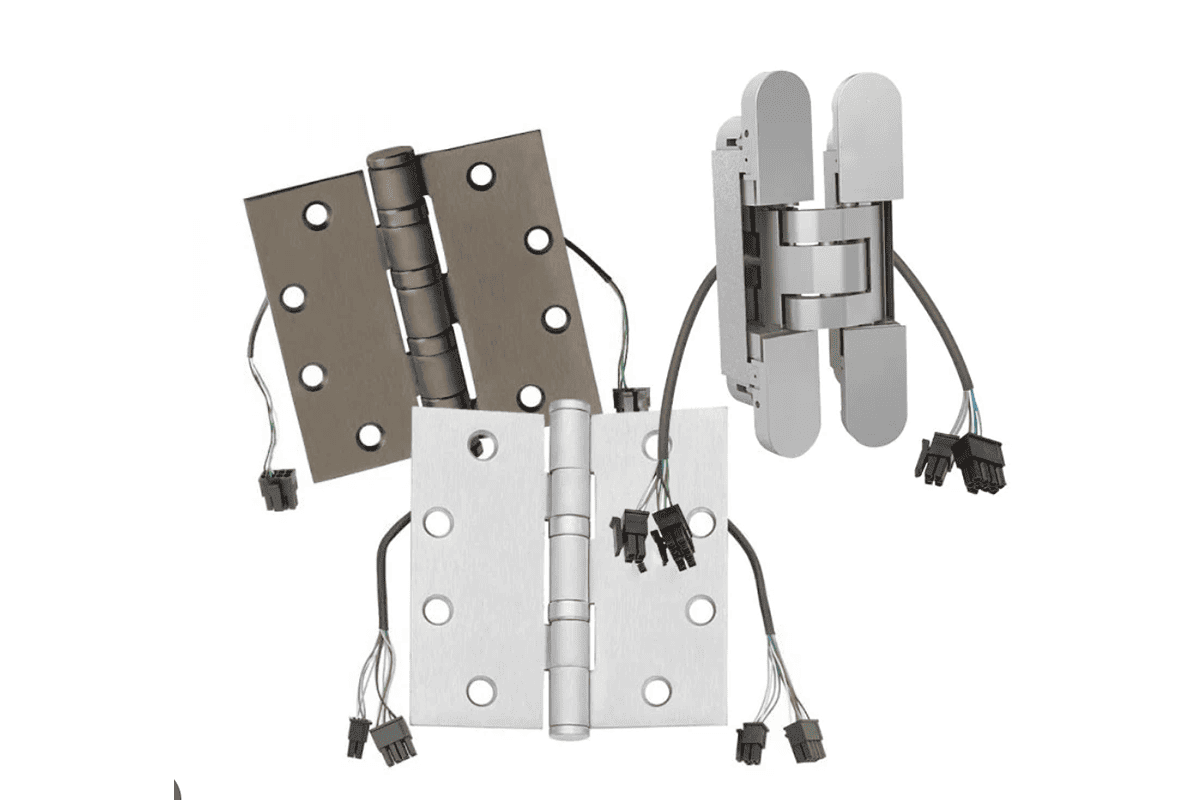
Conductor count creates many purchasing mistakes because it looks like a simple specification. Buyers ask for 4-wire, 6-wire, or 8-wire hinges before they confirm the electronic hardware. That can lead to too few wires, oversized cables, poor flexibility, or a hinge body that cannot handle the cable bundle.
The conductor count for an electric power transfer hinge should be based on the access control device list and each device’s power and signal requirements. Buyers should confirm the lock, reader, smart peephole, sensor, exit button, and control module wiring with the access control supplier before choosing 2, 4, 6, 8, or more conductors.
I do not start with “4-wire or 8-wire?”
I start with the device list. A conductor is simply one insulated wire path. The number needed depends on what the door leaf devices require. One electric lock may need only power. Another device may need power plus signal. A smart peephole may have separate power, video, data, or control wiring depending on its design.
I usually ask customers to prepare a small table like this:
| Door-leaf device | Power needed? | Signal needed? | Supplier wiring diagram confirmed? |
|---|---|---|---|
| Electric lock | Yes | Maybe | Must verify |
| Smart peephole | Yes | Maybe | Must verify |
| Door contact | Maybe | Yes | Must verify |
| Reader | Yes | Yes | Must verify |
| Exit button | Maybe | Yes | Must verify |
| Sensor | Yes/Maybe | Yes | Must verify |
This table helps the buyer avoid guessing. It also gives the access control supplier enough information to confirm wiring.
More conductors are not always better
Some buyers think more conductors are safer. I understand the logic. Extra wires can allow future expansion. However, more conductors also create trade-offs.
A hinge has limited internal space. If I add more wires, each wire may need to be thinner, or the cable bundle may become stiffer. A stiffer bundle may not bend as smoothly during repeated door movement. If the cable is too tight inside the hinge, it may fatigue sooner.
Important conductor-count trade-offs include:
- Wire diameter: Larger conductors may carry more current, but they need more space.
- Flexibility: Multi-strand flexible cable usually performs better in moving areas.7
- Bending radius: Tight bending can reduce cable life.8
- Hinge cavity: Small hinges cannot safely accept large cable bundles.
- Device demand: Power devices and signal devices may have different needs.
- Future expansion: Extra conductors can help, but only if the hinge can handle them.
- Installation quality: Poor routing can damage even a good hinge.
I avoid giving a universal current rating in selection articles because it is project-specific. The lock supplier, access control supplier, electrician, or system designer should confirm voltage, current, cable size, and wiring diagram. The hardware supplier can provide hinge dimensions, conductor options, material, finish, and available certificates for evaluation.
Common conductor-count thinking
A buyer can use the following logic as an early procurement guide, not as an electrical design rule:
| Early question | Procurement meaning |
|---|---|
| Does the door leaf have only one powered lock? | A lower conductor count may be enough, but verify the lock diagram |
| Does the door leaf have lock plus sensor? | More conductors may be needed for power and signal |
| Does the door leaf have smart peephole or reader? | Device-specific wiring must be confirmed |
| Does the buyer want future expansion? | Spare conductors may help if hinge space allows |
| Is the hinge very small? | Too many conductors may reduce flexibility |
| Is the door high frequency? | Cable fatigue resistance becomes more important |
When I help customers select door hardware, I prefer to confirm the full door system before the order. This is especially important for OEM and ODM projects because the buyer may need custom finishes, stamping, logo packaging, drawings, and inspection before shipment.
Is one electric power transfer hinge enough for one door?
One electrified hinge often seems like the simplest answer. It reduces visible differences between hinges, keeps the door set cleaner, and may control cost. However, the answer depends on wiring load, door structure, hinge position, and movement. A wrong assumption can create installation problems.
One electric power transfer hinge is often enough for one door when the conductor count, cable flexibility, hinge size, door structure, and wiring route are suitable. Buyers should still confirm door type, opening direction, opening angle, frequency of use, frame construction, hinge position, finish, and certification needs before ordering.
I check the hinge position before I confirm quantity
In many projects, the electrified hinge is installed at a position that gives a practical cable route from the frame into the door leaf. This is often the middle hinge area or another location selected by the door and hardware designer. The best position depends on the door construction and the internal path to the lock or device.
A door with three hinges may use one electrified hinge and two normal hinges. A heavier door may require more hinges for mechanical support, but that does not mean every hinge must be electrified. The electrified hinge transfers wiring. The full hinge set supports the door. These are related but not identical functions.
I usually review:
- Door height and weight
- Number of mechanical hinges
- Hinge size and thickness
- Door opening direction
- Opening angle
- Lock body position
- Access control device position
- Frame wiring entry point
- Door leaf internal channel
- Installer’s cable pulling method
This review helps me avoid a common problem: the electrified hinge is selected correctly, but it is installed in a position where the cable cannot reach the device safely.
Door movement affects cable life
A door is not a static panel. It swings, stops, slams, and sometimes gets forced beyond its normal range.9 Every movement affects the wire inside a hinge or conduit. For high-use doors, the buyer should care about fatigue resistance, not just conductor count.
I pay attention to:
| Movement factor | Why it matters |
|---|---|
| Opening frequency | More cycles create more bending fatigue |
| Opening angle | Wider opening can change cable stress |
| Door closer force | Fast closing can increase shock |
| Stopper position | A missing stopper may overextend movement |
| User behavior | Public doors receive rougher handling |
| Cable slack | Too little slack can pull the cable |
| Cable routing | Sharp turns can damage insulation |
For commercial and project doors, I recommend that the installer keeps cable movement smooth and avoids sharp edges. The access control supplier or electrician should verify final connection, insulation, grounding where applicable, and local code requirements.
I also check certification and documents
For B2B procurement, documentation matters. Many buyers need CE documents, fire-rated reports, drawings, material information, finish samples, or inspection records. I treat certificates as documents to verify, not as marketing slogans.
At SDH Hardware, I work from a manufacturing and hardware selection perspective. Our core products follow EU standard specifications, and CE or fire-rated documentation may be available depending on the product and project requirement. However, the buyer should always verify that the chosen hinge, door, lock, and installation method match the required project standard.
This is especially important for:
- Fire-rated steel doors
- Hotel and apartment access control doors
- Public building projects
- Export orders to Europe or the Middle East
- OEM products under customer brand
- Doors using special finishes or non-standard dimensions
One electrified hinge can be enough. Still, the complete door system must support that decision.
What should I confirm before ordering an electric power transfer hinge?
Ordering too early can create expensive rework. I have seen buyers confirm finish and quantity before checking door thickness, hinge pocket size, or lock wiring. That sequence feels fast at first, but it can slow the project later when installers discover routing conflicts.
Before ordering an electric power transfer hinge, I confirm the door type, hinge type, powered hardware list, conductor requirement, opening angle, hinge size, mortising space, finish, certification documents, and wiring responsibility. This checklist helps buyers avoid exposed cables, wrong conductor count, poor fit, and access control installation delays.
My practical procurement checklist
I recommend that door factories, hardware brands, wholesalers, and project buyers prepare the following information before asking for a quotation:
Door type
I need to know whether the door is wood, steel, fire-rated steel, copper, armored, frameless, invisible, or slim-profile.Door size and weight
The hinge must match the mechanical requirements of the door.Current hinge system
I check whether the door uses butt hinges, concealed hinges, three-knuckle hinges, or heavy-duty custom hinges.Powered hardware list
I ask for the electric lock, smart peephole, sensor, reader, door contact, or other device list.Wiring diagram from access control supplier
I do not guess the conductor count when the system supplier has not confirmed wiring.Opening direction and opening angle
Cable movement changes with the door swing.Installation position
I confirm where the cable enters the frame and where it enters the door leaf.Finish and appearance requirement
Stainless steel, satin, black, PVD, painted, or custom finishes may affect lead time.Certification requirements
CE, fire-rated, or project-specific documents should be checked before mass production.Packaging and branding requirements
For OEM orders, I confirm logo, color box, label, drawing, and inspection expectations.
I match the solution to the door, not only the catalog
A catalog can show conductor options, hinge sizes, finishes, and drawings. However, a catalog cannot fully understand the project. I usually use catalog data as the starting point, then match it with door drawings and customer requirements.
For example:
- A standard wood door with a mortise electric lock may use an electrified butt hinge if the hinge size and cable route fit.
- A steel fire-rated door may also use an electrified butt hinge, but documentation and door-set compatibility must be verified.
- A copper entrance door with a heavy three-knuckle hinge may be better served by a door cord.
- A luxury invisible door may require an electrified concealed hinge to maintain a clean look.
- A slim aluminum-profile door may need careful review because hinge space can be limited.
I prefer early coordination
The best time to decide the wiring route is before door production. Once the door leaf is finished, adding internal channels becomes harder. Once the finish is completed, rework can damage the surface. Once the door is installed, changing the hinge type can be expensive.10
I suggest early coordination between:
- Door manufacturer
- Hardware supplier
- Access control supplier
- Electrician
- Project contractor
- Certification or inspection party, if required
This coordination does not need to be complicated. A drawing, device list, and clear photo of the hinge area often help me give a more useful recommendation.
Frequently Asked Questions
Can I use an electric power transfer hinge for every access control door?
No. I do not treat one hinge type as universal. Standard wood doors and some steel doors may suit electrified butt hinges, while heavy copper, armored, or reinforced doors may need a door cord. High-end concealed doors may need electrified concealed hinges. The door structure must decide the route.
Is an 8-wire electric power transfer hinge better than a 4-wire hinge?
Not always. An 8-wire hinge may support more devices or spare conductors, but it also needs internal space and flexible cable routing. I first confirm the device wiring diagram, voltage, current, and signal needs with the access control supplier before choosing conductor count.
Can one electrified hinge power both a lock and a smart peephole?
It may be possible, but I would not assume it. The lock and smart peephole may have different power and signal requirements. The access control supplier or electrician should confirm the wiring diagram, conductor quantity, cable specification, and safe routing before purchase.
Are electrified hinges suitable for fire-rated doors?
Some electrified hinges may be used on fire-rated door projects, but compatibility must be verified. I recommend checking the door-set certification, hinge documents, local project requirements, and installation method. A fire-rated door is a complete system, not only a single hinge.
When should I choose a door cord instead of an electrified hinge?
I often consider a door cord when the door is heavy, reinforced, copper, armored, or uses a hinge that cannot route wires internally. A door cord provides protected cable movement through a flexible conduit, although it may be more visible than a concealed wiring hinge.
Conclusion
An electric power transfer hinge should be selected as part of the complete door hardware system, not as a simple conductor-count item. I first check whether the door needs protected wiring, then I compare door cord, electrified butt hinge, and electrified concealed hinge options. After that, I confirm conductor count with the access control device list and wiring diagram. If you are evaluating power transfer hardware for OEM, wholesale, or project doors, contact SDH Hardware with your door drawings, hinge type, and device list so I can help you review the most suitable hardware route.
"How to Select an Electric Power Transfer Hinge | McKinney", https://www.mckinneyhinge.com/content/mckinney/us/en/resource-library/knowledge-center/blog/blog-post.html.aehdynamic-how-to-select-an-electric-power-transfer-hinge-633c8940d5c7b1003db5d8de_mckinney.html. An independent hardware or standards source defines electrified hinges as hinge hardware that provides a protected path for electrical power or signal conductors between the stationary frame and the moving door leaf. Evidence role: definition; source type: institution. Supports: The source should define electrified or power-transfer hinges as hardware that transfers electrical power or signals between the frame and the door while housing or concealing conductors.. Scope note: The source may define the general category of electrified hinges rather than the exact product design described in the article. ↩
"Cable Bending Radius & Flex-Life: A Practical Guide", https://www.l-com.com/resources/blog/proper-bending-radius-flex-life-continuous-motion-applications?srsltid=AYCX9vJ9u0snlA47V7Z9HIbWCwLMY0XZyLix29P454-GsxLxFAJ0RUPw. Electrical installation guidance generally requires conductors to be protected from physical damage, supporting the concern that exposed wiring on a moving door may be damaged by bending, pinching, or abrasion. Evidence role: mechanism; source type: government. Supports: The source should explain that conductors must be protected from physical damage and that repeated bending, abrasion, or pinching can damage insulation or conductors.. Scope note: This would support the general safety mechanism and may not specifically test electric power transfer hinges. ↩
"How to Select an Electric Power Transfer Hinge | McKinney", https://www.mckinneyhinge.com/content/mckinney/us/en/resource-library/knowledge-center/blog/blog-post.html.aehdynamic-how-to-select-an-electric-power-transfer-hinge-633c8940d5c7b1003db5d8de_mckinney.html. Technical door-hardware guidance notes that the choice of power-transfer hardware depends on door construction and hinge preparation, so reinforced or heavy-door applications may require a separate power-transfer loop rather than hinge-routed wiring. Evidence role: general_support; source type: institution. Supports: The source should support that door construction, hinge type, and available internal space affect whether wiring can be routed through a hinge and that alternative transfer devices may be used.. Scope note: This supports the selection principle, but suitability for copper, armored, or three-knuckle doors remains project-specific. ↩
"Armored Loop Power Transfer | Electrified Commercial Exit ...", https://www.amazon.com/Transfer-Electrified-Commercial-Security-Aluminum/dp/B005KXK6N8. Door-hardware references describe power-transfer loops as assemblies that route conductors through a flexible protective conduit between a frame-side and door-side mounting point. Evidence role: definition; source type: institution. Supports: The source should describe the basic construction of door cords or power-transfer loops, including frame and door mounting points and a flexible conduit path.. Scope note: Exact construction varies by product, so the source would support a typical configuration rather than every model. ↩
"4 Types of Flexible Conduits and Their Uses", https://www.electriflex.com/4-types-of-flexible-wire-conduits-and-their-uses/. Electrical-code and installation references characterize conduit and raceways as protective pathways for conductors, supporting the use of a flexible conduit to reduce mechanical damage to door wiring. Evidence role: mechanism; source type: government. Supports: The source should explain that conduit or raceways are used to protect conductors from physical or mechanical damage.. Scope note: General conduit guidance does not directly quantify protection against every door-use scenario. ↩
"Fire Doors and NFPA 80 FAQs", https://www.nfpa.org/news-blogs-and-articles/blogs/2025/04/11/fire-doors-faqs. Fire-door standards treat a rated opening as an assembly of the door, frame, hardware, and related components, supporting the article’s statement that compliance cannot be determined from the hinge alone. Evidence role: expert_consensus; source type: institution. Supports: The source should state that fire door ratings apply to assemblies including door leaves, frames, hardware, glazing, seals, and installation conditions.. Scope note: The source supports the assembly principle but does not evaluate the specific products mentioned in the article. ↩
"Stranded vs. Solid Resistance Wire: A Performance ...", https://pelicanwire.com/industries/stranded-vs-solid-resistance-wire-a-performance-comparison/. Engineering references on conductor construction describe stranded conductors as more flexible than solid conductors, supporting their use in wiring that undergoes repeated movement. Evidence role: mechanism; source type: research. Supports: The source should support that stranded conductors provide greater flexibility and are commonly used where conductors experience motion or repeated flexing.. Scope note: Performance still depends on strand count, alloy, insulation, routing, and the actual motion cycle. ↩
"Cable Bending Radius & Flex-Life: A Practical Guide", https://www.l-com.com/resources/blog/proper-bending-radius-flex-life-continuous-motion-applications?srsltid=AYCX9vKZVSetNmKriT3E7ojpkeqwBSS4-7KTKEU8Z5-K-g2KKuKZta5Z. Cable-flexing studies and installation guidance associate smaller bend radii with higher mechanical strain, supporting the claim that tight bending can shorten cable service life. Evidence role: mechanism; source type: paper. Supports: The source should explain that repeated bending and insufficient bend radius increase mechanical stress and fatigue in conductors or insulation.. Scope note: The relationship may depend on conductor material, strand count, insulation, bend radius, and cycle rate. ↩
"SECTION 087111 - DOOR HARDWARE (SCHEDULED BY ...", https://fpm.usc.edu/wp-content/uploads/2021/11/087102-USC-HSC-door-hardware-Guide-Specification_1.pdf. Door-hardware performance standards use repeated opening-and-closing cycles to evaluate durability, supporting the article’s emphasis that moving doors impose recurring mechanical stresses on hinge-area components. Evidence role: mechanism; source type: institution. Supports: The source should show that door hardware is evaluated for repeated opening and closing cycles and that mechanical movement is a relevant durability condition.. Scope note: Cycle-test standards support the general durability concern but may not directly measure stress on internal hinge wiring. ↩
"Managing the Cost of Rework in Construction Projects", https://cmicglobal.com/resources/article/How-Construction-Software-Can-Help-in-Reducing-Rework. Construction-management research links late design changes with rework, schedule disruption, and added cost, providing contextual support for coordinating door wiring and hinge preparation before fabrication and installation. Evidence role: general_support; source type: paper. Supports: The source should support that late design or installation changes are associated with rework, delays, and added costs in construction projects.. Scope note: The evidence is contextual for construction rework generally and may not measure electric power transfer hinge installations specifically. ↩
