
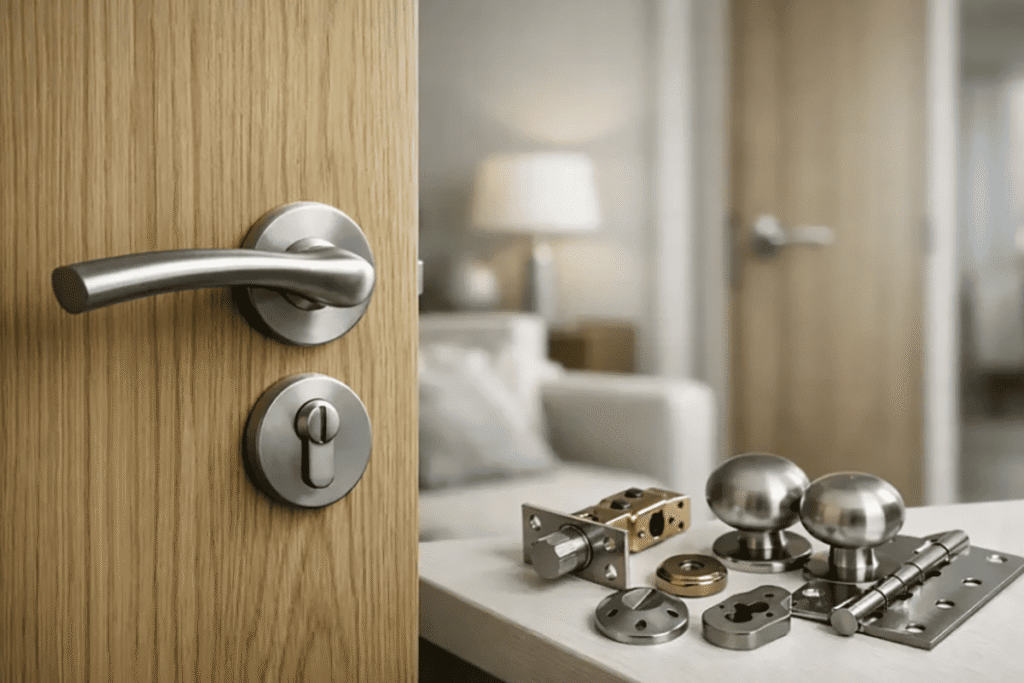
Handle Fixing For Timber / Aluminium / Steel Doors: How to avoid handle loosening
Handle fixing becomes a serious procurement issue when lever handles loosen after installation, especially on repeated-use timber, aluminium, or steel doors. A loose handle creates complaints, return costs, and brand risk. I usually solve this earlier by checking the full fixing structure before sample approval, not after bulk delivery.
Handle loosening is best prevented by matching the handle set, spindle, screws, cover plate, lock body, and door structure before ordering. When the handle and lock body allow it, through-bolt fixing is usually the preferred solution because it clamps both sides of the door more securely than short surface screws alone.1
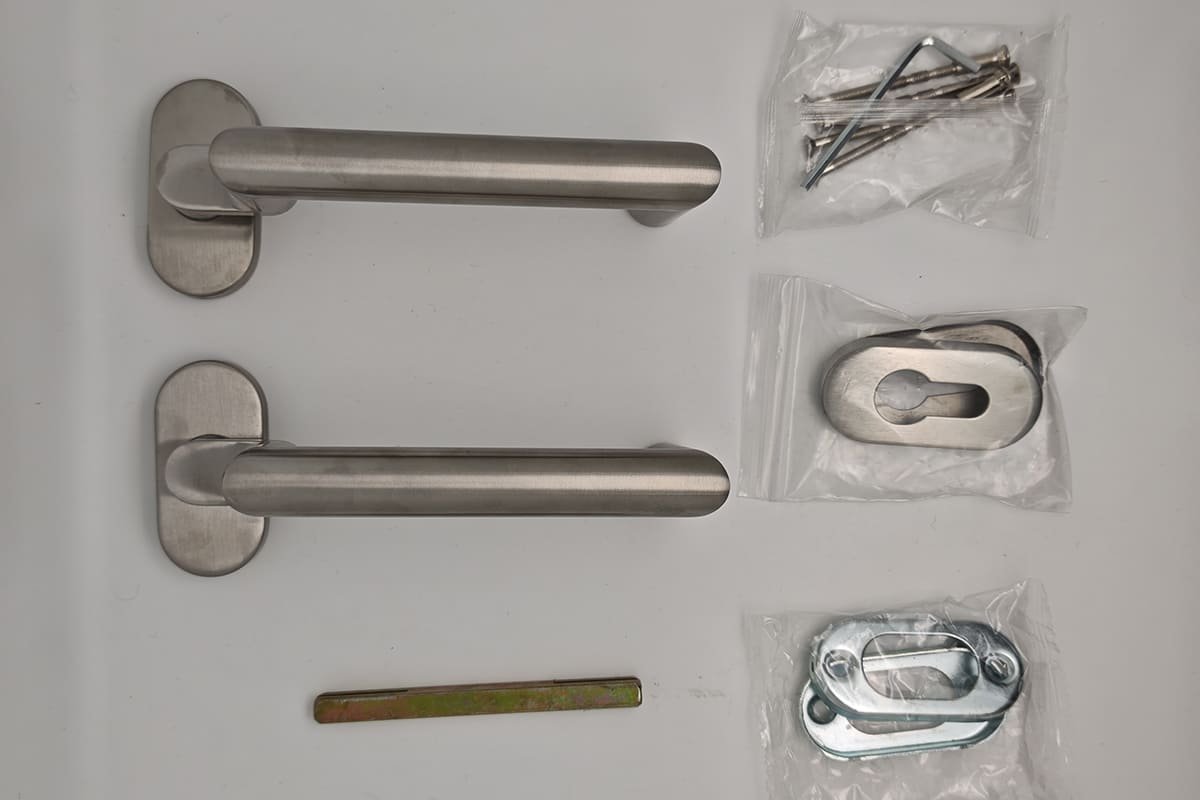
In my factory discussions with door manufacturers and hardware brands, I rarely treat loosening as one simple defect. The real question is usually more practical: does this handle fixing method suit the lock body, door material, spindle type, screw access, and project usage condition?
Why is handle fixing more than simply tightening visible screws?
Loose handles are frustrating because the first reaction is often to tighten the screws harder. That may help for a short time, but it does not always solve the root problem. In many B2B projects, I find that handle fixing fails because the fixing system was not matched correctly at specification stage.
Handle fixing is more than screw tightness because the handle assembly depends on several connection points: rose or plate fixing, spindle engagement, grub screw locking, lock body compatibility, and door structure.2 If one of these points is weak, the handle can move even when the visible screws seem tight.
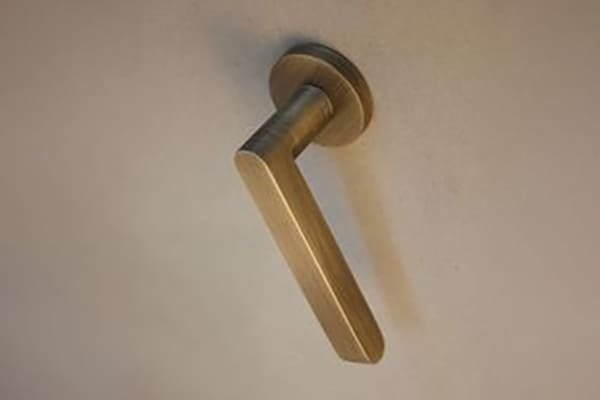
The fixing system works as a chain
A lever handle does not work alone. It connects human force to the lock body through a spindle. That force repeats thousands of times in daily use.3 If the spindle is loose, the handle feels unstable. If the rose is weak, the handle body moves. If the screws are too short, the handle cannot hold position. If the lock body has no suitable through-bolt holes, the fixing options become limited.
In handle configuration discussions, I often check these points before recommending a final structure:
- Door material: timber, aluminium profile, or steel door panel
- Door thickness: common project doors may vary widely by region and design
- Lock body type: whether the lock case supports through-bolt holes
- Handle base: rose, backplate, concealed fixing, or exposed fixing
- Spindle type: plain, slotted, grooved, eccentric, or special project spindle
- Screw length and diameter: whether they provide enough engagement
- Installation access: whether the installer can reach the fixing point properly
- Usage frequency: residential, office, school, hotel, hospital, or commercial door
The same handle may perform well on one door and loosen on another. That does not always mean the handle is poor. It may mean the door structure and fixing method do not support the load in the same way.
Common causes of handle loosening
| Cause | What usually happens | What I check before bulk order |
|---|---|---|
| Weak clamping force | Handle plate moves under repeated use | Through-bolt possibility and screw layout |
| Poor spindle engagement | Lever has play or rotates unevenly | Spindle size, groove, grub screw position |
| Wrong screw length | Screws do not grip enough material | Door thickness and fixing depth |
| Inaccurate holes | Handle pulls out of alignment | Drawing confirmation and sample fitting |
| Lock body mismatch | Through-bolts cannot pass correctly | Lock body hole position and case design |
| [Thin door skin | Surface screws lose holding power](https://scholarsmine.mst.edu/cgi/viewcontent.cgi?article=1271&context=isccss)%%%FOOTNOTE_REF_4%%% | Reinforcement, profile support, or inserts |
Why I do not blame only installers
Installation quality matters, but I do not like to blame installers automatically. A good product configuration should give the installer a realistic fixing method. If a screw is hidden in a hard-to-reach position, if the spindle does not match the handle, or if the lock body blocks through-bolts, even a careful installer may struggle.
For procurement teams, the better approach is to request drawings, check samples, and confirm fixing details before production. At SDH Hardware, we often review customer door drawings, lock body requirements, spindle dimensions, and handle fixing preferences during pre-sales matching. This step helps reduce complaints before they become after-sales problems.
A stable lever handle is not created by one screw. It is created by a compatible fixing system.
When should handle fixing use through-bolts?
Many door projects need better long-term stability than short screws can provide. If a handle loosens after repeated operation, the issue may be insufficient clamping across the door. I usually ask one key question early: can the lock body and handle set support through-bolt fixing?
Handle fixing should use through-bolts when the handle set and lock body have compatible through-bolt holes, the door structure allows clean alignment, and the project requires stronger two-side clamping. Through-bolts are especially useful for repeated-use doors because they pull both handle sides together through the door.
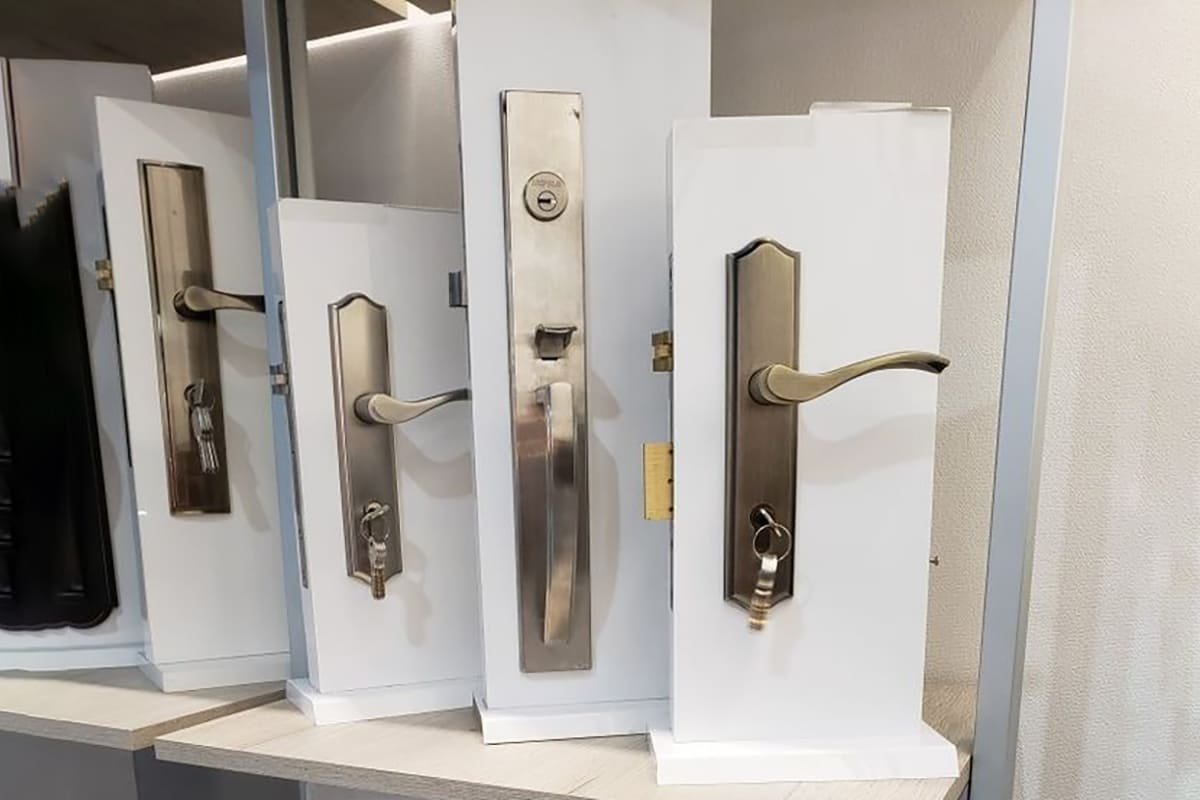
Why through-bolts are often preferred
Through-bolt fixing is different from relying only on small screws on one side of the door. Instead of depending mainly on the holding strength of the door surface, through-bolts connect both sides of the handle set. This creates a more stable clamping force.
In B2B door hardware supply, this matters because project doors are not used gently every time. Commercial buildings, offices, schools, apartment corridors, hotels, and public areas can create repeated lever force.5 Over time, a weak fixing system can become loose even if the handle material itself is acceptable.
Through-bolt fixing versus surface screw fixing
| Fixing method | Main strength | Main limitation | Best used when |
|---|---|---|---|
| Through-bolt fixing | Strong two-side clamping | Requires compatible lock body and hole positions | Repeated-use project doors |
| Surface screw fixing | Simple and common | Depends heavily on door material holding strength | Light to medium-duty applications |
| Concealed rose fixing | Cleaner appearance | Installation access may be tighter | Design-led doors with proper structure |
| Backplate fixing | Larger contact area | Still needs correct screw and spindle matching | Doors needing wider visual coverage |
Lock body compatibility is essential
I do not recommend through-bolts blindly. The lock body must allow the bolts to pass through without interfering with the lock case, latch, follower, springs, or internal mechanism.6 This is why procurement teams should check the lock body drawing together with the handle drawing.
Before confirming a through-bolt solution, I usually check:
- Distance between through-bolt holes
- Position of the follower and spindle hole
- Lock case width and internal clearance
- Door thickness range
- Handle rose or plate hole layout
- Whether the bolts conflict with cylinder or escutcheon positions
If the lock body does not support through-bolts, another fixing method may be necessary. In that case, the supplier should still help optimize screw length, rose design, spindle fit, and door reinforcement.
Why this matters before mass production
For door manufacturers and importers, the cost of changing fixing systems after bulk delivery can be high. New screws, new roses, new lock bodies, or revised door drilling patterns may all affect project timelines.
That is why I prefer sample confirmation that includes the full assembly:
- Handle pair
- Spindle
- Lock body
- Cylinder or thumbturn if required
- Fixing screws
- Cover plate or rose
- Door material sample or drawing
- Drilling template
At SDH Hardware, when a customer asks about handle loosening, I usually start by checking whether through-bolt fixing is possible. It is not the only answer, but it is often the most reliable starting point when the lock body supports it.
How does spindle design affect handle fixing?
A lever handle can look solid on the outside but still feel loose if the spindle connection is weak. This problem is easy to miss in a catalogue because the spindle is a small part. In real use, I see spindle fixing as one of the most important details in handle stability.
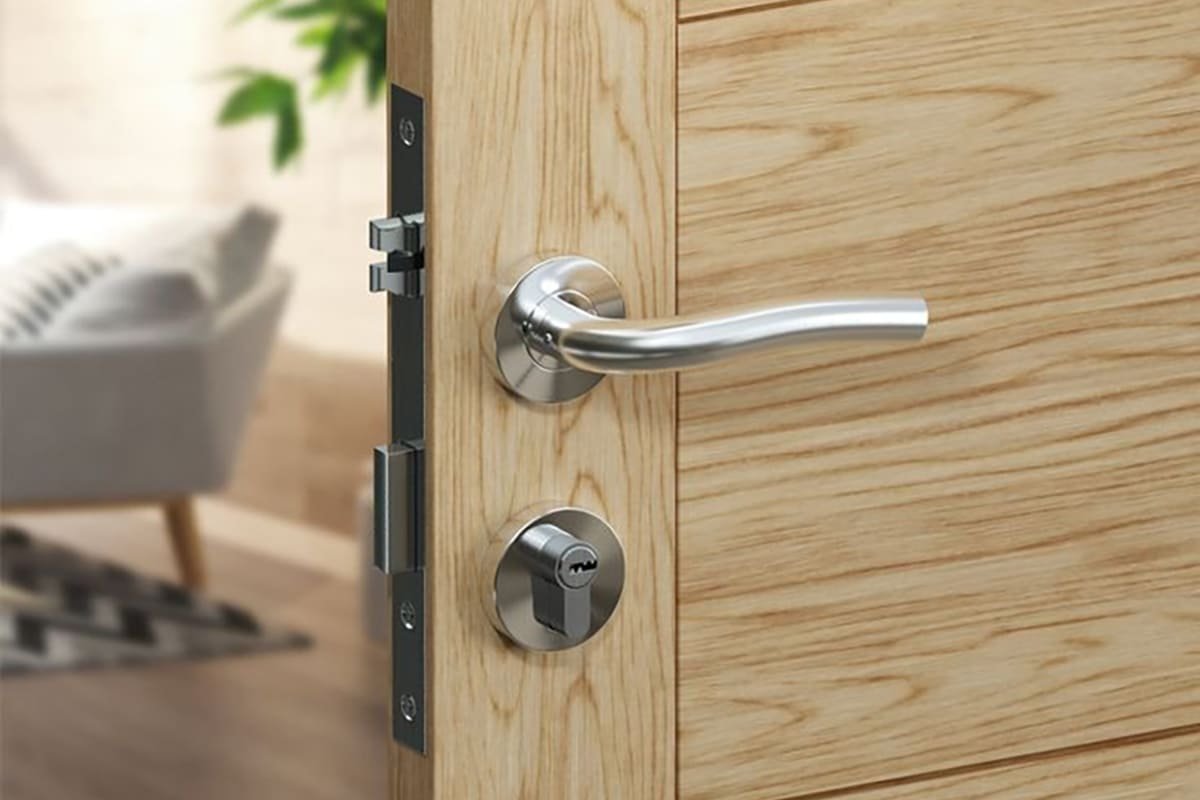
Spindle design affects handle fixing because the lever must grip the spindle securely and transfer force to the lock body without play. For slotted or grooved spindles, the hex socket grub screw should tighten into the groove. For eccentric spindles, the internal hex screw helps lock the handle to the spindle.
Why the spindle is not a small detail
The spindle is the square bar that passes through the lock follower and connects both lever handles. When a user presses the handle, the spindle rotates and operates the latch.7 If the spindle is not correctly engaged, the lever may move before the latch responds. That movement feels like looseness.
In my product matching work, I usually treat spindle configuration as part of the handle fixing system, not as a loose accessory. A correct spindle must match:
- Follower size
- Handle hub size
- Door thickness
- Handle projection
- Grub screw position
- Lock body design
- Regional standard requirements
Slotted or grooved spindle fixing
For slotted or grooved spindles, the grub screw should tighten into the slot or groove. This gives the handle a defined locking point. If the screw only presses against a flat or smooth surface, the grip may be weaker, especially under repeated lever movement.8
A typical check includes:
- Insert the spindle through the lock body.
- Fit both handles in the correct direction.
- Align the grub screw with the spindle groove.
- Tighten the internal hex screw properly.
- Test lever movement several times.
- Check whether the handle returns smoothly without side play.
This detail is simple, but it prevents many complaints. If the installer cannot find the groove, or if the groove does not align with the handle screw, the fixing result may be unstable.
Eccentric spindle fixing
Some handle designs use eccentric spindles or special internal locking arrangements. In these cases, the internal hex screw also plays a key role. It must lock the handle and spindle in the intended position.
The important point is that eccentric spindle systems should be reviewed as a set. The handle, spindle, lock body, and installation direction must be compatible. If one part is changed during procurement, the whole fixing performance may change.
Spindle-related procurement checks
| Check item | Why it matters |
|---|---|
| Spindle cross-section | It must fit the lock follower and handle hub |
| Spindle length | It must suit door thickness and handle design |
| Groove position | It must align with the grub screw |
| Screw type | Internal hex screws need correct size and access |
| Material and finish | It should suit durability and corrosion requirements |
| Lock follower tolerance | Excessive play can create handle movement |
Do not separate spindle quality from handle fixing
I often see buyers focus on handle material, surface finish, or packaging first. These are important, but spindle fixing can determine whether the product feels stable after installation. A heavy handle with poor spindle engagement can still feel loose. A moderate handle with correct spindle locking can perform better in real use.
For B2B buyers, I recommend requesting a complete sample kit instead of only a handle body. The kit should include the spindle and screws intended for bulk supply. This makes the sample test closer to the final installation condition.
How should handle fixing change for timber, aluminium, and steel doors?
Door material is one of the most practical reasons why the same handle can behave differently across projects. I have seen customers test one handle on one door and assume the result applies everywhere. In reality, timber, aluminium, and steel doors provide very different fixing conditions.
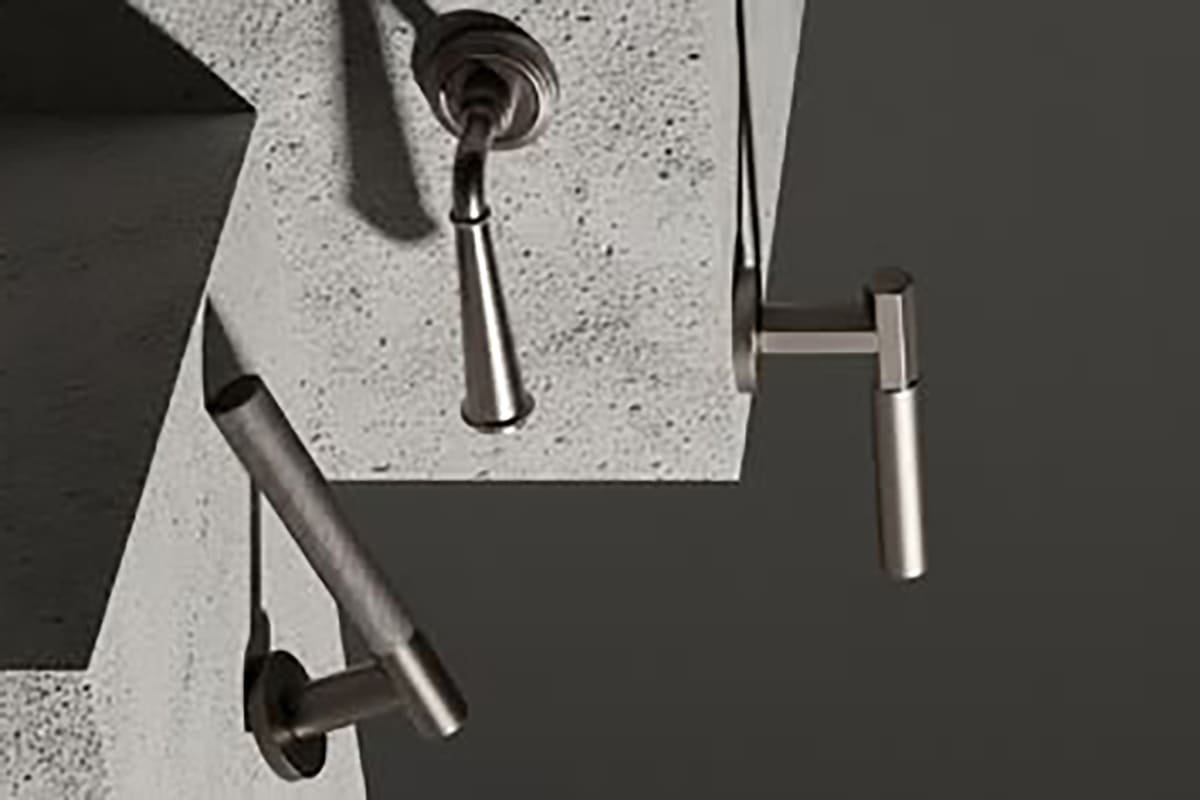
Handle fixing should change according to door material because timber depends on thickness and screw holding strength, aluminium depends on profile structure and internal support, and steel depends on sheet thickness, reinforcement, and screw engagement. The same handle may need different screws, bolts, or support parts on each door type.
Timber doors
Timber doors can provide good screw holding strength when the material is dense, thick, and properly prepared.9 However, not all timber doors are the same. A solid wood door, a laminated core door, and a lightweight hollow core door behave differently.10
For timber doors, I usually check:
- Door thickness
- Core material
- Screw pull-out resistance
- Edge distance around lock cut-out
- Accuracy of drilling
- Whether repeated tightening may damage the material
Through-bolt fixing can reduce dependence on wood screw holding strength because the handle set clamps through the door. If through-bolts are not possible, screw length and pilot hole preparation become more important.
Aluminium doors
Aluminium doors are often built with profiles, chambers, and internal reinforcement. The visible surface may not tell the full story.11 A screw may enter a thin wall, a hollow chamber, or a reinforced section. Each condition gives a different fixing result.
For aluminium doors, I usually ask for profile drawings. This helps confirm whether the handle screws can engage a strong section. If the screw only bites into a thin profile wall, loosening risk increases. Inserts, reinforcement plates, rivet nuts, or through-bolts may be considered depending on the door design.
A simplified comparison looks like this:
| Aluminium structure | Fixing concern | Possible procurement response |
|---|---|---|
| Thin hollow profile | Limited screw bite | Add support, insert, or through-bolt if compatible |
| Reinforced profile | Better fixing base | Confirm screw length and hole position |
| Thermal break profile | Complex internal structure | Check drilling path carefully |
| Narrow stile door | Limited space | Match compact lock body and handle layout |
Steel doors
Steel doors depend on sheet thickness, inner reinforcement, and screw engagement. Thin sheet alone may not hold screws well under repeated lever operation.12 A reinforced steel door can perform much better if the fixing points are designed properly.
For steel doors, I usually check whether there is reinforcement around the lock and handle area. If the fixing point is only thin sheet metal, the handle may loosen over time. If the door includes internal plates, welded support, or compatible threaded inserts, the fixing condition improves.
Steel plugs and steel end parts
Some handle structures may use steel plugs or steel end parts. In relevant applications, steel heads or plugs are often preferred because they can offer:
- Better corrosion resistance when selected with suitable material and finish
- Better suitability for certain fire-performance requirements
- Easier welding in some product designs
- Good mechanical strength for repeated use
I avoid saying steel is always better than brass or copper. The correct choice depends on product design, finish requirement, fire-rating expectation, corrosion environment, and cost target. Buyers should verify certification documents and project requirements before making a final decision.
Material-based specification is better than one universal answer
For procurement, the safest approach is not to ask, “Is this handle good?” The better question is:
“Is this handle fixing method suitable for this timber, aluminium, or steel door structure?”
That question leads to better sample testing and fewer surprises during installation.
How should screw position and appearance be evaluated in handle fixing?
Screw position affects both installation and appearance. I often see this point discussed late, after the buyer has already chosen a handle design. That can create problems because a screw that looks clean in a drawing may be difficult to install on a real door.
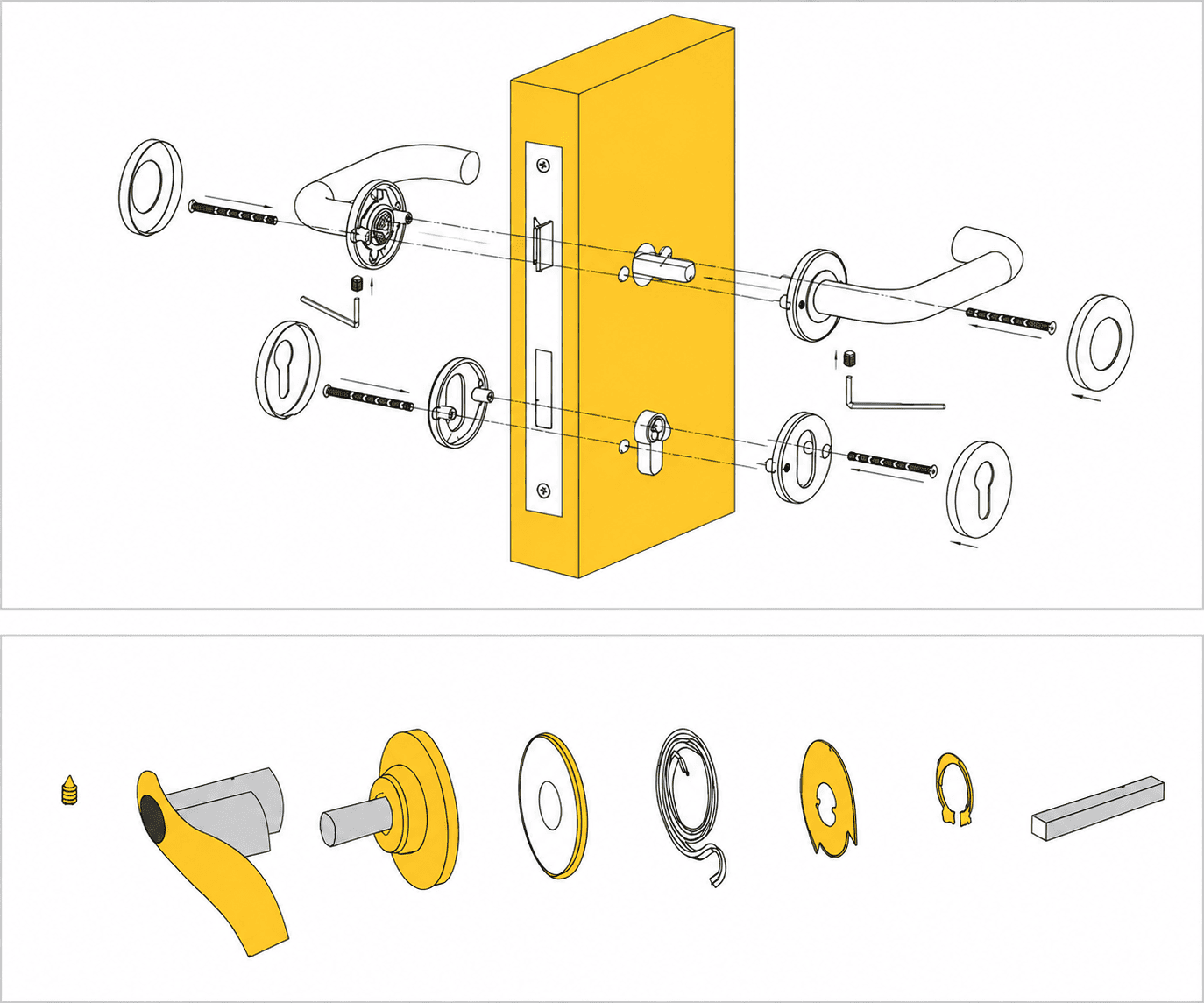
Screw position should be evaluated as both a design and installation factor in handle fixing. Front-facing screws are easier to see and may look less attractive. Inside screws can be harder to access. Left-side screw positioning is often practical, but the best choice depends on door handing, market preference, and handle design.
Visible screws versus concealed fixing
Front-facing screws are easy to understand and simple to inspect. However, they may reduce the visual quality of the handle, especially for architectural projects where clean appearance matters. Concealed fixing can look better, but it may require more precise installation and better access.
For hardware brands, this choice affects market positioning. A wholesaler supplying cost-sensitive projects may accept visible screws. A brand selling to hotel or premium apartment projects may prefer concealed roses or cleaner screw positions.
Inside screw positions
Screws placed on the inside can improve appearance from the public-facing side. However, they may be more difficult to install depending on door location, frame clearance, and handle shape. If installers cannot access the screw comfortably, they may not tighten it correctly.
This is why I prefer to confirm installation access during sample testing. A product can be structurally correct but still inconvenient in field installation.
Left-side and right-side screw positioning
In many handle configurations, left-side screw positioning is commonly preferred because it is generally practical and widely used. It can give installers better access in many common door situations. However, I do not treat this as a universal rule.
Right-side screw positioning may be acceptable or even preferred in some markets or door designs. Door handing, regional habits, lock orientation, and handle style can all influence the best position.
A practical evaluation table may help:
| Screw position | Advantage | Possible concern |
|---|---|---|
| Front-facing | Easy to see and tighten | Less attractive appearance |
| Inside-facing | Cleaner outside look | Harder access during installation |
| Left-side | Often practical and common | Not universal for all door designs |
| Right-side | May suit specific handing or design | May be less convenient in some cases |
| Concealed under cover | Clean appearance | Requires accurate fitting and access |
What I confirm before production
Before confirming a handle order, I like to check:
- Which side of the door is public-facing
- Whether the screw is visible after installation
- Whether the installer can access the screw
- Whether the screw conflicts with the frame or stop
- Whether the market accepts visible fixing
- Whether drawings show the exact screw position
- Whether the final package includes the correct screw type
This is a small detail, but it can affect customer satisfaction. A handle may be strong, but if the fixing screw is hard to reach, the installation team may not achieve the intended clamping force.
Appearance should not weaken structure
I understand why buyers want clean designs. I also support concealed and neat handle structures when they are properly engineered. Still, appearance should not remove necessary fixing strength. If a design hides all screws but leaves weak clamping, the project may face complaints later.
The best result is a balance: clean appearance, realistic installation, compatible lock body, and stable handle fixing.
Frequently Asked Questions
Is through-bolt fixing always required for lever handles?
Through-bolt fixing is not always required, but I prefer it when the handle set and lock body support it. It gives stronger two-side clamping and reduces dependence on surface screw holding strength. However, the lock body must have compatible holes and internal clearance.
Can handle loosening be caused by the lock body?
Yes. The lock body can affect handle fixing if it does not support through-bolts, if the follower has excessive play, or if internal parts conflict with screw positions. I always recommend checking the handle and lock body drawings together before bulk order confirmation.
Why does a handle loosen on aluminium doors but not timber doors?
Aluminium profiles may have hollow chambers or thin walls that give less screw engagement than solid timber. If the fixing point does not align with reinforcement, the handle may loosen. Profile drawings, inserts, reinforcement, or through-bolts can help improve the fixing structure.
What should buyers check in a handle sample?
Buyers should check the handle pair, spindle, grub screws, fixing screws, lock body compatibility, door thickness range, cover plate fit, and installation access. I suggest testing the full assembly instead of judging the handle body alone.
Are steel plugs better than brass or copper plugs?
Steel plugs can be a good durability choice in suitable designs because they may offer corrosion resistance, fire-performance suitability, and easier welding. However, they are not automatically better for every product. Buyers should confirm material, finish, certification documents, and project requirements.
Conclusion
Handle fixing for timber, aluminium, and steel doors should be specified as a complete system, not treated as a last-minute screw issue. I recommend checking through-bolt compatibility, spindle engagement, screw position, lock body design, door structure, and sample installation before bulk ordering. At SDH Hardware, we support door factories, hardware brands, and wholesalers with factory-direct handle matching, OEM/ODM options, drawings, samples, and inspection service. If you want to reduce handle loosening complaints, send us your door material, lock body drawing, and handle requirement for a practical configuration review.
"SECTION 087111 - DOOR HARDWARE (SCHEDULED BY ...", https://fpm.usc.edu/wp-content/uploads/2021/11/087101-USC-UPC-door-hardware-Guide-Specification_1.pdf. A door-hardware standard or institutional installation guide describing through-bolted trim supports the mechanical point that bolts passing through the door clamp the two sides of the lever set together; this is contextual support rather than a direct test of the specific handle assembly discussed here. Evidence role: mechanism; source type: institution. Supports: The source should explain that through-bolts connect or clamp trim on opposite sides of a door, reducing reliance on shallow surface screw holding.. Scope note: Contextual support; the source may not compare this exact product against short surface screws. ↩
"Door handle", https://en.wikipedia.org/wiki/Door_handle. A general reference on door-handle components identifies the spindle, rose or escutcheon, handle body, and latch or lock mechanism as related parts of the operating assembly, supporting the article’s component-level explanation; it does not verify the suitability of any specific fixing layout. Evidence role: definition; source type: encyclopedia. Supports: The source should define the main components of a door handle or lever lock assembly and describe how the spindle and lock/latch mechanism interact.. Scope note: Definition-level support only; it does not assess the article’s particular procurement recommendations. ↩
"087100 – DOOR HARDWARE - Facilities and Campus Services", https://fcs.cornell.edu/087100-door-hardware. BHMA/ANSI door-hardware durability requirements use repeated-cycle testing for locks and lever hardware, supporting the article’s premise that lever assemblies must withstand many recurring operating forces; the standard supports repeated-use exposure, not the exact number of daily operations for every building. Evidence role: statistic; source type: institution. Supports: The source should document that lever locks and door hardware are evaluated through repeated-cycle testing, often in large numbers of operating cycles.. Scope note: Cycle-test standards demonstrate durability expectations but do not prove that every project door is used thousands of times per day. ↩
"Screw Connections Subject to Tension Pull-out and Shear ...", https://scholarsmine.mst.edu/cgi/viewcontent.cgi?article=1271&context=isccss. Engineering studies of screw and sheet-metal joints show that fastener pull-out or pull-through resistance is strongly affected by panel thickness and local support, supporting the claim that a thin door skin gives less reliable surface-screw holding; the evidence is based on fastening mechanics and may not test door handles specifically. Evidence role: mechanism; source type: paper. Supports: The source should show that fastener holding strength is influenced by substrate thickness and local bearing or pull-out resistance.. Scope note: Mechanistic support from fastener research; not necessarily a direct door-handle test. ↩
"ANSI Hardware Grades Explained", https://www.cdfdistributors.com/blog/post/ansi-hardware-grades?srsltid=AYCX9vLxKdjH5s0t6SHdEkN0PzLnFXyjFakTyN_dF2lNRwHzaJ4ED0UT. BHMA/ANSI hardware grading and durability criteria distinguish heavier-duty commercial applications through repeated-cycle performance requirements, supporting the article’s statement that public and commercial doors impose recurring operating loads; the standard does not measure traffic in each named building type. Evidence role: expert_consensus; source type: institution. Supports: The source should show that commercial door hardware is classified or tested for durability under repeated-use conditions, with higher grades for heavier duty use.. Scope note: Supports the general commercial-duty context, not the exact use intensity of every listed facility. ↩
"How to Install a Mortice Lock - Tutorial Video by Tradco",
. Institutional lock-body templates and installation specifications identify fixed locations for spindle holes, through-fixing holes, cylinders, and latch components, supporting the need to verify bolt clearance through the lock case; this supports the design principle rather than documenting this article’s exact lock body. Evidence role: mechanism; source type: institution. Supports: The source should show that lock cases and lever trims use specified hole positions and clearances so fasteners do not interfere with the follower, latch, or case mechanism.. Scope note: Contextual design support; compatibility must still be checked against the actual lock drawing. ↩"Door handle", https://en.wikipedia.org/wiki/Door_handle. General references on door handles describe the spindle as the square bar connecting the handles and transmitting rotation to the latch or lock follower, supporting the article’s explanation of spindle function. Evidence role: definition; source type: encyclopedia. Supports: The source should define a spindle as the bar connecting door handles and explain that rotation of the handle and spindle operates the latch mechanism.. ↩
"Can somebody explain how set screws work? : r/Machinists", https://www.reddit.com/r/Machinists/comments/1clitx8/can_somebody_explain_how_set_screws_work/. Mechanical design references on set-screw joints explain that holding capacity depends on seating geometry and resistance to slip on the shaft, supporting the article’s caution that a screw bearing only on a smooth surface may be less secure under repeated movement; the reference addresses general shaft retention rather than door-handle spindles specifically. Evidence role: mechanism; source type: education. Supports: The source should explain that set screw retention depends on contact geometry, seating, and resistance to slipping on the shaft.. Scope note: General mechanical-design support; it does not test this particular spindle and grub-screw combination. ↩
"Wood Handbook, Chapter 08: Fastenings", https://research.fs.usda.gov/download/treesearch/37424.pdf. The USDA Forest Products Laboratory’s Wood Handbook explains that wood-screw withdrawal resistance is influenced by wood density, screw penetration, and installation conditions, supporting the article’s statement that dense and properly prepared timber can provide stronger screw holding. Evidence role: mechanism; source type: government. Supports: The source should state that withdrawal resistance or holding strength of wood screws varies with wood density, screw dimensions, penetration, and preparation such as pilot holes.. ↩
"4 Wood Door Core Types", https://beaconcdl.com/blogs/news/4-wood-door-core-types?srsltid=AYCX9vIoRlqxQS10bx-09gxrV8rXAGLBXpekr-Cq451Mns_8c4I2ZLbR. Architectural wood-door technical references distinguish solid, engineered, and hollow-core constructions and associate core type with differences in weight, strength, and performance, supporting the article’s point that timber doors do not all behave the same; the reference may not address lever-handle loosening directly. Evidence role: general_support; source type: institution. Supports: The source should describe common wood door core types and indicate that core construction affects strength, weight, and performance.. Scope note: Contextual support for door construction differences, not direct proof of handle performance on each core type. ↩
"SECTION 081113 - HOLLOW METAL DOORS AND FRAMES", https://cpm.umn.edu/sites/cpm.umn.edu/files/2021-12/division8_00_00.pdf. Technical references for architectural aluminium door systems describe extruded profiles with internal chambers, thermal-break elements, and optional reinforcement, supporting the article’s statement that the visible face of an aluminium door may not reveal the underlying fixing structure. Evidence role: general_support; source type: institution. Supports: The source should describe aluminium door systems as using extruded profiles, chambers, thermal breaks, or reinforcement members.. Scope note: Contextual construction support; actual profile strength must be verified from the project-specific extrusion drawing. ↩
"REQUIREMENTS FOR THREADED FASTENING SYSTEMS IN ... - S3VI", https://s3vi.ndc.nasa.gov/ssri-kb/static/resources/nasa-std-5020.pdf. Research on screw joints in thin sheet metal shows that fastener retention and pull-out resistance depend on sheet thickness, thread engagement, and local support, supporting the article’s caution that thin steel sheet alone may be inadequate for repeated lever loading; the evidence is mechanical rather than a direct field study of steel doors. Evidence role: mechanism; source type: paper. Supports: The source should show that screw retention in sheet metal depends on sheet thickness, thread engagement, local reinforcement, and loading conditions.. Scope note: Mechanistic support from sheet-metal fastening research, not direct testing of the article’s door assemblies. ↩
