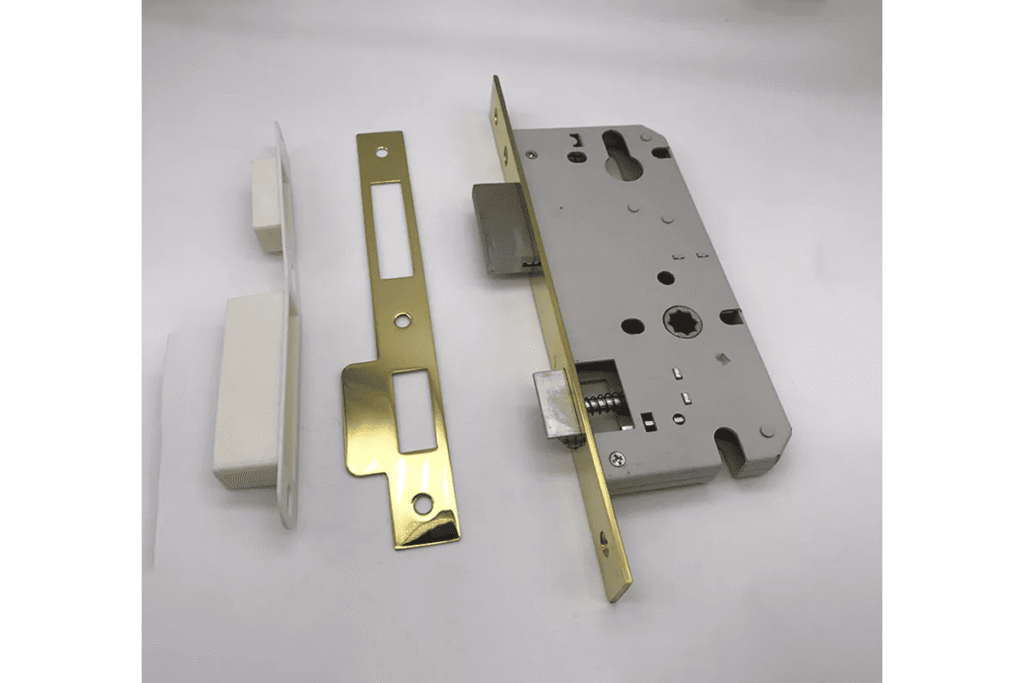
How do I choose the correct mortise lock backset and other DIN dimensions?
Are you struggling to select the right mortise lock for your doors? Many buyers overlook critical dimensions beyond just backset. This mistake can cause costly delays and rework on door machining.
To choose the correct DIN mortise lock, you must confirm the full dimensional system, not just the backset. This includes the 72 mm center distance, backset, lock case width, lock case length, lock case thickness, forend size, door material, and handle/cylinder compatibility, all referencing DIN 182511.
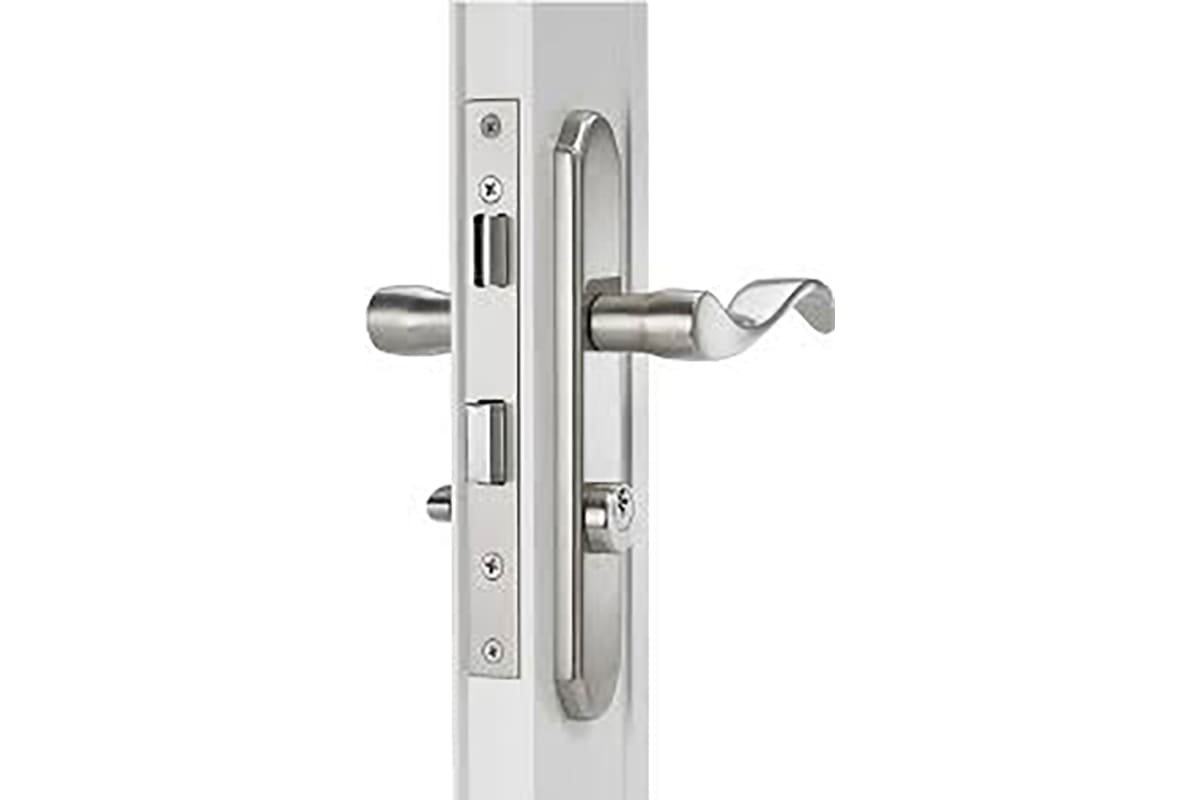
Selecting the right mortise lock involves more than picking a style. As a manufacturer, I often see door factories make quick choices that lead to big problems. This guide helps you understand the key dimensions for DIN mortise locks, so you can avoid common pitfalls and ensure perfect fit for your projects.
What are the key DIN mortise lock dimensions like center distance and backset?
Do you get confused about "backset" versus "center distance" when looking at mortise locks? This common mix-up can lead to ordering the wrong locks.
The center distance is 72 mm for standard DIN mortise locks.2 We measure this from the center of the handle follower (where the lever handle spindle goes) to the center of the cylinder hole3 (where the lock cylinder goes). The backset is measured from the lock's faceplate (the forend) to the center of the handle follower.4
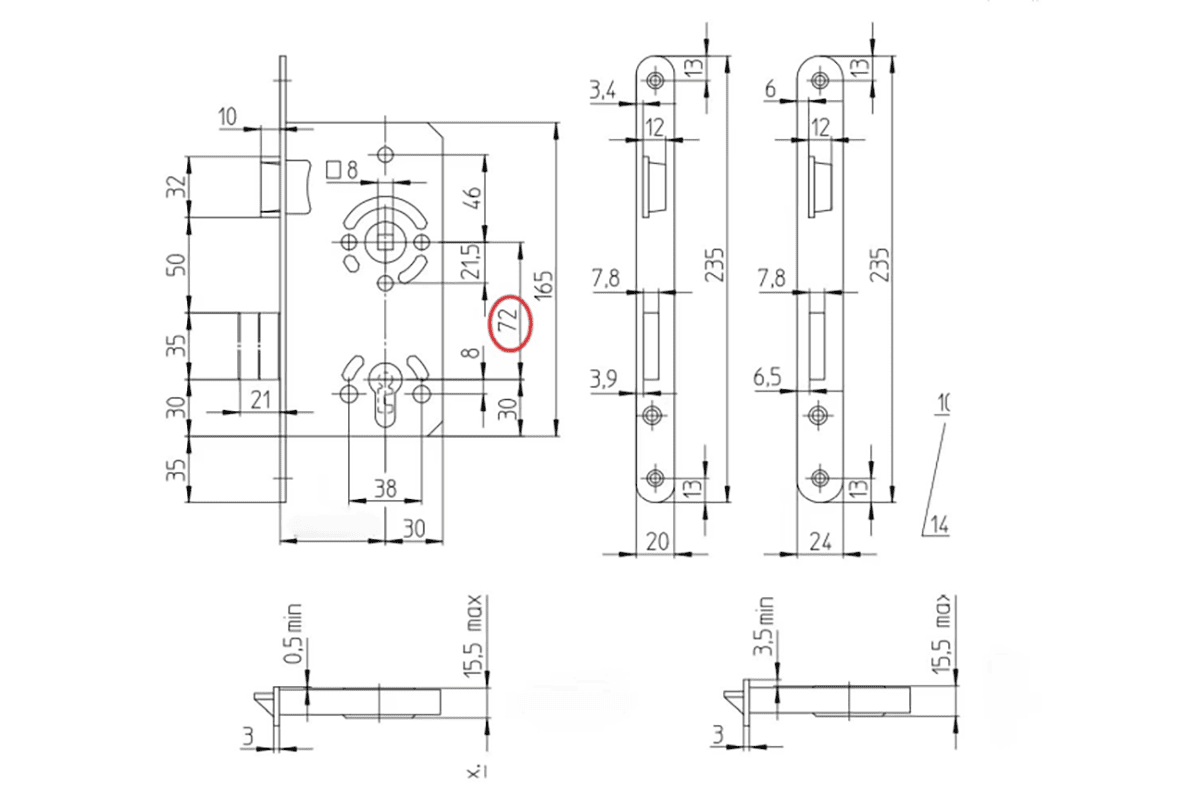
I have worked with many product managers. They often ask me about backset, but sometimes forget about the center distance. It is crucial to understand both. For DIN 18251 locks, the center distance is almost always 72 mm. This 72 mm is a fixed value.5 It means the distance between the handle's pivot point and the keyhole's center point is always the same. This ensures standard handles and cylinders fit correctly. The backset, on the other hand, is variable. It decides how deep the lock body sits inside the door. When I talk with engineers, I explain that if the backset is too small, the handle might hit the door frame. If it is too large, the handle might stick out too far. This affects both the look and how the door works. My team always confirms these two measurements first with our clients. We do this to prevent any issues with door machining later. If these two numbers are wrong, the door's pre-drilled holes will not match the lock. This means wasted time and materials for our customers. We make sure buyers know these basic rules. They help in getting the right lock for their door designs.
How does backset relate to the lock case width?
Are you wondering how your chosen backset affects the overall lock size? A common mistake is only considering the backset without thinking about the lock body's width.
The lock case width is directly related to the backset.6 You can figure it out by adding 29 mm to your backset.7 Common backsets for DIN locks include 40 mm, 45 mm, 50 mm, and 55 mm.8 These usually increase in 5 mm steps, with 55 mm being a very common choice.
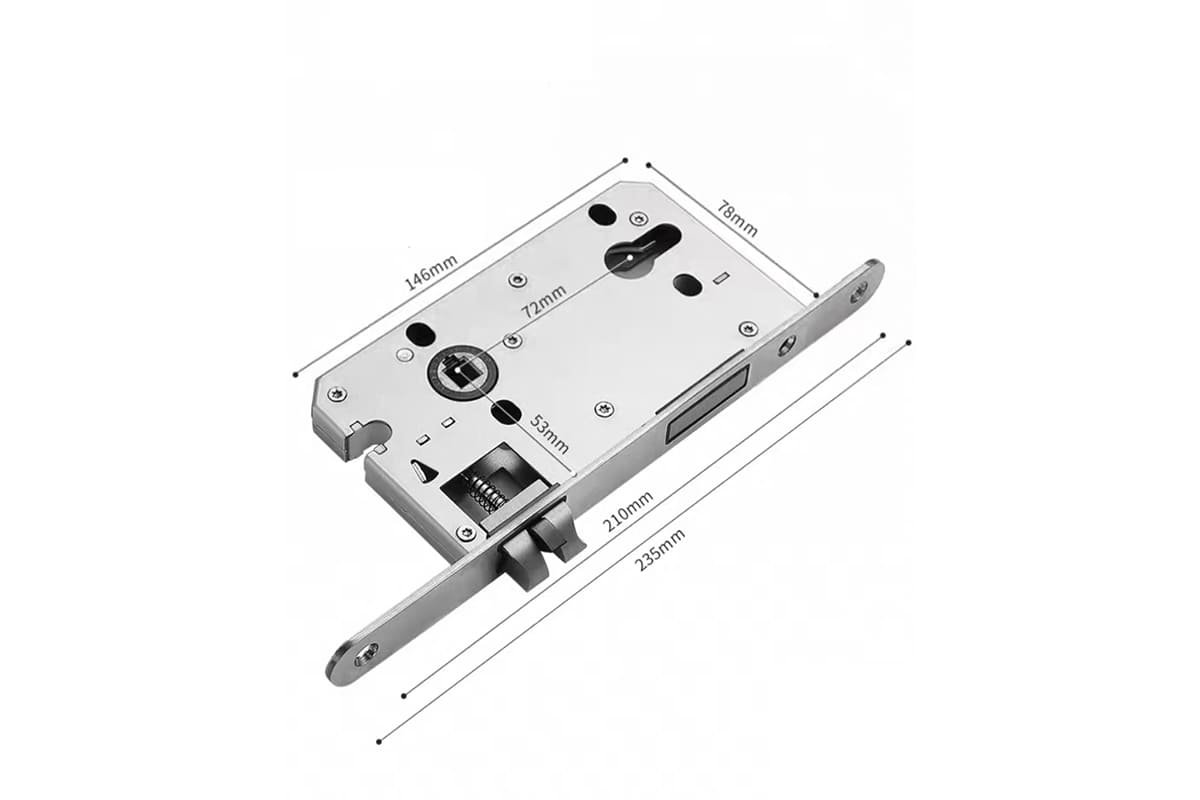
I often guide our buyers through this. The backset dimension determines how far the handle and cylinder are from the edge of the door. This measurement directly influences the total width of the lock case. For most DIN locks, the case width is approximately backset plus 29 mm. For example, if you choose a 50 mm backset, the lock case width will be around 79 mm. This extra 29 mm accounts for the internal mechanism on the side opposite the backset measurement. This is a standard rule I always share with door manufacturers. It helps them prepare the correct cavity within the door panel. If this width is wrong, the lock case will either not fit or will be loose inside the door. A loose lock can cause rattling and poor performance. A lock that is too wide will crack the door. I have seen buyers pick a backset that fits their handle, but then they forget to check if the lock case itself will fit the door's thickness. This is especially true for thinner doors or doors with special internal structures. A 55 mm backset is popular. It gives good clearance for many types of handles. It also works well with many door designs. We always provide detailed drawings. These drawings show all dimensions. This helps our customers avoid mistakes.
| Backset (mm) | Case Width (approx. mm) |
|---|---|
| 40 | 69 |
| 45 | 74 |
| 50 | 79 |
| 55 | 84 |
What are the standard dimensions for lock case length, thickness, and forend?
Are you unsure about the precise measurements for the mortise lock's body and faceplate? Overlooking these dimensions can lead to major installation problems.
Standard DIN mortise locks usually have a case length of 165 mm and a case thickness of 15 mm.9 The forend, which is the visible faceplate on the door edge, typically comes in widths of 20 mm, 22 mm, or 24 mm.10 Its length is usually 235 mm.11 These dimensions ensure proper fit and strength.
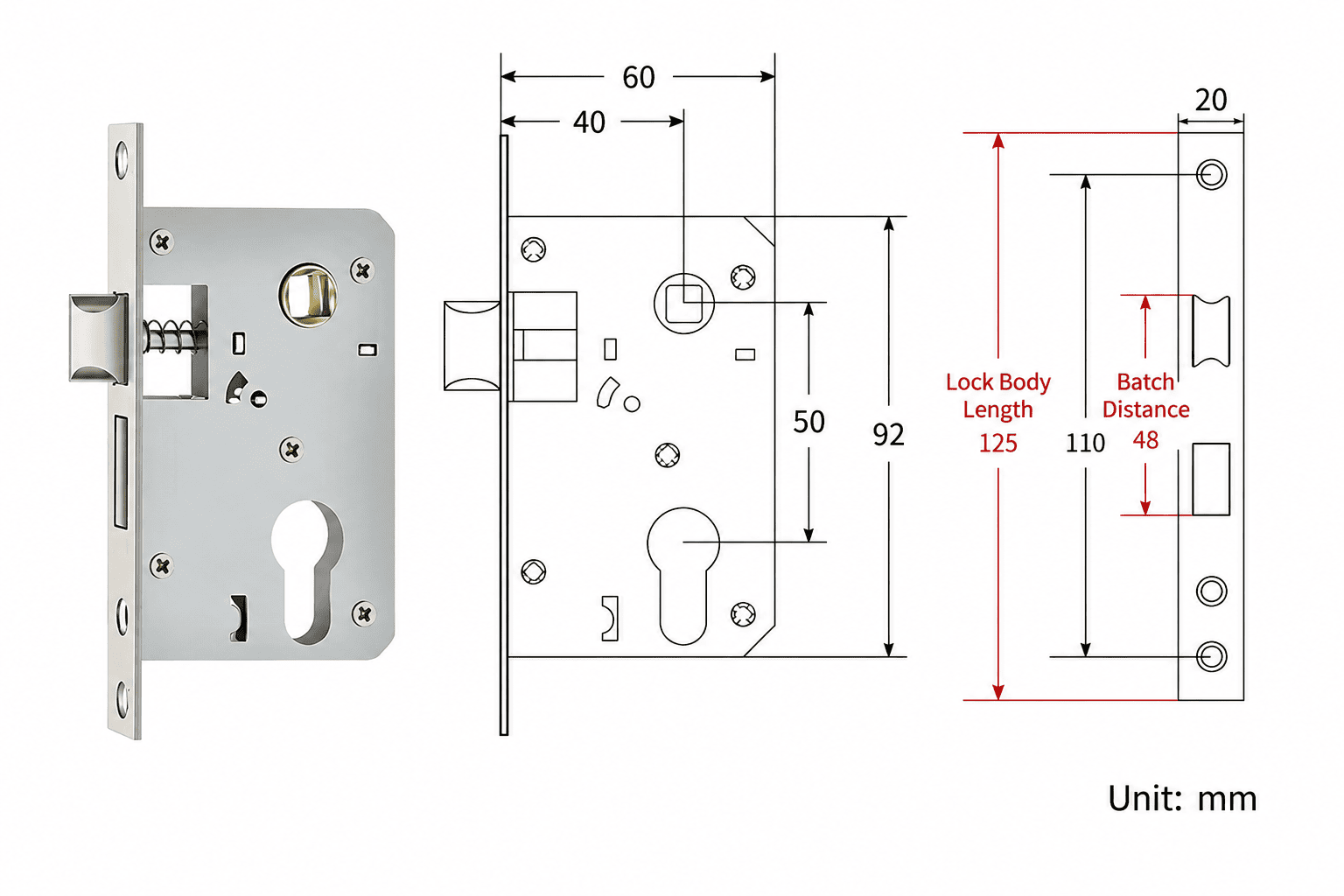
When I review specifications with our clients, I stress the importance of these fixed dimensions. The lock case length of 165 mm and thickness of 15 mm are standard for most DIN 18251 locks. These numbers are critical for door preparation. They define the size of the mortise pocket the door factory must route into the door. If the length is off, the lock will not sit flush or will be too short. If the thickness is off, the lock might be too tight or too loose, affecting its function and durability. The forend dimensions also matter greatly. A 235 mm forend length is common. The forend width, however, has options: 20 mm, 22 mm, or 24 mm. Choosing the right forend width depends on the door's overall thickness and its construction. For example, a thicker door might look better with a 24 mm forend. A thinner door might need a 20 mm forend. The forend must sit perfectly flush with the door edge. This ensures a clean look and smooth operation. Any mismatch here can lead to gaps or protrusions. These issues compromise both the door's appearance and its security. I always advise our buyers to check these dimensions against their door manufacturing plans carefully. This prevents costly adjustments or rejections after production.
Why do we use round-end or square-end forends for mortise locks?
Do you ever wonder why some lock faceplates are rounded and others are square? This choice is more than just about looks; it affects how doors are made.
The shape of the forend depends on the door material and manufacturing process. Wooden doors often use round-end forends because they are easier to rout with milling tools.12 Steel doors commonly use square-end forends. This is because steel door cutouts are typically punched or laser-cut, which easily creates sharp corners.
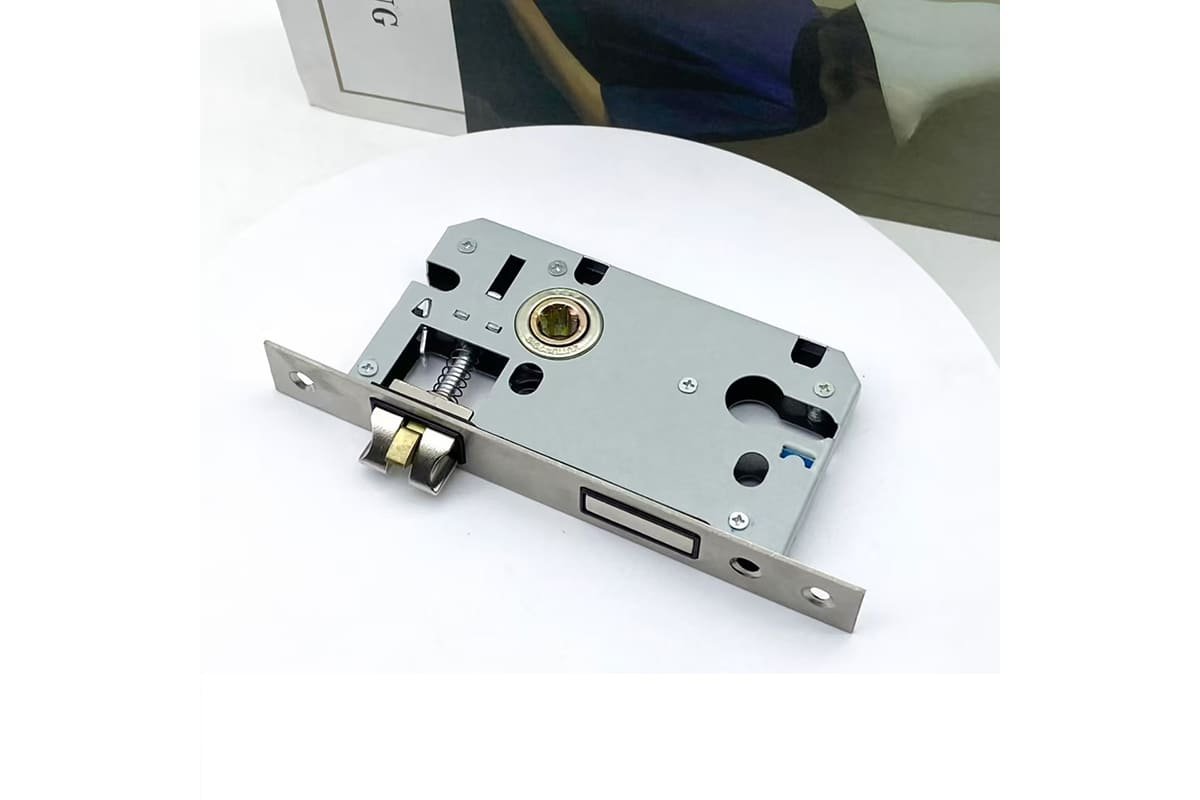
I have seen countless door factories grappling with this choice. The distinction between round-end and square-end forends is very practical. For wooden doors, manufacturers typically use a router to create the mortise pocket and the recess for the forend. A router bit naturally creates rounded corners. So, a round-end forend fits perfectly into this type of cutout without any extra hand chiseling. This speeds up production and reduces labor costs. When I talk to our customers who make wooden doors, I always recommend round-end forends for this reason. On the other hand, steel doors are manufactured differently. The cutouts for the lock case and forend are usually made by stamping, laser cutting, or punching. These methods easily create precise, sharp, square corners. Therefore, square-end forends are the natural choice for steel doors. They fit snugly into these sharp-cornered cutouts. My experience shows that trying to fit a square-end forend into a routed wooden door requires extra work to square off the corners, which is time-consuming and can lead to less precise results. Conversely, putting a round-end forend on a steel door with square cutouts leaves small gaps, which can look unfinished. We make sure our clients understand this simple rule. It helps them choose the correct forend style for their specific door type. This avoids unnecessary steps and ensures a perfect, professional finish for their door products.
Why is confirming all DIN dimensions crucial for mortise lock selection?
Are you focusing only on backset when specifying DIN mortise locks? This narrow view can lead to significant problems down the production line.
Confirming all DIN dimensions is crucial because every measurement impacts fit, function, and aesthetics. Overlooking one aspect, like case thickness or forend width, can result in misaligned hardware, machining errors, or doors that do not meet quality standards.
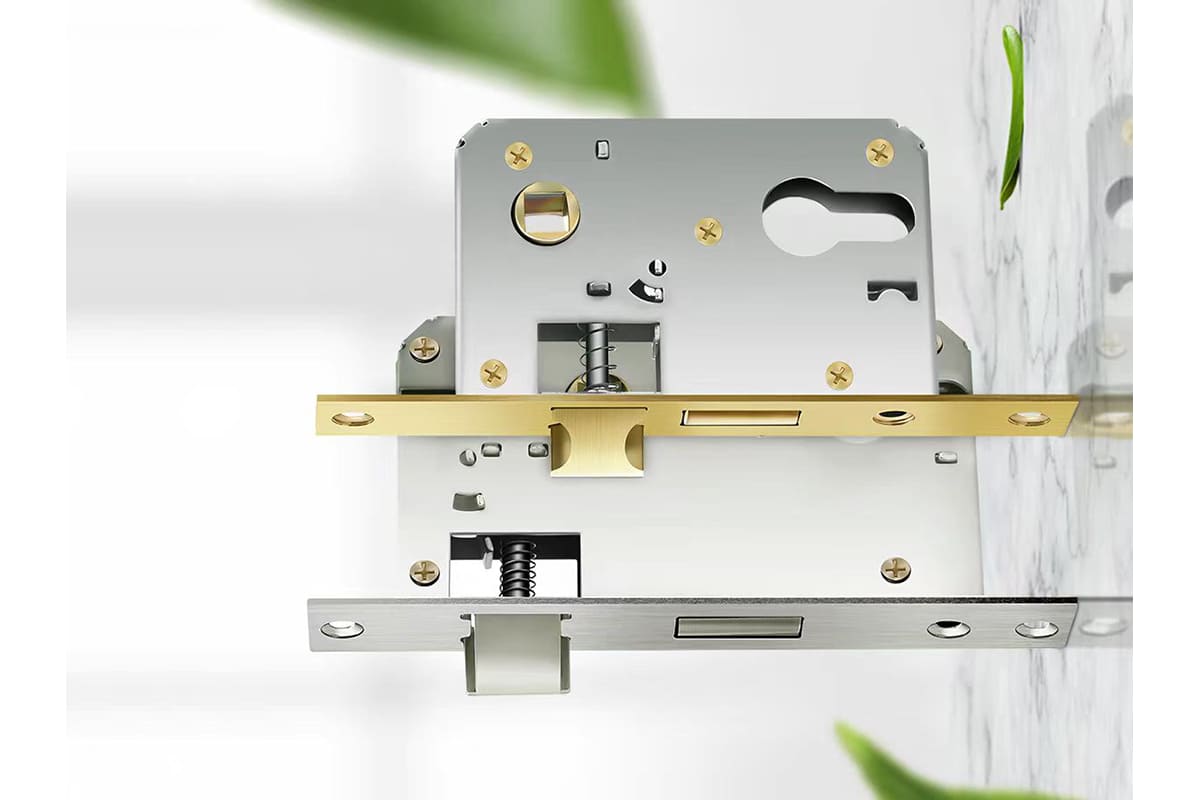
In my role, I have repeatedly seen how crucial it is to confirm every single DIN dimension. Many buyers, especially those new to DIN standards, often fixate on the backset. They think this is the only variable they need to consider. However, my experience tells me this is a dangerous assumption. For example, a customer might correctly choose a 55 mm backset and 72 mm center distance. But if they forget to specify the correct forend width (e.g., 20 mm vs. 24 mm), the lock might not sit flush with the door edge. This creates an unsightly gap or an unwanted protrusion. Another common issue is overlooking the lock case thickness of 15 mm or length of 165 mm. If the door's mortise pocket is not machined to these exact specifications, the lock will either be too tight to install or too loose, causing rattling. This can even compromise the door's structural integrity over time. We work hard to ensure our customers understand that DIN 18251 outlines a complete system of interconnected dimensions. These dimensions guarantee universal compatibility across DIN-standardized hardware. Ignoring any part of this system is like trying to build a puzzle with missing pieces. It simply will not work right. I always advise my clients to review the full technical drawing we provide. We make sure they confirm each dimension against their specific door design. This complete approach helps avoid costly mistakes, ensures smooth assembly, and delivers a high-quality finished product.
Conclusion
Choosing a DIN mortise lock means confirming the full dimensional system, not just backset. My experience shows that matching center distance, backset, case size, and forend ensures proper fit and function for your doors.
"DIN standards", https://www.sullus.com/glossary/din-standards/. DIN 18251 is a German standards series for mortise locks and related door-lock requirements, providing the normative context for specifying DIN-type lock dimensions. Evidence role: definition; source type: institution. Supports: DIN 18251 defines requirements and dimensional references for mortise locks used in doors.. Scope note: A standards listing or abstract may confirm the scope of DIN 18251 but may not reproduce all dimensional tables without access to the full standard. ↩
"How to measure and choose the right mortise lock size - BlueID", https://www.blue-id.com/en/blog/mortise-lock-mass. Technical descriptions of DIN mortise locks identify 72 mm as the standard center distance between the handle follower and the profile-cylinder opening. Evidence role: general_support; source type: institution. Supports: A DIN-type mortise lock commonly uses a 72 mm distance between the lever spindle center and profile cylinder center.. Scope note: Support may describe common DIN practice rather than proving that every DIN 18251 lock variant uses this dimension. ↩
"[PDF] CAM Mechanisms", https://rbb.union.edu/courses/mer312/content/data/Lectures/MER312%20L21%20CAM%20Introduction.pdf. Lock-dimension references define the center distance as the measurement between the handle spindle or follower axis and the center of the cylinder or keyhole opening. Evidence role: definition; source type: education. Supports: Center distance in a mortise lock refers to the distance between the handle spindle/follower center and the cylinder or keyhole center.. Scope note: The source should support the measurement convention; it may not specifically address every DIN 18251 product variant. ↩
"Door Knobs & Backset Explained: Sizes & Measuring", https://www.suffolklatchcompany.com/blogs/news/door-knobs-and-backset-explained?srsltid=AfmBOoqUZHgmNne7uo7tUMjQmQveUlyYXjYgC6eapqC2_pqtYjFtExDA. Door-hardware terminology defines backset as the distance from the lock faceplate or door edge to the centerline of the lock’s operating axis, such as the spindle or follower. Evidence role: definition; source type: education. Supports: Backset is the distance from the faceplate or door edge reference to the centerline of the spindle/follower or key operating point.. Scope note: Some sources define backset from the door edge rather than the lock faceplate; the cited source should be checked for the mortise-lock-specific wording. ↩
"Object/fire doors", https://www.ces.eu/en_us/mechanical-locking-systems/products/mortise-locks/fire-doors.html. DIN-type mortise-lock specifications commonly list a 72 mm handle-to-cylinder center distance, indicating that this value functions as a standard reference dimension for compatible hardware. Evidence role: general_support; source type: institution. Supports: DIN-style mortise locks commonly standardize the handle-to-cylinder center distance at 72 mm.. Scope note: The source may show 72 mm as the common DIN profile-cylinder distance rather than as an absolute value for all possible DIN lock classes. ↩
"How to measure and choose the right mortise lock size - BlueID", https://www.blue-id.com/en/blog/mortise-lock-mass. Dimensional drawings for DIN-type mortise locks show backset as a reference dimension within the lock case, so the total case width varies with the selected backset and the mechanism space behind it. Evidence role: mechanism; source type: institution. Supports: Mortise-lock dimensional drawings show that the case width changes with the backset because the backset locates the follower within the lock body.. Scope note: This supports the dimensional relationship generally; exact offsets may vary by lock design and standard class. ↩
"How to measure and choose the right mortise lock size", https://www.blue-id.com/en/blog/mortise-lock-mass. Published DIN-type mortise-lock dimension tables show common case-width values that are approximately 29 mm greater than the selected backset, supporting the article’s sizing rule as a practical approximation. Evidence role: general_support; source type: institution. Supports: DIN-type mortise-lock dimension tables or drawings use case widths that are approximately 29 mm greater than the corresponding backset for common sizes.. Scope note: The rule should be cited as approximate because manufacturers and lock functions may use different case geometries. ↩
"Monolock 55/92 Single Point Mortise Lock (SPL) - Stainless Steel", https://www.allaboutdoors.com/Monolock-55-92-Single-Point-Mortise-Lock-SPL-Stainless-Steel?srsltid=AfmBOoojpp_HGajK4sj-DjnTsNnvMMYmxsXiBY2-se2F_MjU12wieDqR. DIN-type mortise-lock specification tables commonly list backset options including 40, 45, 50, and 55 mm, supporting these values as standard ordering dimensions. Evidence role: general_support; source type: institution. Supports: DIN-type mortise locks are commonly specified with backsets such as 40, 45, 50, and 55 mm.. Scope note: The cited source may not show that these are the only available backsets, only that they are common standard options. ↩
"[PDF] Mortise Lockcase - Assa Abloy", https://www.assaabloy.com/in/en/content-fragments/products/mortise-lockcases/mortise-lock-case-l100-series/mortise-lockcase-sash-lock/assets/documents/mortise-lockcase.pdf. Technical dimension references for DIN-style mortise locks commonly identify a 165 mm lock-case length and a 15 mm case thickness, supporting these as standard machining reference dimensions. Evidence role: general_support; source type: institution. Supports: DIN-style mortise-lock dimension references commonly specify case lengths around 165 mm and case thicknesses around 15 mm.. Scope note: The support is dimensional and may apply to the common lock type discussed, not necessarily to special-purpose or heavy-duty variants. ↩
"PZ room door mortise lock - forend width 24 mm", https://www.sullus.com/kbv-pz-room-door-mortise-lock-forend-24-mm.html. DIN-type mortise-lock specification references commonly list forend widths of 20, 22, and 24 mm, supporting these as typical faceplate options for door-edge preparation. Evidence role: general_support; source type: institution. Supports: DIN-type mortise-lock forend widths are commonly specified in 20, 22, and 24 mm options.. Scope note: The source may document common options rather than exclude other forend widths used in specialized applications. ↩
"BB mortise lock - forend width 20 mm", https://www.sullus.com/kbv-bb-mortise-lock-forend-20-mm.html. Technical references for DIN-style mortise locks commonly specify a 235 mm forend length, supporting this value as a standard door-edge preparation dimension. Evidence role: general_support; source type: institution. Supports: DIN-style mortise-lock forends are commonly specified with a 235 mm length.. Scope note: The citation should be interpreted as support for the common DIN configuration, not as proof that all mortise locks use this length. ↩
"How To Mortise Door Hinges Using a Router - WOOD magazine",
. Woodworking and machining references explain that rotary router bits produce rounded internal corners, which supports the use of round-end forends where lock recesses are routed in wooden doors. Evidence role: mechanism; source type: education. Supports: Rotary router bits cut rounded internal corners, making round-ended recesses practical in wood door machining.. Scope note: This evidence supports the manufacturing rationale; it may not directly document industry-wide forend selection practices. ↩