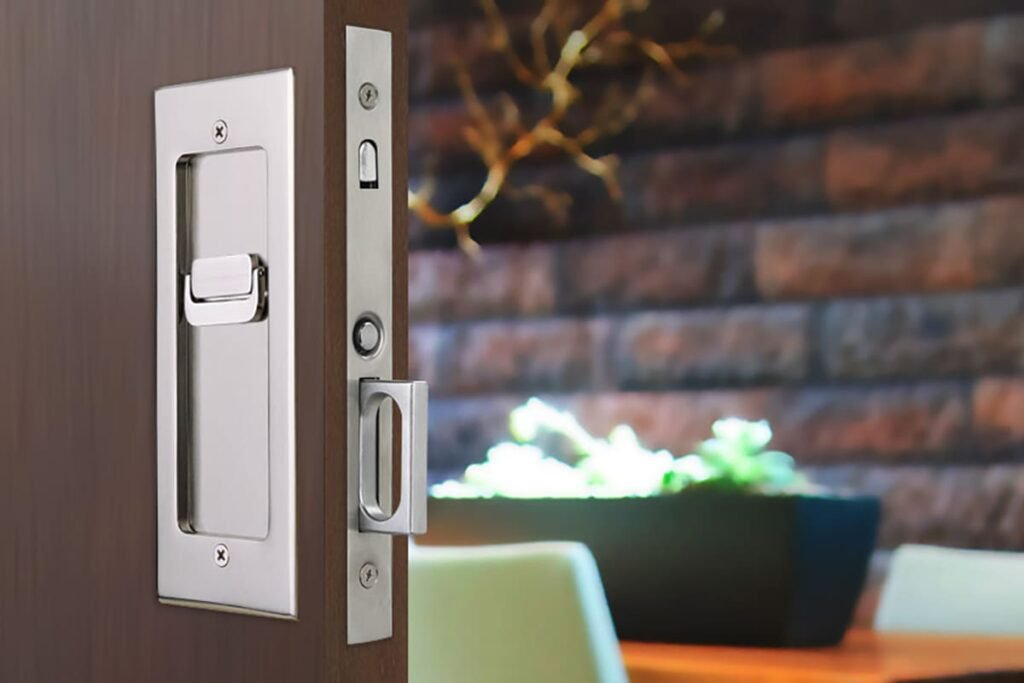
The Ultimate Guide to Pocket Door Hardware?
Pocket door hardware can look simple at first, but a wrong system choice can create noisy sliding, poor closing, accessory mismatch, and batch-order complaints. I often see buyers focus only on track and rollers. A better approach is to evaluate the complete sliding door system before confirming production, resale, or project supply.
Pocket door hardware is a complete sliding door system that lets a door leaf slide into a wall cavity and disappear when opened. Buyers should evaluate the track, rollers, guides, stoppers, soft closers, rebound device, hook lock, flush pulls, seals, and accessory compatibility—not only the track and roller price.
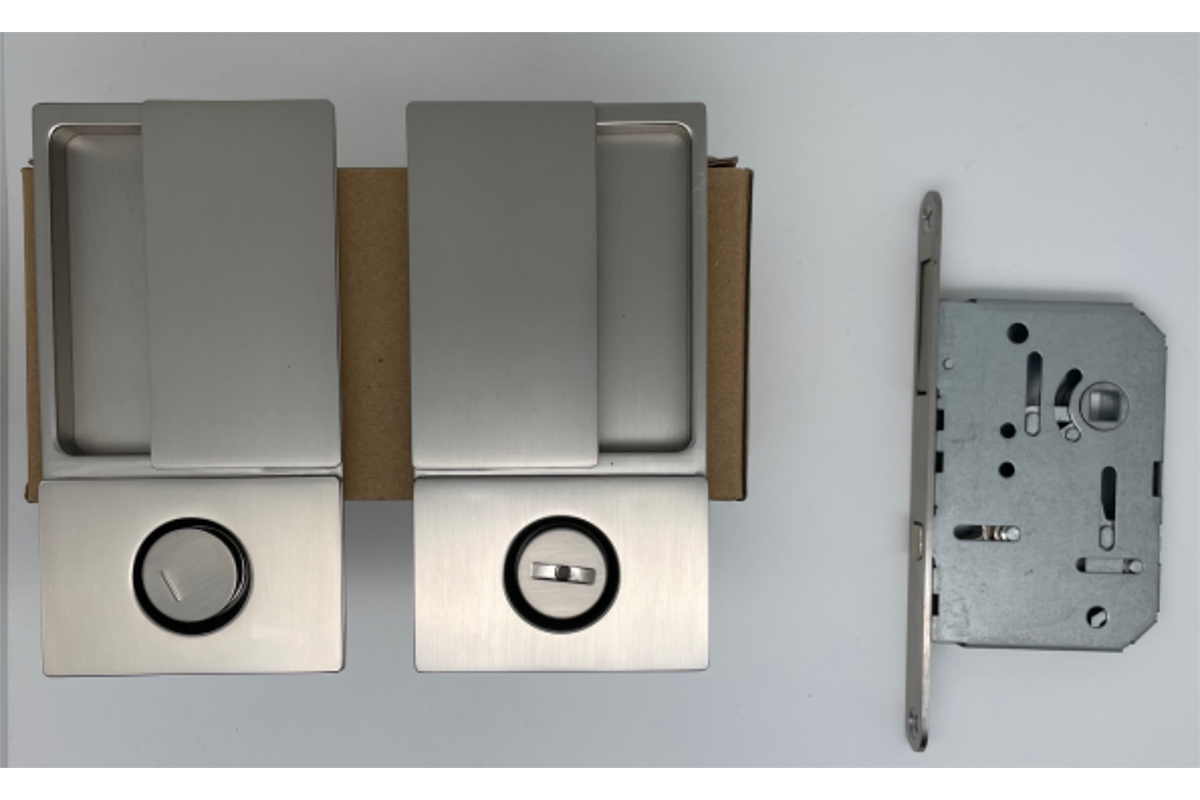
In my experience supplying door factories and hardware brands, the best pocket door systems are not always the most complicated. They are the systems where every part works together smoothly, consistently, and repeatedly across bulk orders.
What Is Pocket Door Hardware and How Does the System Work?
Pocket doors solve a real space problem, but the hardware behind them is often misunderstood. If the system is treated as only a sliding rail purchase, the door may work in a sample room but fail in real production or long-term use.
Pocket door hardware is the hardware system used for a sliding door that moves into a wall pocket.1 A complete system usually includes an aluminum track, rollers, floor guide, stoppers, soft-close units, rebound device, hook lock, flush knobs or pulls, and related accessories.
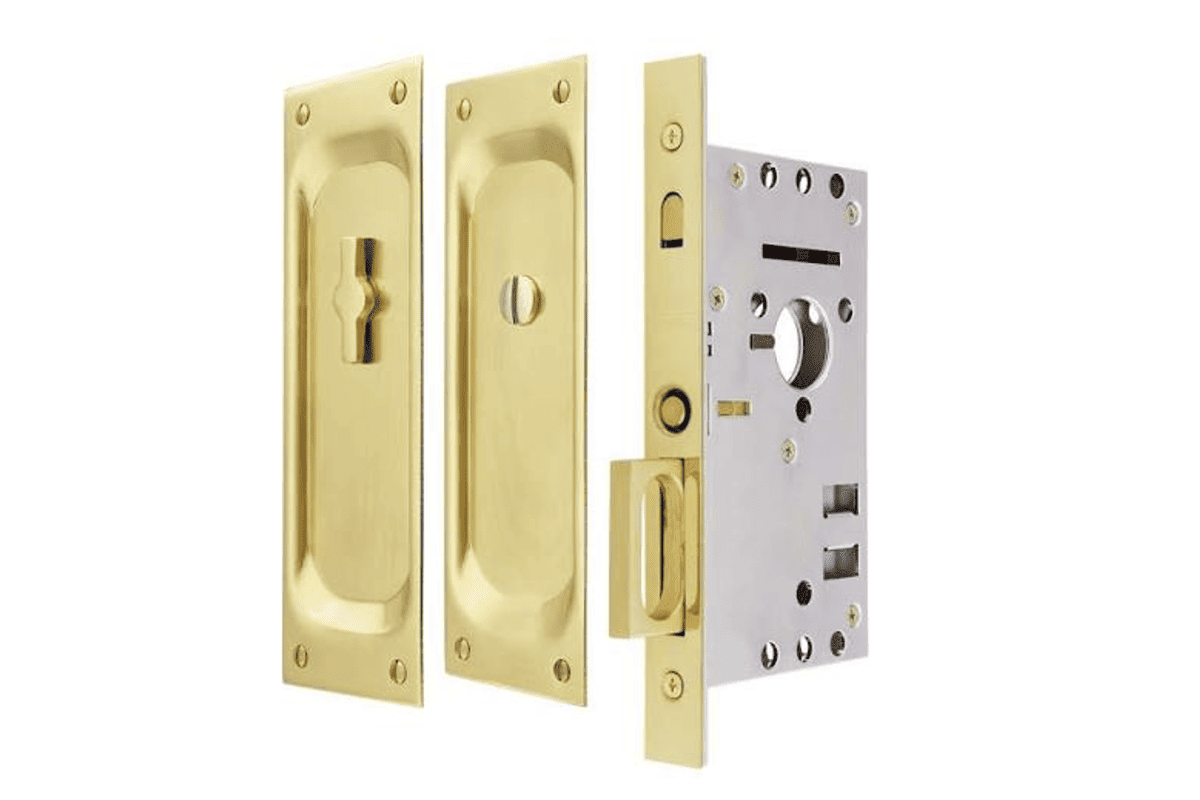
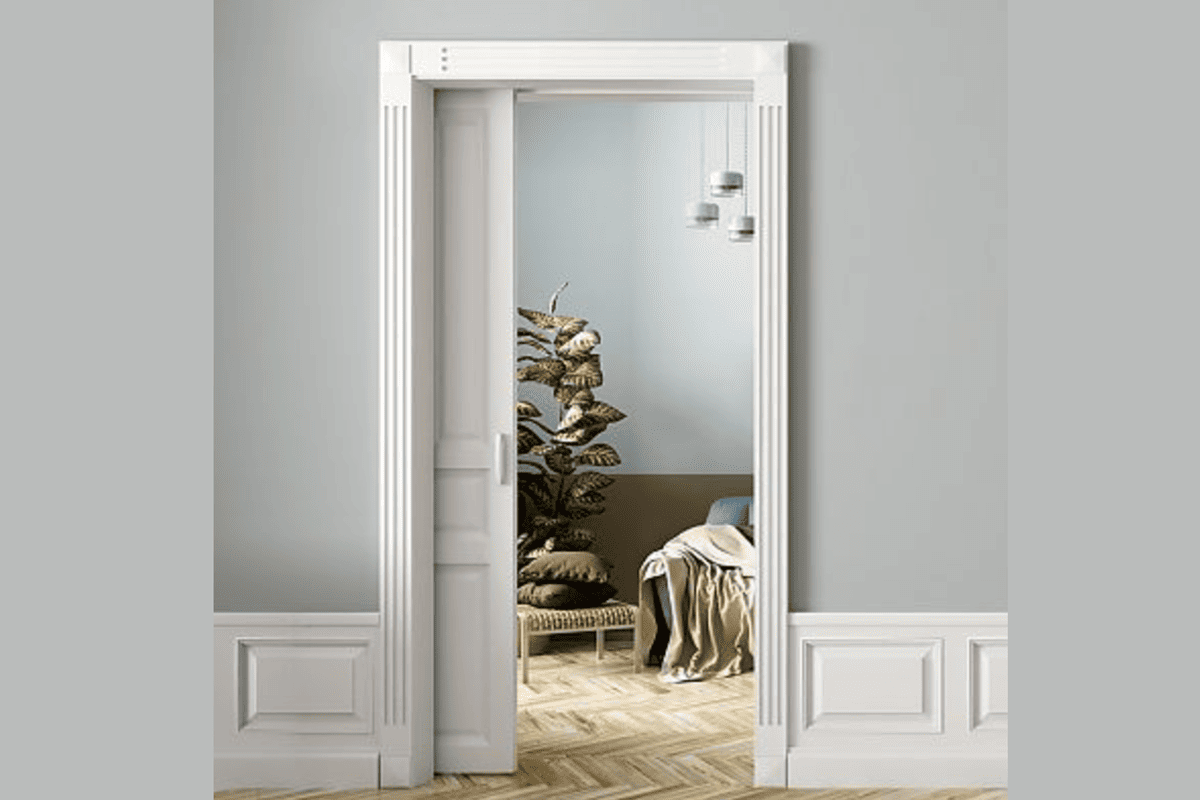
A pocket door is a hidden sliding door
A pocket door is a door leaf that slides into a slot inside the nearby wall. When the door is fully open, the door leaf is hidden inside the wall cavity. This design saves floor area because the door does not swing into the room.2
This makes pocket doors popular in:
- Apartments and compact rooms
- Hotel bathrooms
- Wardrobe areas
- Office partitions
- High-end interior door systems
- Projects where space efficiency matters
However, the hidden structure also creates a procurement challenge. Once the door is installed inside a wall, replacing parts can be more difficult than replacing hardware on a normal swing door.3 So the buyer needs to check system reliability before bulk purchase.
The core parts of a pocket door system
A standard pocket door hardware set usually includes several parts. Each part has a direct effect on sliding feel, door stability, and long-term performance.
| Component | Main Function | Buyer Evaluation Point |
|---|---|---|
| Track | Supports the sliding path | Length, straightness, material, cutability |
| Rollers | Carry the door weight | Load capacity4, smoothness, wheel material |
| Floor guide | Keeps the door aligned | Fit with door thickness and bottom groove |
| Stoppers | Limit opening and closing position | Position accuracy and impact resistance |
| Soft closer | Slows the door near final position | One-way or two-way function |
| Rebound device | Pushes the door out from the wall pocket | Compatibility with soft-close system |
| Hook lock | Locks or latches the sliding door | Pull ring option, lock cylinder option |
| Flush knob / flush pull | Allows users to pull the door | Shape, finish, grip comfort |
| Drop seal | Seals the bottom gap when closed | Automatic lowering, door bottom fit |
In my work with buyers, I often explain that track and roller selection is only the basic layer. The real value of pocket door hardware comes from system matching. A smooth roller cannot solve a poorly matched floor guide. A good soft closer cannot perform well if the stopper position is unstable. A premium hook lock may still cause complaints if the pull ring function is missing where no rebound device is used.
Why system matching matters
Pocket door systems work inside a narrow space. Small mismatches become visible quickly. For example:
- The door may shake if the floor guide does not match the door groove.
- The door may hit the frame if the stopper is weak or poorly positioned.
- The door may be hard to pull out if no rebound device or pull ring is included.
- The soft closer may fail to catch the door if the roller and buffer are not compatible.
- The finish may look inconsistent if pulls, locks, and visible accessories come from different finish standards.
For B2B buyers, these issues are not only technical. They affect complaints, replacement cost, reseller reputation, and production efficiency. I usually recommend that buyers evaluate pocket door hardware as a complete kit, not as isolated components.
How Should Buyers Select Pocket Door Hardware by Door Size and Track Length?
A common purchasing mistake is choosing the track before confirming the door size. This creates problems later, especially when door factories need consistent cutting, drilling, and assembly standards across repeated orders.
Buyers should select pocket door hardware according to door width, door height, door thickness, door weight, wall pocket structure, and required track length. Aluminum alloy tracks can usually be cut to fit project dimensions, but the original specification still needs to match the door system.
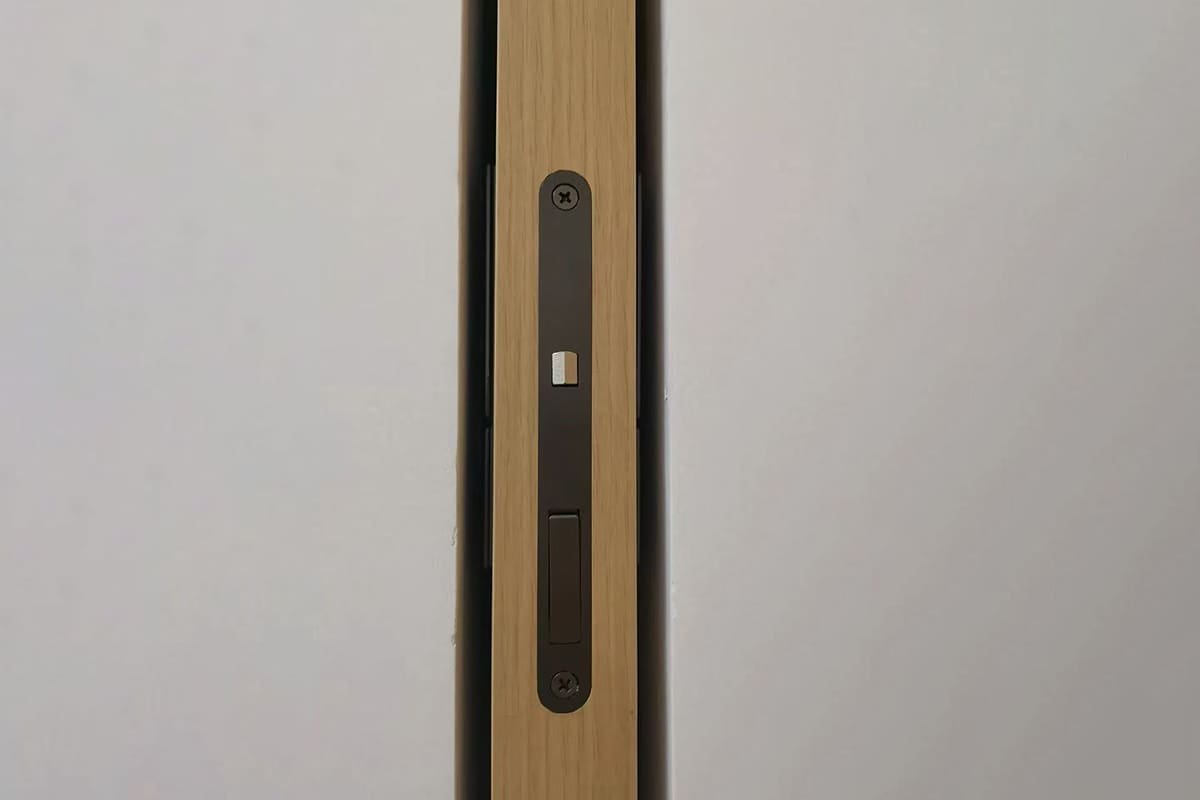
Start with the door leaf, not the catalog
The track length should be selected according to the door length. In many interior applications, the track needs to provide enough travel for the door leaf to slide fully into the wall cavity. Aluminum alloy tracks are widely used because they offer good straightness, corrosion resistance, and practical cutting flexibility.5
However, “can be cut” does not mean “any track is suitable.” The buyer still needs to confirm:
- Door width
- Door height
- Door thickness
- Door weight
- Opening direction
- Wall pocket depth
- Required soft-close or rebound function
- Accessory position
- Lock and pull configuration
- Packaging and batch labeling needs
For door factories, these details are important because pocket door hardware must fit the production process. If every batch needs field adjustment, the factory loses efficiency.
Track and roller selection basics
Track and roller selection remains important, but it is the starting point rather than the full decision.
| Selection Item | What to Check | Why It Matters |
|---|---|---|
| Track material | Aluminum alloy profile, thickness, straightness | Affects smooth sliding and cut accuracy |
| Track length | Match with door width and opening design | Allows full door travel |
| Roller design | Wheel material, bearing quality, adjustment range | Affects noise, load, and alignment |
| Load capacity | Match actual door weight with margin | Reduces risk of sagging or premature wear |
| Installation tolerance | Adjustment screw, hanger design, guide fit | Helps factories handle small variations |
| Surface finish | Visible accessory finish consistency | Supports brand-level appearance control |
I avoid giving a universal load capacity rule without checking the actual product design. Different manufacturers use different roller structures, wheel materials, and track profiles. For procurement, the safer method is to request the supplier’s specification sheet, sample test feedback, and actual system configuration drawing.
Practical procurement questions
When I handle inquiries from product managers, I usually ask several questions before recommending a pocket door hardware set:
- What is the door material: hollow core, solid wood, MDF, aluminum frame, or glass?
- What is the expected door weight range?
- Does the door need one-way or two-way soft close?
- Does the door need a rebound device?
- Will the lock need a pull ring?
- Does the lock need a cylinder for privacy or security?
- Does the market require specific finish colors?
- Will the order be supplied to door factories, wholesalers, or project contractors?
- Does the buyer need one complete carton per door set?
These questions reduce misunderstandings. They also help avoid the common situation where a sample works well but the bulk order lacks some accessories.
For B2B pocket door hardware procurement, the best specification is not only “track length + roller.” It is a complete, repeatable system configuration.
This is especially important for hardware brands. If the brand sells pocket door kits under its own label, missing or inconsistent accessories can damage customer trust quickly.
Why Do Soft-Close and Rebound Functions Matter in Pocket Door Hardware?
Many buyers treat soft close as a decorative upgrade, but that view is too narrow. In a pocket door system, impact control and usability directly affect noise, frame protection, and customer satisfaction.
Soft-close pocket door hardware slows the door before it reaches the fully open or fully closed position. One-way soft close works on one end of travel, while two-way soft close works in both opening and closing directions and is often used for higher-end systems.
One-way soft close vs. two-way soft close
A pocket door without soft close may hit the frame or stopper with force.6 This can create noise and may increase wear on the frame, track, roller, and stopper. A soft closer slows the door near the end position and allows it to finish movement with lighter impact.
There are two common configurations:
| Soft-Close Type | Function | Typical Use |
|---|---|---|
| One-way soft close | Slows the door at one end, usually closing | Mid-range interior systems |
| Two-way soft close | Slows the door when fully opening and fully closing | Higher-end pocket door systems |
For higher-end pocket door hardware, two-way soft close is often preferred because the door is controlled in both directions. When opening, the door slows before it disappears into the wall pocket. When closing, the door slows before it reaches the frame. This makes the system quieter and more comfortable.
Why soft close is not just “premium”
The value of soft close is functional. It helps with:
- Noise reduction7 when the door reaches the frame or pocket end
- Lower impact force on the stopper and frame
- Better user experience in hotels, apartments, and offices
- Reduced risk of damage8 from repeated hard sliding
- More refined product positioning for brands and wholesalers
I do not describe soft close as automatically better for every project. Some budget product lines may choose basic sliding hardware. However, when buyers sell into markets that expect quiet movement and better touch feel, soft close becomes a practical upgrade.
What is a rebound device?
A rebound device solves a different problem. When the pocket door slides fully into the wall, the user needs a way to pull it out again.9
There are two common options:
Without rebound device
The door usually needs a hook lock with a pull ring. The user pulls the ring to bring the door leaf out of the wall pocket.With rebound device
The user presses the door edge. The rebound device pushes the door leaf out slightly. Then the user can hold the flush knob or pull to close the door.
In my experience, buyers sometimes order rebound hardware but forget to adjust the lock and pull configuration. This causes user inconvenience. The rebound device changes how the door is operated, so the rest of the accessory set should match it.
Why rebound works best with two-way soft close
Rebound devices are often paired with two-way soft-close pocket door hardware. This is because the door needs controlled movement when it enters the wall and when it returns toward the frame. The combination improves both usability and comfort.
A typical higher-end configuration may include:
- Aluminum alloy track
- Adjustable rollers
- Two-way soft-close units
- Rebound device
- Floor guide
- Stoppers
- Flush pulls
- Hook lock
- Drop seal if sealing is required
The important point is compatibility. A rebound device must work with the track, roller, stopper, soft-close unit, and door weight range. Buyers should confirm the supplier’s recommended combination instead of mixing unrelated components from different sources.
For batch orders, this matters even more. One sample may feel smooth, but inconsistent rebound force or buffer matching can cause complaints across hundreds or thousands of sets.
Which Locks, Pulls, Seals, and Accessories Complete a Pocket Door Hardware System?
A pocket door can slide smoothly and still feel incomplete if the lock, pull, or seal is wrong. This is a common hidden issue in bulk procurement because small accessories are easy to overlook during quotation comparison.
A complete pocket door hardware system may include a hook lock, flush knobs or flush pulls, pull ring, lock cylinder option, and automatic door bottom seal. Doors without a rebound device should usually use a hook lock with a pull ring for manual door retrieval.
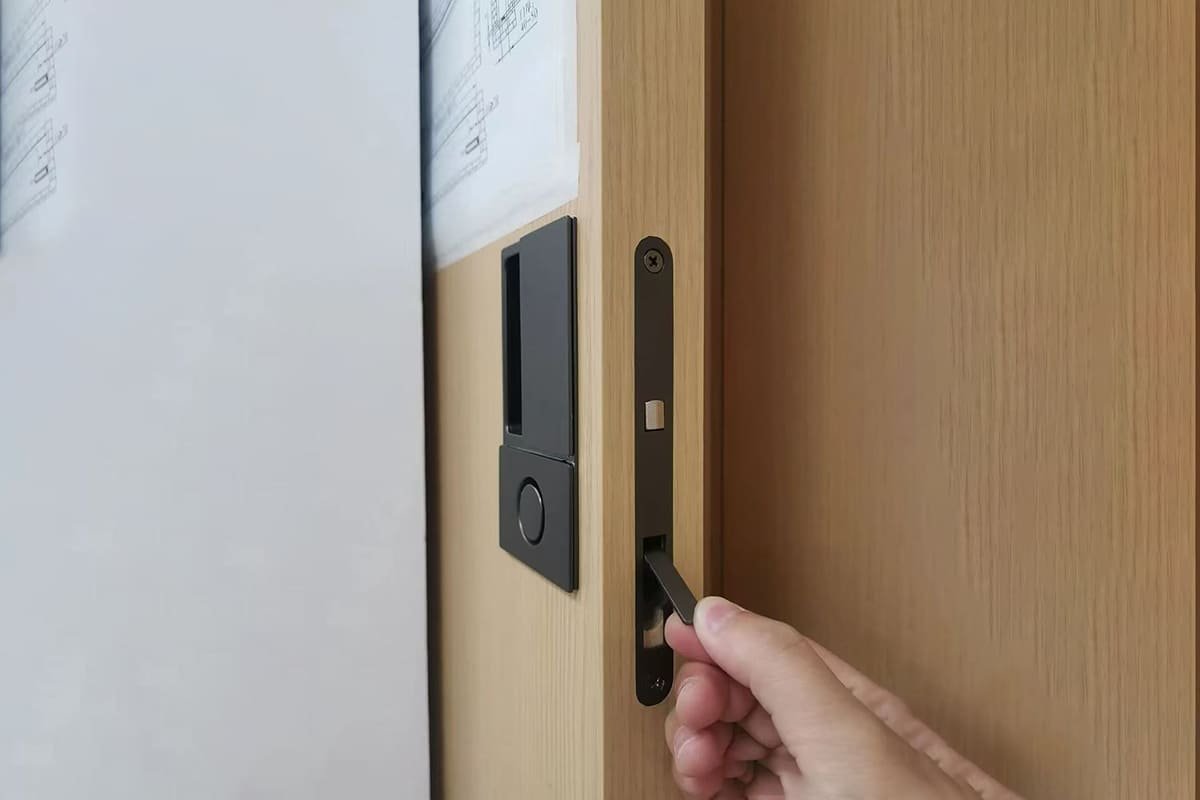
Hook locks for pocket doors
Pocket doors generally use hook locks rather than standard swing-door latch locks.10 A hook lock is suitable because the sliding door moves horizontally. The hook engages with the strike to hold or lock the door in place.
For pocket door applications, buyers should check:
- Hook projection and engagement depth
- Lock body size
- Strike plate matching
- Door thickness compatibility
- Finish consistency
- Pull ring function
- Cylinder option if locking is required
- Packaging with screws and accessories
If no rebound device is installed, the door should usually use a hook lock with a pull ring. When the door is fully hidden in the wall, the user needs that pull ring to manually pull the door out.
Flush knobs and flush pulls
Flush knobs, also called flush pulls in many markets, are installed on both sides of the door leaf. They allow the user to pull the door fully closed after the door has been pushed out by the rebound device or pulled out with the pull ring.
A good flush pull should be:
- Comfortable for fingers
- Low profile
- Smooth at the edges
- Matched with the door finish
- Consistent in color across bulk orders
- Easy for door factories to install repeatedly
For hardware brands, the flush pull is a visible part. Even if the track and rollers are hidden, the user sees and touches the pull. So surface finish consistency matters.
Door bottom seals
A door bottom seal can be useful when the project needs better gap control. An automatic door bottom seal lowers when the door is fully closed. It helps seal the gap under the door.11
Buyers may consider a door bottom seal for:
- Bedrooms
- Bathrooms
- Offices
- Hotel rooms
- Areas needing better dust or sound control
The buyer should confirm the door bottom structure before ordering. The seal must fit the door thickness, bottom groove, and closing position.
A practical lock recommendation
For many pocket door projects, I like to recommend a dedicated pocket door hook lock that integrates flush pull and pull ring functions. Some models also include a cylinder version, which can provide a certain level of privacy or security depending on the project requirement.
This type of lock can simplify the accessory list because one product combines several functions:
| Function | Benefit |
|---|---|
| Hook lock | Holds or locks the sliding door |
| Flush pull | Allows the user to close the door |
| Pull ring | Allows retrieval when no rebound device is used |
| Cylinder option | Supports privacy or controlled access needs |
This does not mean every pocket door must use the same lock. Buyers should still evaluate the application, door thickness, target market, and security expectation. For specific project safety or code requirements, qualified professional evaluation is always necessary.
Accessory completeness matters in B2B orders
In single-home retail, a missing screw is annoying. In factory production, missing accessories can stop assembly lines. In wholesale, incomplete kits create after-sales problems.
I recommend that buyers define a standard packing list before order confirmation. The list should include:
- Track
- Rollers
- Hangers
- Floor guide
- Stoppers
- Soft-close units if required
- Rebound device if required
- Hook lock
- Flush pulls or flush knobs
- Pull ring if needed
- Door bottom seal if needed
- Screws and small fittings
- Installation reference sheet
- Carton label and item code
This keeps the pocket door hardware kit repeatable. It also helps buyers compare suppliers fairly.
How Can B2B Buyers Control Quality Risks in Bulk Pocket Door Hardware Orders?
A smooth sample is helpful, but it is not enough. Bulk orders can still fail because of inconsistent track quality, unstable roller performance, missing parts, poor buffer matching, or changing supply standards.
B2B buyers should evaluate pocket door hardware by sample performance, batch consistency, accessory completeness, supplier manufacturing control, packaging accuracy, and long-term supply stability. A good supplier should provide repeatable specifications, stable finishes, and compatible system configurations.

The hidden risks behind a good sample
I have seen cases where a sample pocket door kit slides smoothly, but the buyer later faces problems in bulk supply. The reason is usually not one single defect. It is often a combination of small inconsistencies.
Common risks include:
- Track profile variation between batches
- Roller wheel material changes
- Bearing smoothness inconsistency
- Soft-close force not matched with door weight
- Rebound device not aligned with stopper position
- Missing screws or small fittings
- Hook lock finish mismatch
- Flush pull color difference
- Carton labeling confusion
- Incomplete accessory list
These risks are especially serious for door factories and hardware brands. A factory needs predictable assembly. A brand needs stable user experience. A wholesaler needs fewer complaints and easier inventory control.
Quality control points buyers should check
A buyer does not need to become a hardware engineer, but the buyer should establish a clear evaluation checklist.
| Evaluation Area | What to Verify | Why It Matters |
|---|---|---|
| Track quality | Straightness, profile accuracy, cut edge quality | Ensures smooth travel |
| Roller performance | Smooth movement, adjustment, load match | Supports stable sliding |
| Soft close | Catching position, damping force, one-way/two-way function | Reduces impact and noise |
| Rebound device | Press force, pop-out distance, reset stability | Improves usability |
| Accessory matching | Lock, pull, guide, stopper, seal compatibility | Prevents system mismatch |
| Finish consistency | Color and surface across visible parts | Protects brand image |
| Packing list | Complete parts per set | Reduces assembly and after-sales issues |
| Supplier capacity | Production line control and repeatability | Supports long-term orders |
At SDH Hardware, we work as a manufacturer with in-house production experience for door hardware categories such as concealed hinges, mortise locks, butt hinges, lever handles, cylinders, and related architectural hardware. For pocket door hardware inquiries, I usually treat the discussion as a system configuration review. I do not only ask, “What price do you need?” I ask what door, what market, what function, and what accessory standard the buyer wants.
Ask for documents, but verify them
For international projects, buyers often ask about CE documents, fire-rated documents, or other compliance files. These documents are important when the target market or project requires them. However, buyers should verify that certificates apply to the exact product, system, and application.12
A safe procurement approach includes:
- Request product specification sheets
- Check technical drawings
- Confirm material and finish standards
- Review test or certification documents where applicable
- Confirm whether documents apply to the ordered model
- Keep approval samples for future comparison
- Use qualified professional evaluation for application-specific requirements
This is especially important for fire-rated door projects or regulated building applications. A pocket door system may involve the door leaf, frame, wall structure, seal, lock, and hardware. The hardware alone should not be evaluated in isolation for code-sensitive decisions.
Batch-order consistency is the real test
For B2B buyers, repeatability is often more important than a perfect one-time sample. A supplier should be able to maintain the same specification over repeated orders.
Before placing large orders, I suggest buyers confirm:
Approved sample standard
The sample should be kept and used as the reference for future batches.Final packing list
Every carton should include the same accessories.Track cutting tolerance
If tracks are cut before shipment, dimensions should be confirmed.Finish standard
Visible accessories should match the approved color and surface texture.Function configuration
The order should clearly state basic, one-way soft close, two-way soft close, rebound, or combined system.Spare parts policy
B2B buyers should discuss replacement parts for rollers, buffers, and small fittings.Production lead time
The supplier should provide realistic delivery timing for repeat orders.
A good pocket door hardware supplier should help the buyer reduce risk, not only reduce unit price. Competitive pricing matters, but a low price loses value if the system creates complaints or delays.
Frequently Asked Questions
What is included in a pocket door hardware kit?
A pocket door hardware kit usually includes track, rollers, hangers, floor guide, stoppers, screws, and accessories. Higher-end kits may also include one-way or two-way soft closers, a rebound device, hook lock, flush pulls, pull ring, and door bottom seal.
Does a pocket door need a rebound device?
A pocket door does not always need a rebound device. Without one, the door usually needs a pull ring or hook lock with pull ring so users can pull the door out from the wall pocket. With a rebound device, users press the door edge and the door pops out.
What lock is suitable for a pocket door?
A hook lock is usually suitable for a pocket door because the door slides horizontally. For doors without rebound devices, a hook lock with a pull ring is practical. Some hook locks also include a cylinder option for privacy or limited security needs.
Is two-way soft close worth choosing for pocket door hardware?
Two-way soft close is often worth choosing for higher-end pocket door hardware because it slows the door when opening and closing. This reduces impact noise, protects the frame and hardware, and creates a more controlled user experience.
Can aluminum pocket door tracks be cut to size?
Aluminum alloy pocket door tracks can usually be cut to fit project requirements. Buyers should still confirm door size, track length, cutting tolerance, roller compatibility, and packaging method before bulk ordering.
Conclusion
Pocket door hardware should be selected as a complete sliding door system, not as a simple track-and-roller set. Buyers need to check door size, track length, roller performance, soft-close direction, rebound function, hook lock type, flush pull design, bottom seal needs, and batch-order consistency. If you are developing a pocket door product line or sourcing for door factory production, I recommend confirming the full configuration before comparing prices. Contact SDH Hardware to discuss a compatible pocket door hardware solution for your market and project requirements.
"Pocket door - Wikipedia", https://en.wikipedia.org/wiki/Pocket_door. A neutral architectural reference defines a pocket door as a sliding door that recesses into a wall cavity, supporting the article’s basic description of the system. Evidence role: definition; source type: encyclopedia. Supports: A pocket door is a sliding door designed to move into a recessed wall compartment or cavity.. ↩
"Chapter 4: Entrances, Doors, and Gates - Access-Board.gov", https://www.access-board.gov/ada/guides/chapter-4-entrances-doors-and-gates/. An architectural design source explains that sliding doors avoid the swing clearance required by hinged doors, providing contextual support for the space-saving claim. Evidence role: mechanism; source type: education. Supports: Sliding or pocket doors can reduce clearance requirements compared with hinged doors because they do not swing through an arc.. Scope note: The source may support the spatial mechanism generally rather than quantify floor-area savings for every pocket-door installation. ↩
"How to replace broken pocket door hardware without ...", https://www.facebook.com/groups/1706748102970911/posts/3808835522762148/. A building-maintenance source describing pocket-door repair notes that key components are concealed in the wall assembly, supporting the article’s caution that replacement can be more involved after installation. Evidence role: general_support; source type: education. Supports: Pocket-door tracks and related components are commonly installed in or above a concealed wall pocket, which can make access and replacement more involved than for exposed hinged-door hardware.. Scope note: The support is contextual because repair difficulty varies with frame design, removable stops, access panels, and installation quality. ↩
"Why Quality Matters with Garage Door Rollers", https://www.fehr.com/articles/why-quality-matters-with-garage-door-rollers/. Engineering literature on bearing load ratings and service life supports the principle that roller assemblies should be selected with load capacity appropriate to the supported door mass. Evidence role: mechanism; source type: paper. Supports: Rolling-element bearings and wheel assemblies have load ratings related to service life, and excessive load can accelerate wear or failure.. Scope note: The source would support the mechanical principle rather than provide a pocket-door-specific load rule. ↩
"Improving the Corrosion Resistance of Aluminum Alloy by Creating a ...", https://pmc.ncbi.nlm.nih.gov/articles/PMC9653635. A materials reference on aluminum alloys documents corrosion resistance, extrudability, and machinability, providing contextual support for their use in cuttable architectural track profiles. Evidence role: general_support; source type: institution. Supports: Aluminum alloys are used in architectural applications because they combine low weight, corrosion resistance, extrudability, and machinability.. Scope note: The source would support aluminum-alloy properties generally, not prove that every pocket-door track has adequate straightness or performance. ↩
"Hydraulic Door Stoppers: The Ultimate Solution to Prevent ...", https://www.aleader-china.com/blog/hydraulic-door-stoppers-the-ultimate-solution-to-prevent-door-slamming/. Research on damping and soft-closing mechanisms supports the mechanism that reducing closing velocity lowers end-stop impact in sliding systems. Evidence role: mechanism; source type: research. Supports: Damping mechanisms reduce the velocity and impact of moving components as they approach an end position.. Scope note: The source may address damping mechanics broadly rather than test the exact pocket-door hardware discussed in the article. ↩
"Analysis of a substitute for the impact damper to damp near ...", https://scholarsmine.mst.edu/masters_theses/5068/. Acoustics and mechanical-engineering literature links damped impact and lower collision velocity with reduced impact noise, providing contextual support for the article’s soft-close noise claim. Evidence role: mechanism; source type: paper. Supports: Reducing impact velocity and damping contact events can reduce impact noise in mechanical systems.. Scope note: The support is mechanism-based and may not provide measured decibel reductions for pocket doors specifically. ↩
"The Fatigue Wear Process of Rubber-Metal Shock Absorbers", https://pmc.ncbi.nlm.nih.gov/articles/PMC8953850/. Mechanical wear and shock literature supports the general principle that reducing repeated impact loads can reduce component stress and potential damage. Evidence role: mechanism; source type: paper. Supports: Repeated mechanical impacts can contribute to wear, fatigue, or damage, and damping reduces shock loads.. Scope note: The evidence is indirect because actual damage rates depend on door mass, user behavior, hardware design, and installation quality. ↩
"Edge Pull For Pocket Door", https://www.amazon.com/edge-pull-pocket-door/s?k=edge+pull+for+pocket+door. A building-hardware or construction reference describing pocket-door pulls supports the article’s point that a recessed door leaf needs a retrieval method. Evidence role: general_support; source type: education. Supports: Pocket doors commonly use recessed pulls, edge pulls, or similar hardware so users can retrieve and move a door that is recessed in the wall pocket.. Scope note: The source would support common design practice rather than prove that all pocket-door installations require the same retrieval hardware. ↩
"Pocket Door Handles, Pulls & Locks", https://www.pocketdoorsuperstore.com/product-category/pocket-door-hardware/pulls-locks/?srsltid=AfmBOoonpERXsLOgVu_EnnXXQDTbYRgmL4iefv0m55dN519H8VNt9iXp. An architectural-hardware reference describing hook locks for sliding doors supports the article’s explanation that hook engagement is suited to horizontal door movement. Evidence role: mechanism; source type: institution. Supports: Hook-style latches or locks are used in sliding-door applications because the hook can engage a strike while the door moves horizontally.. Scope note: The source may describe common practice; specific lock selection still depends on door type, security requirements, and local code. ↩
"Automatic Door Bottom - Door Seal Soundproofing and ...", https://www.amazon.com/Automatic-Surface-Mounted-Anodized-Aluminum/dp/B008MZ6G5I. An architectural-hardware reference defines automatic door bottom seals as devices that lower on closing to seal the under-door clearance. Evidence role: definition; source type: institution. Supports: Automatic door bottom seals are designed to drop or lower when the door closes to close the gap beneath the door.. ↩
"Compliance FAQs: CE Marking", https://www.nist.gov/standardsgov/compliance-faqs-ce-marking. Government guidance on product conformity documentation supports the need to verify that compliance evidence applies to the specific product and intended use being supplied. Evidence role: expert_consensus; source type: government. Supports: Regulatory guidance on conformity marking and product certification requires that documentation correspond to the product and its declared intended use.. Scope note: The precise legal requirement depends on jurisdiction, product category, harmonized standard, and declared application. ↩