What are the parts of a mortise lock called?
I see many buyers lose time because one lock part name is unclear. A small naming mistake can change the whole quotation and sample.
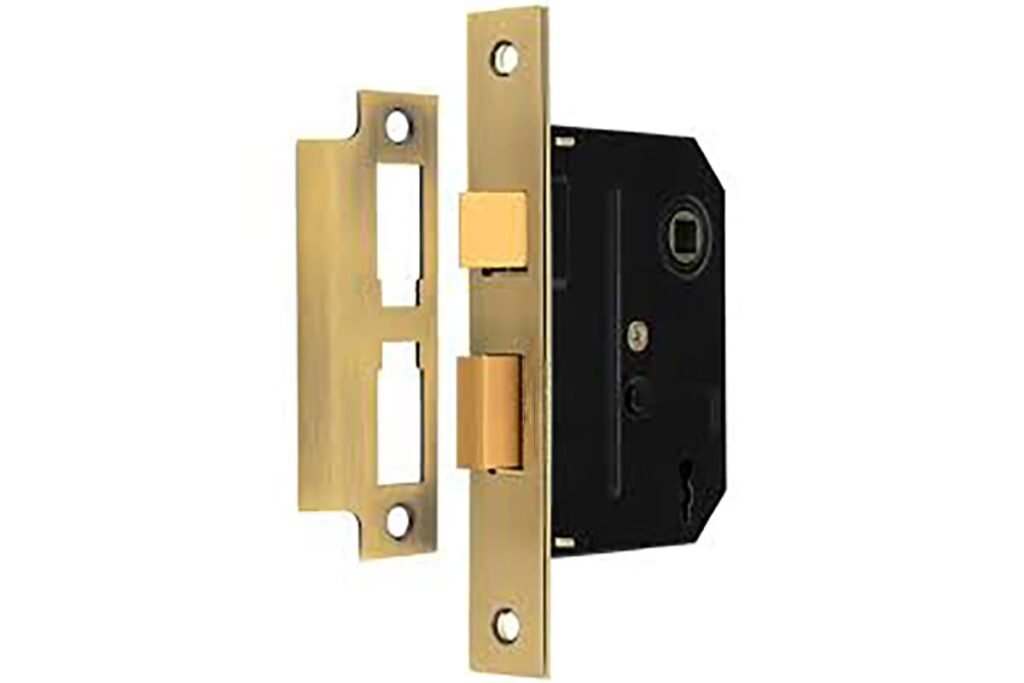
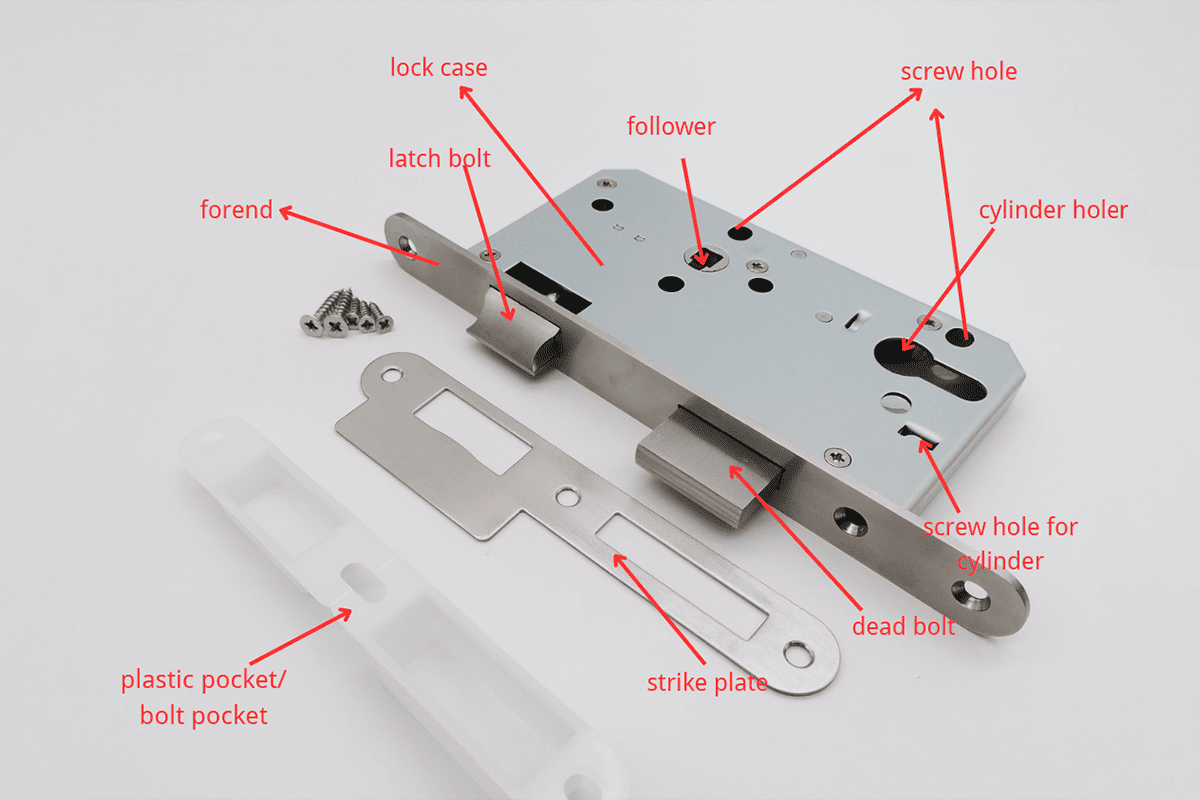
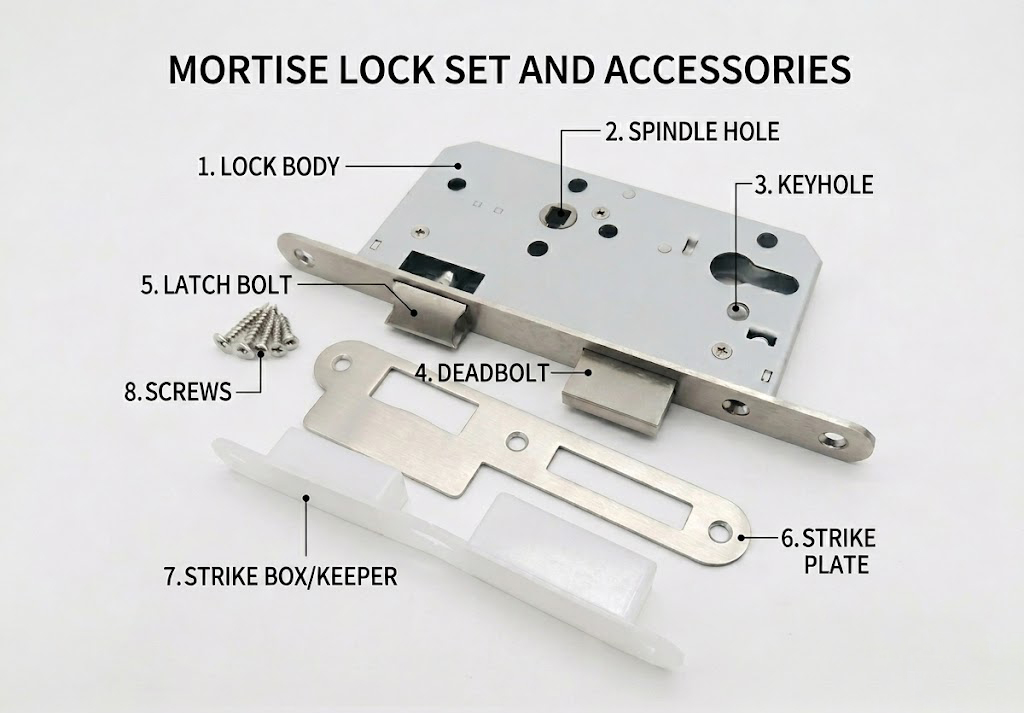
I call the main parts of a mortise lock the forend, lock case, deadbolt, latch bolt, follower, cylinder hole, through screw holes, strike plate, and dust box. These names help me confirm drawings, function, finish, accessories, and price before I make samples or bulk orders.
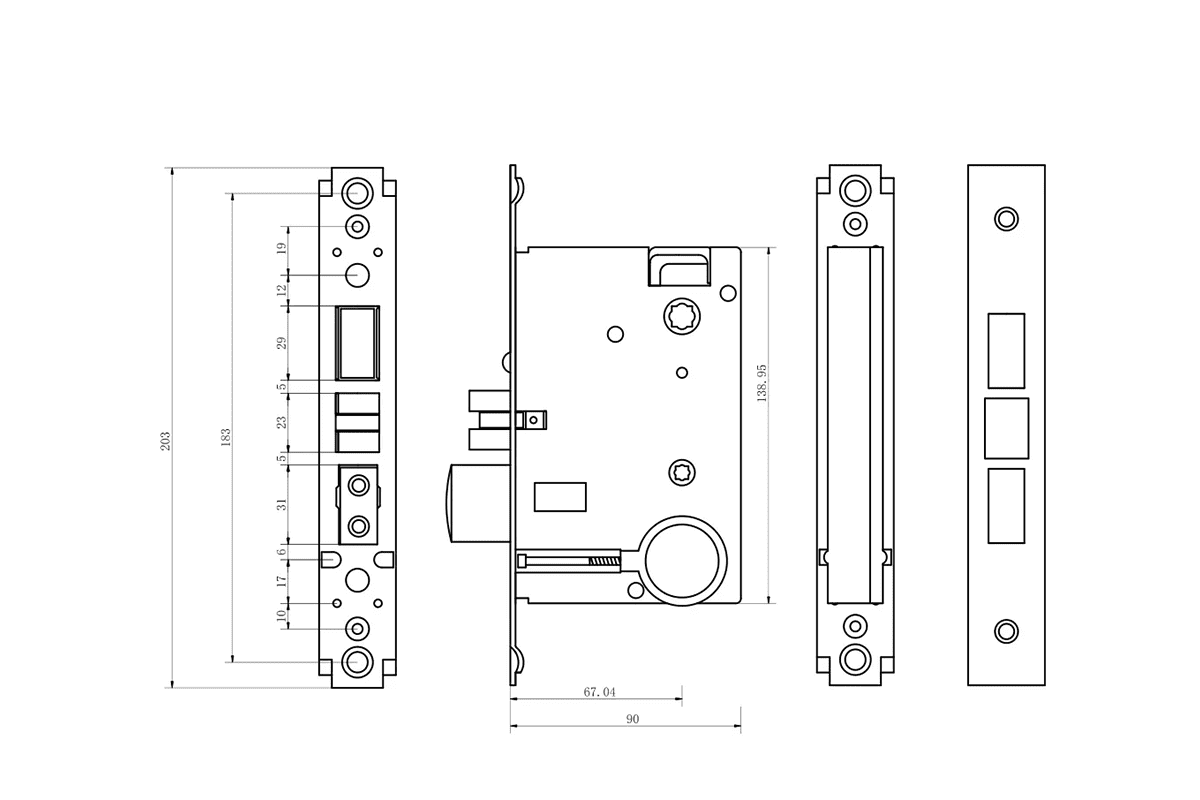
When I talk with overseas buyers, I do not treat a mortise lock as only a “lock body.” I treat it as a complete lock assembly1. The lock body or lock case is only one part of the full configuration. The full set can include the lock case, forend, latch bolt, deadbolt, strike plate, dust box, fixing screws, and sometimes other parts. The cylinder, key, thumb turn, handle, escutcheon, and rose may be included or excluded, based on the quotation. I always ask buyers to confirm this point first. One missing part can create a sample complaint, even when the lock body itself is correct.
What is the forend or faceplate on a mortise lock?
I often see buyers focus on the inner lock case and forget the forend. This creates trouble because the forend is visible after installation.
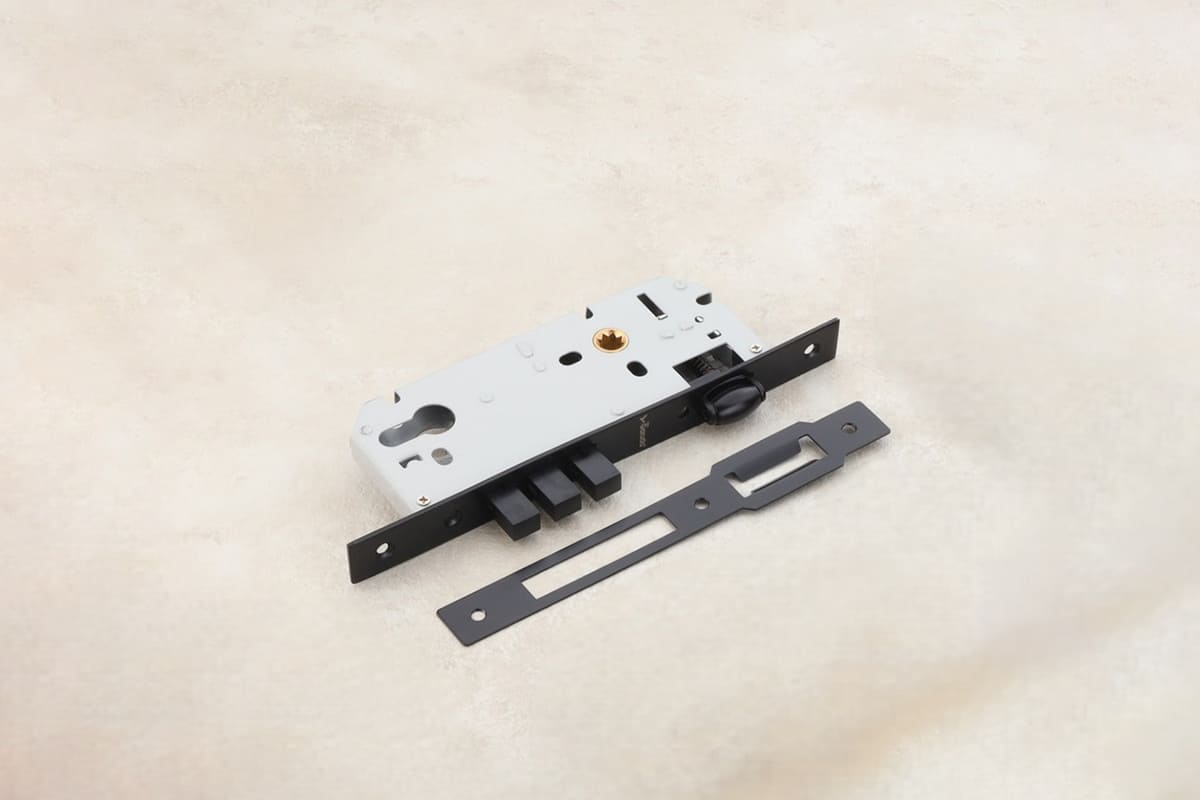
The forend, also called the faceplate, is the front plate fixed on the door edge.2 I use it to cover the lock case opening, hold the lock body in place, and match the door hardware finish3.
How I identify the forend in production
In my factory work, I treat the forend as both a functional part and an appearance part. The customer can see it every time the door is open. The installer also depends on it for correct fixing. This is why I check the length, width, thickness, corner shape, screw hole position, and surface finish before I confirm a drawing.
Forend material can change with market level and cost target. I have seen brass, stainless steel, and iron used in different product ranges. The finish can also change. It may be polished, plated, brushed, painted, or treated in another way. I do not choose these details by feeling. I match them with the door design, handle finish, project requirement, and buyer price level.
| Forend item I confirm | Why I confirm it | Common buyer mistake |
|---|---|---|
| Length and width | It must fit the door edge cutout | Buyer sends only lock case size |
| Thickness | It affects flush fitting | Buyer ignores door edge machining |
| Corner shape | It can be square or round | Buyer assumes one shape fits all |
| Finish | It must match handle or hinge finish | Buyer says “silver” without code |
| Screw holes | They must match fixing position | Buyer uses old drawing by mistake |
I usually ask for a photo, drawing, or old sample. This makes the naming clear.
What is the deadbolt and why does it matter?
I have seen buyers call every bolt a latch. This can cause a serious quotation error because the deadbolt and latch bolt do different jobs.
The deadbolt is the main locking bolt.4 I normally design it to extend and retract by cylinder operation. It gives the lock its main locked position when the door is secured.
How I explain the deadbolt to buyers
I describe the deadbolt as the part that does the real locking work. When the user turns the key or thumb turn, the cylinder moves the internal mechanism, and the deadbolt goes out or comes back. I do not describe it as a security grade by itself. The real grade depends on the whole lock design, the door, the frame, the cylinder, and the standard used for testing.5
Deadbolt projection length is a detail that buyers often ask about. Some markets may use values such as 20 mm or 24 mm6, but I always ask buyers to verify the related market standard, lock grade, or project specification. I do not assume one length fits all countries.
| Deadbolt detail | What I check | Why it affects procurement |
|---|---|---|
| Shape | Square, rectangular, or design-specific | It affects frame preparation |
| Projection | Market or standard dependent | It affects locking depth |
| Material | Brass, stainless steel, iron, zinc alloy, or other | It affects cost and product level |
| Operation | Cylinder side, thumb turn side, or both | It affects user function |
| Alignment | Match with strike plate opening | It affects installation success |
I also check if the deadbolt is single throw or double throw if the buyer has that requirement. I confirm this by drawing, not by word alone.
What is the latch bolt on a mortise lock?
I often meet buyers who only check the deadbolt and forget the latch bolt. Then the door may close poorly or the handing may be wrong.
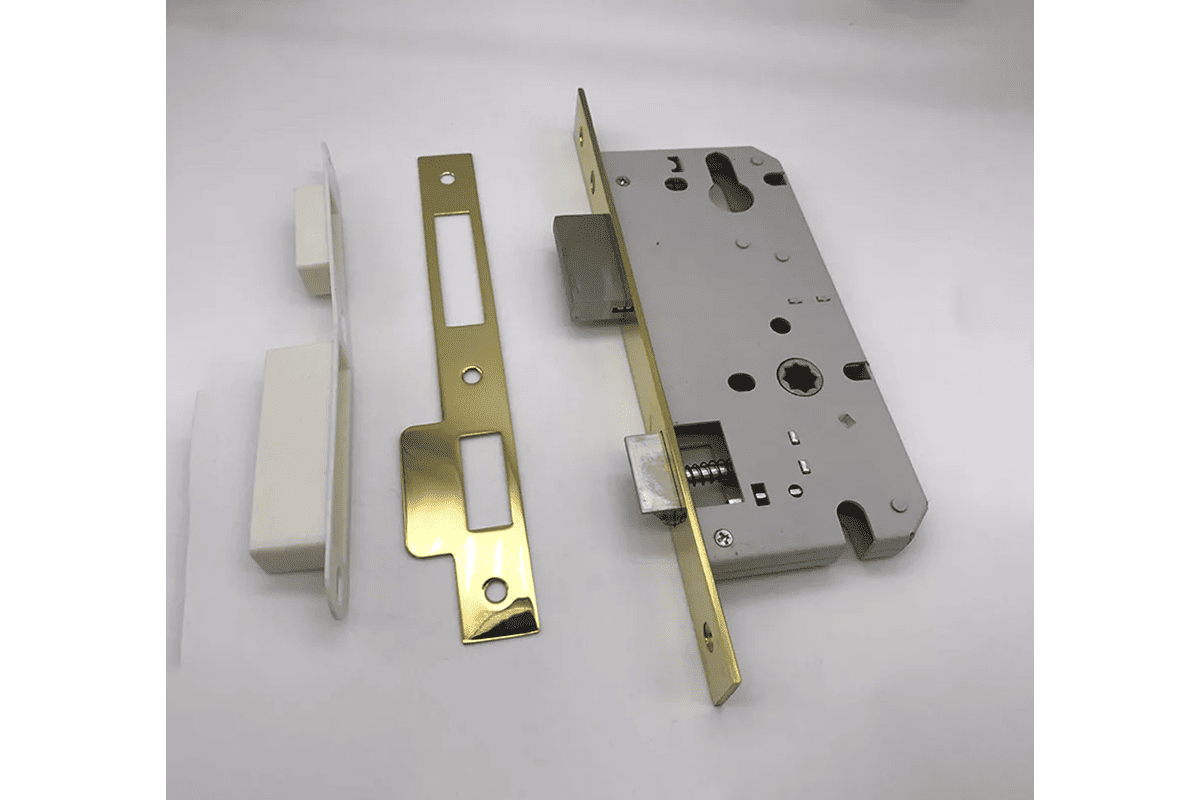
The latch bolt is the spring-loaded bevel bolt that holds the door temporarily closed.7 I connect it with handle operation, spring return, and door-frame contact during daily use.
How I separate the latch bolt from the deadbolt
I explain the latch bolt as the part that works many times each day. When the door closes, the bevel side touches the strike plate. The latch bolt moves inward. The spring pushes it back out when it reaches the strike opening.8 When the user presses the handle, the follower turns, the mechanism pulls the latch back, and the door opens.
Some lock designs also allow the cylinder to retract the latch. Some designs do not. I always confirm this point before quotation. A hotel lock, apartment lock, passage lock, and entrance lock may have different latch functions. The buyer should not assume every mortise lock works the same way.
| Latch bolt point | What I ask the buyer | Why it matters |
|---|---|---|
| Latch direction | Is the door left or right hand? | It affects bevel direction |
| Reversible latch | Does the buyer need field reversal? | It affects stock flexibility |
| Latch operation | Handle only, or cylinder also? | It affects user experience |
| Latch material | Brass, stainless steel, iron, zinc alloy, or other | It affects price and durability target |
| Strike match | Does the strike fit the latch shape? | It affects smooth closing |
I do not turn this into a repair lesson. I only explain enough so the buyer can check the configuration.
What is the follower or spindle hub?
I see many quotation problems start from one small square hole. The handle looks correct, but the spindle does not fit the lock.
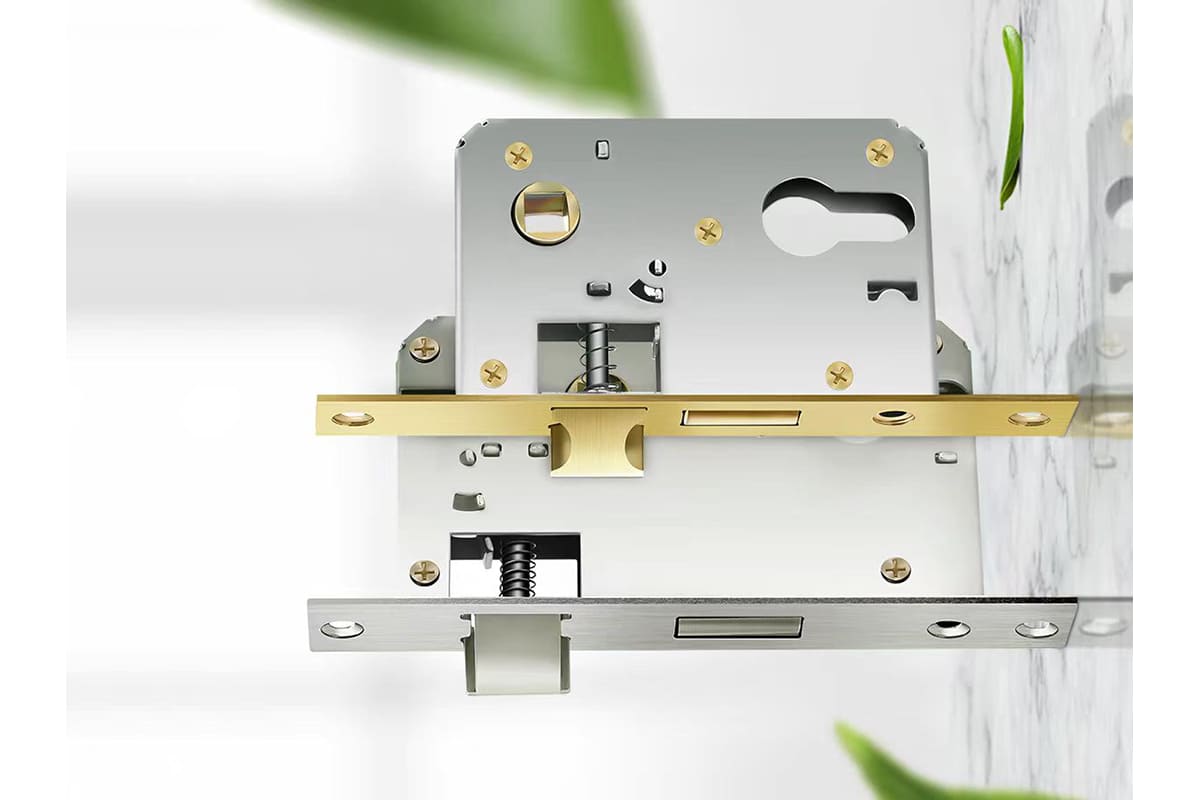
The follower, also called the spindle hub, is the square hole area where the handle spindle passes through.9 I commonly see 8×8 mm, 7×7 mm, and 9×9 mm sizes10 in different markets.
How I confirm follower size and handle matching
I treat the follower as the connection point between the lock and the lever handle. When the user presses the handle, the spindle turns the follower, and the follower pulls back the latch mechanism. If the follower size is wrong, the handle set may not work. If the handle spring and lock spring do not match well, the handle may feel loose or heavy.
Different markets use different spindle sizes. I do not say one size is universal. I see 8×8 mm often in many European-style products. I also see 7×7 mm and 9×9 mm in specific markets and applications. The best method is simple. I ask the buyer to confirm the handle spindle size, handle type, and door thickness before production.
| Follower item | Factory check | Buyer check |
|---|---|---|
| Square size | 7×7, 8×8, 9×9 mm, or other | Match the handle spindle |
| Center position | Match lock drawing | Match door drilling |
| Rotation direction | Match latch operation | Match door handing |
| Spring feeling | Match product level | Match user expectation |
| Material/process | Based on design and cost | Match price target |
I also check the distance between the follower center and the cylinder center. This dimension is critical for handle plate compatibility.
What is the cylinder hole on a mortise lock?
I have handled orders where the buyer chose the right lock size but the wrong cylinder hole. The lock could not match the cylinder.
The cylinder hole is the opening where I install the lock cylinder.11 Its shape must match the cylinder type, such as a European profile cylinder or another market-specific cylinder design.
How I link the cylinder hole to the full lock set
I treat the cylinder hole as a key interface point. It connects the lock body with the cylinder, key, thumb turn, and user locking method. For many export mortise locks, buyers ask for a Euro profile cylinder hole. Some markets use other cylinder types. I never assume the cylinder type from the word “mortise lock.”
The cylinder may be included in the quotation, or it may not be included. The same point applies to keys, thumb turns, fixing screws, and cylinder cam details. If the buyer buys the cylinder from another supplier, I ask for the cylinder drawing or sample. This prevents cam mismatch and operation problems.
| Cylinder hole item | What I confirm | Why it matters |
|---|---|---|
| Hole type | Euro profile or other type | It must match the cylinder |
| Center distance | Follower to cylinder center | It must match handle plate |
| Cylinder inclusion | Included or excluded | It changes quotation price |
| Key/thumb turn | Key-key, key-turn, or other | It changes user function |
| Cam compatibility | Match lock operation | It affects deadbolt movement |
I also remind buyers that a cylinder has its own certification and security level. The lock body alone does not prove cylinder performance.
What are through screw holes used for?
I often see buyers ignore screw holes because they look small. Then the handle rose, backplate, or lock fixing cannot line up.
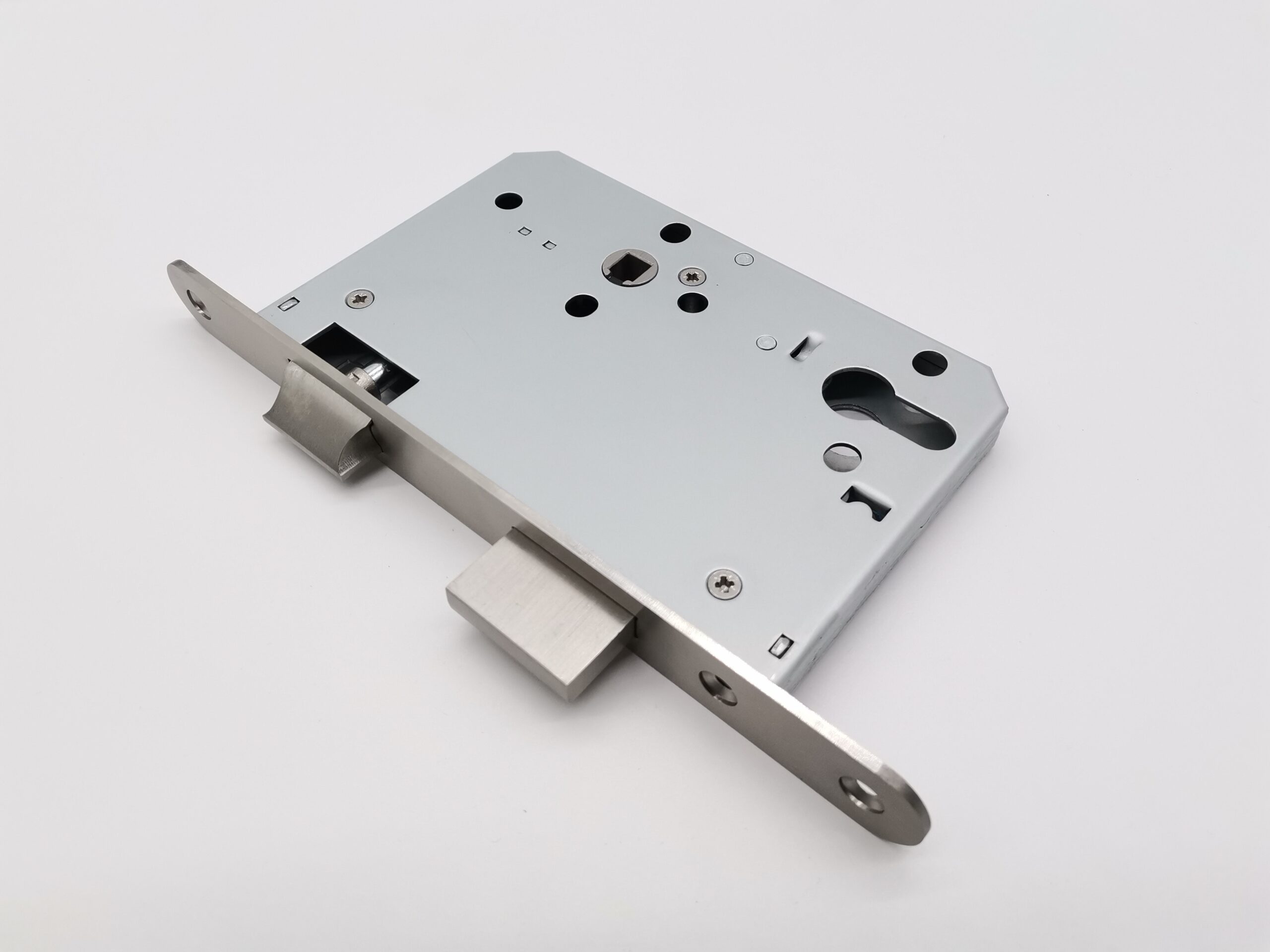
Through screw holes are holes for fixing bolts that connect hardware parts through the door. I use them to match the lock body, door drilling, handle rose, escutcheon, or backplate.
How I read screw holes on a lock drawing
I treat screw hole positions as part of the installation system. The lock body does not work alone. It must fit the door leaf, handle set, cylinder, and sometimes fire door hardware. If the through screw holes are in the wrong place, the installer may drill again. This creates extra labor and may damage the door.
Some mortise locks have through holes near the follower. Some have holes near the cylinder area. Some handle designs use separate fixing methods. I ask the buyer to confirm whether the handle uses a rose, long plate, short plate, or special escutcheon. I also check if the through bolts conflict with the lock case parts inside.
| Screw hole detail | What I check | Risk if ignored |
|---|---|---|
| Hole center distance | Match handle or rose | Handle cannot be fixed |
| Hole diameter | Match screw size | Screw cannot pass |
| Hole location | Avoid internal parts | Lock may be damaged |
| Door thickness | Match screw length | Fixing may be weak |
| Drawing version | Match latest product | Old sample may not fit |
I prefer to mark these holes on a technical drawing. A photo can help, but a drawing gives better control.
What are the strike plate and dust box?
I sometimes receive lock body orders without frame parts. Later the buyer asks why the latch and deadbolt have no receiving part.
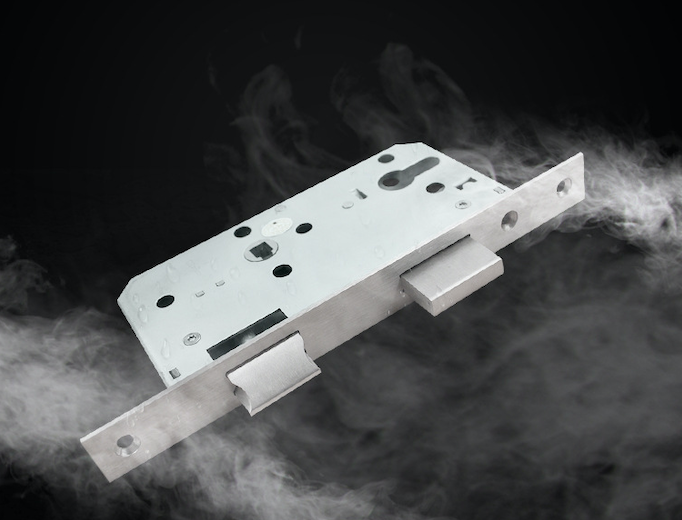
The strike plate is fixed on the door frame to receive the latch bolt and deadbolt.12 The dust box or plastic box sits inside the frame opening and helps cover the cutout.
How I confirm frame-side parts before quotation
I include the strike plate and dust box in the discussion because they affect installation and appearance. The strike plate must match the latch bolt and deadbolt position. The dust box helps make the frame cutout cleaner. In some projects, the buyer may need only the lock body. In other projects, the buyer needs a complete set with strike plate, dust box, and screws.
Strike plate material and finish also matter. A stainless steel or plated strike may be required to match the forend. The hole shape must match the latch and deadbolt. The screw holes must match the frame preparation. If the frame is steel, wood, or aluminum, the fixing method may also change.
| Frame part | Function | What I ask before quoting |
|---|---|---|
| Strike plate | Receives latch and deadbolt | Include or exclude? |
| Dust box | Covers inside frame cavity | Plastic, metal, or not needed? |
| Strike finish | Matches visible hardware | Same as forend or different? |
| Screw holes | Fixes strike to frame | What frame material is used? |
| Opening position | Matches bolt centers | Can buyer confirm drawing? |
I always make this clear in the packing list. This avoids disputes when the buyer checks the carton.
How do the internal mortise lock parts work together?
I know buyers need basic working logic, but they do not need a repair manual. Too much internal detail can create more confusion.
Inside a mortise lock, the latch bolt works with spring movement and handle operation. The deadbolt works mainly through cylinder operation. These parts must align with the case, follower, and strike.
How I explain internal parts without overcomplicating them
I explain the inside of a mortise lock by function. The latch side is for daily closing and opening. The deadbolt side is for locking. The follower connects the handle spindle to the latch mechanism. The cylinder drives the deadbolt mechanism, and in some designs it may also retract the latch. Springs help the latch return after movement. The lock case holds these parts in the correct position.
I do not advise buyers to judge quality only by looking inside. Internal structure, material, thickness, spring force, processing accuracy, and assembly control all matter. In my factory, I check smooth movement, bolt projection, handle return, cylinder operation, surface finish, noise, and fitting position during QC. I also compare the finished lock with the approved drawing and sample.
| Internal function | Main related part | Simple working idea |
|---|---|---|
| Temporary latching | Latch bolt and spring | The latch moves in and returns out |
| Handle opening | Follower and spindle | The handle turns the follower |
| Main locking | Deadbolt and cylinder drive | The key moves the deadbolt |
| Position control | Lock case | The case holds parts in place |
| Frame receiving | Strike plate | The bolts enter the frame opening |
I keep this explanation practical because buyers mainly need correct specification and stable supply.
What should I confirm before asking for a mortise lock quotation?
I often see buyers request a price with only one photo. This creates risk because one photo cannot show the full lock configuration.
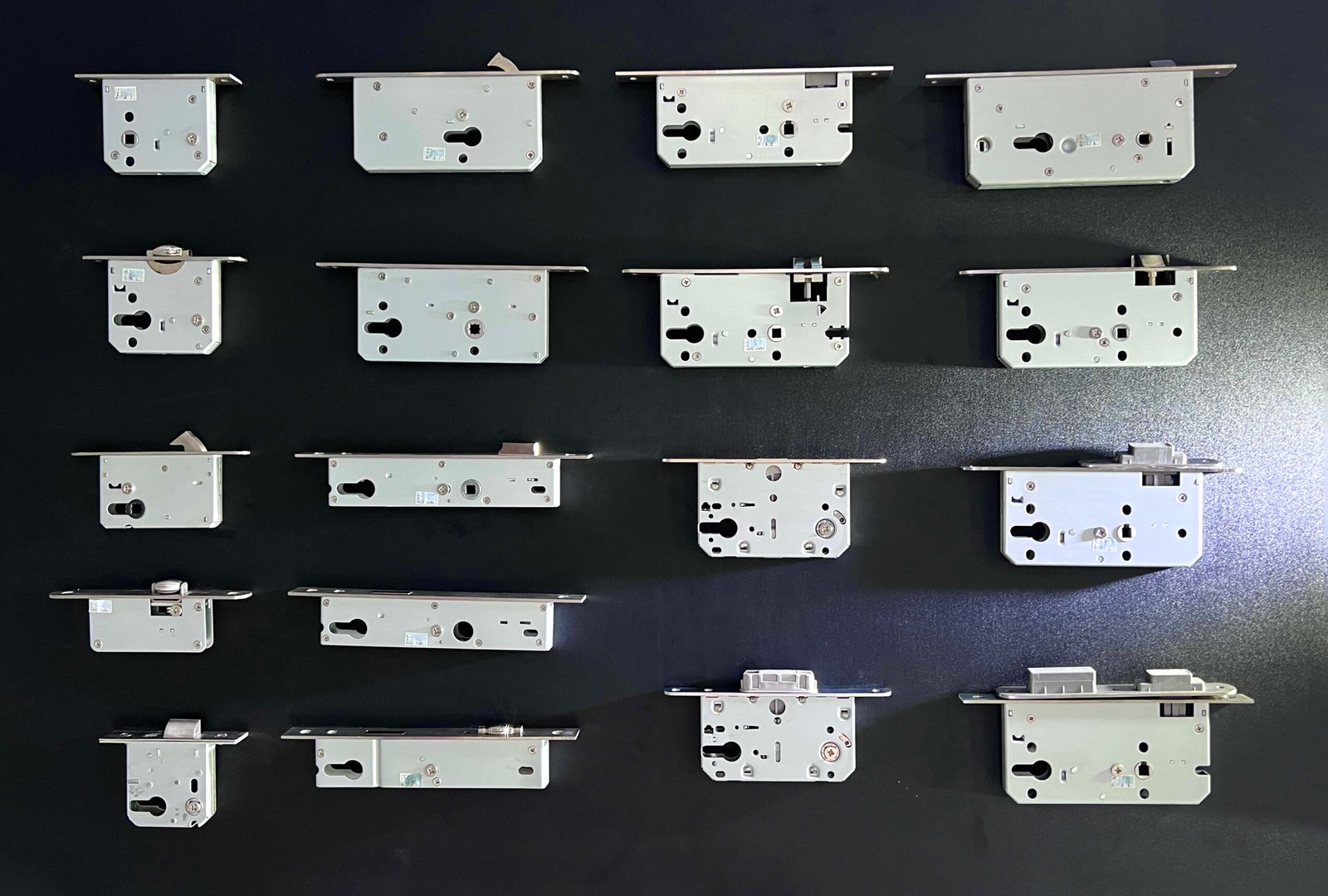
Before I quote a mortise lock, I ask buyers to confirm the model, forend size and finish, bolt types, follower size, cylinder hole, strike plate, dust box, screw holes, drawings, photos, and included accessories.
My practical quotation checklist
I use a checklist because mortise locks have many small choices. These choices affect price, lead time, sample accuracy, and bulk order stability. I first ask for the lock body model or drawing. Then I ask for the forend size, forend material, finish, and screw hole details. I confirm the deadbolt and latch bolt shape. I confirm the follower size and center distance. I confirm the cylinder hole type. I confirm whether the strike plate, dust box, screws, cylinder, keys, thumb turn, handle set, rose, or escutcheon are included.
I also ask if the buyer needs CE or fire-rated documents for the exact product and configuration. I do not promise a certificate for a different product. The certificate must match the product, test scope, and market requirement.
| Quotation item | What I need from the buyer |
|---|---|
| Lock body model | Model number, drawing, or approved sample |
| Forend | Length, width, thickness, corner, material, finish |
| Deadbolt and latch | Type, direction, projection, operation requirement |
| Follower | Square size and center position |
| Cylinder hole | Hole type and cylinder inclusion |
| Strike and dust box | Include or exclude, material, finish |
| Screw holes | Position, diameter, through bolt needs |
| Accessories | Cylinder, key, thumb turn, handle, screws |
| Documents | CE, fire-rated, or other required documents |
| Packing | Bulk packing, inner box, label, barcode |
I prefer clear confirmation before sample making. This saves cost for both sides.
Conclusion
I name mortise lock parts clearly because clear names lead to correct drawings, correct quotations, correct samples, and safer bulk purchasing decisions.
"Mortise lock - Wikipedia", https://en.wikipedia.org/wiki/Mortise_lock. A door-hardware terminology source defines mortise locksets as assemblies that may include the mortised lock body together with operating trim, cylinders, strikes, and related fixing components; this supports treating the quoted item as more than the lock case alone. Evidence role: definition; source type: education. Supports: A neutral door-hardware glossary or educational source should show that a mortise lock or lockset consists of a lock body plus related operating and frame-side components, depending on the specified set.. Scope note: The exact components supplied vary by product specification and contract, so the source would support the terminology context rather than prove any particular packing list. ↩
"agitates fireproofed chariest tuneful Julliard's dustman", https://homepages.math.uic.edu/~leon/mcs360-f07/projects/3-4/dictionary-large-rand.txt. A door-hardware glossary identifies the mortise-lock forend, or faceplate, as the front plate fitted to the door edge and associated with the lock case opening and bolt apertures. Evidence role: definition; source type: education. Supports: A source should define the mortise-lock forend or faceplate as the plate on the door edge through which the latch and bolt project.. ↩
"How to Identify a Commercial Mortise Lock - PDQ Locks", https://www.pdqlocks.com/blog/how-to-identify-a-mortise-lock. Installation guidance for mortise locks describes the faceplate as the door-edge plate fitted over the mortise opening and fastened to the door, which contextualizes its role in both mounting and visible finish coordination. Evidence role: mechanism; source type: education. Supports: A source should explain that the faceplate is installed on the door edge as part of the lock case mounting and remains visible after installation.. Scope note: The source may directly support the mounting and visibility functions, while finish matching is typically a design or specification practice rather than a tested mechanical requirement. ↩
"Lockset - Wikipedia", https://en.wikipedia.org/wiki/Lockset. An encyclopedia or hardware glossary defines a deadbolt as a locking bolt used to secure a door, distinguishing it from spring-latch mechanisms used for temporary closing. Evidence role: definition; source type: encyclopedia. Supports: A source should define a deadbolt as a locking bolt that is not spring-actuated like a latch and is used to secure the door.. ↩
"[PDF] PHYSICAL SECURITY OF DOOR ASSEMBLIES AND COMPONENTS", https://www.ojp.gov/pdffiles1/nij/32269.pdf. Door-lock performance standards classify locks through specified tests of the relevant lock product or assembly, supporting the point that a deadbolt component alone does not establish the security grade of the installed door system. Evidence role: expert_consensus; source type: institution. Supports: A standards or certification source should show that lock performance classifications are assigned under defined test standards and product configurations, not from one component in isolation.. Scope note: The source would support the standards logic generally; the exact dependency on door, frame, and cylinder varies by the particular standard and certification scope. ↩
"PZ room door mortise lock - forend width 24 mm", https://www.sullus.com/kbv-pz-room-door-mortise-lock-forend-24-mm.html. Technical specifications for mortise locks commonly state deadbolt throw as a measured projection, and examples include millimetre values such as 20 mm or 24 mm in particular product or market specifications. Evidence role: general_support; source type: institution. Supports: A standards extract, technical guide, or institutional specification should show that deadbolt throw/projection is specified numerically and that values around 20 mm or 24 mm appear in some lock specifications.. Scope note: This would support the existence of such values in specifications, not establish them as universal requirements for all markets. ↩
"Door Latch Parts Terminology", https://www.inspirehardware.com/blogs/news/door-latch-parts-terminology?srsltid=AfmBOoor2ruNd-cEuhZ1EJvp-AtAokHWktsK_TWWdWBaA-kGGRY1og5F. A door-hardware glossary defines a latch bolt as a spring-actuated bolt, commonly bevelled, that engages the strike to hold the door in the closed position until retracted by the operating trim. Evidence role: definition; source type: education. Supports: A door-hardware glossary should define a latch bolt as a spring-operated bevelled bolt that engages the strike to keep the door closed.. ↩
"Door Latch Parts Terminology - Inspire Hardware", https://www.inspirehardware.com/blogs/news/door-latch-parts-terminology?srsltid=AfmBOorSLomIqosMueBe3PArsbPJjF7_T_K5lC8BLJIjbAQWp7ky3DMK. Educational door-hardware materials explain that a bevelled spring latch retracts when it contacts the strike during closing and then extends under spring force into the strike opening to hold the door shut. Evidence role: mechanism; source type: education. Supports: An installation manual, engineering explanation, or educational hardware source should describe how the bevelled latch retracts on contact with the strike and returns by spring force into the keep/opening.. ↩
"RLS 23 - Spindles - YouTube",
. A door-hardware glossary identifies the follower or spindle hub as the square drive aperture that receives the handle spindle and transmits lever movement to the latch mechanism. Evidence role: definition; source type: education. Supports: A source should define the lock follower as the hub or square opening that receives the handle spindle and transfers lever rotation to the latch mechanism.. ↩"Standard Door Handle / Knob Square Spindle 8mm / Bundle", https://affdoorhardware.com/standard-door-handle-knob-square-spindle-8mm-bundle/?srsltid=AfmBOopdipR7vNeWre2VAkR22OpDcOAOw9Dw2-bJJiDbhLsadxnhtBOJ. Door-hardware specifications identify the follower or spindle as a square drive dimension, with millimetre sizes such as 7 mm, 8 mm, or 9 mm appearing in particular hardware systems and markets. Evidence role: general_support; source type: institution. Supports: A standards document, technical guide, or institutional hardware specification should show that square spindle/follower dimensions are specified in millimetres and that 7 mm, 8 mm, or 9 mm square formats occur in door hardware.. Scope note: The source would document recognized dimensional examples, not prove their frequency or suitability for every country. ↩
"Mortise lock", https://en.wikipedia.org/wiki/Mortise_lock. Door-hardware references describe the mortise-lock cylinder opening as the profile cut-out that receives the corresponding lock cylinder, such as a European profile cylinder where that format is specified. Evidence role: definition; source type: education. Supports: A source should define the cylinder opening/profile in a mortise lock and explain that it must correspond to the cylinder type, such as a Euro profile cylinder.. Scope note: The source would support the compatibility principle; the exact cylinder profile depends on the regional standard and lock design. ↩
"Electric strike - Wikipedia", https://en.wikipedia.org/wiki/Electric_strike. An encyclopedia or door-hardware glossary defines a strike plate as the frame-mounted plate with openings that receive the latch bolt or deadbolt when the door is closed or locked. Evidence role: definition; source type: encyclopedia. Supports: A source should define a strike plate as the metal plate fixed to the frame with openings that receive the latch or bolt.. ↩