Choosing a Front Door Lock Set: Tips to Follow?
Choosing a front door lock set looks simple until the wrong model causes installation delays, security doubts, finish complaints, or after-sales claims. The risk grows in bulk procurement because one small mismatch can affect hundreds of doors.1 I recommend starting with the door, the project, and the market requirements before comparing styles or prices.
A front door lock set should be chosen by checking security requirements, door thickness, cut-out size, backset, center distance, lock body compatibility, opening direction, material durability, and the application scenario. Buyers should also verify relevant certifications, grades, and fire or emergency-exit requirements according to the target market and project specification.
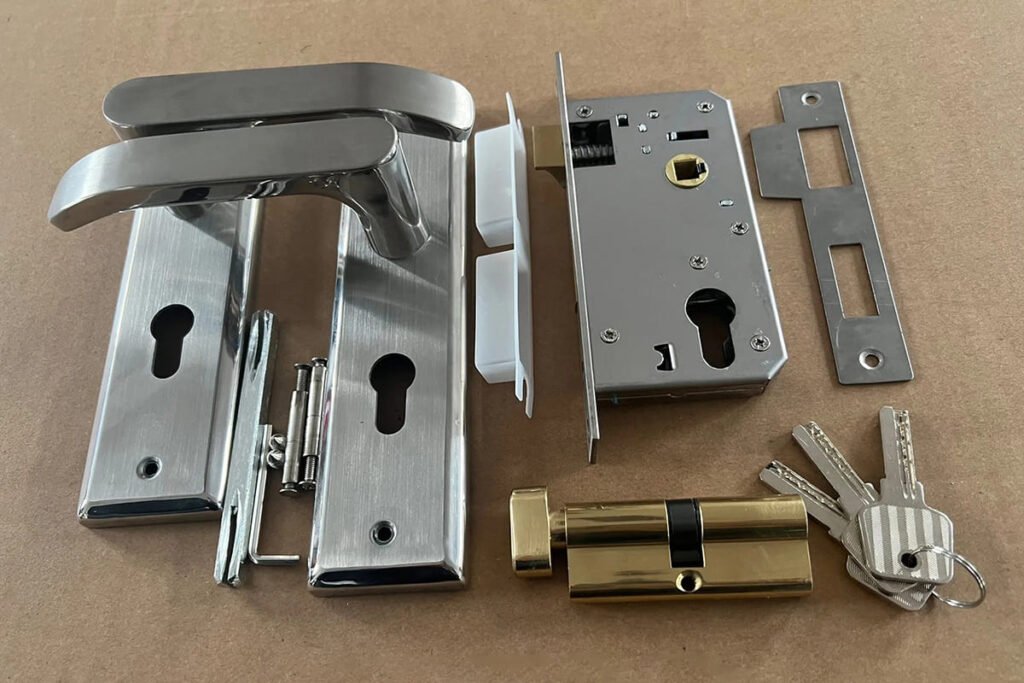
In my experience working with overseas door factories and hardware buyers, the best lock set is rarely a single product decision. It is a matched system decision. The lock body, cylinder, lever handle, escutcheon, screws, strike plate, finish, and door preparation must work together.
Why Should Security Come First When Choosing a Front Door Lock Set?
A beautiful lock can still be the wrong lock if it does not meet the security expectation of the entrance door. Buyers often compare design and price first, but this can create a weak product position in the market. Security should guide the shortlist before appearance.
A front door lock set should be selected first by security level, then by design and finish. Buyers should review lock type, cylinder protection, latch and deadbolt structure, and applicable standards such as ANSI or EN 122092 where required. Exact grade requirements must match the project, door type, and target market.
Dive deeper: How I evaluate security before appearance
When I review a lock set for an entrance door, I do not start with the handle shape. I start with the question: What risk does this door need to manage? A private villa entrance, apartment entrance, hotel room entrance, and commercial front entrance can all require different hardware solutions.
For B2B buyers, security evaluation should be practical and document-based. The goal is not to choose the most expensive lock every time. The goal is to choose a lock set that matches the market expectation and project specification.
Key security factors include:
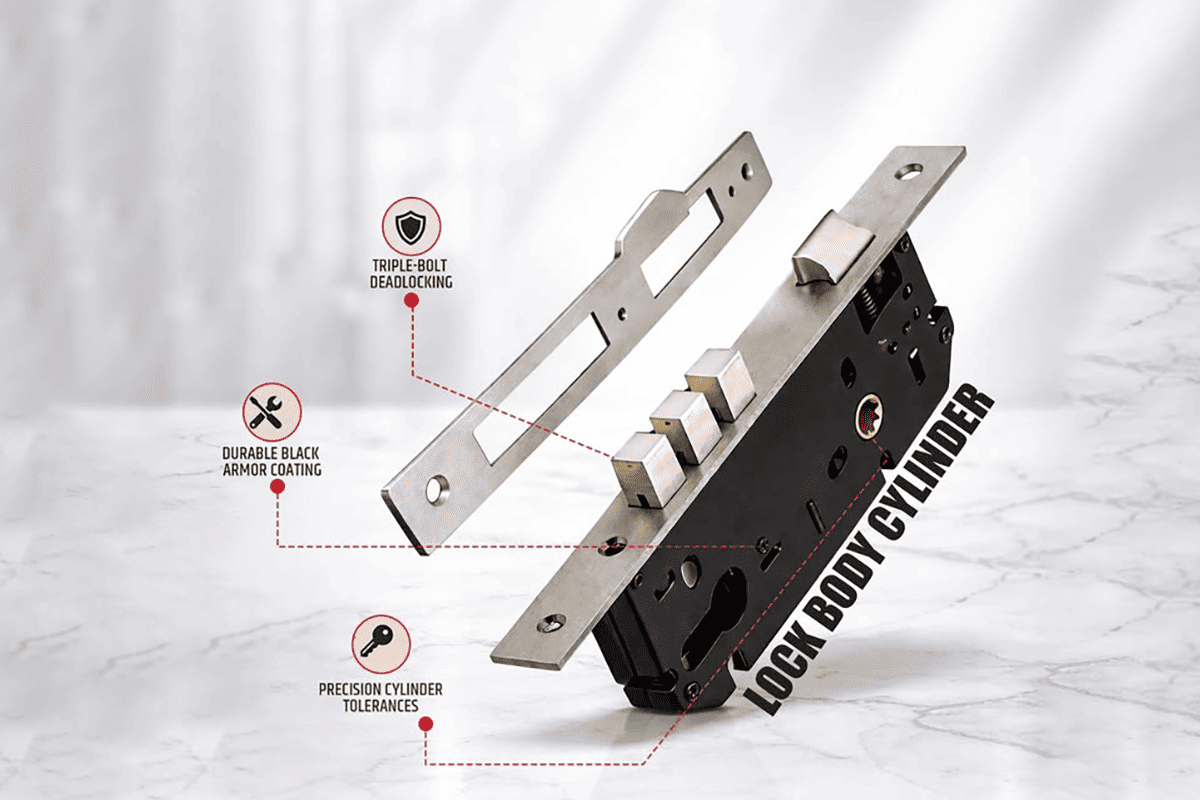
- Lock body structure: Mortise lock bodies are common in many Europe, Middle East, and Southeast Asia projects3 because they can provide a stable locking structure and clean door appearance.
- Deadbolt design: A stronger deadbolt generally improves resistance compared with a simple latch-only solution.4
- Cylinder type: Buyers should check cylinder profile, key system, anti-drill features, anti-pick design, and master key requirements if applicable.
- Strike plate strength: A lock is only as reliable as its engagement with the frame.5
- Handle and escutcheon protection: Weak trim can reduce the real security of the system.
- Certification documents: CE, fire-rated reports, ANSI grades, or EN standards should be verified according to the actual product and target market.
Here is a simple way to compare security expectations:
| Application Scenario | Common Buyer Concern | Possible Lock Direction | Verification Needed |
|---|---|---|---|
| Apartment entrance | Daily use and basic security | Mortise lock with suitable cylinder | Market standard and project spec |
| Villa front door | Higher perceived security | Stronger mortise or multi-point system | Door structure and test documents |
| Commercial entrance | Heavy use and access control | Mechanical or electronic solution | Usage cycle and maintenance plan |
| Emergency route door | Safe exit under emergency | Escape or anti-panic function | Local code and project requirement |
I have seen buyers lose time because they selected a lock set based on catalog appearance, then discovered the product could not meet the project’s required standard. This is avoidable. Before confirming a model, I suggest asking suppliers for:
- Technical drawing
- Material specification
- Surface finish details
- Available certificates or test reports
- Installation instructions
- Sample for fit and function testing
Certifications should not be treated as marketing words. They should be treated as documents that buyers verify for the correct product model, standard, test scope, and validity.
For entrance doors, standards such as ANSI Grade 16 or EN 12209 Grade 37 may be relevant in some markets or projects. However, I would not say one grade is universally required. Exact requirements depend on the country, project specification, door construction, fire requirements, and customer positioning.
How Do Door Dimensions Affect a Front Door Lock Set?
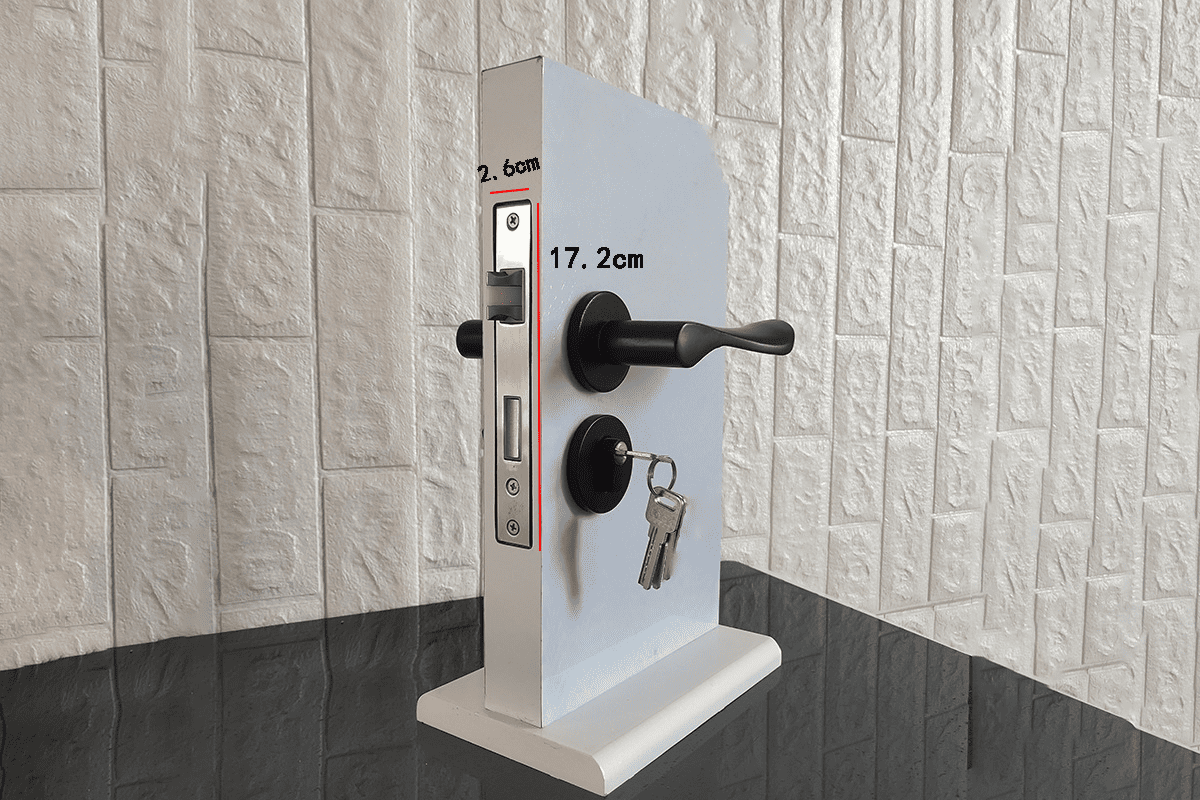
A lock set can look perfect in a catalog and still fail on the production line if the dimensions do not match the door. This is one of the most common procurement risks. Door thickness, backset, center distance, and lock body size must be confirmed early.
A front door lock set must match the door thickness, cut-out size, backset, center distance, lock body dimensions, opening direction, handle fixing method, and escutcheon design. Buyers should confirm these details with drawings and samples before bulk purchase to avoid installation rework and delivery delays.
Dive deeper: Fit is a technical decision, not a small detail
In manufacturer-side communication, I often ask buyers for door drawings before I recommend a lock. Some buyers first send a handle photo and ask for a price. That can work for a rough quotation, but it is not enough for production approval.
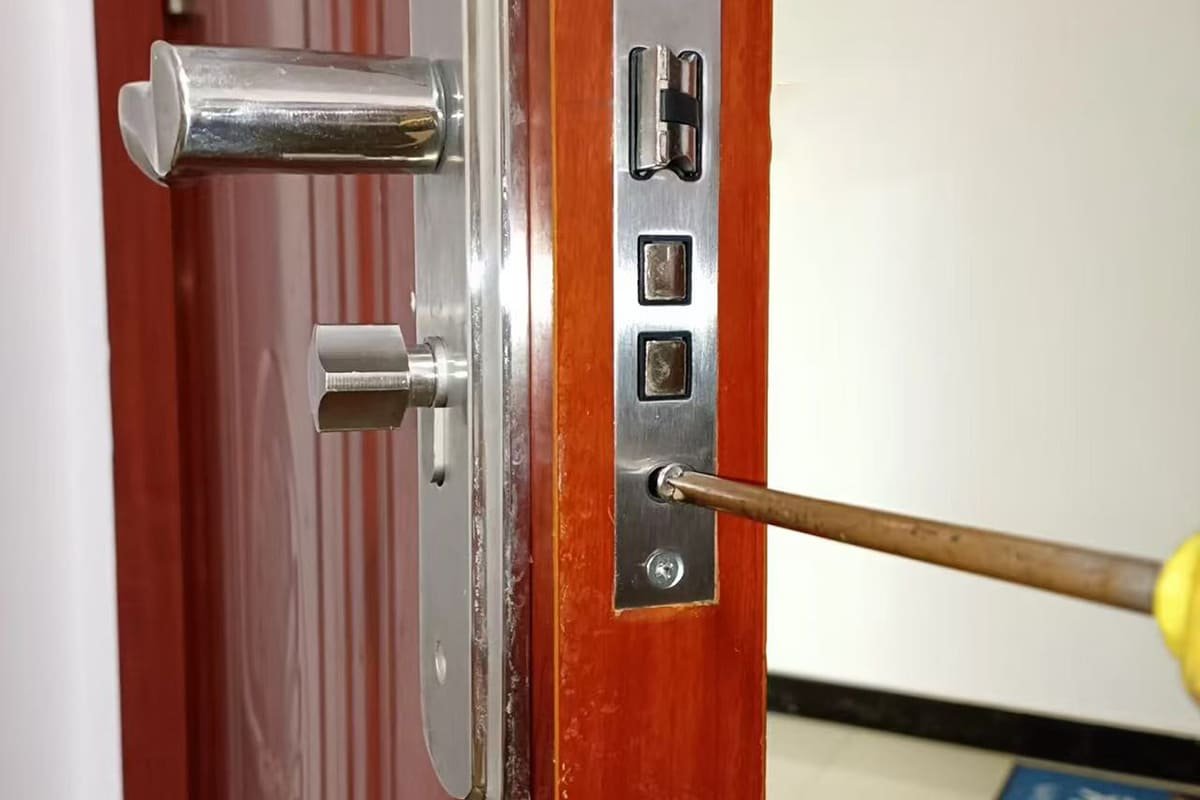
A front door lock set includes several components that must align physically. If one dimension is wrong, the whole system may become difficult or impossible to install.
Important dimensions include:
- Door thickness: Common entrance door thickness may vary by region and door type. A lock set suitable for a 40 mm timber door may not fit a 70 mm metal security door.
- Backset8: This is the distance from the door edge to the center of the spindle or keyhole, depending on lock design.
- Center distance: This usually refers to the distance between the handle spindle and cylinder center.
- Lock body size: Height, width, case depth, and faceplate size must match the door cut-out.
- Cut-out size: Existing door machining may limit which lock body can be used.
- Opening direction: Left-hand, right-hand, inward, and outward opening should be confirmed.
- Handle compatibility: Spindle size, fixing screw position, rose or plate size, and spring mechanism all matter.
- Cylinder length: The cylinder should suit door thickness and escutcheon thickness.
Here is a practical compatibility checklist:
| Item to Confirm | Why It Matters | Common Risk if Ignored |
|---|---|---|
| Door thickness | Determines cylinder and screw length | Cylinder too short or too long |
| Backset | Aligns lock with handle position | Door machining does not match |
| Center distance | Matches handle and cylinder layout | Escutcheon holes misalign |
| Lock case depth | Fits inside door edge | Lock body cannot be inserted |
| Faceplate size | Matches door edge preparation | Visible gaps or rework needed |
| Opening direction | Ensures latch and handle function | Incorrect latch direction |
| Strike plate | Aligns with frame | Poor closing or rattling |
I prefer approval samples before bulk orders
For export orders, I always prefer a sample confirmation process before mass production. A sample can reveal small problems that drawings do not show clearly, such as:
- Handle return force
- Finish consistency
- Cylinder projection
- Screw length
- Strike plate alignment
- Door closing feel
- Packaging protection
For door factories, this step is especially important because the lock set affects the assembly line. If the factory has already prepared door cut-outs for one lock body size, changing to another model may require new tooling or machining adjustment.
For hardware brand buyers, compatibility also affects after-sales costs. If installers complain that the screws are short, the spindle is loose, or the cylinder does not sit flush, the buyer’s brand reputation suffers even if the lock material itself is acceptable.
This is why I view fit as part of quality control. A well-selected front door lock set should be easy to install, stable after installation, and repeatable across batch production.
Which Front Door Lock Set Type Fits Different Applications?
A lock type that works well for one building can be wrong for another. Buyers sometimes ask for the “best” lock type, but the better question is: best for which door, user, region, and risk level? Application should decide the lock direction.
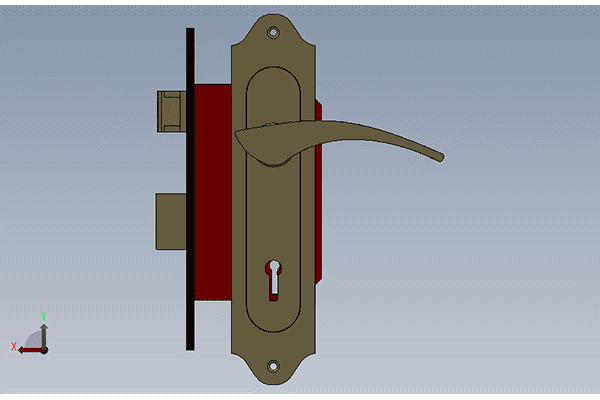
The right front door lock set depends on the application scenario. Standard entrance doors may use mortise lock sets, higher-security doors may require multi-point locking, and emergency-exit doors may need anti-panic or escape-function locks. Buyers should verify function and compliance according to the project and local market requirements.
Dive deeper: Do not make one lock type solve every problem
Different lock types solve different problems. In procurement, I prefer to define the application first, then choose the mechanism.
Common front door lock set options
| Lock Type | Where It Often Fits | Main Strength | Main Procurement Concern |
|---|---|---|---|
| Standard mortise lock set | Apartments, residential doors, interior entrance areas | Stable structure and clean appearance | Must match door preparation |
| Multi-point lock set | Higher-security entrance doors, villas, some metal doors | Locks at several points on the door | Requires accurate door and frame alignment |
| Anti-panic lock | Public buildings and emergency exit routes | Supports emergency exit function | Must match local code and project requirements |
| Electronic lock set | Offices, apartments, hospitality, access-controlled doors | User management and convenience | Requires power, maintenance, and support |
| Cylinder deadlock combination | Some residential or market-specific doors | Extra locking point | Installation and user habit must be considered |
Mortise lock sets
Mortise locks are widely used in architectural door hardware because the lock body is installed inside the door edge. This creates a clean surface and allows strong integration with lever handles and cylinders. For many B2B buyers, a mortise lock set is a balanced choice because it supports standardized production and a wide range of finishes.
However, mortise locks require accurate door machining. Buyers must confirm case size, backset, center distance, faceplate, and strike plate.
Multi-point lock sets
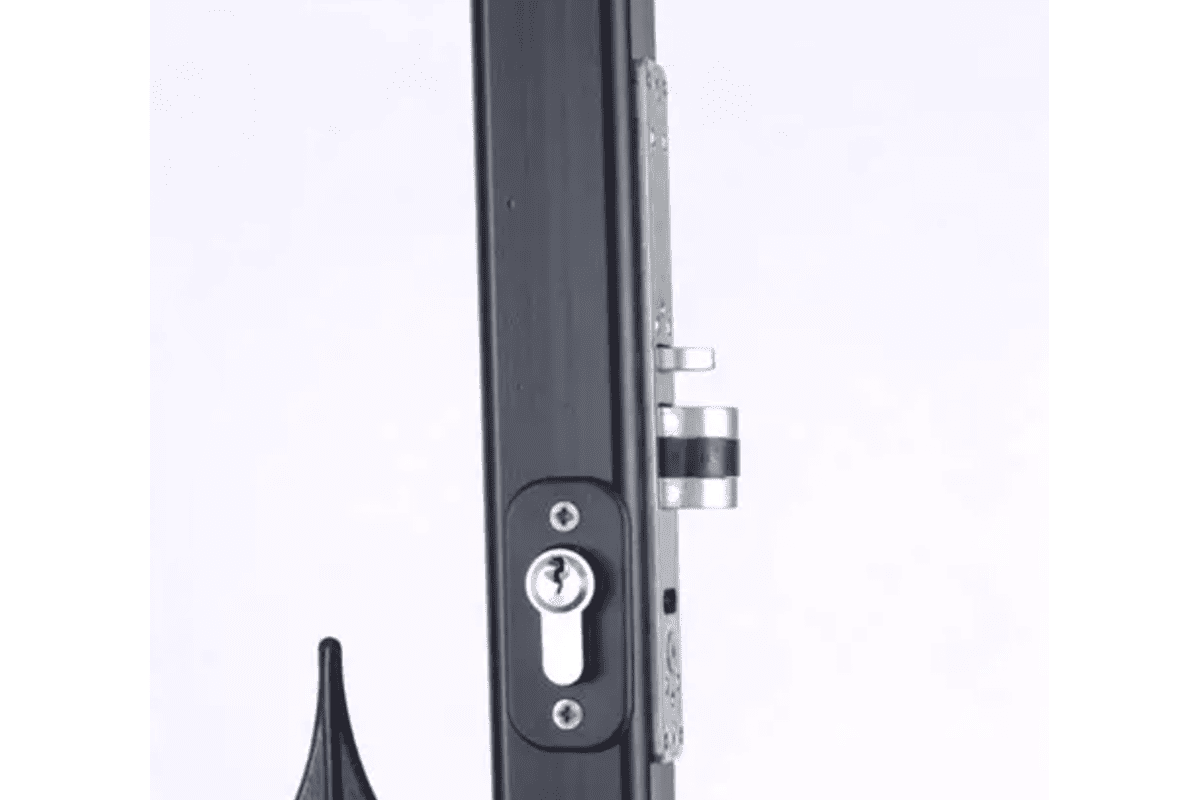
Multi-point locks can improve door compression and security by locking at more than one point.9 They may be useful for taller doors, villa doors, metal entrance doors, or projects where customers expect higher security.
Still, multi-point locks are not automatically best for every project. They require better door and frame precision. If the door warps or the frame is not aligned, users may feel hard operation or poor locking. Buyers should test multi-point systems with the actual door profile.
Anti-panic and escape-function locks
Public buildings, commercial projects, and emergency routes may require escape functions.10 In these cases, the lock must support safe exit under defined conditions. The exact requirement depends on project specification and local regulations.
I recommend buyers avoid casual substitution here. If the project calls for an emergency exit function, the hardware should be reviewed by qualified professionals and supported by relevant documents.
Electronic lock sets
Electronic locks can be suitable when user management matters. They may support cards, PIN codes, fingerprints, mobile apps, or access-control integration. However, electronic does not always mean better. It means different.
Buyers should consider:
- Battery or power supply
- Failure mode
- Mechanical key override
- Waterproof rating claims
- Software or app support
- Spare parts availability
- Installer training
- Warranty and after-sales plan
A mechanical front door lock set may be better for a price-sensitive wholesale channel. An electronic model may be better for serviced apartments or managed buildings. The right answer depends on usage habit and support capacity.
Should You Choose a Mechanical or Electronic Front Door Lock Set?
Many buyers feel pressure to add electronic locks because the market looks modern. However, electronic systems add maintenance, power, software, and user-management questions. Mechanical systems remain strong where simplicity, cost control, and long service life matter.
A mechanical front door lock set is usually simpler to install, maintain, and stock, while an electronic lock set offers access control and user convenience. The better choice depends on budget, user habits, power supply, installation skill, after-sales support, and the product positioning of the target market.
Dive deeper: I compare total ownership cost, not only purchase price
When buyers compare mechanical and electronic locks, the unit price is only one part of the decision. I prefer to compare total ownership cost. This includes installation time, support cost, return rate risk, spare parts, packaging, training, and user complaints.
Mechanical lock set advantages
Mechanical lock sets remain popular because they are:
- Easy to understand
- Less dependent on power
- Easier to install in many markets
- Suitable for wholesale distribution
- Easier to repair with standard parts
- Often more predictable in long-term use
For door factories, mechanical lock sets also support stable production. The same lock body, cylinder, handle, and accessory configuration can be repeated across many door models.
Mechanical lock set limitations
Mechanical locks do not provide flexible user management. If a key is lost, the user may need to replace or rekey the cylinder. For apartments, offices, or rental spaces, this can be less convenient.
Electronic lock set advantages
Electronic lock sets may provide:
- PIN, card, fingerprint, or mobile access
- Temporary user codes
- Audit trails in some systems
- Better fit for managed properties
- Modern market positioning
These features can help hardware brands build higher-value product lines. However, the supply chain must support the product after sale.
Electronic lock set limitations
Electronic products have more variables.11 Buyers should evaluate:
| Factor | Why It Matters |
|---|---|
| Battery life | Users may complain if battery replacement is frequent |
| Emergency power | Users need a way to open the door when power is low |
| Mechanical override | The lock should have a practical backup method |
| Weather exposure | Outdoor electronics need verified protection |
| Software support | App or system issues can create after-sales pressure |
| Spare parts | Keypads, boards, motors, and covers may need replacement |
| Installer training | Incorrect installation can cause malfunction |
For importers, electronic locks also require stronger documentation and testing before launch. Packaging must protect electronic components. User manuals must be clear. The buyer should check whether the supplier can provide technical support after shipment.
I do not present electronic locks as “newer is better.” I present them as suitable for certain market needs. A mechanical front door lock set may still be the most reliable and cost-effective choice for many door manufacturers, wholesalers, and project buyers.
How Does Weather Exposure Change Front Door Lock Set Selection?
Outdoor conditions can damage a lock set faster than buyers expect. Rain, humidity, coastal salt air, dust, and high temperature can affect finish, corrosion resistance, cylinder movement, and handle performance. A good entrance lock must match the environment, not just the door.
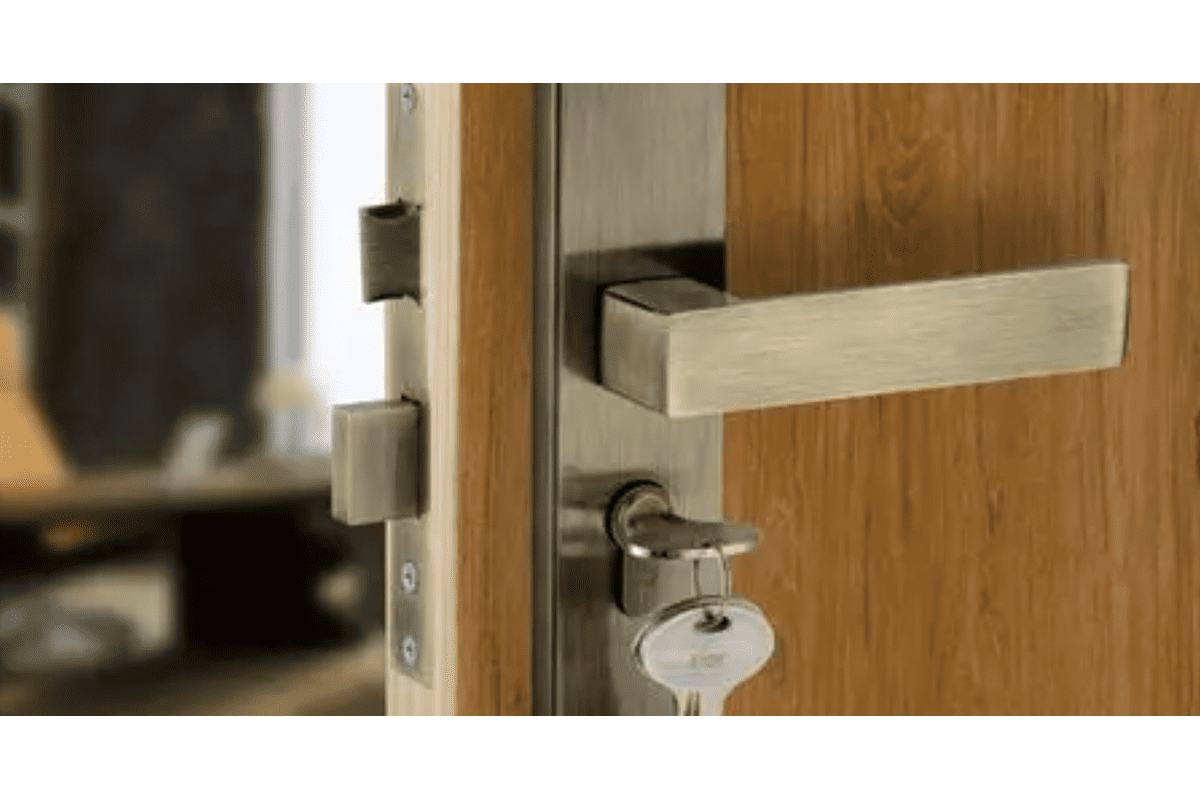
A front door lock set used outdoors should be evaluated for material, finish durability, corrosion resistance, water exposure, cylinder protection, and maintenance requirements. Stainless steel 304 or 316 may be suitable for many exposed applications, but buyers should verify the exact material grade and supplier test documents before confirmation.
Dive deeper: Outdoor hardware needs verified material and finish control
In export hardware, finish complaints are some of the most expensive after-sales problems. A lock may function well, but if the finish stains, rusts, peels, or fades too quickly, the customer sees it as a quality failure.
Outdoor exposure changes the buying criteria. The lock set must be reviewed as a material and surface-treatment system.
Main environmental risks
- Rain exposure can affect the cylinder, internal parts, and surface finish.
- High humidity can accelerate corrosion on low-grade materials.
- Coastal air contains salt, which is aggressive to many metals and finishes.
- Dust and sand can affect cylinder operation in some regions.
- UV exposure can change the appearance of some coatings.
- Temperature changes can affect expansion, contraction, and user feel.
Material considerations
Common material options include:
| Material | Typical Use | Buyer Notes |
|---|---|---|
| Stainless steel 304 | Many architectural hardware applications | Good general corrosion resistance, but verify grade |
| Stainless steel 31612 | Coastal or more corrosive environments | Better corrosion resistance than 304 in many salt-air conditions |
| Zinc alloy | Handles and decorative parts | Needs reliable plating or coating |
| Brass | Cylinders and premium components | Good machinability and stable performance |
| Iron or low-grade steel | Cost-sensitive parts | Requires strong surface protection |
If a supplier says “stainless steel,” buyers should ask which grade. If a document mentions a grade that looks unusual, such as “3004,” I would verify whether it is a typo, a different alloy reference, or a real specified material before publishing or purchasing.
Finish durability matters
Surface finish is not only decoration. It protects the product and supports brand consistency. Common finishes may include satin stainless steel, polished stainless steel, PVD, powder coating, electroplating, matte black, antique finishes, or custom colors.
For bulk orders, buyers should confirm:
- Finish sample approval
- Color tolerance
- Salt spray test requirements if applicable
- Packaging method
- Batch consistency
- Cleaning and maintenance instructions
Waterproofing claims need care
Many lock suppliers describe products as waterproof or weather resistant. Buyers should ask what that means. Does the claim apply to the handle, the cylinder cover, the electronic keypad, or the whole installed product? Has it been tested? Under which standard?
For electronic locks, this question becomes more important. Outdoor keypads, circuit boards, and battery compartments need stronger protection than mechanical handles. The project team should verify the rating and installation conditions.
A front door lock set for a coastal villa project should not be treated the same as a lock for an interior apartment corridor. The environment should influence the material, finish, cylinder cover, maintenance plan, and packaging.
How Should Buyers Evaluate a Front Door Lock Set Supplier?
Even a good lock design can become risky if the supplier cannot control quality, finish consistency, documentation, and delivery. For bulk buyers, supplier selection is part of product selection. A reliable factory helps reduce hidden procurement costs.
Buyers should evaluate a front door lock set supplier by checking manufacturing capability, product drawings, sample quality, finish consistency, certification documents, inspection process, customization ability, packaging, delivery stability, and after-sales support. The supplier should prove repeatable production, not only provide attractive catalog photos.
Dive deeper: A matched lock set needs a matched supplier process
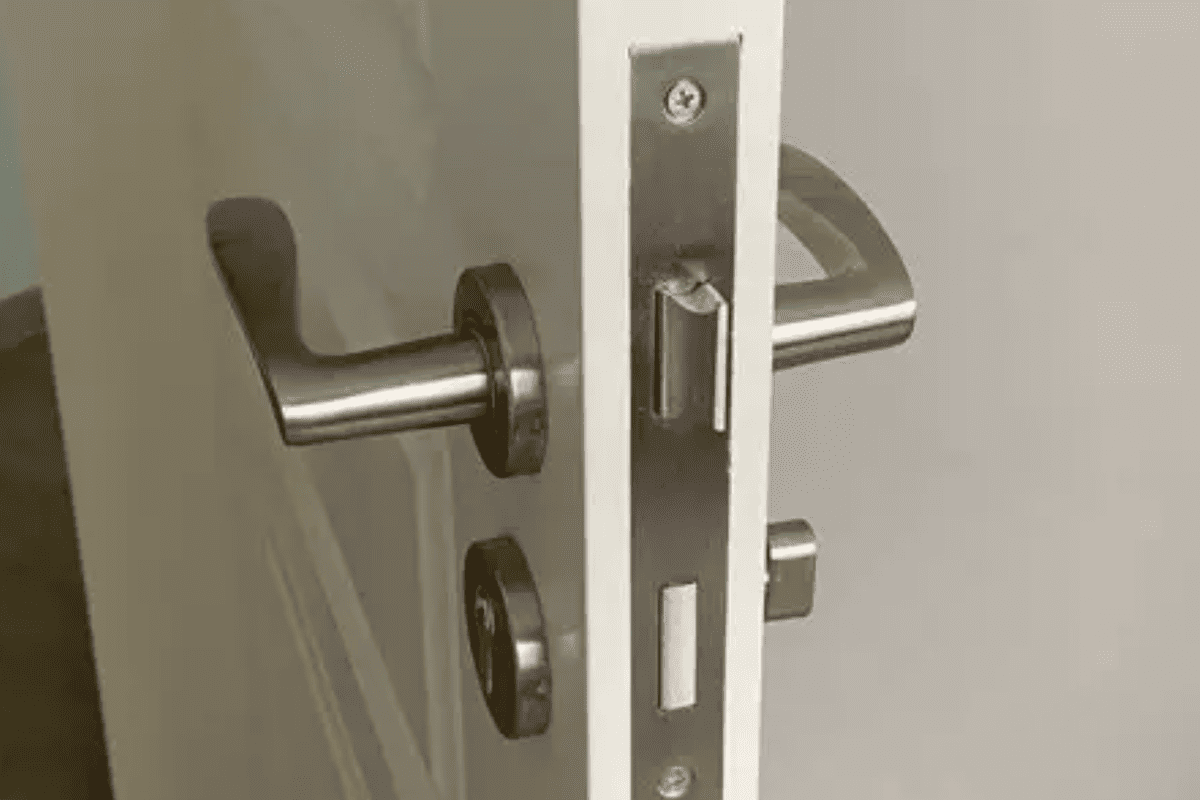
A complete lock set is not just one item from one production step. It may include a lock body, cylinder, lever handle, rosette or plate, keys, screws, spindle, strike plate, dust box, and packaging. If these parts are not controlled as one system, buyers may face problems during installation.
At SDH Hardware, our manufacturer-side work has made me pay close attention to system matching. I usually look at whether the supplier can provide complete front door hardware configurations, not only one attractive component.
Supplier evaluation checklist
| Evaluation Area | What to Check | Why It Matters |
|---|---|---|
| Factory capability | Production lines, workers, machinery | Supports stable bulk supply |
| Product range | Mortise locks, cylinders, handles, hinges | Helps one-stop sourcing |
| Technical drawings | Dimensions and installation details | Reduces compatibility risk |
| Sample quality | Function, finish, packaging | Shows real production level |
| Certification documents | CE, fire-rated, EN or ANSI documents where applicable | Supports market access verification |
| QC process | Raw material, production, final inspection | Controls batch consistency |
| Customization | Size, finish, accessories, branding | Supports regional market needs |
| Delivery control | Lead time and capacity | Reduces supply chain risk |
| After-sales support | Spare parts, documentation, response | Reduces long-term buyer cost |
Questions I suggest asking suppliers
Before confirming a bulk order, buyers can ask:
- Can you provide the exact technical drawing for this lock body?
- Which door thickness range does this configuration support?
- What backset and center distance are available?
- What cylinder lengths can be supplied?
- Which finishes are stable for bulk production?
- Can you provide finish samples before order confirmation?
- Which certificates or test reports apply to this exact model?
- Can you support OEM or ODM customization?
- What is your standard inspection process?
- How do you pack the lock set to protect the finish during shipment?
Conclusion
Choosing a front door lock set should start with security, door compatibility, application scenario, and environmental exposure. Style and price still matter, but they should come after the technical basics are clear. Buyers should verify grades, certificates, materials, drawings, and samples according to the target market and project requirements. If you need matched lock bodies, cylinders, lever handles, finishes, and ODM configurations for bulk supply, SDH Hardware can support practical front door hardware selection and factory-direct production.
"Why Defects Keep Repeating in Production: Root Cause ...", https://www.linkedin.com/posts/isyra-qualibrain_qualitymanagement-manufacturing-qualitycontrol-activity-7458816597604921344-4cef. Quality-management and construction-rework literature describes how specification errors in repeated components can propagate across batches or projects, supporting the article’s warning that a small lock-set mismatch may have large procurement consequences. Evidence role: general_support; source type: research. Supports: A neutral source should support the principle that repeated component specifications in production or construction can multiply defects, rework, and delay risks.. Scope note: The support is contextual rather than lock-specific unless the source directly discusses door hardware. ↩
"Product Classification & Grade Levels – BHMA Standards", https://buildershardware.com/ANSI-BHMA-Standards/Product-Grade-Levels. ANSI/BHMA lock standards and EN 12209 provide classification and performance criteria for mechanical door locks and latches, supporting their use as reference standards when evaluating lock-set suitability. Evidence role: definition; source type: institution. Supports: A standards or institutional source should define the scope of ANSI/BHMA lock standards and EN 12209 and show that they classify or test lock performance.. Scope note: These standards establish test and classification frameworks but do not by themselves prove that any specific product complies. ↩
"Mortise lock - Wikipedia", https://en.wikipedia.org/wiki/Mortise_lock. Reference sources describe mortise locks as lock cases fitted into a pocket cut in the door edge and as a long-established form of architectural door hardware, giving contextual support to their common use in building projects. Evidence role: general_support; source type: encyclopedia. Supports: A neutral reference should explain what mortise locks are and indicate their established use in architectural door hardware.. Scope note: A general reference may not verify the specific regional prevalence in Europe, the Middle East, and Southeast Asia. ↩
"Home Burglary Prevention Tips", https://www.phillca.gov/448/Home-Burglary-Prevention-Tips. Public-safety guidance commonly treats deadbolts as a stronger residential door-security measure than spring-latch locks, because the bolt engages the frame more securely and is less vulnerable to simple latch manipulation. Evidence role: mechanism; source type: government. Supports: A government or public-safety source should explain that deadbolts improve door security because they project a solid bolt into the frame and are harder to force than spring latches.. Scope note: The degree of resistance depends on the deadbolt design, strike reinforcement, door frame, and installation quality. ↩
"Burglary Prevention | Lago Vista, TX", https://www.lagovistatexas.gov/551/Burglary-Prevention. Crime-prevention guidance notes that lock performance is affected by strike-plate and door-frame reinforcement, supporting the article’s claim that reliable locking depends on secure engagement with the frame. Evidence role: mechanism; source type: government. Supports: A neutral source should show that proper strike plates, screws, and frame reinforcement affect the strength of a locking system.. Scope note: Such guidance usually addresses residential security generally and may not evaluate each commercial lock-set configuration. ↩
"Product Classification & Grade Levels – BHMA Standards", https://buildershardware.com/ANSI-BHMA-Standards/Product-Grade-Levels. ANSI/BHMA product standards use graded performance classifications for door hardware, with Grade 1 generally representing the highest level within the applicable product category. Evidence role: definition; source type: institution. Supports: A standards body or institutional source should explain ANSI/BHMA grading and the meaning of Grade 1 for applicable lock hardware.. Scope note: The grade applies only to products tested under the relevant ANSI/BHMA standard and does not automatically transfer across unrelated lock types. ↩
"BS EN 12209:2003 – Mechanical Operated Locks, Latches ... - HOPPE", https://www.hoppe.com/in-en/contacts-service/standards/bs-en-12209/. EN 12209 sets classification and performance requirements for mechanically operated locks and latches, supporting the article’s reference to EN grades as project-relevant verification criteria. Evidence role: definition; source type: institution. Supports: A standards source should explain that EN 12209 classifies mechanically operated locks and latches by several performance categories.. Scope note: The meaning of “Grade 3” depends on the specific classification digit being discussed, so the cited source should clarify the relevant category. ↩
"Door Knobs & Backset Explained: Sizes & Measuring", https://www.suffolklatchcompany.com/blogs/news/door-knobs-and-backset-explained?srsltid=AfmBOope5BDPqd0-AYm7dOEExGQcndCdJ_nHF3i3eR_ghxsNLwfA1foK. Door-hardware glossaries define backset as the distance from the door edge to the centerline of the lock bore, spindle, or key cylinder, supporting its use as a critical compatibility dimension. Evidence role: definition; source type: institution. Supports: A door-hardware glossary or standards source should define backset as a standard lock-preparation dimension.. Scope note: The exact measuring point can vary by lock type, so the source should be matched to the lock configuration being discussed. ↩
"Multipoint Locking Systems for Wood Doors", https://aristadoors.com/articles/multipoint-lock-system-door/. Technical descriptions of multipoint locking systems state that they secure a door at several points along the edge, which can improve door compression and distribute locking engagement when the door and frame are properly aligned. Evidence role: mechanism; source type: research. Supports: A neutral technical source should explain that multipoint locks engage a door at multiple positions and can improve sealing or resistance compared with a single-point latch in suitable installations.. Scope note: The support is conditional because actual security and compression depend on installation accuracy, door construction, and frame alignment. ↩
"1910.36 - Design and construction requirements for exit ...", http://www.osha.gov/laws-regs/regulations/standardnumber/1910/1910.36. Building and life-safety codes require means of egress to allow safe exit during emergencies and, in specified occupancies or occupant loads, may require panic or fire-exit hardware on designated doors. Evidence role: general_support; source type: government. Supports: A building-code or safety authority source should show that certain occupancies and egress routes require doors to permit safe emergency exit, sometimes using panic or fire-exit hardware.. Scope note: Exact requirements vary by jurisdiction, occupancy type, occupant load, and adopted code edition. ↩
"NIST.SP.800-53r5.pdf", https://nvlpubs.nist.gov/nistpubs/SpecialPublications/NIST.SP.800-53r5.pdf. Access-control guidance describes electronic locking systems as dependent on power, credentials, control electronics, configuration, and maintenance, supporting the article’s distinction between electronic-lock procurement risks and purely mechanical lock sets. Evidence role: mechanism; source type: government. Supports: A cybersecurity, facilities, or access-control source should explain that electronic access systems depend on power, configuration, electronic components, and maintenance processes.. Scope note: The cited source may address access-control systems broadly rather than standalone consumer electronic lock sets. ↩
"Corrosion Resistance of Stainless Steels Intended to Come ...", https://pmc.ncbi.nlm.nih.gov/articles/PMC6471766/. Materials-science references explain that 316 stainless steel, because of its molybdenum content, generally has greater resistance to chloride-related corrosion than 304 stainless steel, supporting its frequent selection for more corrosive outdoor or coastal conditions. Evidence role: mechanism; source type: education. Supports: A university or materials-science source should explain that 316 stainless steel contains molybdenum and is generally more resistant to chloride-induced corrosion than 304.. Scope note: Actual performance still depends on finish, fabrication, maintenance, exposure severity, and the precise alloy specification. ↩