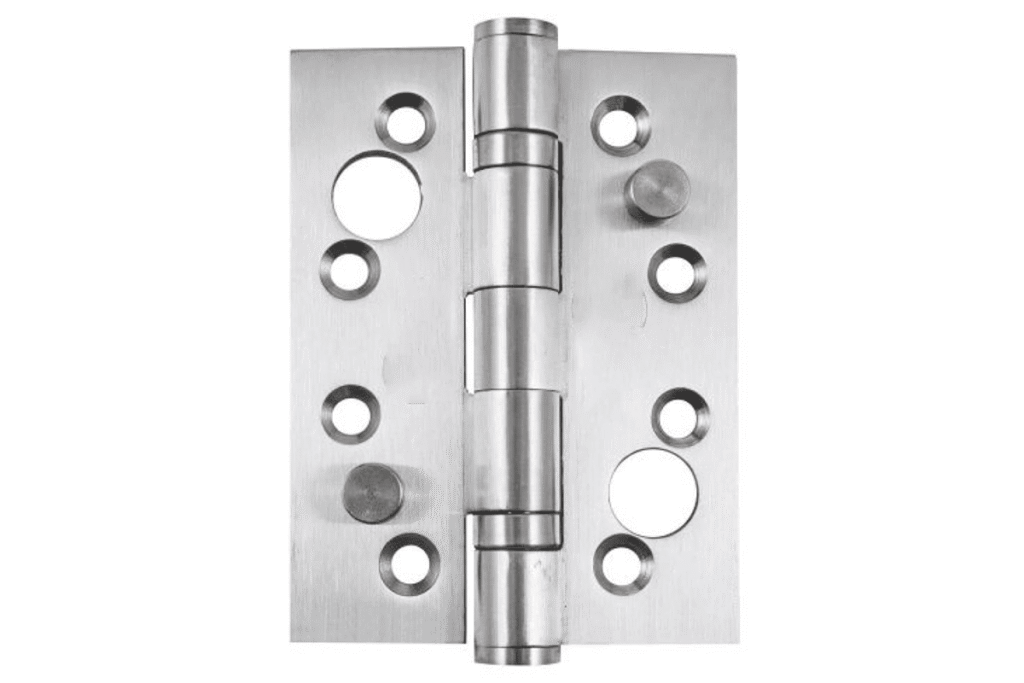
The Importance of Locked Door Hinges for Enhanced Home Security?
Locked door hinges matter because many buyers focus on the lock side of a door and forget the hinge side. That gap can create a weak point, especially when hinge pins are exposed or easy to attack. A better security plan uses anti-tamper hinge structures together with the correct lock, frame, screws, and installation.
Locked door hinges improve home security by helping prevent the door leaf from being removed from the frame when the door is closed.1 They usually use non-removable pins, fixed pin structures, security studs, or anti-tamper lugs. They do not replace a good lock, but they strengthen the hinge side of the door system.
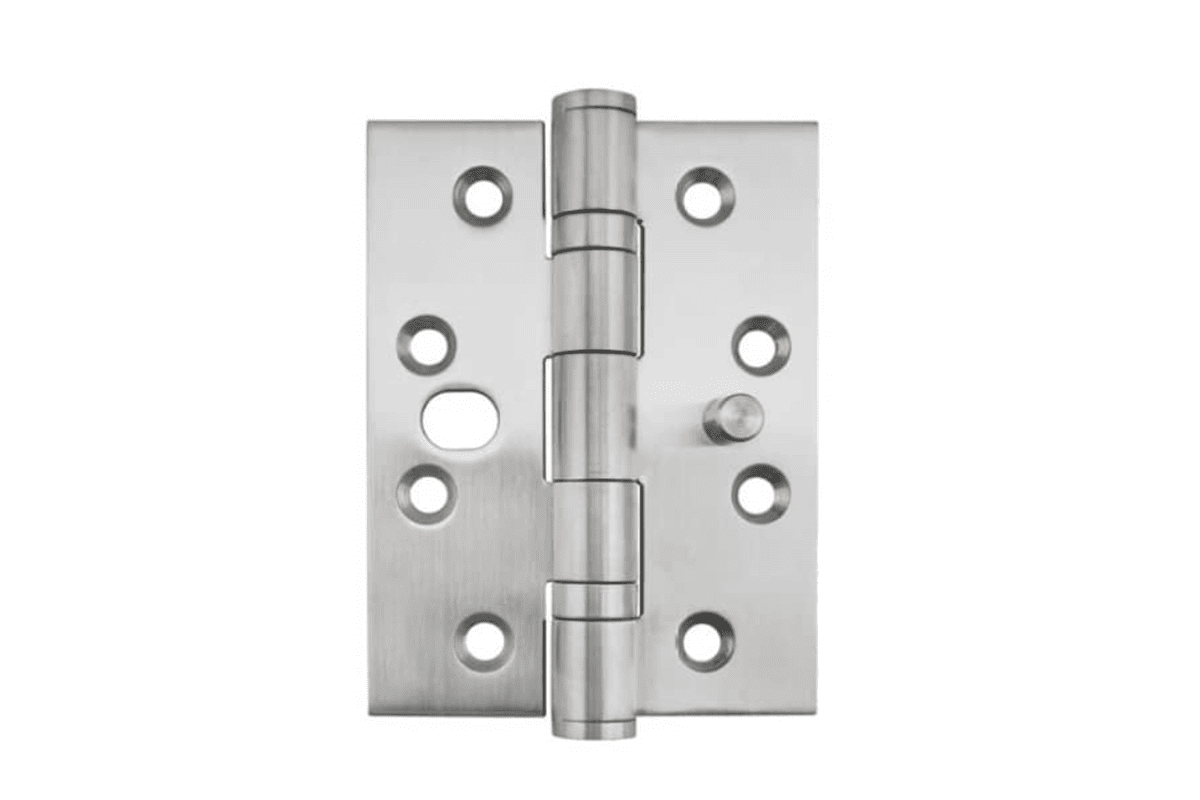
In my work with architectural door hardware, I often see security discussions start with mortise locks, cylinders, and handles. Those parts are important. However, the hinge side also deserves attention because a secure door works as a complete system, not as separate parts2.
Why Do Locked Door Hinges Matter for the Hinge Side of a Door?
A strong lock can still leave a door vulnerable if the hinge side is poorly specified. Buyers may select a certified lock body, a solid cylinder, and a thick door leaf, but then use ordinary hinges with removable pins3. That mismatch can reduce the overall security value of the door.
Locked door hinges matter because they protect the hinge side from common tampering risks. When the door is closed, designs such as non-removable pins and security studs help keep the door leaf connected to the frame, even if someone tries to force or remove the hinge pin.
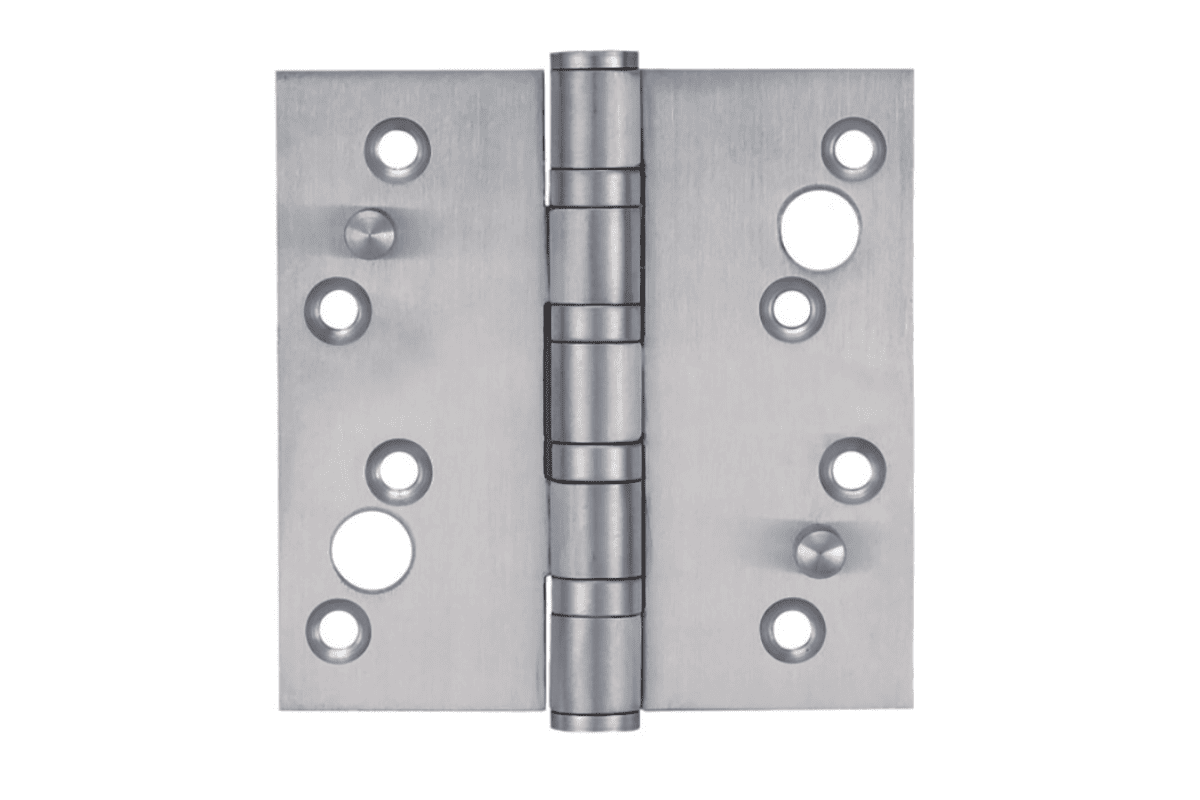
The hinge side is part of the security system
I always explain to buyers that a door has two main resistance zones:
- The lock side, where the latch, deadbolt, cylinder, strike plate, and handle work together.
- The hinge side, where the door leaf rotates and stays attached to the frame.
Many product managers already have detailed lock specifications. They may ask for a Euro standard mortise lock, a brass cylinder, a fire-rated lock body, or a specific handle finish. But hinge specifications are sometimes less detailed. The purchase order may simply say “butt hinge, stainless steel, satin finish.”
That is not enough for higher-security doors.
For entrance doors, villa doors, shop doors, office doors, and apartment doors, the hinge side should be evaluated with the same discipline as the lock side. Locked door hinges are one way to close that gap.
What can happen with ordinary exposed hinge pins?
On some outward-opening doors, the hinge barrel may be accessible from the outside4. If the hinge uses a loose or removable pin, the pin can become an attack point. A standard hinge may perform well for daily opening and closing, but it may not be ideal for a higher-security application.
A security hinge reduces this risk through:
- Non-removable pin construction
- Fixed pin or crimped pin design
- Welded pin ends in some hinge types
- Anti-tamper studs or security lugs
- Stronger screw fixing
- Better plate thickness and material stability
These features are not magic. They do not make the door impossible to attack. However, they add resistance and delay5, which are important in practical security design.
Door security is layered
A secure door should combine several elements:
| Door Component | Security Role | Buyer Evaluation Point |
|---|---|---|
| Door leaf | Provides main barrier strength | Material, thickness, core structure |
| Frame | Holds the door under load | Steel thickness, fixing method, alignment |
| Lock body | Controls latching and locking | Certification, bolt throw, case strength |
| Cylinder | Controls key access | Key system, anti-drill and anti-pick features |
| Hinges | Keep leaf attached to frame | Pin design, studs, plate thickness, screw quality |
| Installation | Connects all parts correctly | Gap control, screw depth, frame fit |
I have seen cases where the hinge itself was good, but the installation was poor. The screw length was too short, or the frame reinforcement was weak. In those cases, even a better hinge cannot perform as intended. This is why I treat locked door hinges as part of a complete door system, not as a standalone anti-burglary product.
What Features Define Locked Door Hinges in Real Product Specifications?
The phrase “locked hinge” can confuse buyers because it does not always mean a hinge with a key lock. In door hardware sourcing, the practical meaning is usually an anti-tamper hinge6. The risk is that unclear wording leads to the wrong product being quoted, sampled, or installed.
Locked door hinges are usually defined by anti-removal and anti-tamper structures. The main features include non-removable pins, fixed pin construction, security studs, stable hinge barrels, thicker plates, accurate screw holes, and proper engagement with the frame when the door is closed.
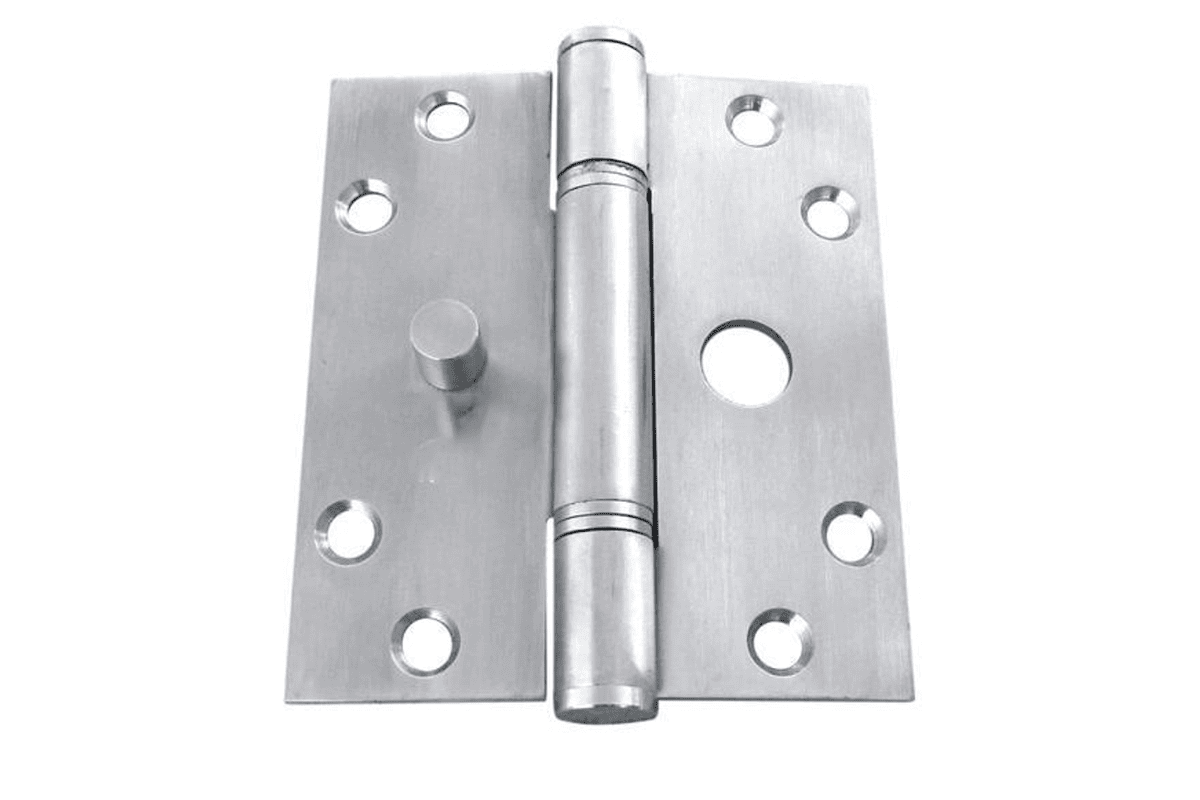
Non-removable pins
A non-removable pin is one of the most common features in locked door hinges. In a standard butt hinge, the pin may be removable for easy installation or door maintenance. That can be convenient. But on an exposed hinge side, it can also create a security concern.
A non-removable pin may be made in several ways:
- The pin end is crimped
- The pin is staked
- The barrel is formed so the pin cannot slide out
- The pin is fixed by a hidden mechanical structure
- The pin end is welded or capped in some designs
For B2B buyers, the key question is simple:
When the door is closed, can the pin be removed from the outside without destroying the hinge?
If the answer is yes, the hinge may not be suitable for a high-security outward-opening door.
Security studs and anti-tamper lugs
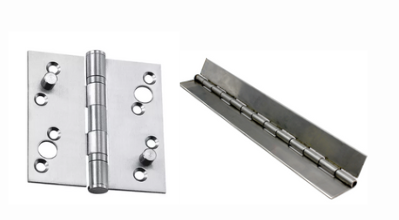
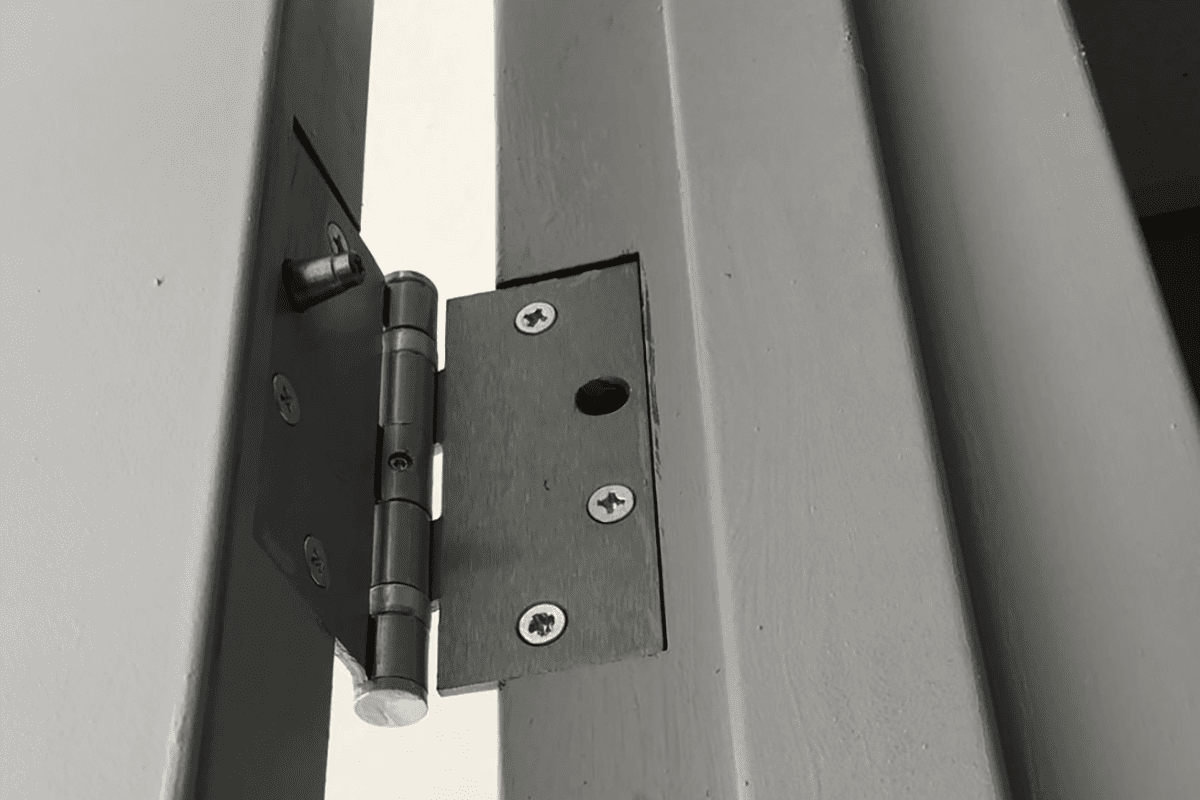
Security studs add another layer of protection. A stud is usually a small protruding part on one hinge leaf. When the door closes, that stud enters a matching hole or recess on the opposite side or in the frame area.
This feature helps keep the door leaf fixed even if the hinge pin or barrel is attacked.7 In simple terms, the hinge does not rely only on the pin. The stud provides an extra mechanical engagement point.
Common names include:
- Security stud hinge
- Anti-lift hinge
- Anti-tamper hinge
- Hinge with dog bolt
- Hinge with security lug
Different markets use different terms, so procurement teams should not rely on product names alone. They should check drawings, samples, photos, and installation conditions.
Material and plate thickness
The hinge material also matters. In our production experience, buyers often request stainless steel butt hinges for entrance doors because they offer good corrosion resistance and a clean finish. Common material options include:
| Material | Common Use | Evaluation Notes |
|---|---|---|
| Stainless steel 201 | Cost-sensitive indoor or light-duty use | Check corrosion requirement carefully |
| Stainless steel 304 | Residential and commercial hardware | Better corrosion resistance than 2018 |
| Stainless steel 3169 | Coastal or high-corrosion areas | Higher cost, stronger corrosion performance |
| Steel with coating | Fire doors or specific project doors | Check finish durability and certification documents |
| Brass | Decorative or premium doors | Good appearance, different strength profile |
Plate thickness is another important detail. A thicker hinge plate may offer better load performance, but it must match the door and frame preparation. A hinge that is too thick can cause installation problems if the mortise depth is not adjusted.
Typical butt hinge thicknesses may range from around 2.0 mm to 3.0 mm or more10, depending on size, material, and door weight. Heavy entrance doors may require larger hinges, more hinges per leaf, or special structures. Buyers should confirm this with door weight, door height, and application.
Screw fixing and hole accuracy
A hinge can only perform well if it is fixed correctly. I pay close attention to screw hole countersinking, hole position, and plate flatness during production checks because these details affect installation quality.
Procurement teams should verify:
- Screw hole quantity
- Screw diameter
- Countersink accuracy
- Screw material and coating
- Screw length
- Frame reinforcement
- Door leaf reinforcement
- Alignment between hinge leaf and frame
Small dimensional errors can create big site problems. If the hinge sits unevenly, the door may sag, rub, or fail to close smoothly. For bulk orders, consistent hole position is especially important because door factories need repeatable assembly.
How Should Buyers Match Locked Door Hinges to Different Door Systems?
A hinge may look strong on the table but fail to fit the actual door system. That mismatch creates delays, rework, and customer complaints. Buyers need a selection process that connects the hinge structure with the door type, opening direction, frame design, lock configuration, and market requirement.
Buyers should match locked door hinges to the full door system. They should consider whether the door opens inward or outward, whether the hinge side is exposed, how the frame is built, what lock is used, how heavy the leaf is, and whether certification documents must be verified.
Start with opening direction
Opening direction is one of the first questions I ask when discussing hinge specifications. An inward-opening apartment door has different hinge-side exposure than an outward-opening shop door. If the hinge barrel is accessible from the outside, non-removable pin design becomes more important.
A simple decision guide can help:
| Door Condition | Hinge-Side Risk | Recommended Buyer Focus |
|---|---|---|
| Inward-opening door, hinges inside | Lower | Load capacity, finish, smooth movement |
| Outward-opening door, hinges outside | Higher | Non-removable pin, security studs |
| Door in public corridor | Medium to high | Anti-tamper design, durable finish |
| Shop or office entrance | Higher | Strong hinge, frame engagement, screw fixing |
| Villa or premium entrance door | Higher | Security structure plus appearance consistency |
This table is not a replacement for project engineering. It is a procurement screening tool.
Match hinge size to door weight
Door weight is a practical factor. A security hinge should not only resist tampering. It should also carry the door leaf over many cycles of use.
Buyers should collect these details before asking for a quotation:
- Door height
- Door width
- Door thickness
- Door weight
- Door material
- Frame material
- Opening direction
- Expected daily use frequency
- Required finish
- Certification or test document requirements
A large solid entrance door may need 3 or 4 hinges11, depending on weight and height. A lighter interior apartment door may use a different hinge size. If the door is very heavy or used in a high-traffic area, the buyer may need ball bearing hinges, heavy-duty hinges, or a project-specific hinge solution.
Consider the lock configuration
The hinge side and lock side should support each other. A strong mortise lock with a weak hinge is unbalanced. A heavy-duty hinge with a low-grade lock is also unbalanced.
For secure residential and light commercial doors, buyers usually evaluate:
- Mortise lock body strength
- Deadbolt throw
- Latch function
- Cylinder security level
- Strike plate fixing
- Handle durability
- Hinge anti-tamper design
- Door and frame reinforcement
As a manufacturer, I do not claim that one hinge can guarantee home security. That would be misleading. Instead, I recommend a layered approach. The lock resists opening from the lock side. The hinge resists leaf removal and hinge-side tampering. The frame holds both sides together.
Check frame fit and installation tolerances
Locked door hinges need accurate installation. Security studs must align with the matching recess. Non-removable pins must rotate smoothly. Hinge leaves must sit flat. If the frame is twisted or the mortise is too deep, the hinge may bind or create uneven gaps.
Door factories and project teams should control:
- Hinge mortise depth
- Vertical alignment
- Door gap consistency
- Screw torque
- Frame reinforcement
- Paint or coating thickness around hinge cutouts
- Clearance between door leaf and frame
I have worked with buyers who send us door drawings before confirming the hinge order. That is a good practice. It helps avoid the common mistake of choosing a hinge only by size and finish.
Choose finish based on market and application
Security is important, but buyers also need visual consistency. A wholesaler or brand owner may need the hinge finish to match lever handles, lock cylinders, escutcheons, and other door hardware.
Common finishes include:
- Satin stainless steel
- Polished stainless steel
- PVD gold
- Black
- Antique bronze
- Nickel
- Custom electroplated finishes
For bulk orders, finish consistency should be verified with approved samples and production control. A slight color difference between hinges and handles can create complaints in retail or project supply.
How Can Procurement Teams Evaluate Locked Door Hinges Before Bulk Orders?
Bulk hinge procurement carries risk because small defects multiply quickly across thousands of doors. A buyer may approve a low-cost hinge, but later face pin looseness, finish variation, screw mismatch, or installation delays. A structured evaluation process reduces these risks before mass production.
Procurement teams should evaluate locked door hinges through drawings, samples, material checks, dimensional inspection, installation trials, finish approval, packaging review, and document verification. For security-related projects, buyers should also consult qualified professionals for application-specific performance requirements and local compliance expectations.
Review drawings before samples
A product photo is not enough. I always prefer to confirm technical drawings because drawings show details that photos can hide.
A good hinge drawing should include:
- Overall length
- Open width
- Leaf width
- Plate thickness
- Knuckle diameter
- Pin diameter
- Screw hole size
- Screw hole position
- Countersink dimensions
- Stud position if used
- Stud diameter and projection
- Material grade
- Finish requirement
- Tolerance notes if available
If the hinge has security studs, the drawing should also show the required matching hole or recess. The door factory needs that information to prepare the frame correctly.
Inspect physical samples
Samples should be tested in a practical way. Buyers do not need a laboratory for every first-stage review, but they should check visible and measurable quality points before approving production.
A sample inspection checklist may include:
| Inspection Item | What to Check | Why It Matters |
|---|---|---|
| Pin retention | Pin cannot be removed easily | Reduces hinge-side tampering risk |
| Barrel alignment | Smooth rotation, no binding | Supports long-term operation |
| Plate flatness | Hinge leaf sits flat | Improves installation accuracy |
| Stud engagement | Stud enters recess correctly | Adds anti-removal support |
| Hole accuracy | Holes match drawing | Prevents assembly delays |
| Finish consistency | Color and texture match sample | Supports brand quality |
| Edge treatment | No sharp burrs | Improves safety and appearance |
| Packaging | Prevents scratches in transit | Reduces after-sales claims |
I have seen buyers approve samples only by appearance. That is risky. A hinge can look beautiful but still have poor pin stability or incorrect hole placement.
Ask for material and compliance documents
For international buyers, documentation matters. However, documents should be treated as items to verify, not as marketing slogans. If a supplier claims CE certification, fire-rated certification, or compliance with a project standard, the buyer should request copies and check the scope.
Important questions include:
- Does the certificate apply to the exact product model?
- Does it cover the door type or hardware category required?
- Is the certificate still valid?
- Which testing body issued the document?
- Does the project require a complete door set test rather than only hardware documents?
- Are fire-rated requirements linked to the door assembly, not just one component?12
This is especially important for fire doors and regulated projects. A hinge used on a fire-rated door may need specific documentation, material, size, and installation conditions. Buyers should consult qualified testing bodies, project engineers, or local compliance professionals for final decisions.
Run a small installation trial
Before mass production, a door factory should install the hinge on an actual door and frame. This trial can reveal problems that do not appear in a sample box.
The trial should check:
- Door closing smoothness
- Gap consistency
- Stud alignment
- Screw fixing strength
- Door sag after repeated operation
- Contact between hinge leaves and frame
- Finish damage during installation
- Compatibility with lock and handle operation
A small trial can save a large shipment. It can also help the buyer refine the specification before placing a bulk order.
Evaluate supplier capability
Locked door hinges require stable production control. If the supplier cannot maintain dimensions, finish, and pin structure across batches, the buyer may face inconsistent quality.
When evaluating a hinge supplier, I suggest checking:
- Factory production experience
- In-house manufacturing capacity
- Quality inspection process
- Material sourcing control
- Surface treatment control
- Customization ability
- Packaging standard
- Delivery performance
- Communication speed
- Export market experience
At SDH Hardware, our direct factory work with hinges, mortise locks, lever handles, and lock cylinders helps us understand how these parts interact. That experience is useful when buyers need a complete door hardware package rather than one isolated product. Still, every project should confirm final suitability through drawings, samples, and professional evaluation where needed.
Frequently Asked Questions
Are locked door hinges the same as hinges with a key lock?
No. In most architectural door hardware discussions, locked door hinges usually mean hinges with anti-tamper structures. These may include non-removable pins, fixed pins, security studs, or anti-lift lugs. They are not normally operated by a key like a door lock.
Do locked door hinges guarantee home security?
No. Locked door hinges do not guarantee home security by themselves. They strengthen the hinge side of the door, but they should work together with a strong lock, secure cylinder, reinforced frame, proper screws, and accurate installation.
When should buyers specify non-removable pin hinges?
Buyers should consider non-removable pin hinges when the hinge side is exposed or accessible, especially on outward-opening entrance doors, villa doors, shop doors, and office doors. The final choice should also consider door weight, frame design, local requirements, and application risk.
What is the purpose of security studs on hinges?
Security studs help keep the door leaf engaged with the frame when the door is closed. If the hinge pin or barrel is attacked, the stud provides another mechanical fixing point. This improves hinge-side resistance, but it must be installed with accurate alignment.
What should I check before ordering locked door hinges in bulk?
You should check drawings, material grade, plate thickness, pin structure, stud design, screw holes, finish samples, packaging, and certification documents where required. You should also run an installation trial on the actual door and frame before confirming mass production.
Conclusion
Locked door hinges are important because they protect a part of the door that buyers often overlook: the hinge side. A secure door needs more than a strong lock. It also needs anti-tamper hinge structures, correct material, stable pin design, proper screw fixing, accurate installation, and a frame that supports the whole system. If you are sourcing hinges for residential or light commercial door projects, I recommend starting with drawings, samples, and application details. For tailored hinge, lock, and complete door hardware solutions, you can contact SDH Hardware for factory-direct support.
"Apex Sterlyn Door | NPSA", https://www.npsa.gov.uk/cse/apex-sterlyn-door. Institutional door-security guidance identifies hinge-side protection, including hinge bolts or non-removable-pin hinges, as a measure that can reduce the risk of removing or forcing a door from the hinge side. Evidence role: general_support; source type: institution. Supports: Anti-removal hinge features, such as hinge bolts, dog bolts, or non-removable pins, are used to reduce hinge-side removal risk on closed doors.. Scope note: The source is likely to support hinge-side protection generally rather than prove the security performance of every locked hinge model. ↩
"nistir 89-4027", https://nvlpubs.nist.gov/nistpubs/Legacy/IR/nistir89-4027.pdf. Physical-security guidance treats doors as assemblies in which the leaf, frame, hinges, locks, fasteners, and installation conditions interact to determine resistance to forced entry. Evidence role: expert_consensus; source type: institution. Supports: Security performance of a door depends on multiple interacting components and installation quality.. Scope note: The support is conceptual and system-level; it does not independently test the specific hinge products described in the article. ↩
"Physical Security Toolbox: Emergency Exit Doors", https://www.fs.usda.gov/t-d/phys_sec/deter/edoors.htm. Government or public-safety door-security guidance notes that exposed removable hinge pins can present a hinge-side vulnerability and that non-removable pins or hinge bolts are commonly used to mitigate this risk. Evidence role: mechanism; source type: government. Supports: Exposed removable hinge pins can be treated as a vulnerability, particularly on outward-opening doors.. Scope note: Such guidance usually describes common risk mechanisms and mitigation practices, not quantified burglary-risk reductions for a specific product. ↩
"Burglary Convention", https://www.glendalewi.gov/882/Burglary-Convention. Public-security guidance explains that when hinges are exposed on the exterior side of a door, hinge-side protective measures such as non-removable pins or hinge bolts can be relevant to forced-entry resistance. Evidence role: mechanism; source type: government. Supports: Outward-opening doors may expose hinge components, making hinge-side protection relevant.. Scope note: The source may address residential door security generally and may not distinguish among all hinge barrel designs. ↩
"U.S. Domestic Molten Salt Reactor: Security- by-Design", https://www.sandia.gov/app/uploads/sites/273/2024/11/U.S.-Domestic-Molten-Salt-Reactor-Security-by-Design.pdf. Physical-protection literature describes delay as a key function of barriers and hardware, supporting the view that anti-tamper hinge features can contribute by increasing the time or effort required for hinge-side attack. Evidence role: mechanism; source type: research. Supports: Security barriers are evaluated partly by their ability to delay or resist unauthorized entry attempts.. Scope note: This supports the security principle of delay; it does not quantify the delay produced by any particular hinge design. ↩
"NRP Hinges: Why Outswing Doors Need Them - DoorwaysPlus.com", https://www.doorwaysplus.com/blog/our-blog-1/nrp-hinges-on-outswing-doors-when-and-why-non-removable-pins-matter-86?srsltid=AfmBOoos3u7Ll3HvFUCGUGW2WoCvzE_bsJvy047SPM0HUBVZYYkxznXj. Architectural-hardware references define security hinges primarily by anti-removal or anti-tamper construction, including non-removable pins or similar features, rather than by the presence of a key-operated lock. Evidence role: definition; source type: institution. Supports: Security hinges are commonly described by anti-tamper features such as non-removable pins, security studs, or hinge bolts rather than by key operation.. Scope note: Terminology varies by market, so the source should be used to clarify common usage rather than establish a universal definition. ↩
"Hinge Bolts - Surelock McGill", https://www.surelockmcgill.com/na/products/door-window-accessories/hinge-bolts. Door-security guidance describes dog bolts or hinge bolts as supplementary hinge-side engagement points that help retain the door in the frame if hinges are cut, damaged, or otherwise attacked. Evidence role: mechanism; source type: institution. Supports: Security studs, dog bolts, or hinge bolts provide an additional engagement point between door and frame when the door is closed.. Scope note: The support is for the general mechanism; actual performance depends on frame strength, alignment, fasteners, and installation. ↩
"304 vs 201 stainless steel Archives - By: ExhaustEnthusiast", https://buzz.uni.edu/exhaustenthusiast/tag/304-vs-201-stainless-steel/. Materials-engineering references explain that 304 stainless steel generally provides superior corrosion resistance to 201 stainless steel because of its alloy composition, especially its nickel and chromium content. Evidence role: general_support; source type: education. Supports: The higher nickel and chromium composition typical of 304 stainless steel contributes to better corrosion resistance than 201 in many environments.. Scope note: Corrosion performance also depends on environment, surface finish, fabrication quality, and maintenance conditions. ↩
"The localized corrosion behavior of 6% Mo and 316L stainless ...", https://fount.aucegypt.edu/retro_etds/1683/. Materials references state that 316 stainless steel, which contains molybdenum, is commonly selected for marine or chloride-bearing environments because it offers improved resistance to pitting and crevice corrosion compared with many standard austenitic grades. Evidence role: general_support; source type: education. Supports: 316 stainless steel is commonly preferred in chloride-rich or marine environments because molybdenum improves pitting and crevice corrosion resistance.. Scope note: The source supports material suitability in general, not the corrosion resistance of a specific hinge finish or manufacturing batch. ↩
"A156.1 - 2025 Butts and Hinges", https://buildershardware.com/ANSI-BHMA-Standards/Hardware-Highlights/A1561-2025-Butts-and-Hinges. Architectural-hardware standards classify hinges by dimensions, materials, and performance grades, providing context for typical butt-hinge plate thickness ranges used across residential and commercial applications. Evidence role: general_support; source type: institution. Supports: Architectural hinge standards or specification guides provide dimensional categories and performance classifications for butt hinges, including relationships among hinge size, material, and intended duty.. Scope note: A standard may not state the exact 2.0–3.0 mm range as a universal norm; it may instead contextualize dimensional variation by hinge class and duty. ↩
"[PDF] DOOR HARDWARE (SCHEDULED BY DESCRIBING PRODUCTS)", https://fpm.usc.edu/wp-content/uploads/2021/11/087102-USC-HSC-door-hardware-Guide-Specification_1.pdf. Architectural-hardware installation guidance bases hinge quantity on door dimensions, weight, and usage conditions, supporting the practice of using three or more hinges for many large or heavy entrance doors. Evidence role: general_support; source type: institution. Supports: The required number of hinges is commonly determined by door height, width, weight, and service conditions, with heavier or taller doors often needing additional hinges.. Scope note: The source should be treated as general selection guidance; exact hinge quantity must be verified against the hinge rating, door construction, and project specification. ↩
"WRCRWA STEEL DOORS AND FRAMES AERATION ...", https://westernwaterca.gov/documentview.aspx?did=581. Fire-door standards and inspection guidance treat a fire door as a rated assembly, meaning that hardware such as hinges must be compatible with the tested or listed door-and-frame assembly and installed under the applicable conditions. Evidence role: expert_consensus; source type: institution. Supports: Fire-door compliance is generally evaluated at the assembly level, including the door, frame, hinges, latching hardware, and installation conditions.. Scope note: The source supports the compliance principle; local code requirements and accepted listings can vary by jurisdiction and project type. ↩