
Fire Rated Hinge for Wooden Doors: The Complete Code-Compliance Guide
A fire rated hinge for wooden doors can look simple, but the wrong choice can delay project approval, create documentation gaps, and weaken buyer confidence. Many buyers first ask, “Is this hinge fire rated?” I suggest asking a better question: “Is this hinge tested for this wooden fire door assembly?”
A fire rated hinge for wooden doors is code-compliant only when its tested application matches the door assembly, fire duration, installation method, hinge model, and project documentation requirements. Buyers should verify the hinge type, test report scope, screw fixing, door material, applicable standard, and local acceptance before confirming bulk orders.
In my work with door factories, hardware brands, and importers, I often see buyers focus on hinge size or material first. Those details matter, but they are not enough. The real decision starts with the fire door assembly and the documents that support it.
What makes a Fire Rated Hinge for Wooden Doors code-compliant?
Many buyers assume that a “fire rated” label is enough. That assumption creates risk because fire door hardware is reviewed as part of a full assembly1. If the hinge documentation does not match the actual door, the project may face questions during inspection.
A fire rated hinge for wooden doors is code-compliant when the hinge has valid fire-test evidence for the intended wooden door assembly, required fire duration, fixing method, and installation position2. Buyers should confirm the test report scope, certification documents, local code requirements, and project specifications before procurement.
Compliance starts with the full door assembly
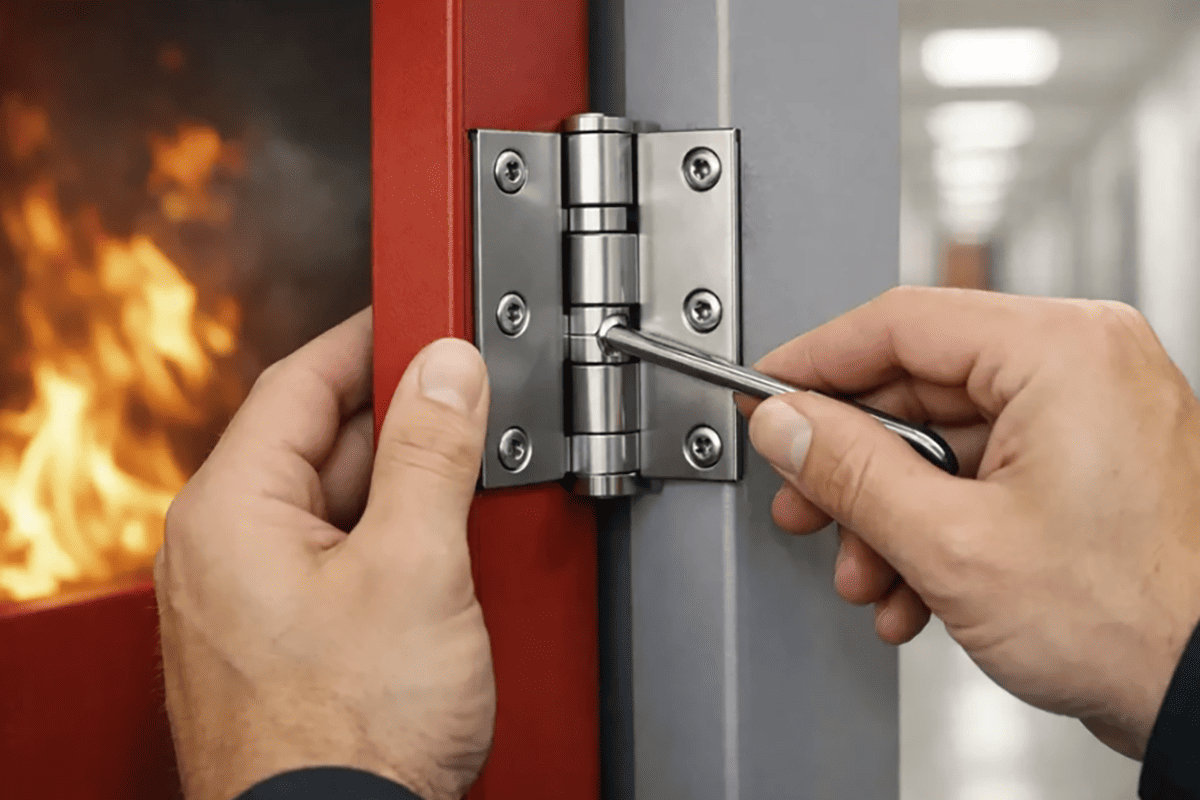
A wooden fire door is not approved only because one component performs well. I always remind buyers that the fire door leaf, frame, intumescent seals, lock, latch, closer, glazing, and hinges work together as one tested system3.
A fire-rated hinge needs to support the tested performance of that system. It should not be selected only by:
- Hinge size
- Stainless steel grade
- Leaf thickness
- Ball bearing quantity
- Load capacity
- Surface finish
- General catalog wording
Those details help with mechanical performance, but fire performance depends on tested application4.
What buyers should verify
When I review a customer’s hinge inquiry, I usually ask for the project requirement first. I then compare it with the available test evidence and certification file. The buyer should check these points:
Door material
The report should clearly state whether the tested assembly included timber, solid core wood, composite wood, or another wooden door construction.Fire duration
Common market requirements include 30 minutes, 60 minutes, and sometimes up to around 120 minutes5. Buyers should confirm the required rating from project documents and local authorities.Hinge model and size
The exact hinge model, dimensions, bearing structure, and material should match the tested product or the permitted variation in the report.Fixing method
Screw type, screw size, fixing depth, and reinforcement details can affect the result.Installation position
The number of hinges and their positions on the door leaf may be part of the tested configuration.Applicable standard
The standard used for testing should be relevant to the target market and project requirement.
CE marking is not the same as fire approval6
This point is important. I see this confusion often when customers import hardware for Europe, the Middle East, or Southeast Asia.
| Document or mark | What it usually shows | What it does not automatically prove |
|---|---|---|
| CE marking | Product meets relevant EU regulatory requirements for declared characteristics | Local project acceptance for every fire door assembly |
| Fire test report | Product or assembly performance under a defined test standard | Universal use on all wooden fire doors |
| Classification report | Fire resistance classification under stated conditions | Approval beyond its stated scope |
| Local approval | Acceptance under a specific market or project authority | Global acceptance in all regions |
A responsible supplier should help buyers understand these differences. At SDH Hardware, we provide product selection and documentation support from a manufacturer’s perspective. However, we do not act as a testing laboratory or local code consultant. I recommend that buyers confirm final acceptance with the project’s fire consultant, certification body, or local authority.
A practical way to define compliance
I prefer this procurement question:
“Which hinge has the right tested application for this wooden fire door, this fire duration, and this project’s documentation requirements?”
This question protects the buyer better than asking only, “Do you have a fire-rated hinge?” It also helps the supplier respond with more accurate options.
How should I match a Fire Rated Hinge for Wooden Doors to the door rating?
A buyer can easily create a mismatch between the door rating and the hardware rating. That mismatch may not appear during quotation, but it can appear during document review. I have seen projects slow down because the required fire duration was not confirmed early.
A fire rated hinge for wooden doors should generally not be rated below the required fire performance of the door assembly. Buyers should match the hinge’s tested duration to the project’s wooden fire door requirement and verify the relationship through test reports, classification documents, and local code review.
Start with the door schedule
The door schedule usually gives the most useful starting information. It may list the required rating as 30 minutes, 60 minutes, 90 minutes, or 120 minutes depending on the project and market. Wooden fire doors are often specified at 30 or 60 minutes, but higher requirements can appear in certain commercial or public buildings7.
I do not recommend assuming the fire rating from the door thickness alone. A thicker door is not automatically a higher-rated door8. The actual tested construction matters.
Compare door requirement and hinge evidence
The hinge should be checked against the required fire door assembly. This does not mean a buyer can simply choose the highest number in a catalog. The hinge’s fire evidence must still match the application.
| Project question | Why it matters | What buyers should request |
|---|---|---|
| What is the required door rating? | The hinge must support the assembly requirement | Door schedule or project specification |
| What is the door material? | A metal-door test may not support a wooden-door use | Test report showing wooden door application |
| How many hinges are used? | Quantity affects load and fire behavior | Tested installation layout |
| What fixing method is required? | Screws and reinforcement affect performance | Installation instructions and report details |
| What market is the project in? | Local acceptance rules vary | Relevant certification and local review |
Common fire duration examples
Buyers often mention these market terms:
- 30-minute wooden fire door
- 60-minute wooden fire door
- 90-minute fire door requirement
- 120-minute fire-rated door assembly
These terms help the conversation, but they do not replace document review. I usually ask customers to send the required standard or door schedule. That simple step prevents many mistakes.
Do not rely on load capacity alone
A heavy-duty hinge may carry a large wooden door smoothly. However, load capacity does not equal fire rating9. A hinge can perform well mechanically and still lack the correct fire-test documentation for a wooden fire door.
Buyers should evaluate both sides:
Mechanical performance
- Door weight
- Door width and height
- Opening frequency
- Bearing type
- Corrosion resistance
- Screw holding strength
Fire documentation
- Fire duration
- Door assembly material
- Test standard
- Classification scope
- Hinge model
- Fixing details
My practical matching sequence
When I help a buyer compare fire-rated hinge options, I prefer this sequence:
- I confirm the required fire duration.
- I confirm whether the door is wooden, steel, or composite.
- I check door thickness, door weight, and door size.
- I confirm whether the buyer wants butt hinges or concealed hinges.
- I review the available test documents.
- I check whether the hinge model, screw fixing, and installation method fit the project.
- I suggest that the buyer confirm local acceptance with the project authority.
This sequence keeps the selection process clear. It also helps avoid the common mistake of choosing a hinge first and looking for supporting documents later.
Which hinge types work best for wooden fire doors?
Many buyers want a fast answer, such as “Use this hinge size for all wooden fire doors.” I avoid that answer because door construction, fire duration, weight, opening frequency, and project documents can all change the correct choice.
Tested butt hinges and tested concealed hinges are the common choices for wooden fire doors. The best option depends on the door construction, required fire duration, load, installation method, design requirement, and test evidence. Buyers should not choose hinge type only by appearance or catalog load rating.
Butt hinges for wooden fire doors
Butt hinges are still one of the most common solutions for wooden fire doors. They are familiar to installers, easy to inspect, and widely used in commercial and residential fire-rated assemblies.
A fire-rated butt hinge may be suitable when:
- The wooden fire door design allows visible hinges
- The project prefers conventional installation
- The door frame and leaf can accept mortised hinge leaves
- The test report supports the required door material and duration
- The buyer needs a cost-effective and easy-to-source hardware solution
At SDH Hardware, we manufacture stainless steel butt hinges for architectural doors, and we often receive requests for CE and fire-rated documentation. I usually remind customers that the hinge model, size, screw fixing, and tested door type must be checked together.
Concealed hinges for wooden fire doors
Concealed hinges are popular when the project requires a clean architectural look. They can also support premium door designs and brand positioning. However, they need careful evaluation because the installation pocket removes material from the door leaf and frame10.
A fire-rated concealed hinge may be suitable when:
- The door design requires hidden hardware
- The hinge model has relevant fire-test evidence
- The door leaf and frame construction support the routing depth
- The installation method matches the tested configuration
- The project accepts concealed hinge documentation
Concealed hinges should never be chosen only because they look better. The fire-test evidence must show that the hinge can be used in the intended wooden door assembly.
Butt hinge vs concealed hinge comparison
| Factor | Tested butt hinge | Tested concealed hinge |
|---|---|---|
| Appearance | Visible when door is closed | Hidden or nearly hidden |
| Installation | Usually simpler and familiar | Requires precise routing |
| Inspection | Easy to check after installation | More difficult to visually inspect |
| Cost | Often more economical | Usually higher cost |
| Fire documentation | Commonly available for many applications | Must be checked carefully by model and assembly |
| Best fit | Standard commercial wooden fire doors | Premium or minimalist wooden fire doors |
Other selection details buyers should not ignore
The hinge type is only one part of the decision. Buyers should also review:
Door weight and dimensions
A taller or heavier wooden fire door may need a stronger hinge configuration.Opening frequency
A hotel corridor door and a warehouse office door may experience very different usage.Surface treatment
Stainless steel finishes, PVD finishes, or painted finishes may be required for design or corrosion resistance.Screw compatibility
Screws should match the tested fixing method and the door/frame material.Intumescent protection
Some assemblies may require intumescent pads or specific edge protection11. Buyers should confirm this from the tested assembly documents.Regional market expectations
Europe, the Middle East, and Southeast Asia may have different document expectations and approval workflows.
A note from my daily experience
I once reviewed an inquiry where the buyer asked for a “120-minute concealed hinge for wooden doors” but did not provide the door thickness, door weight, or target market. The safest response was not to quote immediately. I asked for the door schedule and documentation requirement first. That extra step saved both sides time because the final specification changed after the buyer checked the project file.
What certification documents should I verify before buying a Fire Rated Hinge for Wooden Doors?
Certification documents can be confusing. Buyers may receive a CE certificate, a fire test report, a classification report, and a product datasheet in one file. The risk appears when those documents are treated as the same thing.
Before buying a fire rated hinge for wooden doors, buyers should verify CE documents, fire test reports, classification reports, product datasheets, installation instructions, and local acceptance requirements. The most important step is checking whether the document scope matches the actual wooden door assembly and project fire duration.

The document stack buyers should request
A serious fire-rated hardware supplier should be able to discuss documentation clearly. The exact documents vary by market, but buyers commonly request:
Product datasheet
This document should list model number, size, material, finish, bearing type, load guidance, and intended application.Fire test report
This document should show test standard, tested assembly, fire duration, and product details.Classification report
This document may summarize classification under a relevant standard and define application limits.CE-related documentation
This document may support regulatory compliance for certain declared characteristics in the EU market.Installation instructions
This document helps ensure that the hinge is installed in the way supported by testing.Quality inspection records
For bulk orders, inspection records help buyers control consistency before shipment.
What to look for inside the fire test report
The fire test report is not just a cover page. Buyers should review the details carefully.
| Report detail | Buyer question |
|---|---|
| Tested door material | Was the door wooden or another material? |
| Fire duration | Does it match the project requirement? |
| Hinge model | Is it the same model being ordered? |
| Hinge size | Is the size covered by the report? |
| Screw fixing | Are screws and fixing depth described? |
| Hinge quantity | Does the tested quantity match the project design? |
| Door orientation | Does the report define opening direction or exposure side? |
| Standard used | Is the standard accepted in the target market? |
| Extended application | Are variations clearly permitted? |
CE marking and fire testing must be separated
I want to repeat this because it matters in procurement. CE marking, fire-rated testing, and local code acceptance are not the same.
A CE document can be important for European sales. A fire test report can be important for fire-performance evidence. Local code acceptance can depend on the project authority, country, building type, and complete door assembly.
Buyers should not assume that one document replaces all others.
Supplier consistency matters
A test report supports a product only when production remains controlled. That is why manufacturing quality control matters. At SDH Hardware, our work includes raw material screening, standardized production supervision, and finished product inspection. We also use testing machines for function checks and product verification within our manufacturing process.
However, I describe this as factory quality control, not as official fire certification. Official fire performance should always be supported by recognized testing and certification documents.
How importers can reduce documentation risk
Importers and hardware brand owners should create a standard document checklist before placing orders. I suggest this practical checklist:
- Confirm the exact hinge model number.
- Confirm the ordered size and finish.
- Request the fire test or classification documents.
- Check the required fire duration.
- Compare the tested door material with the actual door.
- Confirm installation accessories and screws.
- Ask whether branding or packaging changes affect traceability.
- Keep batch inspection records for resale support.
- Ask the project consultant or local authority to confirm acceptance.
This process is not complicated, but it needs discipline. A buyer who checks documents before payment usually avoids stressful corrections later.
How do I select the right supplier for fire-rated wooden door hinges?
A low price can be attractive, but fire-rated door hardware requires more than a quotation. Buyers need a supplier who understands product consistency, certification-file questions, project documentation, and bulk order control.
Buyers should select a supplier for fire-rated wooden door hinges by reviewing manufacturing capability, product range, document support, quality control, customization ability, and export experience. The right supplier should help match hinge specifications to the wooden fire door requirement without making unsupported compliance claims.
Why supplier evaluation matters
Fire-rated hardware procurement usually involves more stakeholders than standard door hardware. The buyer, door factory, project contractor, consultant, distributor, and inspector may all ask questions. A supplier who only says “yes, fire rated” may not be helpful when document details are reviewed.
I recommend evaluating suppliers in six areas:
- Manufacturing experience
- Product range
- Certification-file support
- Quality control process
- Customization capability
- Export market experience
Manufacturing capability
A factory-direct supplier gives buyers better control over specifications, production timing, and customization. SDH Hardware operates as a professional architectural door hardware manufacturer in China, with more than 10 years of specialized production experience and independent factory operations.
Our product range includes:
- Euro mortise locks
- Stainless steel lever handles
- Butt hinges
- Concealed door hinges
- Euro brass cylinders
- Door accessories
This matters because a wooden fire door normally needs a complete hardware set. A buyer may need hinges, locks, handles, cylinders, door closers, and accessories to work together in one project.
Quality control questions to ask
A buyer should ask direct questions before confirming bulk orders:
| Supplier question | Why it matters |
|---|---|
| Do you manufacture the hinge in-house? | Factory control supports consistency |
| Can you provide product drawings? | Drawings help door factories prepare machining |
| Can you support OEM or ODM requirements? | Brand owners may need private labeling |
| What inspection is done before shipment? | Inspection reduces bulk order risk |
| Are the documents linked to the exact model? | Model traceability supports review |
| Can you explain the test report scope? | Clear explanation helps buyers avoid misuse |
Customization must not break compliance
Customization is useful in B2B hardware supply. Buyers may request:
- Custom logo stamping
- Laser logo marking
- Custom color packaging
- Adjusted surface treatment
- Accessory configuration changes
- Detailed product drawings
However, customization should be controlled. A change in material, structure, size, screws, or installation method may affect whether the existing fire documentation still applies. Buyers should ask before changing any functional detail.
Branding changes such as packaging or logo marking may be easier to manage, but the buyer should still maintain traceability between the product, order, and documents.
Export experience and market fit
SDH Hardware serves customers in the Middle East, Europe, and Southeast Asia. We also work with door factories, professional hardware brand enterprises, and bulk wholesalers. Over time, we have established long-term partnerships with recognized brands including HAFELE, DORMAKABA, BKS, ECO, GEZE, and ASSA ABLOY.
From a buyer’s point of view, export experience helps because documentation expectations differ by region. A European hardware brand may focus heavily on CE-related files. A Middle East project buyer may request fire-rated reports and project submittal documents. A Southeast Asian importer may need both resale packaging and technical support.
What a good inquiry should include
A clear inquiry helps the supplier respond with the right fire-rated hinge option. I suggest buyers send these details:
- Door type
- Door thickness
- Door weight
- Door width and height
- Required fire duration
- Target market
- Preferred hinge type
- Required standard or certification documents
- Finish requirement
- Order quantity
- Branding or packaging needs
- Installation method, if already defined
Conclusion
A fire rated hinge for wooden doors should be selected through evidence, not assumptions. Buyers should match the hinge type, fire duration, tested wooden door application, fixing method, installation details, and documentation requirements before confirming orders. CE marking, fire test reports, and local approval each play different roles. If you need support, send SDH Hardware your door type, door thickness, door weight, required fire duration, target market, hinge preference, and document requirements. We can help you confirm a suitable fire-rated hinge specification for procurement review.
"Fire Doors and NFPA 80 FAQs", https://www.nfpa.org/news-blogs-and-articles/blogs/2025/04/11/fire-doors-faqs. NFPA 80 and related fire-door guidance treat hinges and other hardware as components of a fire door assembly, supporting the article’s statement that hardware review is assembly-based rather than limited to the individual hinge. Evidence role: expert_consensus; source type: institution. Supports: Fire door hardware is generally regulated or evaluated within the context of a listed, labeled, or tested fire door assembly.. Scope note: This supports the general compliance principle but does not determine whether any specific hinge model is acceptable for a particular project. ↩
"EN1634 Fire Testing for Door Hardware", https://www.camax.cn/what-is-en-1634-fire-testing-for-door-hardware-and-how-does-it-work_2217.html. Door assembly fire-resistance standards such as EN 1634-1 and UL 10C base performance on the tested specimen and its recorded construction and installation details, supporting the need to match hinge evidence to the intended wooden door assembly and fire duration. Evidence role: general_support; source type: institution. Supports: Fire-resistance tests for doorsets record the construction, hardware, installation details, and duration, and their results are limited to defined applications.. Scope note: The standards support the principle of matching test scope to use, but the actual permitted variations depend on the relevant test or classification report. ↩
"What Components Does a Fire Door Need?", https://www.rawlinspaints.com/blog/what-components-does-a-fire-door-need-how-fire-door-components-work-together-to-protect-a-building/?srsltid=AYCX9vJ4LlhcN1aRfvXnD6AbLxrvYuglASr7AqyKNXWXeqaIB9K_yfBx. Government fire-door guidance describes fire doors as assemblies whose resistance depends on compatible components such as the leaf, frame, seals, hardware, and glazing, supporting the article’s system-level description. Evidence role: mechanism; source type: government. Supports: Fire doors are described as assemblies or doorsets whose performance depends on the interaction of the door leaf, frame, seals, hardware, and other components.. Scope note: This provides general support for fire-door assemblies but does not prove that every listed component is required in every door design. ↩
"Doors, fire doors & windows", https://dbifire.com/services/fire-testing/buildings-and-materials/fire-doors-and-windows/. Guidance on direct and extended application for fire-resisting doorsets states that performance classifications apply within defined tested configurations or justified variations, supporting the statement that hinge fire performance depends on tested application. Evidence role: expert_consensus; source type: institution. Supports: Fire-resistance results for door assemblies are linked to tested configurations and defined fields of application.. Scope note: This is contextual support; the permissible application for a particular hinge must be read from its own test and classification documents. ↩
"All You Need to Know for Fire Rated Door Assemblies", https://safti.com/articles/fire-rated-doors-standards-testing-and-glazing-requirements/. Building-code and government fire-door guidance use time-based fire-resistance classifications, commonly including 30-minute and 60-minute fire doors and higher ratings in some applications, supporting the article’s description of typical market requirements. Evidence role: general_support; source type: government. Supports: Building regulations and fire-door guidance commonly use time-based fire-resistance ratings, including 30-minute, 60-minute, and higher-rated doors depending on location and occupancy.. Scope note: The exact required duration varies by jurisdiction, occupancy, wall rating, and project specification. ↩
"CE marking", https://en.wikipedia.org/wiki/CE_marking. European Commission guidance explains that CE marking indicates conformity with applicable EU product requirements, supporting the article’s distinction between CE marking and project-specific fire approval. Evidence role: definition; source type: government. Supports: CE marking indicates conformity with applicable EU harmonized requirements for declared product characteristics, not universal project-level fire approval.. Scope note: This explains the legal meaning of CE marking generally; local acceptance for a fire door assembly remains governed by the applicable construction rules and project authority. ↩
"A Beginner's Guide to Fire-rated Doors", https://titanmetalproducts.com/articles/a-beginners-guide-to-fire-rated-doors/. Government and building-code guidance commonly specifies fire doors by resistance duration, including 30-minute and 60-minute doors, while requiring higher ratings in some building locations, supporting the article’s statement about typical and higher specifications. Evidence role: general_support; source type: government. Supports: Fire-door guidance and building regulations commonly refer to 30-minute and 60-minute doors and require higher ratings for some building locations or risk conditions.. Scope note: This is contextual support and does not establish that wooden doors are the dominant material for every listed rating or building type. ↩
"Basic Fire Door & Frame, Transom, Sidelight | SDI", https://steeldoor.org/sdi-118/. Fire-door testing and certification guidance bases ratings on the tested construction of the complete doorset or assembly, supporting the statement that greater thickness alone does not automatically create a higher fire rating. Evidence role: mechanism; source type: institution. Supports: Fire-resistance ratings are based on tested door constructions and assemblies rather than door thickness alone.. Scope note: Thickness can be one factor in a tested design, but it is not sufficient evidence of rating without a relevant test or listing. ↩
"Understanding BS EN 1935:2002 single-axis hinge grades", https://uk.sfs.com/resources/article/understanding-bs-en-1935. Door-hinge performance standards distinguish mechanical characteristics such as mass, durability, and corrosion resistance from fire-resistance suitability, supporting the article’s statement that load capacity is not equivalent to a fire rating. Evidence role: definition; source type: institution. Supports: Mechanical hinge classifications such as load and durability are distinct from fire-resistance evidence for door assemblies.. Scope note: The source supports the distinction between performance categories; actual compliance still depends on the fire-test evidence for the hinge and assembly. ↩
"Fire Door Fitting | Life Saving Upgrade",
. Technical fire-door and doorset assessment guidance notes that hardware recesses and machining details form part of the evaluated construction, supporting the article’s caution that concealed hinge pockets remove material relevant to assessment. Evidence role: mechanism; source type: research. Supports: Concealed hinge installation typically involves recessing or routing the door leaf and frame, and such modifications can be relevant to fire-door performance assessments.. Scope note: This supports the mechanism and evaluation concern, but it does not prove that all concealed hinges reduce fire performance when properly tested. ↩"Intumescent Hinge Pads Guide", https://jjbuildingmaterials.co.uk/blogs/news/intumescent-hinge-pads-sizes-corners-guide?srsltid=AYCX9vKbKxTY8QLkldT0b7cc93-3evJy2sVHLwEhDFvmx3h4LDuBP_Kf. Fire-door installation guidance describes intumescent seals and, in some tested assemblies, hardware protection such as intumescent pads as measures used to maintain fire resistance at gaps and hardware penetrations. Evidence role: mechanism; source type: institution. Supports: Some fire-door assemblies use intumescent seals, pads, or edge protection to limit heat, smoke, and flame spread around gaps and hardware locations.. Scope note: The need for pads or edge protection is assembly-specific and must be verified in the relevant test report, listing, or installation instructions. ↩
