
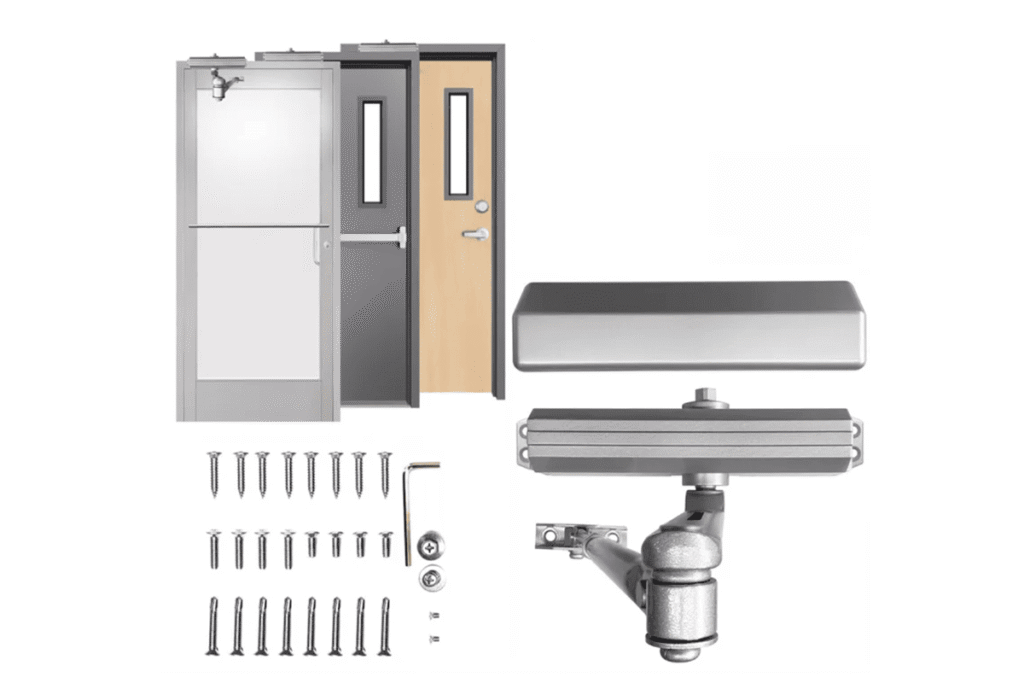
# How to Select a Door Closer by Door Weight and Width
A door closer looks simple until the wrong size causes slamming, slow latching, frame damage, or user complaints. I often see buyers focus only on door weight, then miss door width, wind pressure, opening angle, and mounting space. The better solution is to match the closer power size to the full door application.
**To select a door closer by door weight and width, match the closer’s power size to the [door leaf width, door weight, traffic level, and installation conditions](https://doorsforpros.com/blog/post/door-closer-size-chart?srsltid=AYCX9vIqfNeXNQX-qn9tDYJzQ0yn6oPxPNzVI5bF9UbID4Xcq7K3DEd5)[^1]. Wider or heavier doors need stronger control, but the best choice also depends on mounting position, arm clearance, opening angle, fire-rating requirements, and local code verification.**

I treat door closer selection as a risk-control decision, not a simple table lookup. A size chart is useful, but it is only the starting point. Below, I explain how I evaluate closer size, installation feasibility, quality, and specification choices for B2B purchasing.
## What Door Closer Size Matches Door Weight and Width?
A door closer can fail in daily use when its power size is too weak, too strong, or poorly matched. If the force is too low, the door may not latch. If the force is too high, users may complain that the door is hard to open.
A suitable door closer size should be matched to both **door weight and door width**. [Wider or heavier doors require stronger control](https://www.tellmfg.com/articles/pushing-to-close-top-considerations-for-door-closers)[^2], but buyers should also consider traffic frequency, wind exposure, latch resistance, hinge condition, and whether the closer has adjustable power for fine tuning after installation.

### Start With a Power Size Table
Most commercial door closer specifications use power sizes similar to [EN 1154 force grades](https://www.hoppe.com/in-en/contacts-service/standards/bs-en-1154/)[^3]. The table below is a practical reference. I recommend that buyers always compare it with the supplier’s datasheet, because different models can have different mounting limits.
| Closer Power Size | Approx. Max Door Width | Approx. Max Door Weight | Common Application |
|—:|—:|—:|—|
| Size 1 | 750 mm | 20 kg | Light internal doors |
| Size 2 | 850 mm | 40 kg | Light residential or office doors |
| Size 3 | 950 mm | 60 kg | Standard commercial doors |
| Size 4 | 1100 mm | 80 kg | Heavier office, school, or public doors |
| Size 5 | 1250 mm | 100 kg | Wider and heavier commercial doors |
| Size 6 | 1400 mm | 120 kg | Large entrance doors |
| Size 7 | 1600 mm | 160 kg | Very large or heavy doors |
This table does not mean the closing force only needs to be “greater than the door weight.” I avoid that wording because it is too simple. A closer controls a rotating door leaf. The door’s **width creates leverage**, so a wide door can be harder to control even when its weight is not extreme.
### Why Weight Alone Is Not Enough
I once reviewed an order where the customer specified the door weight but not the door width. The closer looked strong enough on paper, but the door leaf was unusually wide. The installed unit struggled to latch when air pressure changed in the corridor. The issue was not only weight. It was the combination of width, airflow, latch resistance, and mounting geometry.
When I check a door closer specification, I usually ask for:
– **Door leaf width**
– **Door leaf weight**
– **Door material**, such as timber, steel, aluminum, or glass-framed door
– **Door thickness**
– **Opening direction**
– **Traffic frequency**
– **Indoor or outdoor installation**
– **Wind or stack pressure exposure**
– **Fire-rated door requirement**
– **Mounting type**, such as regular arm, parallel arm, or top jamb
### Fixed Power vs Adjustable Power
For B2B orders, I often recommend adjustable power models when buyers serve multiple project types. An adjustable door closer gives more flexibility during installation and after-sales support.
| Type | Advantage | Limitation | Best For |
|—|—|—|—|
| Fixed power closer | Simple specification and stable cost | Less flexible if site conditions change | Repeated standard door projects |
| Adjustable power closer | Easier matching across door sizes | Usually higher cost | Wholesalers, brand buyers, mixed projects |
| Cam-action closer | Easier opening feel in many cases | Higher specification and cost | Accessibility-focused commercial projects |
| Floor spring | Good for frameless glass or heavy entrance doors | Requires floor preparation | Glass doors and premium entrances |
### Practical Selection Method
I use this basic method before confirming a closer model:
1. **Confirm door width first.** Width often drives the minimum power size.
2. **Check door weight next.** Weight confirms whether the selected size has enough control.
3. **Review site pressure.** Outdoor doors or corridor pressure may require stronger or adjustable power.
4. **Check latch condition.** A stiff lock latch can require more final closing force.
5. **Verify mounting space.** The closer must physically fit the door and frame.
6. **Confirm certification documents.** Fire-rated or CE-marked applications need document verification.
> A stronger door closer is not always a better door closer. The right unit closes reliably, opens comfortably, and fits the door structure.
For bulk orders, this method reduces mismatches before production. It also helps buyers create a clearer specification sheet for factory quotation.
## Why Does Door Width Matter When Selecting a Door Closer?
[Door width creates leverage](https://web.physics.ucsb.edu/~lecturedemonstrations/Composer/Pages/28.18.html)[^4]. A wide door places more demand on the door closer because the door leaf acts like a longer arm. Buyers who only check weight may choose a model that closes well in the sample room but performs poorly on the actual project.
Door width matters because it affects both **closing control and installation feasibility**. A wider door usually needs a higher closer power size, and the closer body, arm, mounting plate, and opening angle must also fit the physical door leaf and frame conditions.

### Width Changes the Closing Moment
A door closer does not lift the door. It controls rotation around the hinges. That means the distance from the hinge line to the outer edge of the door matters. A wider door increases the torque demand on the closer, especially near the final latching area.
For example, two doors may both weigh 70 kg:
| Door | Width | Weight | Selection Risk |
|—|—:|—:|—|
| Door A | 900 mm | 70 kg | Often manageable with a medium commercial closer |
| Door B | 1200 mm | 70 kg | May require a stronger closer due to greater leverage |
| Door C | 1200 mm | 90 kg | Requires careful review of closer size, arm type, and mounting |
This is why I always ask customers for both dimensions. If a buyer only sends door weight, I cannot responsibly confirm the best closer size.
### Width Also Affects Opening Comfort
A high-power door closer can solve some latching problems, but it can also create new problems. [If the closer is too strong, users may feel the door is heavy to open.](https://www.access-board.gov/ada/guides/chapter-4-entrances-doors-and-gates/)[^5] This matters in:
– Apartment entrances
– Schools
– Hospitals
– Elderly care buildings
– Offices with frequent traffic
– Retail spaces
In many projects, the best closer is not the strongest model. The best choice is the model that balances:
– **Reliable closing**
– **Comfortable opening**
– **Safe speed control**
– **Consistent latching**
– **Long service life**
– **Compliance with verified project requirements**
### Width Can Limit the Mounting Position
A wider door may need a stronger closer, but the door structure may not provide enough space for the larger body or arm sweep. This issue appears often on narrow top rails, aluminum profiles, glass-frame doors, and decorative entrance doors.
Before buyers place a bulk order, I suggest checking these details:
1. **Top rail height**
The closer body needs enough flat mounting surface.
2. **Frame depth**
The arm bracket must align correctly with the closer body.
3. **Reveal condition**
A deep reveal may require special mounting brackets.
4. **Opening angle**
Some closers support 105°, 120°, or 180° depending on the model and mounting method.
5. **Door stop location**
The closer should not be used as the only door stop unless the model is designed for that function.
### Do Not Ignore Environmental Pressure
A door in an air-conditioned corridor may behave differently from the same door near an exterior entrance. [Wind and pressure can prevent proper latching.](https://en.wikipedia.org/wiki/Stack_effect)[^6] In my experience, customers sometimes ask for a “bigger closer” after installation, but the root cause can be site pressure or poor sealing.
Common pressure-related issues include:
– Strong wind at entrance doors
– Negative pressure in stairwells
– Air pressure from HVAC systems
– Poorly adjusted seals
– Heavy latch resistance from the lock body
– Misaligned strike plates
A correctly sized door closer helps, but it cannot fix every building condition. For critical projects, buyers should involve a qualified door hardware consultant or local professional, especially when fire doors, escape routes, or accessibility requirements are involved.
## How Should I Check Door Closer Installation Space Before Ordering?
A door closer may be correctly sized but still fail the project if it cannot be mounted. I have seen samples pass performance checks, then become difficult to install because the door rail, frame depth, or opening angle was not confirmed before ordering.
Buyers should check door closer installation space by confirming the door top rail, frame shape, arm clearance, screw fixing area, opening angle, and mounting method. The selected model must physically fit the door leaf and frame while allowing smooth arm movement during the full opening cycle.

### Main Mounting Methods
Most overhead closers use one of three common mounting arrangements. Each one changes the force efficiency and space requirement.
| Mounting Method | Closer Body Position | Arm Position | Common Use | Key Check |
|—|—|—|—|—|
| Regular arm | Pull side of door | Frame | Standard interior and commercial doors | Enough door top rail height |
| Parallel arm | Push side of door | Door/frame bracket | Corridors and public buildings | Bracket clearance and lower efficiency |
| Top jamb | Frame head | Door | Narrow top rails or glass/aluminum doors | Frame strength and depth |
Parallel arm mounting is common in public buildings because the arm does not project as much into the room. However, [it can reduce effective closing power compared with regular arm mounting](https://www.merlinarc.com/parallel-arm-vs-standard-arm-door-closer-fitting/)[^7]. That means the same door may require a higher power setting or a different model.
### Check the Door Leaf Before the Closer
I recommend checking the door construction before selecting the door closer model. This is especially important for OEM and ODM buyers who sell complete door sets.
Important checks include:
– **Is the door hollow or solid?**
– **Does the door have internal reinforcement at the fixing points?**
– **Is the top rail wide enough for the closer body?**
– **Can screws hold long-term under repeated cycles?**
– **Will the closer interfere with trim, seals, or glass panels?**
– **Does the door require a mounting plate?**
A heavy closer on a weak door surface can loosen over time. In that case, the issue is not only the closer quality. The door reinforcement may be unsuitable for repeated mechanical load.
### Opening Angle Matters
Buyers often specify “door closer for 90° opening,” but real sites may require more. A hotel room door, apartment entrance, school classroom, or service door may need a different opening angle.
Common opening requirements include:
– **90°** for basic access
– **105° to 120°** for many commercial doors
– **180°** where walls and hinges allow full swing
The door closer body and arm must allow the required angle without hitting the frame, wall, or door stop. [If the door opens beyond the closer’s designed range, the internal mechanism can be damaged.](https://www.assaabloy.com/hk/en/product-assets/door-closer/assets/documents/AA%20Project%20Catalogue%20-%20Door%20Closer%20LR.pdf)[^8]
### Screw Pattern and Template Control
For bulk orders, I suggest asking the supplier for the installation template before shipment. This helps the door factory prepare holes accurately and avoid site drilling errors.
A good B2B specification package may include:
1. Product drawing
2. Installation template
3. Screw size and fixing recommendation
4. Mounting plate option
5. Arm type drawing
6. Adjustment valve position
7. Packing label and model identification
8. Certification copies when required
At SDH Hardware, I prefer to clarify these details during the sample stage. A small drawing check can prevent expensive rework after container shipment.
### Fire-Rated Door Reminder
If the closer is intended for a fire-rated door, [buyers should not rely on verbal claims](https://usmadesupply.com/resources/building-codes-standards/ansi-a156-4/door-closers)[^9]. They should request and verify the relevant certification documents, test reports, and project requirements. I can supply hardware documentation based on product scope, but local professionals should confirm whether the selected door closer is acceptable for the specific door assembly and regional regulation.
## What Quality Tests Matter for a Commercial Door Closer?
A commercial door closer works thousands of times after installation. If the internal spring, piston, seals, valves, or arm system is weak, problems may appear after shipment and installation. For B2B buyers, quality testing is more important than surface appearance alone.
Important door closer quality checks include [cycle testing, closing and latching speed control, power adjustment, oil leakage inspection, temperature performance, corrosion resistance, arm strength, and certification document verification](https://buildershardware.com/ANSI-BHMA-Standards/Hardware-Highlights/A1564-2024-Door-Closers-and-Pivots)[^10]. Buyers should request test data and sample evaluation before confirming large-volume orders.

### Key Performance Tests
A closer must provide controlled closing over time. I usually focus on the following test areas when discussing specifications with buyers:
| Test Area | What It Checks | Why It Matters |
|—|—|—|
| Cycle test | Long-term opening and closing durability | Predicts service life |
| Oil leakage test | Seal and body integrity | Prevents speed failure |
| Speed adjustment | Sweep and latch speed control | Supports safe, reliable closing |
| Backcheck function | Resistance near wide opening | Helps protect door and wall |
| Delayed action | Slower closing for access needs | Useful in hospitals, schools, and public buildings |
| Corrosion test | Surface and component resistance | Important for humid or coastal markets |
| Temperature test | Oil and valve behavior | Important for seasonal climates |
| Arm strength test | Arm and fixing reliability | Prevents mechanical failure |
Different projects do not need every function. However, buyers should know which functions are required before price comparison.
### EN 1154 and Certification Review
Many European and international projects reference EN 1154 for controlled door closing devices. A standard classification can cover [categories such as use, durability, power size, fire behavior, safety, corrosion resistance](https://www.aldridgesecurity.co.uk/standards-bs-en-1154)[^11], and more.
For procurement, I suggest using certification documents in this way:
– Request the **certificate or test report**
– Check whether the **model number matches**
– Check the **power size range**
– Check whether the **mounting method is covered**
– Check the **fire-door suitability**, if needed
– Confirm whether the document is still valid
– Ask a qualified professional to review application-specific compliance
This approach is more reliable than accepting a general statement such as “CE approved.” In B2B trade, document accuracy matters.
### Why Valve Quality Is Important
The adjustment valves control closing speed and latching speed. If the valve design is unstable, installers may struggle to fine tune the closer. A door may slam, fail to latch, or [change speed after temperature shifts](https://en.webtec.com/education/viscosity-of-hydraulic-oil/)[^12].
A good closer should allow controlled adjustment for:
1. **Sweep speed**
This controls the main closing movement.
2. **Latch speed**
This controls the final closing stage near the lock.
3. **Backcheck**, if available
This helps resist sudden opening at a wider angle.
4. **Delayed action**, if available
This holds the door in a slower closing phase for access convenience.
I usually advise buyers not to reduce cost by removing essential adjustment functions from commercial models. The saving can look attractive, but site complaints can cost more than the hardware difference.
### Surface Finish and Corrosion
Door closer finish matters for appearance, but it also affects corrosion resistance. Common finishes include silver, white, black, brown, and custom colors. For humid markets, coastal regions, or exterior doors, corrosion performance should be evaluated carefully.
A buyer may ask for:
– Salt spray test information
– Finish thickness control
– Paint adhesion checks
– Batch color consistency
– Custom brand logo or packaging
– Inspection after order completion
As a manufacturer, I see quality control as a full-process issue. Raw material screening, production supervision, assembly control, and finished product inspection all affect final performance. For large projects, I recommend sample testing before mass production and final inspection before shipment.
## How Can Buyers Compare Door Closer Specifications Before Bulk Ordering?
A door closer quotation can look simple, but two models with similar photos may have different power sizes, functions, certifications, arms, mounting plates, and service life. If buyers compare only unit price, they may miss the cost of installation problems and after-sales claims.
Buyers should compare door closer specifications by reviewing power size, door width range, door weight range, mounting method, adjustment functions, certification documents, finish, accessories, packaging, and factory quality control. A clear comparison sheet helps avoid wrong substitutions during bulk procurement.

### Build a Procurement Comparison Sheet
For wholesalers, brand buyers, and door factories, I recommend creating a standard comparison sheet. It helps purchasing teams compare suppliers fairly.
| Item | Supplier A | Supplier B | Supplier C |
|—|—|—|—|
| Model number | | | |
| Power size | | | |
| Adjustable power range | | | |
| Max door width | | | |
| Max door weight | | | |
| Mounting methods | | | |
| Arm type | | | |
| Backcheck | | | |
| Delayed action | | | |
| Hold-open option | | | |
| Fire-rated documentation | | | |
| CE documentation | | | |
| Cycle test data | | | |
| Finish options | | | |
| Packaging | | | |
| MOQ and lead time | | | |
This simple table often reveals differences that are hidden in a short quotation.
### Do Not Compare Photos Only
A closer body can look similar from outside, but the internal structure may differ. Spring strength, piston design, hydraulic oil, seals, valves, and casting quality can all affect performance.
When I help buyers review a model, I prefer to check:
– Product drawing
– Installation template
– Internal specification, when available
– Test standard
– Sample performance
– Packaging strength
– Label accuracy
– Batch consistency
For brand customers, I also discuss logo marking, color box design, and spare part control. A door closer is not only a mechanical product. It is also part of the customer’s brand promise.
### Decide the Product Level by Market
Different markets need different product positioning. A project buyer in Europe may focus on certification and fire-rated documentation. A wholesaler in the Middle East may ask for durable performance under heat and dust. A Southeast Asian distributor may need corrosion-resistant finishes for humid conditions.
Common positioning levels include:
1. **Economy standard model**
This suits light-duty doors and price-sensitive wholesale markets.
2. **Commercial adjustable model**
This suits mixed door widths and medium to high traffic.
3. **Fire-rated project model**
This requires document verification and project-specific review.
4. **Heavy-duty entrance model**
This suits large doors, higher traffic, and stronger environmental pressure.
The best product is the one that fits the market promise. I do not recommend selling an economy closer as a heavy-duty project closer. That mismatch creates risk for everyone.
### Sample Approval Before Mass Production
Before a bulk order, I recommend a sample approval process:
– Confirm the door width and weight range
– Install the sample on a real or simulated door
– Test opening comfort
– Adjust sweep and latch speed
– Check latching reliability
– Review arm clearance
– Confirm packaging and labeling
– Verify certificates and reports
– Approve finish color
– Confirm inspection criteria
This process takes time, but it protects the buyer. It also helps the manufacturer produce according to the correct expectation.
At SDH Hardware, our wider architectural hardware range includes mortise locks, lever handles, hinges, cylinders, and accessories. Because these items work together on a door set, I always prefer to review the full hardware combination rather than one item alone.
## What Can Door Closer Selection Teach Us About Deadbolt Cylinder Choices?
A door closer and a deadbolt cylinder solve different problems, but buyers often make the same mistake with both. They assume “stronger,” “larger,” or “more secure” automatically means better. In real projects, the best choice depends on application risk and user needs.
Door closer selection and deadbolt cylinder selection both require balanced judgment. A closer must match door weight, width, and installation space. A deadbolt cylinder must balance security, emergency exit, convenience, glass proximity, and local regulation. Buyers should avoid one-size-fits-all specifications.

### Single Cylinder vs Double Cylinder Deadbolt
Many buyers ask about cylinders while they are also selecting closers, locks, and hinges. The key question is usually whether to use a single cylinder or double cylinder deadbolt.
| Deadbolt Type | Outside Operation | Inside Operation | Main Advantage | Main Limitation |
|—|—|—|—|—|
| Single cylinder | Key | Thumb turn | Convenient quick exit | Lower protection if thumb turn is reachable from outside |
| Double cylinder | Key | Key | Higher security where glass is near the lock | May create emergency-exit concerns depending on local rules |
A **single cylinder deadbolt** is common where quick inside exit is important and the thumb turn is not easily reachable from outside. It should not be described as only for indoor doors. Many standard entry doors use single cylinder deadbolts because they are convenient for daily life.
A **double cylinder deadbolt** uses key operation from both sides. It is often considered where glass panels or nearby windows may allow an intruder to reach the inside thumb turn. However, double cylinder use may create emergency-exit concerns. Local regulations and project requirements must be verified before selection.
## Conclusion
Selecting a door closer by door weight and width requires more than reading one chart. I always match the closer power size to the door’s width, weight, mounting space, traffic, latch condition, and project requirements. The same practical thinking also applies to cylinders, locks, and hinges. If you need factory-direct support for door closer matching, lock cylinders, hinges, or complete architectural door hardware sourcing, contact SDH Hardware for specification guidance, customization options, and B2B order support.
—
[^1]: “Door Closer Size Chart: How to Choose the Right Size”, https://doorsforpros.com/blog/post/door-closer-size-chart?srsltid=AYCX9vIqfNeXNQX-qn9tDYJzQ0yn6oPxPNzVI5bF9UbID4Xcq7K3DEd5. Industry standards and door-hardware guidance treat door closer selection as an application-specific decision involving door size, expected use, mounting configuration, and performance requirements, rather than door weight alone. Evidence role: expert_consensus; source type: institution. Supports: The source should support that door closers are selected according to multiple application factors, including door size, use conditions, and installation method.. Scope note: This is general selection support and may not validate a specific model or project condition.
[^2]: “Pushing to Close: Top Considerations for Door Closers”, https://www.tellmfg.com/articles/pushing-to-close-top-considerations-for-door-closers. Door-closer sizing tables in recognized standards and technical guidance associate higher closer force sizes with larger door widths and, in many applications, greater door mass. Evidence role: general_support; source type: institution. Supports: The source should show that door closer force ratings increase with door width and/or door mass in recognized standards or technical guidance.. Scope note: The relationship is a sizing guideline; environmental loads, latch resistance, and mounting geometry can require adjustment.
[^3]: “BS EN 1154 – Controlled Door Closing Devices”, https://www.hoppe.com/in-en/contacts-service/standards/bs-en-1154/. EN 1154 classifies controlled door closing devices using force-size grades and related performance categories, providing a standards-based context for power-size references in door-closer specifications. Evidence role: definition; source type: institution. Supports: The source should define EN 1154 as a standard for controlled door closing devices and explain its force-size classification.. Scope note: This supports the standards framework; individual closer capacity still depends on the tested model and manufacturer documentation.
[^4]: “28.18 — Open door to demonstration preparation area”, https://web.physics.ucsb.edu/~lecturedemonstrations/Composer/Pages/28.18.html. Basic mechanics defines torque as the product of applied force and the perpendicular distance from the axis of rotation, so increasing the distance from the hinge line increases the moment acting on a swinging door. Evidence role: mechanism; source type: education. Supports: The source should explain that torque depends on force and perpendicular distance from the axis of rotation, which is the mechanical basis for door width increasing leverage.. Scope note: This explains the mechanical principle; it does not by itself determine the correct closer size for a specific door.
[^5]: “Chapter 4: Entrances, Doors, and Gates”, https://www.access-board.gov/ada/guides/chapter-4-entrances-doors-and-gates/. Accessibility standards address maximum opening forces for certain doors, reflecting the principle that excessive door-opening resistance can restrict usability for building occupants. Evidence role: general_support; source type: government. Supports: The source should support that door opening force is an accessibility concern and that excessive force can impede use.. Scope note: Opening-force limits vary by jurisdiction and door type, especially for fire-rated doors.
[^6]: “Stack effect”, https://en.wikipedia.org/wiki/Stack_effect. Building-science literature describes how wind loads, stack effect, and mechanical ventilation can create pressure differentials across openings, which can resist or accelerate door movement and affect latching. Evidence role: mechanism; source type: research. Supports: The source should explain how pressure differentials from wind, stack effect, or mechanical ventilation can affect door movement and closing behavior.. Scope note: This provides a mechanism; actual latching performance depends on the door assembly, closer adjustment, seals, and site conditions.
[^7]: “Parallel Arm Vs. Standard Arm Door Closer Fitting”, https://www.merlinarc.com/parallel-arm-vs-standard-arm-door-closer-fitting/. Door-hardware technical guidance notes that mounting configuration affects the geometry and force transmission of overhead closers, and parallel-arm installations may require different sizing or adjustment than regular-arm installations. Evidence role: mechanism; source type: institution. Supports: The source should support that mounting configuration affects closer force transmission and may require different sizing or adjustment.. Scope note: The amount of force reduction is product-specific and should be verified in the closer’s tested installation data.
[^8]: “Door Closer”, https://www.assaabloy.com/hk/en/product-assets/door-closer/assets/documents/AA%20Project%20Catalogue%20-%20Door%20Closer%20LR.pdf. Door-closer standards and installation guidance treat opening angle as a defined application parameter, indicating that closers must be installed within their intended range of motion to avoid malfunction or damage. Evidence role: general_support; source type: institution. Supports: The source should support that closers are rated or installed for specific opening angles and should not be forced beyond their designed range.. Scope note: Direct damage risk depends on the closer design, use of auxiliary door stops, and site installation.
[^9]: “ANSI A156.4 Door Closers | Grade, ADA & NFPA 80 Requirements”, https://usmadesupply.com/resources/building-codes-standards/ansi-a156-4/door-closers. Fire-door codes and inspection guidance require fire-door assemblies and their hardware to be verified against applicable listings, labels, or approval documentation, rather than accepted solely on informal claims. Evidence role: expert_consensus; source type: government. Supports: The source should support that fire-door hardware must be approved, listed, labeled, or otherwise verified as suitable for the fire-door assembly.. Scope note: Specific requirements depend on the adopted local code, the door assembly listing, and the authority having jurisdiction.
[^10]: “A156.4 – 2024 Door Closers and Pivots”, https://buildershardware.com/ANSI-BHMA-Standards/Hardware-Highlights/A1564-2024-Door-Closers-and-Pivots. Recognized door-closer standards evaluate performance characteristics such as durability cycling, closing control, strength, corrosion resistance, and classification documentation, supporting their use as quality-control criteria. Evidence role: expert_consensus; source type: institution. Supports: The source should show that recognized door closer standards evaluate durability, closing performance, corrosion resistance, and related functional characteristics.. Scope note: The exact tests and pass levels differ between standards and product classifications.
[^11]: “Standards – BS EN 1154”, https://www.aldridgesecurity.co.uk/standards-bs-en-1154. EN 1154 uses a classification system for controlled door closing devices that includes categories for use, durability, closing force, fire behavior, safety, and corrosion resistance. Evidence role: definition; source type: institution. Supports: The source should identify the classification categories used in EN 1154 for controlled door closing devices.. Scope note: This supports the classification categories only; it does not confirm that any particular product has a given classification.
[^12]: “Viscosity of Hydraulic Oil”, https://en.webtec.com/education/viscosity-of-hydraulic-oil/. Fluid-mechanics references explain that hydraulic fluid viscosity varies with temperature, which can alter resistance through valves and thereby affect the operating speed of hydraulic control devices. Evidence role: mechanism; source type: education. Supports: The source should explain that fluid viscosity changes with temperature, affecting hydraulic resistance and motion control.. Scope note: This is contextual mechanical support; actual closer behavior depends on the specific oil, valve design, and temperature compensation features.
