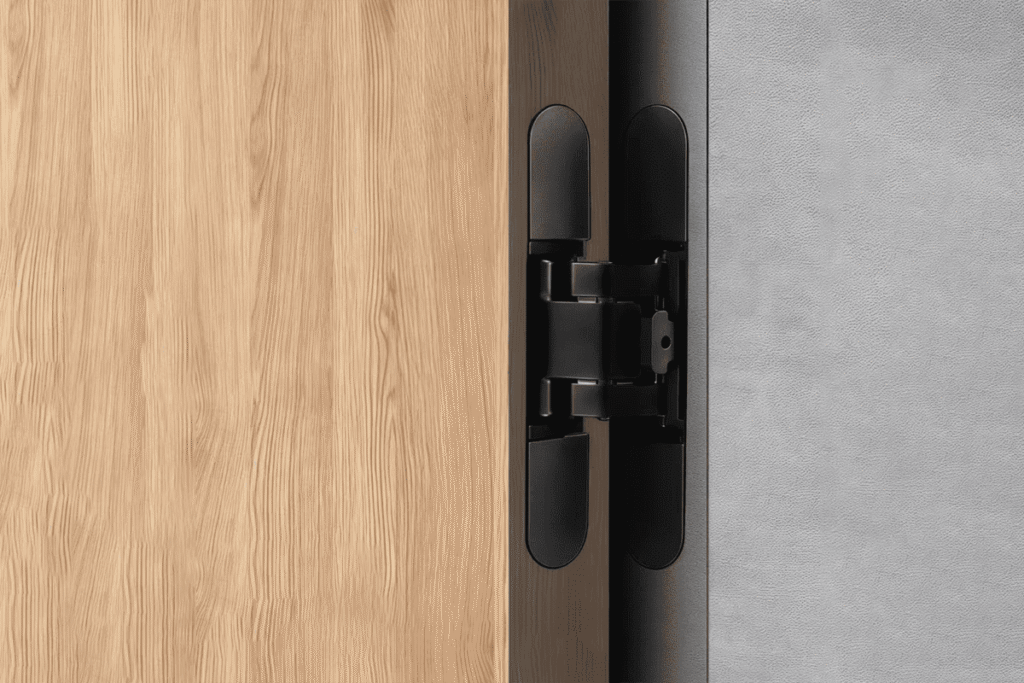
How Do You Adjust Self Closing Door Hinges?
Self closing door hinges can be frustrating when a door slams, stays open, rubs the frame, or fails to latch. The risk is that many people tighten the spring first and make the problem worse. The better solution is to identify the hinge type, correct door alignment, then adjust closing speed and force within the hinge’s designed range.
To adjust self closing door hinges, first confirm whether the hinge uses an internal spring, hydraulic system, or door-weight mechanism. Then check door alignment, adjust the 3D hinge position if available, fine-tune closing speed or latch speed, adjust spring force in small steps, and finally tighten all screws and test the door several times.
From my manufacturer-side experience, the biggest mistake is treating every self-closing hinge as the same product. Some models allow 3D adjustment. Some only allow spring tension changes. Some include buffer speed control. So the correct method starts with the hinge structure, not with the wrench.
What Should You Check Before Adjusting Self Closing Door Hinges?
Self closing door hinges often get blamed for every door problem. However, the hinge may only be one part of the issue. A heavy door, twisted frame, poor installation, or friction at the lock can make even a good hinge perform badly.
Self closing door hinges should be checked for hinge type, door weight, frame alignment, rubbing points, latch engagement, loose screws, and adjustment range before any force adjustment. If the door is not aligned correctly, increasing closing force may hide the problem temporarily but can increase wear, noise, and safety risk.1
Start With the Hinge Mechanism
A self-closing hinge is a hinge that can automatically close a door after opening by using an internal spring, hydraulic system, or door leaf self-weight. These mechanisms are not adjusted in the same way.
In practice, I normally group them like this:
| Hinge type | Closing principle | Common adjustment focus | Buyer caution |
|---|---|---|---|
| Spring self-closing hinge | Internal spring stores force | Closing pull or spring tension | Do not over-tension the spring |
| Hydraulic self-closing hinge | Oil/hydraulic damping controls motion | Closing speed and latching speed | Do not assume all models have speed control |
| Gravity/self-weight hinge | Door weight and hinge geometry close the door | Installation angle and door position | Force control may be limited |
| Adjustable concealed self-closing hinge | Built-in closing mechanism plus 3D adjustment | Door gap, speed, pull force | Follow the product-specific screw layout |
This distinction matters because a spring hinge may close harder when adjusted, but it may not offer precise speed control. A hydraulic hinge may allow smoother closing, but the adjustment screw may control only one part of the closing arc. A self-weight hinge may depend heavily on installation geometry.
Inspect the Door Before Touching Tension
Before adjusting the closing force, I would check the door like a buyer or quality inspector would check a sample:
- Does the door rub the frame?
- Does the top gap narrow on the latch side?
- Does the lock tongue hit the strike plate?
- Are hinge screws loose?
- Is the door heavier than the hinge rating?
- Are there enough hinges for the door height and weight?
- Does the door close differently when opened to 30°, 80°, or 180°?
If the door rubs near the top, the issue may be sagging. If the latch hits the strike plate, the door may need horizontal adjustment. If the door stops just before latching, the final latching speed or closing force may need adjustment.
My practical rule is simple: alignment first, force second.
Know the Functional Closing Zones
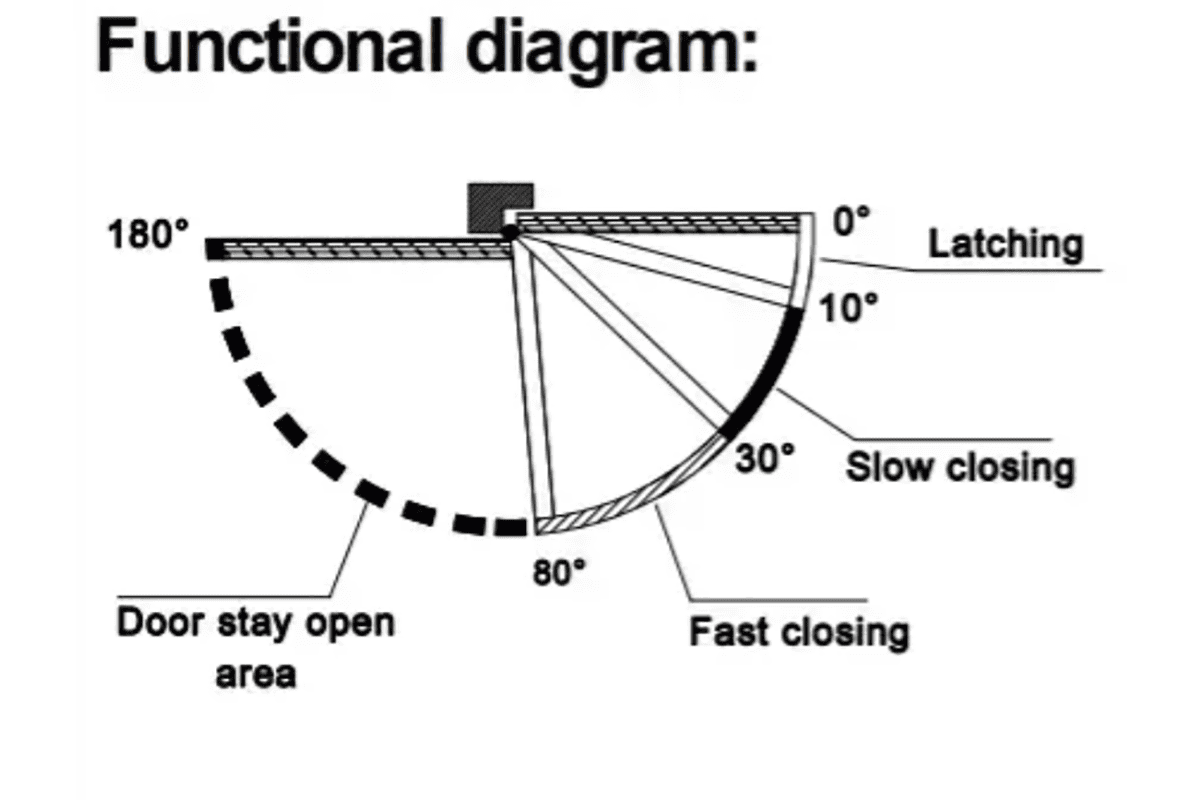
Some adjustable self-closing hinge designs divide the 0°–180° opening range into different functional zones.2 A typical structure may work like this:
| Door angle range | Function | What it means in use |
|---|---|---|
| 80°–180° | Hold position | The door can stay at different open positions |
| 30°–80° | Fast self-closing | The door returns quickly from the open position |
| 10°–30° | Slow buffer | The door slows down before final closing |
| 0°–10° | Accurate latch closing | The door completes the final lock engagement |
This kind of segmented closing action is useful in commercial and residential doors because users need both convenience and control. However, not every hinge has this four-stage function. Buyers and installers should always check the technical drawing, user manual, and tested specification for the exact model.
For fire-rated doors, public buildings, or project doors, I recommend involving a qualified installer or door hardware professional. The door assembly may need to meet local codes, and any adjustment should not compromise certified performance.3 Certificates such as CE or fire-rated documents should be verified by the buyer for the specific product and application.
How Do You Adjust Self Closing Door Hinges for Door Gap Alignment?
Self closing door hinges cannot perform well if the door sits incorrectly in the frame. A door that rubs, drops, or leans may close too slowly, slam unexpectedly, or fail to latch. This is why door gap alignment should come before spring force adjustment4.
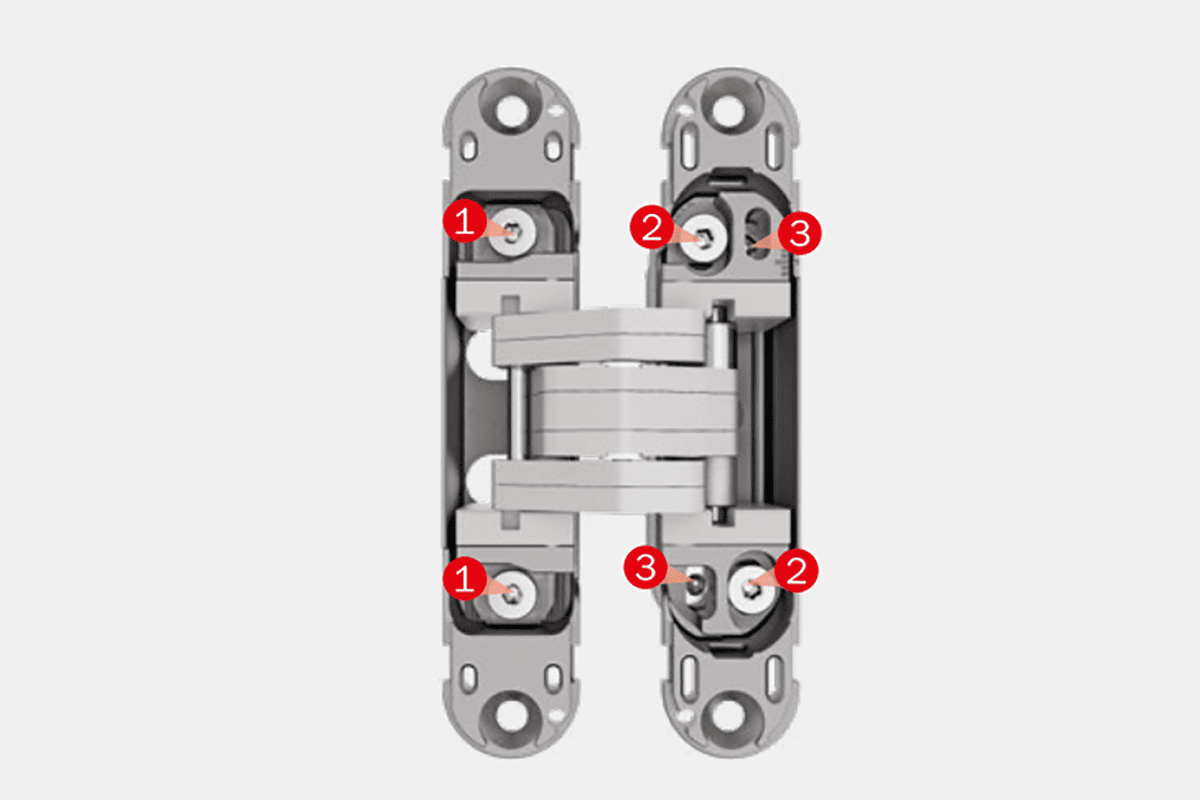
To adjust self closing door hinges for door gap alignment, use the hinge’s designed 3D adjustment points if available. On one adjustable hinge structure, pressure/depth adjustment is about ±1mm, vertical adjustment is about ±2mm, and horizontal adjustment is about ±1.5mm. Loosen the correct screws, reposition carefully, and retighten after adjustment.
Understand 3D Adjustment Before You Move the Hinge
On adjustable concealed or architectural hinge systems, “3D adjustment” normally means the hinge can be adjusted in three directions:
- Pressure or depth adjustment
- Vertical height adjustment
- Horizontal side adjustment
For the referenced adjustable hinge structure, the common ranges are:
| Adjustment direction | Approximate range | Typical purpose | Adjustment method |
|---|---|---|---|
| Pressure/depth | ±1mm | Adjust door compression and front-back seating | Loosen screw 1, move hinge body, retighten |
| Vertical | ±2mm | Raise or lower door leaf | Loosen screw 2, use screwdriver movement under spring thrust, retighten |
| Horizontal | ±1.5mm | Move door left or right | Move screw 3 within its designed range |
These ranges are small for a reason. Door hardware is precision hardware. A 1mm movement can change the way the latch meets the strike plate.5 A 2mm vertical lift can remove rubbing at the threshold. A 1.5mm horizontal shift can improve side clearance.
Pressure or Depth Adjustment: ±1mm
Pressure adjustment changes how the door sits toward or away from the frame. In the referenced structure:
- Loosen screw 1
- Move the hinge body slightly
- Check the door compression
- Tighten screw 1 after adjustment
This adjustment is useful when the door is too tight against the frame seal or too loose when closed. It can also affect how much resistance the closing mechanism feels during the last few degrees.
However, I would not use depth adjustment to solve a serious installation error. If the frame is not square, or the door leaf is warped, the hinge adjustment range may not be enough.
Vertical Adjustment: ±2mm
Vertical adjustment raises or lowers the door. In the referenced design:
- Loosen screw 2
- Use a screwdriver to move the hinge body vertically under spring thrust
- Adjust in small steps
- Tighten screw 2 after adjustment
This step is important when the door scrapes the floor, drags at the top frame, or shows uneven top clearance. A door that is too low may require more force to close, which can make someone think the spring is weak. In reality, the hinge may be fighting friction.
Horizontal Adjustment: ±1.5mm
Horizontal adjustment changes side gap and latch position. In this design, it is done by moving screw 3 within its adjustment range.
This adjustment helps when:
- The latch does not enter the strike plate cleanly.
- The door edge rubs the frame.
- The side gap is uneven.
- The door looks visually misaligned after installation.
A good visual gap is not only an appearance issue. For door manufacturers and hardware wholesalers, consistent gaps reduce after-sales complaints. For facility teams, clean alignment reduces noise and wear. For project buyers, standardized adjustment also helps installers work faster across many doors.
After any 3D adjustment, always open and close the door several times. I usually recommend checking the door at multiple angles, such as 30°, 80°, and near full opening, because the closing behavior may change across the movement path.
How Do You Adjust the Closing Speed on Self Closing Door Hinges?
Self closing door hinges may close too fast near the end, causing noise or poor user experience. However, closing speed adjustment depends on whether the hinge includes a hydraulic or buffer speed-control function. Not every spring hinge has this capability.
To adjust closing speed on self closing door hinges, locate the dedicated micro-adjustment screw on the hinge body if the model includes one. Use the specified Allen key to make small changes, mainly controlling the buffer and latching speed during the final closing degrees. Test after each small turn and never force the screw.
Separate Closing Speed From Closing Force
Many users confuse speed with force. They are related, but they are not the same.
- Closing speed describes how fast the door moves.
- Closing force describes how strongly the hinge pulls the door closed.
- Latching speed describes how the door completes the final lock engagement.
- Buffer speed describes how the hinge slows the door before final closing.
On some adjustable hinge designs, a special micro-adjustment screw on the hinge body can control the final few degrees of closing. This is often adjusted with an Allen key. In the product context provided, this screw is used to control the buffering and latching speed near the end of the closing action.
Use Small Adjustments Only
I suggest small turns because speed-control screws can be sensitive. A quarter-turn may be enough to change the final action. A full turn may be too much on some products.
A careful adjustment sequence looks like this:
- Open the door to around 80° and release it.
- Observe the movement through the fast self-closing range.
- Watch the door enter the 10°–30° buffer zone.
- Check whether the door slows too much or not enough.
- Watch the final 0°–10° latch zone.
- Adjust the micro screw slightly.
- Test again through several open-close cycles.
If the door slows too much and does not latch, the final speed may be too low, or the latch may be misaligned. If the door slams during the last few degrees, the buffer may be insufficient, or the closing force may be too high.
Match the Adjustment to the Functional Zone
For a hinge with segmented closing function, the door movement may be divided like this:
| Range | User symptom | Likely adjustment area |
|---|---|---|
| 80°–180° | Door does not hold open as expected | Check hinge design and hold-position function |
| 30°–80° | Door closes too slowly from open position | Check closing mechanism and door friction |
| 10°–30° | Door hits the frame too quickly | Adjust buffer speed if available |
| 0°–10° | Door fails to latch or slams | Adjust latching speed, alignment, or force |
This staged thinking helps avoid random adjustment. It also helps buyers evaluate samples. When I discuss hinge samples with customers, I often ask them to describe the angle where the problem happens. A door that fails at 30° has a different cause than a door that fails at the last 5°.
Avoid Over-Adjusting Hydraulic or Buffer Components
If a hinge uses an internal hydraulic system, the internal structure should not be dismantled during normal adjustment.6 Users should only operate the external adjustment point described by the manufacturer. If oil leakage, abnormal noise, or unstable damping appears, the hinge may need professional inspection or replacement.
For procurement teams, this is also a supplier evaluation point. A good supplier should provide:
- Clear adjustment instructions
- Screw position diagrams
- Door weight and size recommendations
- Tested cycle life data where available
- Valid certification documents for the product type
- Stable finish quality across batch production
Closing speed is not only a comfort issue. In commercial doors, stable closing behavior reduces impact, protects lock parts, and improves the perceived quality of the complete door set.7
How Do You Adjust Closing Force on Self Closing Door Hinges Without Over-Tightening?
Self closing door hinges sometimes need more closing pull, especially when a door stops before latching. But too much force can cause slamming, fast wear, or unsafe operation. The spring should be adjusted carefully, not treated as the first or only solution.
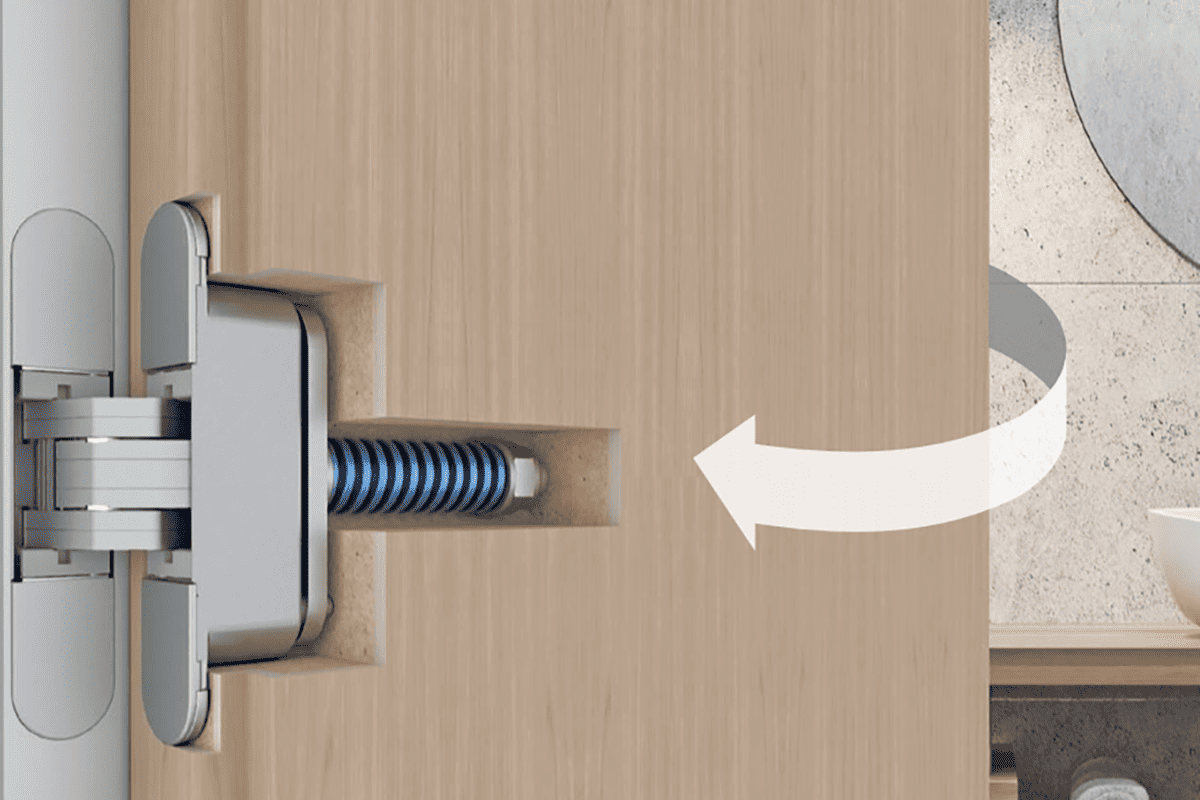
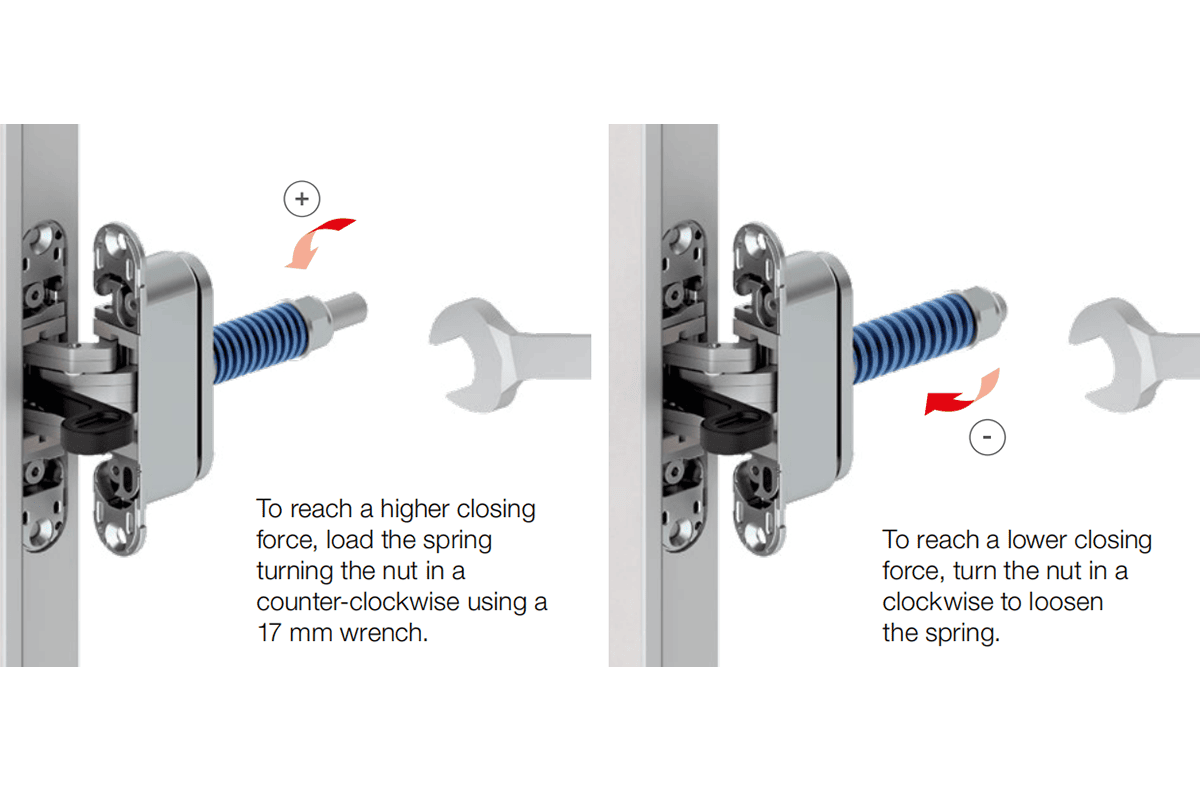
To adjust closing force on self closing door hinges in the referenced spring-tail design, use a wrench on the nut at the spring shaft end. Turning the nut counterclockwise toward “+” increases closing force, while turning clockwise toward “-” reduces force. Adjust slightly, test repeatedly, and tighten all screws afterward.
Use the Correct Tool and Direction
For the referenced adjustable hinge structure, closing pull is adjusted at the spring tail shaft nut. The tool is a wrench, commonly a 17mm wrench for this design.
The direction is:
| Adjustment direction | Effect |
|---|---|
| Counterclockwise (+) | Increases closing pull |
| Clockwise (-) | Reduces closing pull |
This direction applies to the referenced hinge design. It should not be treated as universal for every self-closing hinge on the market. Other hinges may use pins, holes, set screws, or different tensioning systems.
Adjust in Small Steps
Spring force should be adjusted gradually. A safer workflow is:
- Confirm the door is aligned.
- Confirm the latch and strike plate meet smoothly.
- Open the door to a normal use angle.
- Turn the spring tail nut slightly.
- Release the door and observe the closing.
- Repeat only if needed.
- Stop when the door closes and latches reliably.
- Tighten all screws and nuts after adjustment.
The goal is not maximum closing force. The goal is controlled closing with reliable latching.
Too little force may cause:
- The door remains slightly open.
- The latch fails to engage.
- Wind or air pressure stops the door.
- The door closes only from wider angles.
Too much force may cause:
- Loud impact at the frame
- Fast wear on the latch and strike plate
- User discomfort
- Higher stress on hinge screws
- Damage to lightweight doors or frames
Check the Door Angle Where Force Fails
A useful diagnostic question is: At what angle does the door stop closing?
If the door closes from 80° but fails near 10°, the issue may be latching speed, strike alignment, or final friction. If the door does not start closing from 30°, the spring force may be too weak, or the door may be too heavy. If the door moves unevenly, the hinge axis may not be aligned.
For facilities and installers, this angle-based diagnosis is practical. For door manufacturers, it also helps during sample testing. A sample hinge should be tested with a door leaf close to the intended size and weight. A hinge that performs well on a light showroom panel may not perform the same on a heavy solid-core door.
Do Not Dismantle the Internal Spring
Users should not dismantle the internal spring or hydraulic mechanism. The internal energy in spring systems can create risk, and unauthorized disassembly may damage the product. It may also void supplier warranty terms.
From a supplier-selection point of view, I prefer products where routine adjustments can be made from accessible external points. A good adjustable hinge should allow installers to correct practical site variations without opening the core mechanism.
After the force feels correct, the final step is not optional: tighten all screws and nuts. Then test the door through several complete open-close cycles. I would test from different angles, including a small opening angle, a normal walking angle, and a wide opening angle.
When Are Self Closing Door Hinges Not the Real Problem?
Self closing door hinges are often adjusted again and again when the real issue is somewhere else. This wastes time and may shorten hardware life. If correct alignment, speed, and force adjustment do not fix the problem, the hinge specification or door installation should be reviewed.
Self closing door hinges may not be the real problem if the door is too heavy, the hinge quantity is insufficient, the frame is twisted, the latch has high friction, the door is exposed to wind pressure, or the hinge model does not match the door size, weight, or application requirements.
Look Beyond Tension
A common site response is to increase spring force whenever the door fails to latch. Sometimes that works. Sometimes it only creates a harder-closing bad door.
If the door still does not close properly after correct adjustment, check these possible causes:
- Door weight exceeds hinge capacity
- Door width creates too much leverage
- Too few hinges are installed
- Frame is not square
- Hinge mortise depth is incorrect
- Screws are loose or not suitable for the substrate
- Weather seals create too much compression
- Lock body or latch has internal resistance
- Strike plate is not positioned correctly
- Air pressure affects the door in corridors or stairwells8
For project doors, these issues are common because door performance depends on the complete assembly, not only the hinge.
Match the Hinge to the Door Specification
When I look at a hinge from a manufacturing and supply perspective, I want the product specification to match the project conditions. The hinge should be selected according to:
| Selection factor | Why it matters |
|---|---|
| Door weight | Heavier doors need higher load capacity and correct hinge quantity |
| Door width | Wider doors create greater torque on hinges9 |
| Door material | Wood, steel, aluminum, and fire doors load hinges differently |
| [Usage frequency | High-traffic doors need better durability](https://buildershardware.com/ANSI-BHMA-Standards/Hardware-Highlights/A1561-2025-Butts-and-Hinges)%%%FOOTNOTE_REF_10%%% |
| Closing function | Hold-open, buffer, latch speed, and force adjustment vary by model |
| Certification needs | CE and fire-rated documents may be required for project access |
| Finish requirement | Bulk projects need consistent color and surface quality |
| Regional standard | Europe, Middle East, and Southeast Asia may require different specifications |
For buyers, the important point is not only whether a hinge can close a door once. The important point is whether it can perform consistently across a batch of doors and across repeated use.
Evaluate Supplier Support
A reliable hinge supplier should do more than ship metal parts. Buyers should ask for documents and technical support before bulk ordering.
Useful evaluation items include:
- Product drawings with adjustment points
- Door size and weight recommendations
- Material and finish information
- Installation instructions
- Packing and accessory configuration
- Batch finish consistency control
- CE certification documents where applicable
- Fire-rated certification documents where applicable
- Quality inspection process
- Customization capability for regional requirements
At SDH Hardware, our business context is manufacturing architectural door hardware such as concealed hinges, mortise locks, butt hinges, lever handles, and lock cylinders. From that perspective, I see adjustment performance as part of product design and production quality. A hinge that is easy to adjust saves installation time. A hinge that holds adjustment after tightening reduces after-sales cost.
However, application-specific decisions should still be checked by qualified professionals, especially for fire doors, public safety doors, and large engineering projects. Buyers should verify certification documents for the exact product and intended use.
Frequently Asked Questions
Can I adjust all self closing door hinges the same way?
No. Self closing door hinges may use spring, hydraulic, concealed, surface-mounted, or self-weight mechanisms. Each design may use different screws, tools, directions, and adjustment ranges. Always check the product manual or supplier drawing before adjusting the hinge.
Should I increase spring tension if the door does not latch?
Not immediately. First check door alignment, latch position, frame friction, loose screws, and door sagging. If the door moves freely but lacks final pull, then spring tension or latching speed may need small adjustment.
Why does my self-closing door slam after adjustment?
The spring force may be too high, the buffer speed may be too fast, or the hinge may not include hydraulic damping. The door may also be misaligned. Reduce force slightly if the design allows, check the final speed screw if available, and test again.
What tool do I need to adjust closing force?
For the referenced adjustable hinge structure, closing force is adjusted with a wrench on the spring tail nut, often using a 17mm wrench. Other hinges may require an Allen key, tension pin, or special tool, so confirm the exact hinge design first.
What should I do if the door still does not close after adjustment?
Check whether the door is too heavy, the hinge quantity is insufficient, the frame is twisted, or the product specification is mismatched. If the door is part of a fire-rated or commercial assembly, ask a qualified door hardware professional to evaluate it.
Conclusion
Adjusting self closing door hinges is a step-by-step process, not just a spring-tightening task. I recommend confirming the hinge type first, correcting 3D door alignment where the product allows it, adjusting closing speed only if the hinge has that function, and then fine-tuning spring force in small steps. After adjustment, all screws and nuts must be tightened, and the door should be tested through several open-close cycles. If you need adjustable self-closing hinge solutions for bulk door projects, SDH Hardware can support product selection, customization, and factory-direct supply.
"Safety Standard for Automatic Residential Garage Door Operators", https://www.federalregister.gov/documents/2016/04/07/2016-07552/safety-standard-for-automatic-residential-garage-door-operators. Door-hardware installation guidance generally treats alignment, latch engagement, and friction points as prerequisites to force adjustment, supporting the view that increasing closing force can conceal rather than correct installation defects. Evidence role: expert_consensus; source type: institution. Supports: An industry or institutional guide should support that door alignment, latch engagement, and hardware condition should be checked before increasing closing force.. Scope note: The source may address door closers or door assemblies broadly rather than self-closing hinges specifically. ↩
"Self-Closing Hinge - ScholarWorks", https://scholarworks.boisestate.edu/cgi/viewcontent.cgi?article=1003&context=bsu_patents. Technical descriptions of controlled-closing hinge mechanisms show that hinge geometry and damping components can produce different actions over separate portions of the opening arc, supporting the article’s discussion of functional closing zones. Evidence role: mechanism; source type: research. Supports: A patent, technical paper, or product-independent engineering source should support that some self-closing hinge mechanisms provide different behaviors at different door-opening angles.. Scope note: The source would establish the mechanism type generally and may not verify the exact angle ranges listed in the article. ↩
"Stacy Middle School Fire Doors Proposal", https://www.milfordma.gov/Archive/ViewFile/Item/261. Fire-door standards and certification guidance treat the door, frame, hinges, latch, and closing hardware as a tested assembly whose maintenance or alteration must preserve the listed performance, supporting the caution against adjustments that compromise certification. Evidence role: expert_consensus; source type: institution. Supports: A fire-safety standards body or certification organization should support that fire-door assemblies must be maintained as tested and listed, and that field changes can affect compliance.. Scope note: The source would support the compliance principle, while local legal requirements still vary by jurisdiction. ↩
"087100 – DOOR HARDWARE - Facilities and Campus Services", https://fcs.cornell.edu/087100-door-hardware. Facilities maintenance guidance commonly identifies door reveal alignment, frame squareness, and latch fit as conditions affecting closing performance, providing contextual support for addressing door gap alignment before adjusting spring force. Evidence role: general_support; source type: education. Supports: A university facilities or technical installation guide should support that door reveals, frame squareness, and latch alignment affect closing performance and should be corrected before hardware force adjustment.. Scope note: The evidence is likely contextual because it may discuss general door maintenance rather than this exact hinge design. ↩
"087100 – DOOR HARDWARE - Facilities and Campus Services", https://fcs.cornell.edu/087100-door-hardware. Architectural door-hardware installation guidance recognizes that latch and strike alignment depends on accurate door positioning and reveal control, supporting the statement that small hinge adjustments can affect latch engagement. Evidence role: general_support; source type: institution. Supports: A door installation or architectural hardware source should support that minor changes in door position or reveal can affect latch-to-strike engagement.. Scope note: The source may not quantify the threshold as exactly 1 mm for all door and latch types. ↩
"How to repair a commercial door closer",
. Door-closing hardware maintenance guidance commonly treats hydraulic bodies as sealed mechanisms adjusted through external valves or screws, supporting the instruction not to dismantle internal hydraulic components during routine adjustment. Evidence role: expert_consensus; source type: institution. Supports: A neutral maintenance or safety source should support that sealed hydraulic door-closing mechanisms are normally adjusted externally and should not be opened by unqualified users.. Scope note: The source may refer to hydraulic door closers rather than hydraulic self-closing hinges, but the maintenance principle is analogous. ↩"Types, Lifespans, and Signs You Need Replacement", https://www.nashvilledoorcloser.com/the-complete-guide-to-commercial-door-closers-types-lifespans-and-signs-you-need-replacement. Facilities maintenance references commonly associate uncontrolled door slamming with increased impact on door frames, latches, strikes, and hinges, providing contextual support for the claim that stable closing behavior can protect commercial door hardware. Evidence role: general_support; source type: education. Supports: A facilities maintenance or building-operations source should support that uncontrolled door slamming increases impact loads and wear on latches, strikes, frames, or hinges.. Scope note: The source would support the wear-and-impact relationship, not necessarily the subjective claim about perceived quality. ↩
"[PDF] A computer program for analysis of pressurized stairwells and ...", https://nvlpubs.nist.gov/nistpubs/Legacy/IR/nbsir80-2157.pdf. Building-science and stairwell-pressurization studies describe pressure differentials across doors as producing measurable operating forces, supporting the article’s point that corridor or stairwell air pressure can interfere with closing and latching. Evidence role: mechanism; source type: government. Supports: A building-science or fire-safety source should support that pressure differentials across doors can create forces that affect door operation.. Scope note: The source may address pressurized fire stairs or building airflow generally rather than ordinary residential doors. ↩
"28.18 -- Open door to demonstration preparation area", https://web.physics.ucsb.edu/~lecturedemonstrations/Composer/Pages/28.18.html. Basic engineering mechanics defines torque as the product of force and lever arm distance, supporting the statement that a wider door creates a larger moment on its hinges for the same door weight distribution. Evidence role: mechanism; source type: education. Supports: An engineering mechanics source should support that torque increases with force and perpendicular distance from the pivot, explaining why wider doors increase hinge moment.. Scope note: This supports the physical principle; actual hinge load also depends on door construction, hinge spacing, and installation conditions. ↩
"A156.1 - 2025 Butts and Hinges", https://buildershardware.com/ANSI-BHMA-Standards/Hardware-Highlights/A1561-2025-Butts-and-Hinges. Door-hardware standards classify hinges and closing devices by durability grades and cycle-test performance, supporting the selection principle that high-traffic doors require hardware with higher durability capacity. Evidence role: expert_consensus; source type: institution. Supports: A door-hardware standard should support that hinges and related hardware are classified by durability or cycle testing, which is relevant to high-traffic applications.. Scope note: The source supports durability selection generally; the correct grade still depends on door weight, application, and local standard requirements. ↩