
The Role of Vibratory Polishing in Concealed Hinge Manufacturing?
Vibratory polishing in concealed hinge manufacturing often looks simple from the outside, but poor surface preparation can create burrs, uneven plating, and unstable batch appearance. These issues become costly when hinges reach assembly lines or project sites. In our factory practice, controlled polishing helps reduce these risks before electroplating and final inspection.
Vibratory polishing in concealed hinge manufacturing is a machine-based batch surface-treatment process that removes burrs, smooths edges, cleans minor surface defects, and prepares parts for later finishing.1 It is not only for appearance. It supports more consistent electroplating preparation, smoother hinge movement, and more stable quality in mass production.
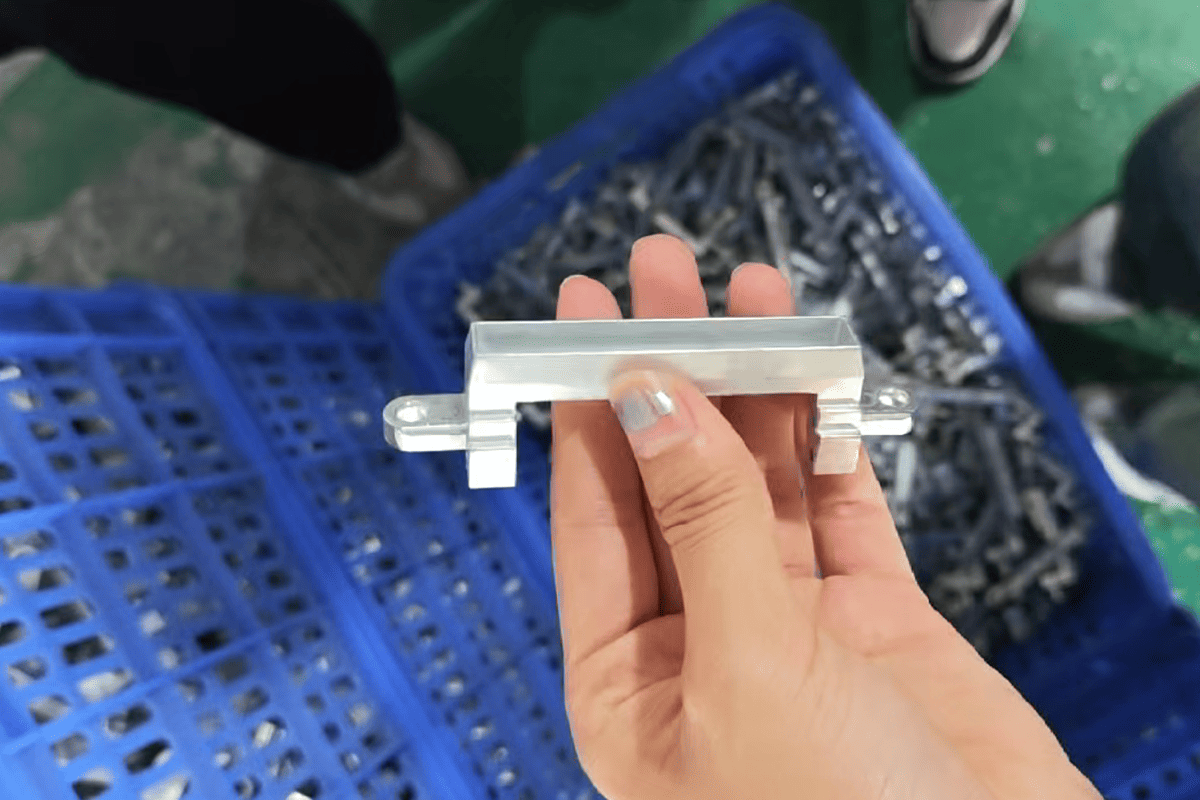
Many buyers judge a concealed hinge by its finish, movement, and consistency across cartons. That final result depends on several production steps. Polishing is one of them, and it works together with machining accuracy, material control, assembly, inspection, and plating.
What Does Vibratory Polishing in Concealed Hinge Manufacturing Actually Do?
When buyers hear “polishing,” they may think only of a bright or shiny surface. That view is too narrow. If a concealed hinge has burrs, oxidation marks, or rough edges, later processes may hide the problem temporarily, but assembly and function risks can still remain.
Vibratory polishing in concealed hinge manufacturing removes small burrs, reduces minor surface defects, cleans the workpiece surface, and creates a more uniform base for later finishing. It is usually a controlled machine polishing method, not a random cosmetic step, and it helps prepare concealed hinges for electroplating, assembly, and batch inspection.

Polishing Is a Surface Treatment, Not Just a Shine
In hardware manufacturing, polishing is a surface treatment process2. It is used to remove small surface defects, burrs, oxidation layers, and rough areas left by cutting, stamping, machining, drilling, or casting-related operations. For concealed hinge production, polishing supports both appearance and function.
I often explain polishing to buyers this way: a hinge surface may look acceptable in a raw state, but the edge condition and surface cleanliness still matter. A small burr near a moving contact point can affect assembly. A rough area may create inconsistent plating. A sharp edge may make handling and packaging riskier.
Polishing is generally divided into two broad types:
Machine polishing
This includes vibratory polishing, tumbling, belt polishing, wheel polishing, and other equipment-based processes.Manual polishing
This relies more on workers using hand tools, polishing wheels, abrasive pads, or localized finishing methods.
Both methods can have value. However, for concealed hinges, the choice depends on the part structure, volume, required surface effect, tolerance needs, and later surface treatment.
Why Concealed Hinges Need Careful Surface Preparation
A concealed hinge has several characteristics that make surface preparation important:
- It contains moving parts, so burrs and rough edges can affect movement.
- It is installed inside the door and frame, so dimensional fit matters.
- It often receives electroplating or other surface finishing, so surface cleanliness matters.
- It is usually purchased in large batches, so appearance consistency matters.
- It may be used in project doors, so stable quality reduces after-sales risk.
Vibratory polishing helps because it treats many parts at once in a controlled machine environment. The process uses vibrating motion, abrasive media, and polishing compounds to contact the hinge surface repeatedly. This action can remove fine burrs and improve the overall surface condition.
However, I do not treat vibratory polishing as a magic solution. A good concealed hinge still depends on:
| Quality Factor | Why It Matters |
|---|---|
| Raw material selection | It affects strength, stability, and finishing behavior |
| Machining accuracy | It affects fit, movement, and installation |
| Tolerance control | It protects hinge alignment and door performance |
| Polishing control | It improves edge smoothness and surface preparation |
| [Electroplating quality | It affects corrosion resistance and appearance](https://en.wikipedia.org/wiki/Electroplating)%%%FOOTNOTE_REF_3%%% |
| Assembly inspection | It confirms movement and structure |
| Final QC | It reduces shipment risk |
In manufacturing practice, polishing is one part of a full quality-control chain. We use it because it supports stability before the next process, not because it replaces good engineering.
Why Is Vibratory Polishing Important Before Electroplating?
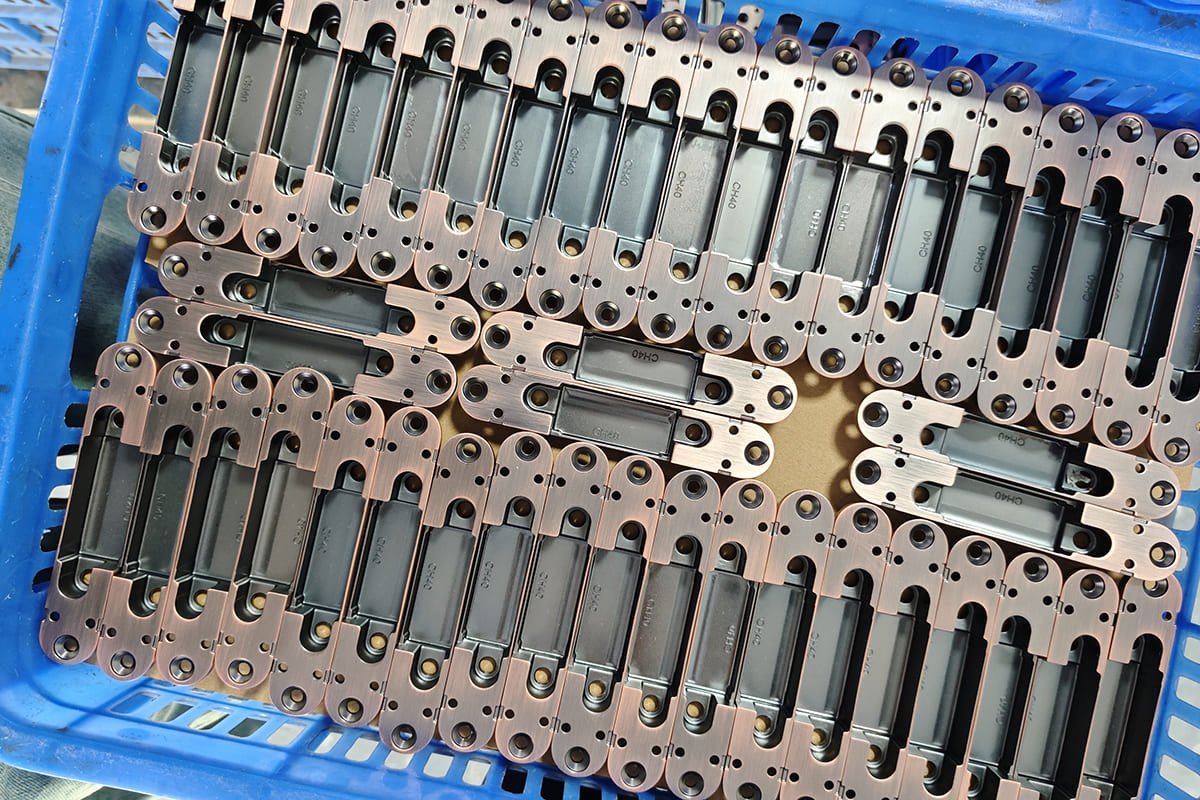
Electroplating can make a concealed hinge look more refined, but plating cannot solve every surface problem. If the base surface has burrs, dirt, oxidation, or uneven texture, the plated finish may also become inconsistent.4 That creates risk for hardware brands and importers.
Vibratory polishing is important before electroplating because it helps create a cleaner, smoother, and more consistent pre-treated surface. This can support better plating adhesion and more stable surface appearance5, although plating durability also depends on material, cleaning, plating chemistry, thickness control, and inspection standards.6
The Surface Under the Plating Still Matters
A plated concealed hinge is only as reliable as the preparation behind it. Buyers often focus on the visible finish, such as satin nickel, chrome, black, brass tone, or custom colors. That is understandable because end users see the finish first. However, in factory production, we know the surface below the finish has a major role.
Vibratory polishing helps prepare that surface by reducing small high points and cleaning minor irregularities. When the part enters cleaning and electroplating stages, a more consistent base can help later processes perform more predictably.
I like to compare it to painting a wall. A good paint layer looks better when the wall is smooth and clean. The paint itself matters, but the wall preparation also matters. The same thinking applies to concealed hinge finishing.
What Vibratory Polishing Can Support
For electroplated concealed hinges, controlled polishing can support:
- Better surface uniformity before plating
- Reduced burrs around edges, holes, or contact areas
- Cleaner part surfaces before chemical pretreatment
- More consistent reflection and texture after plating
- Lower risk of visible surface defects in final inspection
- More stable batch appearance for brand buyers and wholesalers
These benefits are practical, not theoretical. In B2B supply, one carton of good hinges is not enough. Buyers need repeated production batches that match the approved sample.
What Vibratory Polishing Cannot Guarantee Alone
I also want to be clear about limits. Vibratory polishing in concealed hinge manufacturing does not alone determine the final quality of the plated product. It works together with other controlled processes.
For example, the final electroplated layer can be affected by:
| Process Area | Buyer Evaluation Point |
|---|---|
| Material quality | Does the base metal meet the required specification? |
| Degreasing and cleaning | Are oils and residues removed before plating? |
| Acid activation or pretreatment | Is the surface properly prepared chemically? |
| Plating bath control | Are bath chemistry and process conditions stable? |
| Layer thickness control | Does the supplier inspect coating consistency? |
| Neutral salt spray or corrosion tests | Are tests available when required by the buyer? |
| Packaging | Is the finish protected during export transport? |
A supplier should not simply say, “Our hinges are polished, so they are durable.” That statement is too broad. A better supplier should explain how polishing connects to pretreatment, plating, inspection, and packaging.
For SDH Hardware, we position polishing as part of our full-process quality control. We encourage buyers to verify relevant documents, sample results, drawings, and finishing requirements before confirming bulk orders. For application-specific projects, I always recommend qualified professional evaluation, especially for fire-rated doors, public buildings, or regional compliance needs.
How Does Vibratory Polishing Improve Batch Consistency?
A single hinge can be polished by hand and look excellent. The challenge comes when a buyer needs thousands or tens of thousands of pieces with stable texture, clean edges, and reliable surface preparation. Manual work alone can create variation between workers, shifts, and batches.7
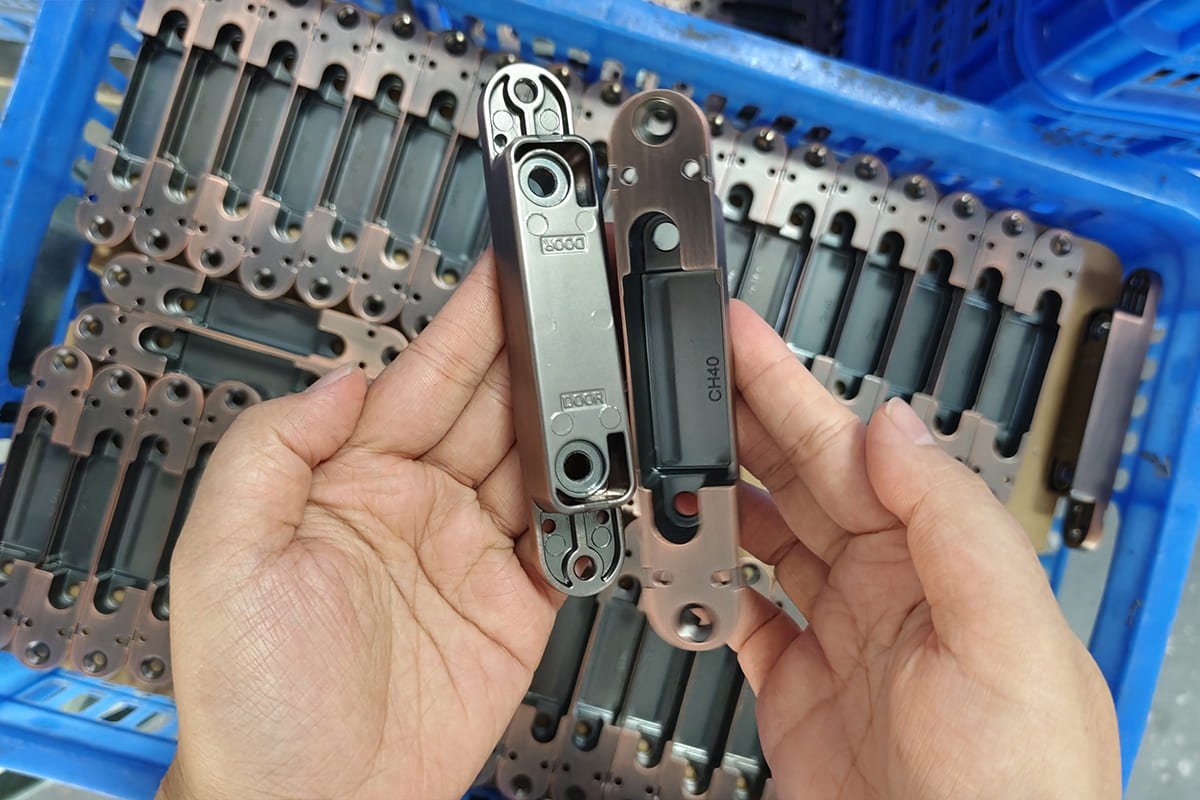
Vibratory polishing improves batch consistency because multiple concealed hinge parts are processed together under repeatable machine movement, media contact, and compound action.8 Compared with fully manual polishing, it can improve production efficiency, reduce variation, help control cost, and create a more uniform surface condition before electroplating.
Why Consistency Matters More Than One Perfect Sample
In B2B hardware purchasing, buyers often approve one sample and then expect the bulk order to match it. That expectation is reasonable. However, concealed hinge manufacturing involves many steps, and every step can introduce variation.
Vibratory polishing helps reduce one type of variation: surface preparation variation. The machine processes many hinges at once with a repeated motion. The abrasive media contacts exposed surfaces and edges, which helps create a more stable surface texture.
This is especially useful for buyers such as:
- Door factories that need smooth assembly and predictable installation
- Hardware brands that need stable appearance under their brand standard
- Bulk wholesalers that need cartons to match across different shipments
- Importers that need lower complaint risk in destination markets
- Project suppliers that need consistent hardware for many doors
Manual Polishing vs. Vibratory Polishing
Manual polishing still has value. It can help with targeted areas, visible surfaces, or special finish effects. However, when a concealed hinge order has large volume, machine polishing often becomes more practical.
| Evaluation Point | Manual Polishing | Vibratory Polishing |
|---|---|---|
| Production speed | Slower for large batches | Better for batch processing |
| Worker dependence | Higher | Lower |
| Surface consistency | Can vary by operator | More uniform when controlled |
| Cost control | Higher labor impact | More scalable |
| Complex local areas | Good for targeted correction | Limited by media access |
| Bulk concealed hinge production | Useful as support | Often more suitable as main deburring process |
In our production thinking, we do not treat these methods as enemies. We use the right method for the right purpose. A concealed hinge may require machine polishing for batch deburring and later manual attention for certain surface standards or special customer requirements.
Controlled Polishing Is Better Than Aggressive Polishing
Some buyers assume stronger polishing always means better quality. That assumption can be risky. A concealed hinge has important dimensions, contact surfaces, screw holes, pivot areas, and installation tolerances. Excessive material removal can affect fit.9
Controlled vibratory polishing should improve surface quality without changing critical dimensions. The goal is not to grind the part aggressively. The goal is to remove small burrs, smooth rough edges, clean the surface, and prepare it for the next process.
A good supplier should control:
Part loading method
The factory should avoid part damage from poor loading or overcrowding.Media selection
The media should match the hinge material, shape, and surface requirement.10Compound use
The compound should support cleaning and finishing without creating contamination.Process consistency
The factory should maintain repeatable batch handling and inspection.Post-polishing inspection
The QC team should check burr removal, deformation risk, and visible defects.
I avoid giving universal processing times or media formulas because each hinge design and material may require different settings. Buyers should ask suppliers how they validate the process for a specific concealed hinge model. That conversation reveals more than a polished sample photo.
What Should Buyers Ask Suppliers About Vibratory Polishing?
Many buyers ask about price, material, and finish, but they do not always ask how the hinge is prepared before plating and assembly. That gap can create hidden risk. A supplier may show bright samples, yet fail to maintain consistent surface preparation in bulk production.
Buyers should ask concealed hinge suppliers how vibratory polishing is controlled, inspected, and connected to electroplating preparation. The best questions focus on deburring, surface cleanliness, batch consistency, dimensional protection, inspection records, and whether the process is suitable for the specific hinge design and order volume.

Practical Questions for Procurement Teams
When I speak with professional buyers, I suggest asking questions that connect directly to production risk. The goal is not to become a polishing engineer. The goal is to confirm that the supplier understands process control.
Here are useful questions:
- How do you remove burrs from concealed hinge parts before finishing?
- Do you use vibratory polishing, manual polishing, or both?
- How do you prevent over-polishing near functional areas?
- How do you inspect hinges after polishing?
- How do you prepare the surface before electroplating?
- Can you keep surface texture consistent across repeat orders?
- Do you provide samples from mass production, not only hand-prepared samples?
- Can you support custom surface treatments and packaging?
- Which certifications or reports are available for verification?
These questions are simple, but they separate real manufacturers from trading-only suppliers. A factory with in-house production experience can usually explain the workflow clearly.
Supplier Evaluation Checklist
A buyer can use the following checklist during supplier selection:
| Evaluation Item | What to Look For | Why It Matters |
|---|---|---|
| In-house production | Factory has direct manufacturing control | Better process traceability |
| Polishing capability | Machine polishing and manual support are available | Better flexibility |
| Deburring inspection | QC checks edges, holes, and moving areas | Lower assembly risk |
| Electroplating preparation | Surface treatment is part of a defined workflow | Better finish stability |
| Sample-to-bulk control | Bulk samples match approved samples | Lower buyer complaint risk |
| Customization support | Supplier can adjust specs, colors, logos, packaging | Better brand fit |
| Documentation | CE or fire-rated documents can be verified when needed | Supports compliance review |
| Final inspection | Finished products are checked before shipment | Reduces import risk |
How We Think About This at SDH Hardware
At SDH Hardware, we manufacture architectural door hardware with direct factory operations in China. Our product range includes concealed door hinges, Euro mortise locks, stainless steel lever handles, butt hinges, Euro brass cylinders, and door accessories. Because we serve door factories, hardware brands, and wholesalers, we focus on repeatability rather than one-time presentation.
For concealed hinge production, vibratory polishing is part of our broader manufacturing and quality-control approach. We view it as a batch surface-treatment process that supports:
- Deburring
- Surface cleaning
- Electroplating preparation
- Batch appearance consistency
- Functional stability before assembly
- Lower risk during final inspection
We also provide OEM and ODM support when buyers need custom specifications, surface treatments, logo stamping or laser logos, packaging design, and product drawings after order confirmation. For certifications such as CE or fire-rated documentation, buyers should always review the actual documents and confirm whether they apply to the product model and target market.
I have seen buyers focus only on the visible plating color, then later discover that the bulk order has inconsistent edge quality. That is why I prefer early technical discussion. A short conversation about polishing, plating, tolerances, and inspection can prevent much larger problems after shipment.
How Does Vibratory Polishing Affect Concealed Hinge Function?
A concealed hinge is not only a decorative hardware part. It must carry movement, alignment, and installation performance inside a door system. If burrs remain in contact areas, the hinge may feel rough, create noise, or cause assembly difficulty.11
Vibratory polishing can support concealed hinge function by smoothing minor burrs and rough edges that may interfere with movement or assembly. It does not replace precise machining or correct hinge design, but it can reduce small surface-related risks that affect opening, closing, handling, and final product inspection.
Concealed Hinges Have Functional Surfaces
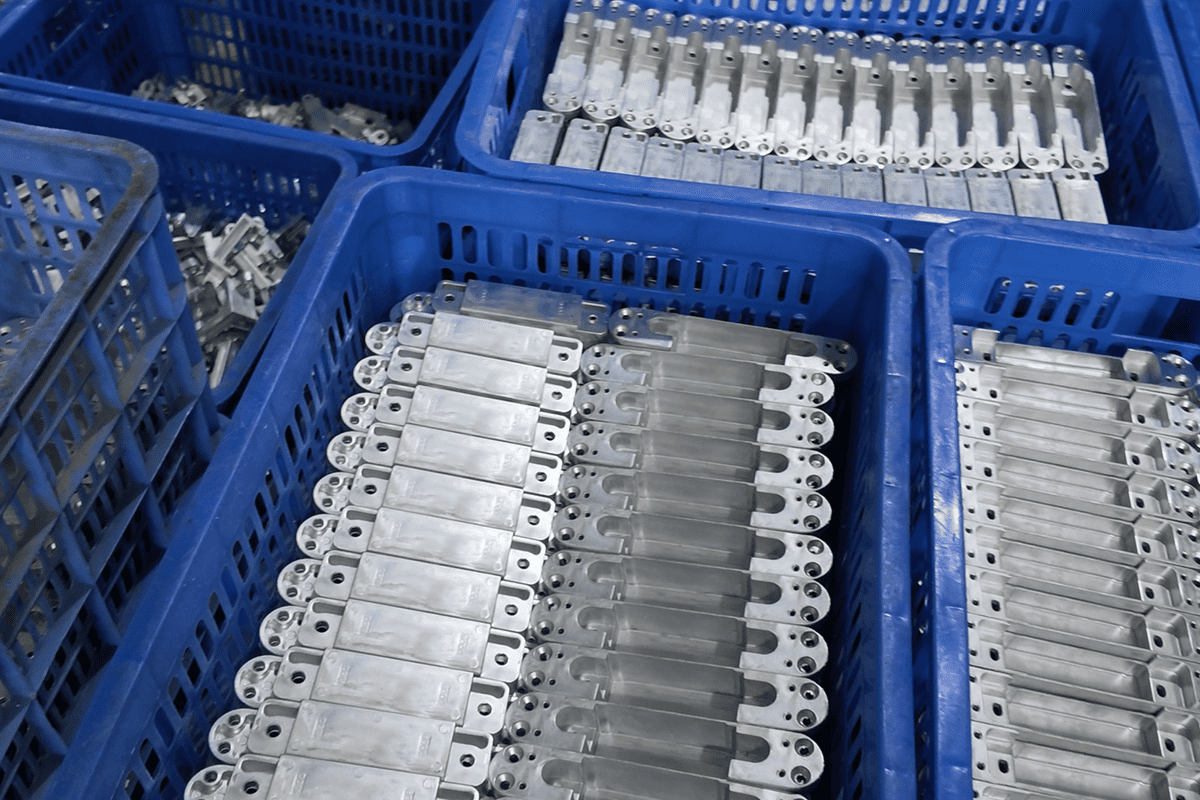
Concealed hinges are compact and often have more complex geometry than simple butt hinges. They may include arms, link structures, recessed bodies, screw holes, covers, and pivot-related areas. These parts must work together smoothly after assembly.
A rough edge may seem small, but it can cause practical problems:
- Workers may feel sharp burrs during assembly.
- Parts may not sit cleanly in fixtures.
- Moving areas may feel less smooth.
- Plating may build unevenly around rough edges.
- Packaging contact may mark the finish.
- End users may notice inconsistent movement.
Vibratory polishing helps by smoothing many of these small surface issues before the hinge is finished. It is especially useful after machining operations that create burrs around holes, slots, or edges.
Function Depends on More Than Polishing
I want to keep the point balanced. A smooth surface does not automatically make a high-quality concealed hinge. The hinge still needs proper design, correct material, accurate machining, controlled tolerances, and careful assembly.
For example:
| Functional Requirement | Main Production Influence |
|---|---|
| Smooth opening and closing | Design, machining, assembly, lubrication, polishing |
| Correct door alignment | Hinge geometry, tolerance control, installation accuracy |
| Load performance | Material strength, structure, testing, application suitability |
| Stable screw fixing | Hole accuracy, material, installation method |
| Long-term movement | Assembly quality, wear control, finish, usage environment |
Vibratory polishing contributes most to surface-related function. It helps remove small obstacles that could otherwise affect movement or handling. However, a buyer should still evaluate the hinge as a complete product.
Buyer Tip: Test Movement After Surface Finishing
I suggest buyers test concealed hinges after finishing, not only in raw metal form. Electroplating and coating can slightly change surface feel, edge definition, and part contact.12 Final inspection should include both visual checks and functional checks.
A simple buyer-side evaluation can include:
- Open and close the hinge several times.
- Check whether movement feels smooth and controlled.
- Inspect screw holes and edges for burrs or plating build-up.
- Compare several pieces from different cartons.
- Install samples in the intended door and frame system.
- Confirm whether the hinge meets the project or market requirement.
For technical or high-risk applications, qualified professional evaluation is important. A concealed hinge used in a light interior door may have different requirements from one used in a commercial project, fire-rated system, or heavy-duty installation.
Frequently Asked Questions
Is vibratory polishing only used to make concealed hinges shiny?
No. Vibratory polishing is used for deburring, cleaning, edge smoothing, and surface preparation. A brighter or more refined appearance may result, but the main manufacturing value is controlled surface improvement before electroplating, assembly, and final inspection.
Can vibratory polishing replace manual polishing completely?
Not always. Vibratory polishing is efficient for batch processing and consistency, but manual polishing may still be needed for targeted areas, special finishes, or customer-specific appearance standards. Many factories use both methods depending on the hinge design and order requirements.
Does vibratory polishing improve electroplating quality?
Vibratory polishing can support electroplating quality by creating a cleaner and more uniform base surface. However, final plating performance also depends on material quality, cleaning, chemical pretreatment, plating bath control, coating thickness, inspection, and packaging protection.
Can over-polishing damage a concealed hinge?
Yes. Excessive or poorly controlled polishing can affect edges, dimensions, contact areas, or fit. The goal is controlled surface improvement, not aggressive material removal. Buyers should ask suppliers how they protect critical dimensions during polishing and inspection.
What should I check in a concealed hinge sample?
You should check surface smoothness, burr removal, plating consistency, screw holes, hinge movement, dimensional fit, packaging protection, and whether the supplier can reproduce the same quality in bulk production. You should also verify applicable CE or fire-rated documents when required.
Conclusion
Vibratory polishing in concealed hinge manufacturing is more than a cosmetic finishing step. It is a controlled batch process that helps remove burrs, clean surfaces, smooth edges, prepare parts for electroplating, and support consistent production quality. It works best when combined with good material selection, machining accuracy, assembly control, plating management, and final inspection. If you are evaluating a concealed hinge supplier, we welcome you to contact SDH Hardware for factory-direct OEM/ODM support, samples, drawings, and practical production discussion.
"Vibratory Equipment - Mass Finishing Machines", https://surfaceprep.com/product-category/equipment-parts/vibratory-equipment/. A technical manufacturing reference describes vibratory finishing as a mass-finishing process in which parts, abrasive media, and compounds are agitated together to deburr, smooth edges, and improve surface condition before later finishing steps. Evidence role: definition; source type: education. Supports: A university or technical manufacturing reference should define vibratory finishing as a batch mass-finishing process using media and compounds to deburr, smooth edges, clean surfaces, and prepare parts for subsequent finishing.. Scope note: The source would support the general process description, not prove performance for the specific concealed hinge factory discussed in the article. ↩
"Surface finishing", https://en.wikipedia.org/wiki/Surface_finishing. Materials-engineering references classify polishing as a surface-finishing operation used to reduce surface roughness and improve the condition of a workpiece surface. Evidence role: definition; source type: encyclopedia. Supports: An encyclopedia or materials-engineering reference should define polishing as a surface-finishing or surface-treatment operation used to reduce roughness and improve surface condition.. ↩
"Electroplating - Wikipedia", https://en.wikipedia.org/wiki/Electroplating. General references on electroplating describe the process as depositing a metal coating to provide functions such as corrosion protection and decorative appearance. Evidence role: definition; source type: encyclopedia. Supports: An encyclopedia or institutional source should explain that electroplating is used for corrosion protection and decorative surface appearance.. ↩
"Substrate Effect on Electroplating", https://www.sharrettsplating.com/blog/substrate-effect-on-electroplating/. Electroplating literature identifies surface cleanliness, oxide removal, and substrate smoothness as important factors in coating adhesion and finish uniformity, supporting the connection between poor substrate preparation and inconsistent plated results. Evidence role: mechanism; source type: research. Supports: A neutral electroplating source should explain that surface contamination, oxides, and mechanical irregularities can interfere with coating adhesion, uniformity, and appearance.. Scope note: The source would support the general electroplating mechanism rather than quantify defect rates for concealed hinges. ↩
"Achieving Better Adhesion with Proper Surface Preparation", https://fpg.phys.virginia.edu/fpgweb/useful_info/Master_Bond-Proper_Surface_Preparation_Bonding.pdf. Research on electrodeposited coatings reports that substrate pretreatment, including cleaning and surface conditioning, is a significant determinant of coating adhesion and surface quality. Evidence role: mechanism; source type: paper. Supports: A peer-reviewed paper or technical review should support that substrate pretreatment, including cleaning and surface conditioning, affects electroplated coating adhesion and appearance.. Scope note: The evidence would address electroplated coatings generally and may not test vibratory polishing of concealed hinges specifically. ↩
"Compliance and Technical Assistance: Plating", https://www.in.gov/idem/ctap/guidance-for-industry-sectors/plating/. Technical guidance on electroplated coatings treats coating performance as dependent on substrate condition, cleaning and pretreatment, bath chemistry, process control, and coating thickness, rather than on any single preparation step alone. Evidence role: expert_consensus; source type: institution. Supports: An institutional or standards-oriented source should describe multiple process variables that influence electroplated coating performance, including substrate preparation, bath control, and coating thickness.. ↩
"Effect of Human Factor on Product Quality in Manufacturing ...", https://www.academia.edu/107413554/Effect_of_Human_Factor_on_Product_Quality_in_Manufacturing_Activities. Manufacturing-quality studies commonly identify manual operations as a source of operator-dependent variability, which can affect consistency across shifts and production batches. Evidence role: general_support; source type: paper. Supports: A manufacturing-quality or human-factors paper should support that manual operations can introduce operator-dependent variability in production outcomes.. Scope note: The support would be contextual manufacturing evidence and may not measure polishing variation in concealed hinge production directly. ↩
"experimental and computational evaluation of a vibratory", https://ninercommons.charlotte.edu/record/720/files/Navare_uncc_0694N_11401.pdf. Mass-finishing literature describes vibratory finishing as a batch process governed by machine motion, media, compounds, loading, and time, supporting its use for repeatable surface treatment across groups of parts. Evidence role: general_support; source type: research. Supports: A research or technical source should explain that vibratory finishing is a controlled batch process whose outcomes depend on repeatable motion, media selection, compound use, and process parameters.. Scope note: The source would support process repeatability in general, not guarantee identical appearance across every hinge batch. ↩
"Types of Cutting and Machining Pocess and Tolerances", https://uark.pressbooks.pub/mechanicaldesign/chapter/types-of-cutting-and-machining-pocess-and-tolerances/. Manufacturing-engineering references note that material-removal operations, including finishing and deburring, must be controlled because dimensional changes can affect tolerances and assembly fit. Evidence role: mechanism; source type: education. Supports: A manufacturing-engineering source should explain that material removal during finishing can alter dimensions and therefore affect tolerance-dependent fit.. ↩
"Vibratory Finishing for CNC Parts: Process, Media, Deburring", https://jlccnc.com/blog/vibratory-finishing. Mass-finishing guidance explains that abrasive media are selected according to workpiece material, part geometry, access to features, and the required deburring or finishing effect. Evidence role: mechanism; source type: research. Supports: A mass-finishing source should state that media type, size, shape, and material are selected according to workpiece material, geometry, and required surface finish.. Scope note: The source would support the general media-selection principle, not specify the correct media for any particular concealed hinge model. ↩
"The Formation and Properties of Machining Burrs", https://digitalcommons.usu.edu/cgi/viewcontent.cgi?referer=&httpsredir=1&article=5595&context=etd;The. Research on burr formation and deburring reports that burrs can interfere with assembly, alter contact conditions, and impair functional performance of mechanical parts. Evidence role: mechanism; source type: paper. Supports: A paper on burr formation or deburring should support that burrs can interfere with assembly, part fit, friction, and functional performance of mechanical components.. Scope note: The source would support the mechanism for mechanical components broadly and may not discuss concealed hinges specifically. ↩
"Design and Thickness of Plating Affects Final Dimensions", https://www.anoplate.com/news-and-events/electroplating-metal-plating/. Coating literature notes that electroplated layers add measurable thickness to component surfaces, so coating build-up can influence dimensions, edges, and contact conditions in assembled parts. Evidence role: mechanism; source type: paper. Supports: A coating or electroplating source should explain that deposited coating thickness adds material to surfaces and can affect dimensions, edges, and contact interfaces.. Scope note: The evidence would support the physical mechanism, not determine whether the effect is significant for every hinge design. ↩