
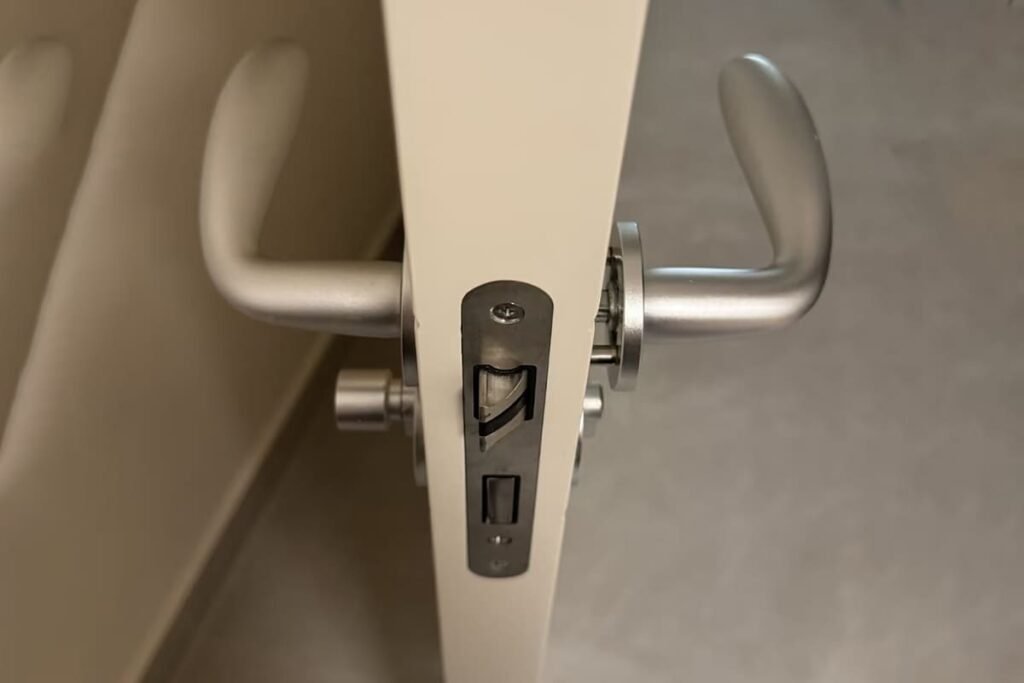
Door Handle and Lock Compatibility: A Pre-Order Checklist
Door Handle and Lock Compatibility becomes expensive when buyers treat it as automatic. A small mismatch in PZ distance, spindle size, through-bolt holes, or certification scope can turn good stock into rework. I use a pre-order checklist because the safest solution is to verify the set before production, packing, and shipment.
Door handle and lock compatibility means the lock, lever set, cylinder, escutcheon or plate, fixing screws, door thickness, function, and certification scope all match before ordering. In EN/DIN projects, buyers should pair EN/DIN locks with EN/DIN handles and verify drawings, test records, and certificates instead of assuming a universal fit.
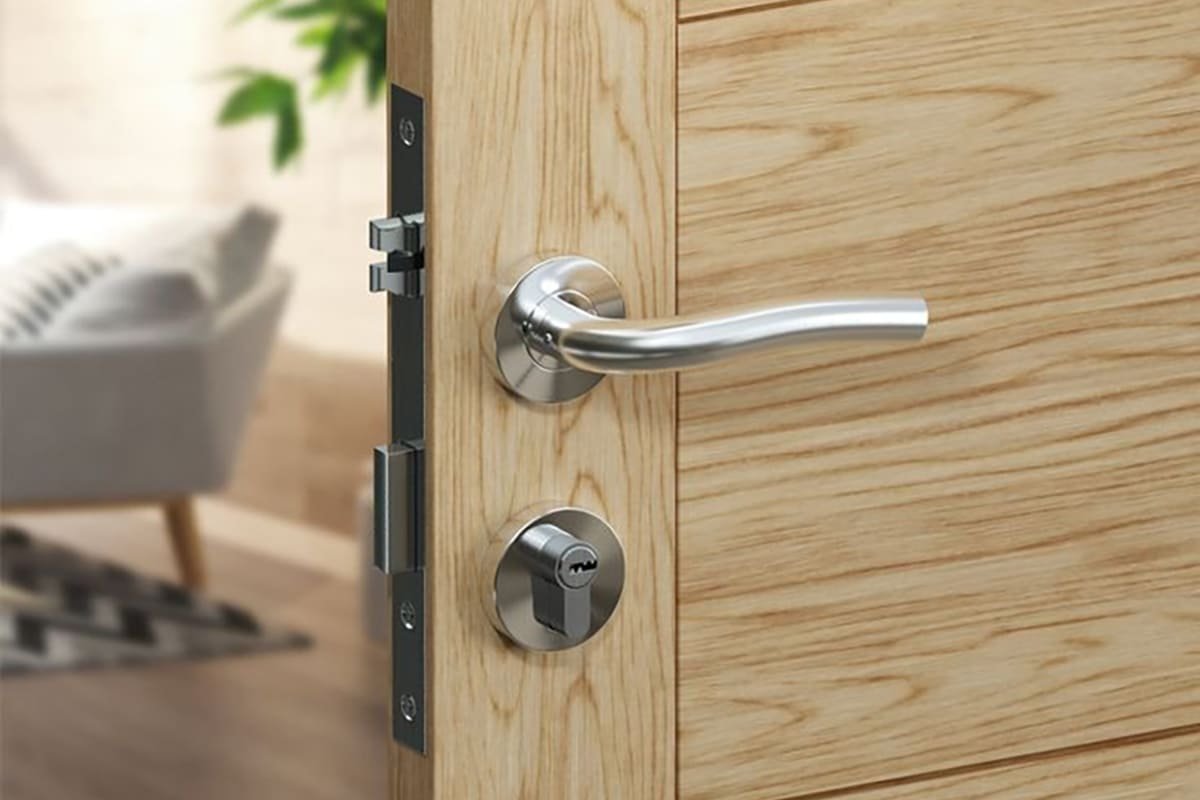
I have seen small selection errors create large commercial problems. A handle can look correct in a catalog but still fail on the door. So I start every project with four checks: standard, function, mechanical fit, and compliance.
Why does Door Handle and Lock Compatibility start with the standard and function?
A buyer may choose a beautiful lever handle first and then ask which lock fits it. That order creates risk. If the standard or function is wrong, the product may not assemble, may feel loose, or may fail inspection. I prefer to define the door application first.
Door Handle and Lock Compatibility starts with the standard and function because EN/DIN, ANSI, BS, and other systems use different geometry, drilling logic, and compliance assumptions1. For EN/DIN projects, I select the lock type, door function, and certification requirement first, then match the handle set, cylinder, plates, and accessories.
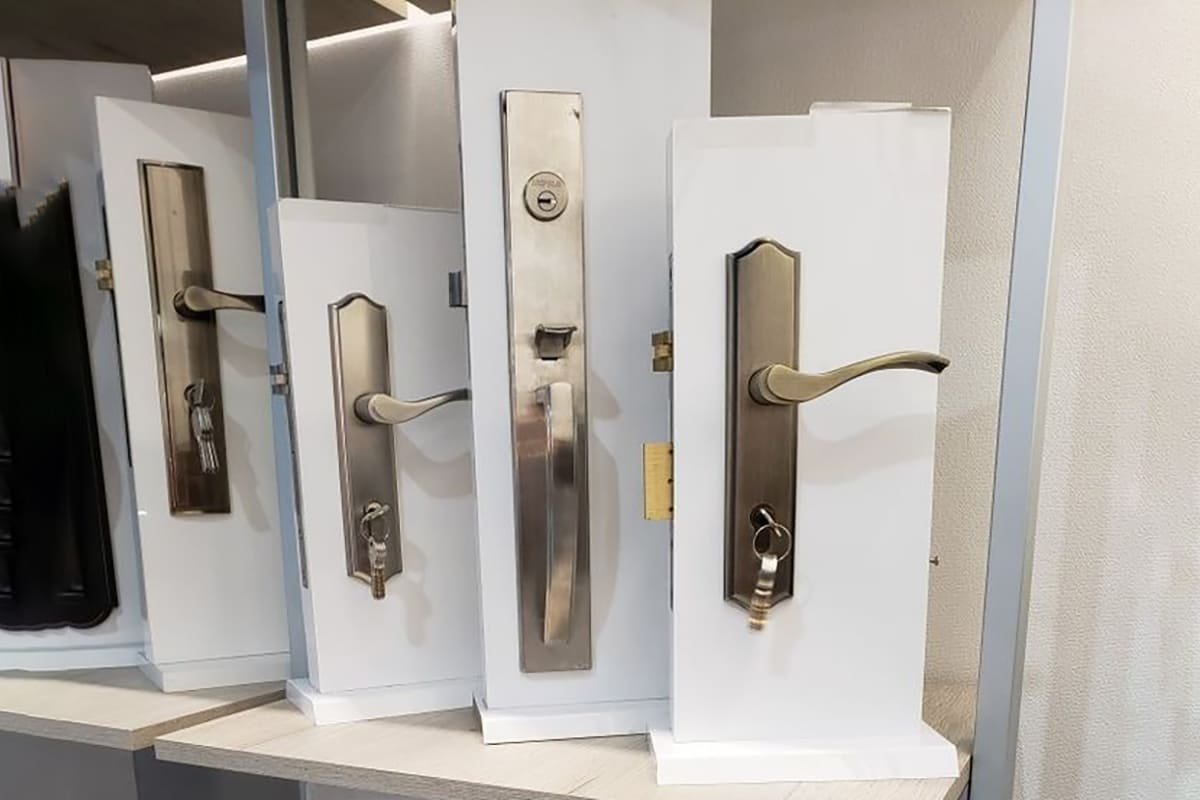
Start with the same-standard rule
In our pre-sales work at SDH Hardware, I treat same-standard pairing as the first filter.
For EN/DIN projects, the normal rule is:
EN/DIN locks should pair with EN/DIN handles, cylinders, plates, and door preparation. ANSI, BS, or mixed-standard pairings are not compatible by default.2
This rule sounds simple, but it prevents many returns. Mixed-market regions, especially parts of the Middle East and Southeast Asia, often receive door schedules from one standard and hardware requests from another. That is where problems start. A non-EN component may not align with EN/DIN backset, PZ center distance3, through-bolt locations, or door preparation.
I do not say cross-standard use is impossible. I say it is high-risk and to be verified. If a customer asks for cross-standard adaptation, I request drawings, drilling schemes, and an explicit approval process. I also make clear that adaptation may affect certification, lead time, and liability.
Map the function before selecting the set
For EN/DIN scope, I usually separate functions like this:
| Door function | Typical EN/DIN hardware set | Key compatibility point |
|---|---|---|
| Passage door | Lever handle set only | Latch function and spindle/follower must match |
| Room or entrance door | Lever handle + euro-cylinder escutcheons or long plate | PZ distance and euro-profile keyhole alignment must match |
| Public restroom door | Lever handle + red/green indicator turn | WC/privacy lock function and spindle mechanics must match |
| Interior wooden door | Silent latch or magnetic latch + lever handle | Quiet closing and lever return must be checked |
| Fire door | Fire-rated lock + certified handle set | Components must be listed together in certificate scope |
This mapping prevents wrong purchases. For example, a WC/privacy indicator is not just a decorative turn. It must match the privacy lock’s mechanics, spindle, indicator position, and release function. If the lock uses one privacy system and the turn set uses another, the door may not operate correctly even if the rose size looks correct.
A return case I still remember
I once handled a rework case where the customer ordered EN-style lever handles but paired them with an existing non-EN door preparation. The visible design was acceptable, but the through-bolt pattern did not align with the lock and door holes. The installation team tried to adjust on site. That caused finish damage and inconsistent clamping.
The corrective action required:
- new drilling drawings,
- replacement fixing screws,
- additional inspection,
- repacking,
- and delayed delivery.
The cost was not only product cost. It also affected trust between the importer and the local installer. Since then, I always ask customers to approve the standard and function before we discuss finishes.
Which red lines make Door Handle and Lock Compatibility fail before ordering?
Some mismatches are small enough to solve during engineering review. Others should stop the order immediately. If a buyer ignores these red lines, the problem often appears after shipment, when repair is slow and costly. I prefer to reject a risky configuration early.
Door Handle and Lock Compatibility fails before ordering when the project mixes standards without approved drawings, pairs fire or escape products outside certificate scope, mismatches PZ or spindle size, or uses screws and fixing methods that cannot clamp the handle securely on the specified door thickness.
Red line 1: Cross-standard mixing without validation
The first non-negotiable issue is cross-standard mixing. EN/DIN hardware should not be assumed to work with ANSI, BS, or other non-EN components. I avoid giving detailed cross-standard dimensions unless the buyer provides the exact drawings. The safe comment is simple:
Likely incompatible. To be verified by drawings, drilling plan, sample fitting, and written approval.
If an adapter plate or special drilling scheme is proposed, it must be reviewed before production. The buyer should also consider whether the modified solution remains acceptable for the project’s inspection requirements. In many cases, adaptation adds lead time and creates responsibility that must be clearly assigned.
Red line 2: Fire or escape sets outside certificate scope
This is the point I stress most carefully. Stainless steel does not automatically mean fire-rated.4 A fire-rated door set depends on tested and documented combinations.5 The lock, handle, cylinder, escutcheon, plate, spindle, screws, and sometimes finish must fall within the certificate scope.6
For procurement teams, the correct question is not, “Is this handle stainless steel?” The correct questions are:
- Is the handle model listed on the relevant certificate?
- Is the lock model listed with it?
- Is the cylinder or plate included in the tested set?
- Does the certificate cover this door type and application?
- Does the finish or material variant remain inside the document scope?
At SDH Hardware, we can provide CE and fire-rated documents for relevant products, but I always tell buyers to verify the document number, scope, model list, and project requirement. I do not recommend mixing vendors for fire or escape doors unless a qualified professional and the required documentation confirm the set.
Red line 3: PZ and spindle mismatch
In EN/DIN lock–handle selection, PZ center distance and follower/spindle size are common failure points. A handle plate or escutcheon may not line up with the cylinder hole. A spindle may not fit the follower. Or a loose fit may create poor lever feel.
Typical issues include:
- wrong PZ center distance between lever and keyhole,
- 8 mm vs 9 mm spindle/follower mismatch7,
- spindle length not suitable for door thickness,
- square spindle tolerance causing loose operation,
- keyhole escutcheon not aligned with the lock body.
A buyer may not notice this from a product photo. That is why I request drawings before confirming a bulk order.
Red line 4: Door thickness and fixing mismatch
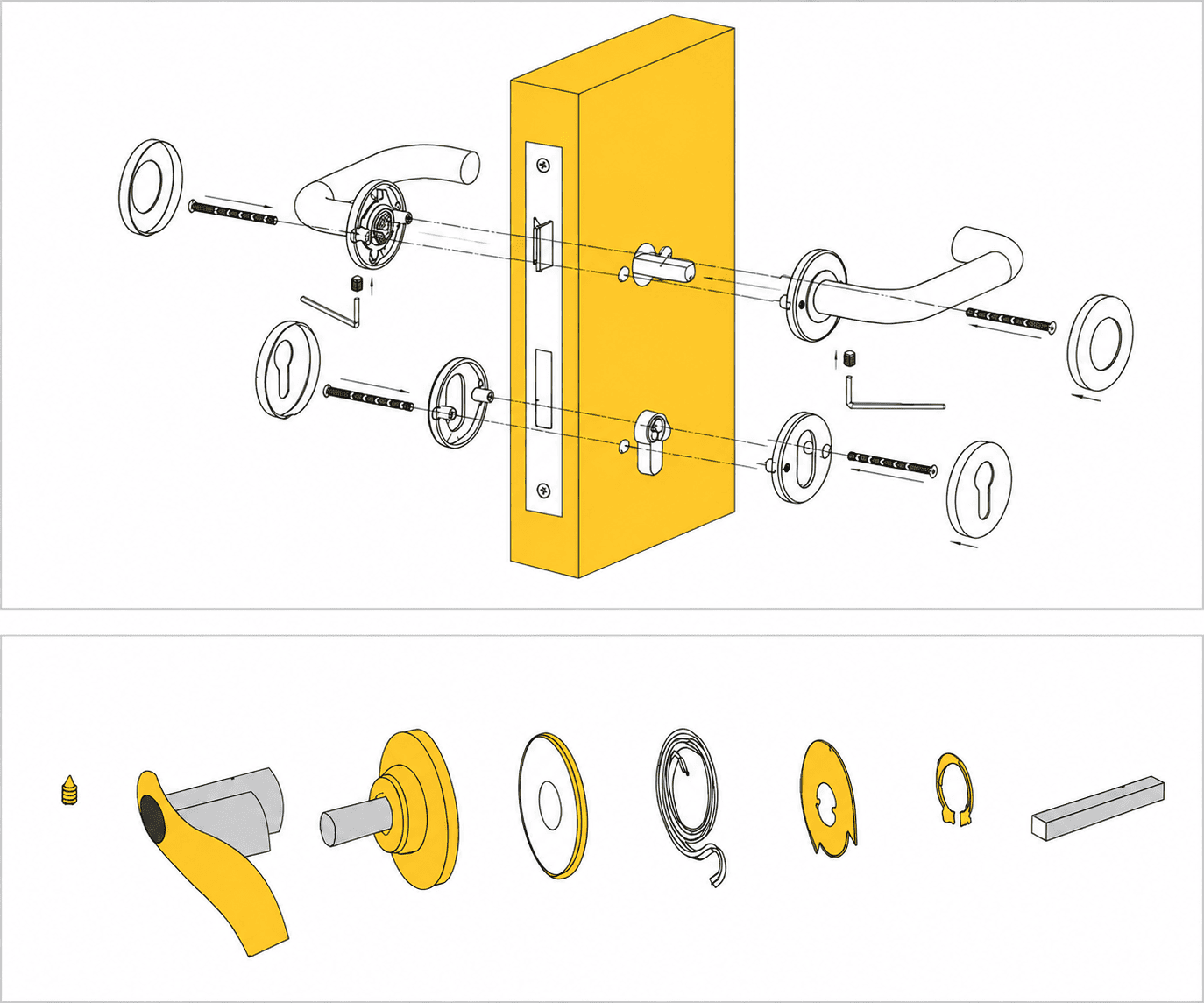
A handle set must clamp securely. If the door thickness exceeds the screw range, the handle may feel loose.8 If the screws are too long, they may bottom out or interfere. If the through-bolt positions do not align, the installer may be tempted to drill new holes. That can weaken the door preparation and create warranty disputes.
Our inspection records normally check:
| Item | What I verify | Why it matters |
|---|---|---|
| Door thickness range | Handle kit and screw length | Secure clamping |
| Through-bolt spacing | Handle rose/plate vs lock/door prep | Correct installation |
| Spindle length | Door thickness and lever engagement | Smooth operation |
| Screw engagement | Thread depth and fixing stability | Long-term durability |
| Plate or rose coverage | Existing holes and prep area | Clean appearance |
If one of these items fails, I pause the order. It is better to adjust the selection before production than to repair hundreds of doors after delivery.
How should buyers check Door Handle and Lock Compatibility for EN/DIN mechanical fit?
Mechanical fit looks simple on paper, but it is where many bulk orders fail. A lock case and lever handle are not just two separate products. They work as one assembly. If geometry, fixing, springing, and accessories are not aligned, the door will not feel reliable.
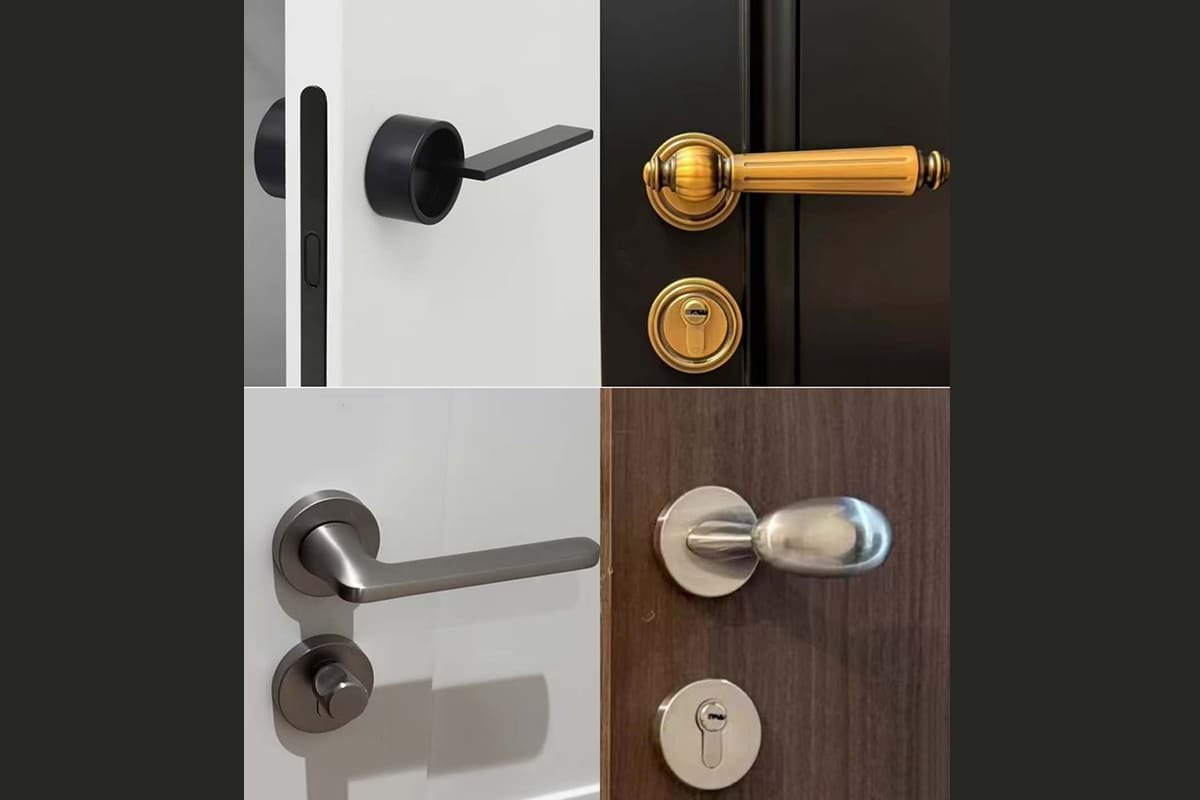
Buyers should check Door Handle and Lock Compatibility for EN/DIN mechanical fit by confirming backset, case size, PZ distance, follower size, door thickness range, through-bolt positions, springing logic, euro-profile cylinder alignment, WC/privacy mechanics, and approved finishes before purchase order confirmation.
Use drawings, not only catalog pages
Catalog pages are useful for product selection. Drawings are necessary for procurement approval. In my daily work, I compare the lock drawing, handle drawing, door preparation drawing, and accessory list before recommending a set.
The core EN/DIN mechanical checklist includes:
Backset
The distance from the door edge to the lock centerline must match the door design and lock function.9Lock case height and width
The mortise pocket must accept the lock body without weakening the door.PZ center distance
The lever center and cylinder center must match the escutcheon or long plate.Follower size
The spindle must fit the lock follower correctly. Common mismatch examples include 8 mm and 9 mm systems.Door thickness range
The handle kit, screws, spindle, and cylinder length must suit the door thickness.Through-bolt hole positions
The handle’s fixing pattern must align with the lock and door preparation.Euro-profile cylinder compatibility
The cylinder shape, length, cam operation, and escutcheon alignment must be checked.WC/privacy spindle and turn system
The indicator/turn must match the lock’s privacy function and release design.
Check springing before the sample feels wrong
Lever return is another common issue. Some systems rely on springing inside the lock. Some rely on springing inside the handle. Some use both.10 If the design is not reviewed, the lever may feel too stiff, bind during return, or sag after use.
I normally ask three questions:
- Does the lock have a spring strong enough to return the lever?
- Does the handle have its own return spring?
- Will double springing create binding or an uncomfortable operating force?
For heavy commercial levers, springing should be checked carefully. The user will notice lever feel immediately. A door manufacturer may pass a visual inspection but still receive complaints if the handle feels heavy or loose.
Match material and finish to application
Finish selection also affects compatibility in a practical sense. For normal interior wooden doors, buyers may choose zinc-alloy lever handles with a silent latch or magnetic latch for quieter use. This can be suitable for residential, hotel, or office interiors, depending on project requirements.
For fire doors, I do not treat finish as a free decorative choice. The buyer should verify whether the selected stainless-steel handle model, finish, lock, spindle, screws, and accessories are within the certificate scope. A different finish or component can be outside the listed set.
A simple pre-order table I use
When I compare sets for a customer, I often prepare a matrix like this:
| Checkpoint | Required information | Pass condition |
|---|---|---|
| Standard | EN/DIN project or other | Same-standard set selected |
| Function | Passage, entrance, WC, fire, etc. | Hardware set matches function |
| PZ | Lock drawing and plate/escutcheon drawing | Centers align |
| Follower | Lock follower and spindle size | Correct fit, no looseness |
| Door thickness | Door spec and handle kit range | Screws and spindle suitable |
| Through-bolts | Hole pattern and lock clearance | No interference |
| Cylinder | Euro-profile cylinder and escutcheon | Correct alignment and length |
| Certificate | Document scope and model list | All required parts listed |
This table is not complicated, but it saves time. I would rather spend 20 minutes on a drawing review than handle 20 cartons of returned goods.
How does Door Handle and Lock Compatibility affect fire, escape, and mixed-market projects?
Fire, escape, and mixed-market projects carry higher risk because compatibility is not only physical. It is also documentary. A handle may operate a lock, but the set may still fail a compliance review. That difference matters for importers, door factories, and brand companies.
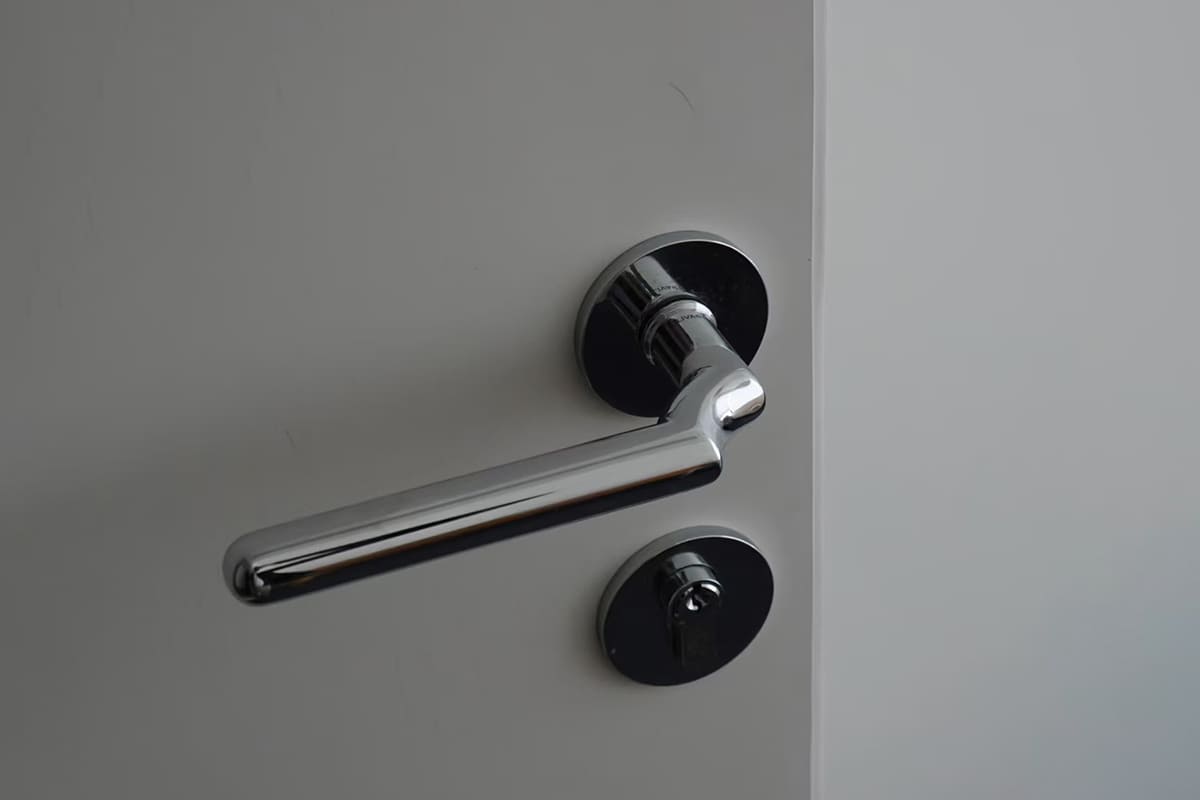
Door Handle and Lock Compatibility affects fire, escape, and mixed-market projects because the complete set must be physically matched and supported by valid documents. Fire or escape doors require tested combinations, while mixed-standard regions require drawings, sample approval, lead-time planning, and clear responsibility for any adaptation.
Fire-rated sets must be treated as tested systems
A fire door is not a place for casual substitution. The lock, handle, cylinder, plates, screws, spindle, and installation conditions may all affect the tested performance. I advise buyers to treat the approved hardware set as a system.
For procurement, this means:
- Do not replace a listed handle with a similar-looking model.
- Do not replace a certified cylinder or plate without checking scope.
- Do not assume another stainless-steel product is acceptable.
- Do not mix brands unless certification and project authority allow it.
- Do not accept verbal confirmation without documents.
At SDH Hardware, we manufacture fire-rated products for relevant project needs, and we can provide supporting documentation where applicable. However, the buyer should verify certificates against the project specification. If a door is subject to a local authority, consultant, or testing requirement, that qualified party should confirm acceptance.
Escape hardware needs even stricter review
Escape or emergency applications require careful professional evaluation. The handle, lock function, door direction, cylinder use, and user operation may affect safety.11 I keep my advice restrained here because project-specific decisions should be reviewed by qualified professionals.
For bulk procurement, I recommend that buyers collect:
- project door schedule,
- lock function description,
- required standard documents,
- approved model list,
- installation drawings,
- sample test feedback,
- and inspection records.
This prevents a common problem: the buyer orders products that are mechanically close but not documented for the intended escape use.
Mixed-market regions need written assumptions
In markets where EN/DIN products may be used beside non-EN systems, I use written assumptions. I do not rely on “usually fits.” I write down what we know and what remains to be verified.
A practical mixed-market note may read:
The requested EN/DIN lock and handle set is verified only within the supplied EN/DIN drawings. Pairing with existing non-EN door preparation is likely incompatible unless the buyer approves an adapter plate, drilling scheme, sample fitting, and responsibility statement. Certification scope may not remain valid after modification.12
This language protects both sides. It also helps the customer explain the risk to their installer or project owner.
Rework costs are rarely only technical
When compatibility fails after delivery, the cost spreads across the supply chain. A door factory may need to stop production. A wholesaler may need to sort stock. An importer may need to answer installation complaints. A brand company may need to protect its market reputation.
I have seen corrective actions include:
- sorting cartons by lock type,
- replacing spindles and screws,
- remaking escutcheons,
- changing cylinders,
- sending adapter plates,
- revising drawings,
- issuing inspection reports,
- and discounting affected stock.
These costs can exceed the cost of the original part difference. That is why I believe compatibility is earned before ordering. It is not assumed from a product photo or a short item description.
What should a pre-order checklist include before confirming production?
A purchase order can look complete while still missing critical compatibility data. If the buyer only lists model codes and finishes, the factory may not see the door preparation, lock function, or certification need. I prefer a checklist that connects commercial order details with engineering details.
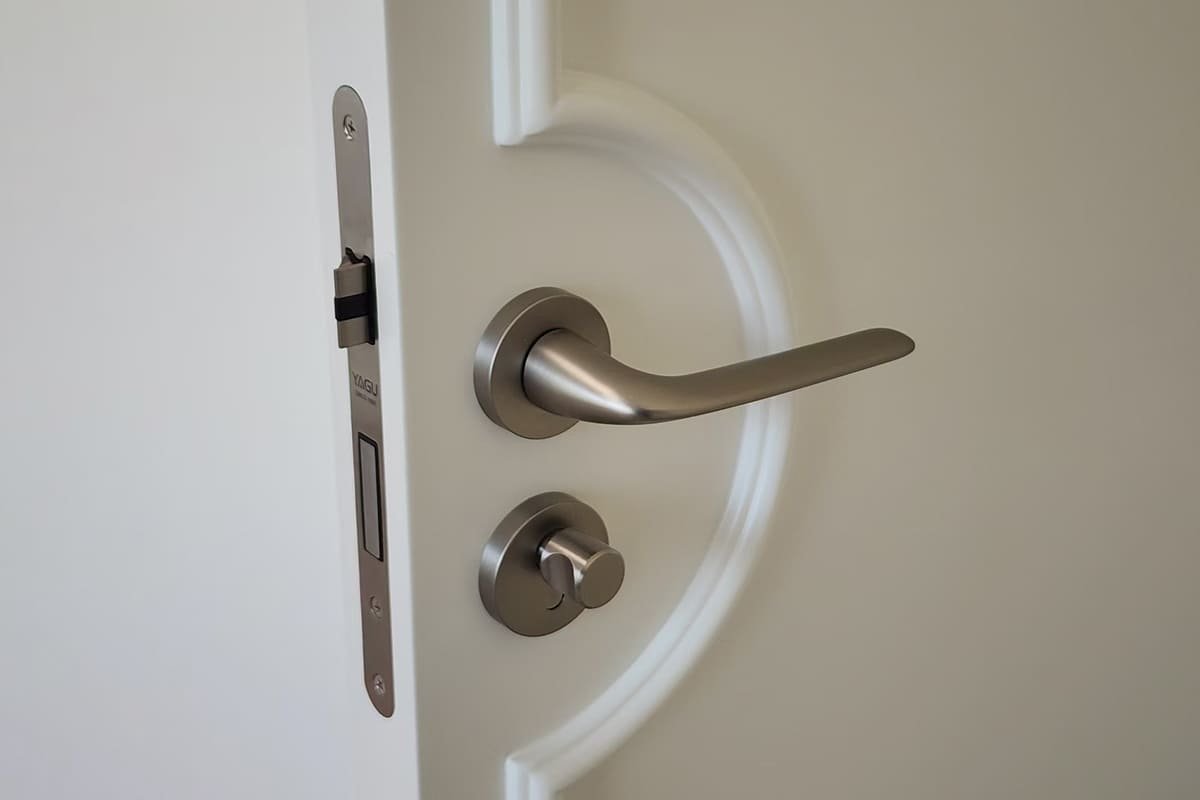
A pre-order checklist should include the standard, door function, lock model, handle model, PZ distance, follower size, backset, door thickness, through-bolt pattern, cylinder or privacy turn details, finish, certificate requirements, packaging needs, logo requirements, drawings, samples, and inspection method.
My practical checklist for B2B buyers
When I help door manufacturers, hardware brands, and wholesalers compare options, I usually ask for the following information before final confirmation.
| Category | Buyer should confirm | Why I need it |
|---|---|---|
| Market standard | EN/DIN or other system | Prevents cross-standard assumptions |
| Door type | Wood, metal, fire door, hotel room, restroom, etc. | Defines function and compliance |
| Lock function | Passage, entrance, WC/privacy, fire, escape | Selects correct lock-handle set |
| Key dimensions | Backset, PZ, follower size, case size | Confirms mechanical alignment |
| Door thickness | Minimum and maximum thickness | Selects spindle, screws, cylinder |
| Fixing method | Through-bolt pattern, rose or plate | Prevents installation failure |
| Accessories | Cylinder, escutcheon, thumbturn, indicator | Ensures full-set matching |
| Finish | Stainless steel, PVD, painted, plated, etc. | Checks appearance and certificate scope |
| Documents | CE, fire-rated certificate, inspection report | Supports procurement verification |
| Branding | Logo, packaging, drawings | Supports ODM/OEM order needs |
| Inspection | Sample, pre-shipment inspection, test records | Reduces return risk |
Use samples before bulk production when risk is high
For standard repeat orders, approved drawings and previous inspection records may be enough. For new combinations, mixed-market requests, or fire-rated sets, I prefer sample approval before mass production.
A sample can confirm:
- lever return feel,
- spindle engagement,
- screw length,
- through-bolt alignment,
- cylinder operation,
- plate coverage,
- indicator function,
- surface finish,
- packaging protection,
- and installation sequence.
At SDH Hardware, our production process includes raw material screening, production supervision, and finished product inspection. We also use specialized testing machines for function research, frame detection, and final product checks. Still, I never treat factory capability as a substitute for project-specific verification. The buyer’s door design and market requirements must be part of the decision.
Confirm inspection boundaries
A useful inspection report should not only say “passed.” It should state what was checked. For compatibility, I like to see:
- measured PZ distance,
- follower/spindle size,
- door thickness range,
- screw and spindle length,
- handle return test,
- cylinder alignment,
- privacy indicator operation,
- surface finish review,
- and packaging quantity.
For OEM and ODM orders, I also recommend confirming product drawings after order approval. This helps both sides lock the specification. If the customer later changes door thickness or lock function, we can identify whether the original set still works or needs adjustment.
Do not let finish approval replace fit approval
Buyers sometimes approve a golden sample mainly by appearance. The color, texture, and logo look right, so the order moves forward. I understand the pressure. Importers and brand companies need attractive products. However, a good finish cannot fix wrong geometry.
I always separate approval into two tracks:
Appearance approval
Finish, logo, packaging, surface quality, and design.Compatibility approval
Standard, function, lock fit, cylinder fit, fixing, door thickness, and documents.
Both tracks matter. A product can fail if either one is ignored.
Frequently Asked Questions
Are EN/DIN door handles universally compatible with EN/DIN locks?
No. EN/DIN parts are not universally compatible. Buyers still need to verify PZ distance, follower size, backset, lock case dimensions, door thickness, through-bolt positions, springing, and accessory alignment. Same-standard selection reduces risk, but it does not replace parameter checking.
Can I use a fire-rated lock with a normal stainless-steel handle?
I do not recommend it. Stainless steel alone does not prove fire compliance. Fire-rated doors should use tested combinations listed within the relevant certificate scope. Buyers should verify the lock, handle, cylinder, plates, screws, finishes, and application before ordering.
What is the most common handle and lock mismatch in bulk orders?
In my experience, common mismatches include wrong PZ center distance, 8 mm vs 9 mm spindle/follower mismatch, incorrect through-bolt positions, and unsuitable screw length for the door thickness. These problems often appear during installation rather than catalog selection.
Can cross-standard hardware be adapted with an adapter plate?
Sometimes an adaptation plan may be engineered, but I treat it as high-risk and to be verified. It requires drawings, drilling approval, sample fitting, extra lead time, and clear responsibility. Fire or escape certification may become invalid after modification.
What documents should I request before confirming an order?
I suggest requesting product drawings, technical data sheets, certificate copies where applicable, inspection reports, and sample approval records. For fire-rated or escape-related projects, buyers should verify document scope and consult qualified project professionals before final selection.
Conclusion
Door Handle and Lock Compatibility is not a guess and not a catalog shortcut. I verify the standard, function, mechanical fit, fixing method, door thickness, accessories, and certificate scope before confirming production. This process helps door factories, hardware brands, and wholesalers avoid mismatched stock, installation rework, and failed inspections. If you need an EN/DIN lock–handle set for bulk supply, SDH Hardware can support selection with drawings, samples, customization options, and factory-direct production review.
"087100 – DOOR HARDWARE - Facilities and Campus Services", https://fcs.cornell.edu/087100-door-hardware. Door-hardware standards such as EN 12209/EN 1906 and ANSI/BHMA lock and trim standards define product-specific dimensions, classifications, and test requirements, supporting the article’s claim that EN/DIN, ANSI, and BS hardware should not be assumed to share the same geometry or compliance basis. Evidence role: general_support; source type: institution. Supports: Standards organizations publish separate EN, BS, and ANSI/BHMA specifications for locks and door furniture, indicating that hardware geometry and compliance requirements are standard-specific.. Scope note: Such standards support the general incompatibility risk but do not prove that every individual cross-standard combination is mechanically incompatible. ↩
"Lever Handle Manufacturer & Supplier", https://www.dirock.com/Lever-Handle-pl46667787.html. European and DIN building-hardware standards separately specify mechanically operated locks, lever furniture, cylinders, and related dimensions, providing standards-based support for specifying lock cases and trim within the same standard family rather than assuming universal interchangeability. Evidence role: expert_consensus; source type: institution. Supports: EN/DIN locks, lever furniture, and associated door preparations are governed by interrelated European and DIN dimensional conventions.. Scope note: The source would establish the standards framework; project drawings are still required to determine whether a specific nonstandard adaptation can work. ↩
"Door Handle Sizes & PZ Dimensions: The Specifier's ...", https://www.eraeverywhere.com/news/door-handle-sizes--pz-dimensions-the-specifiers-complete-guide/. Technical documentation for DIN/European mortise locks identifies PZ distance as the center spacing between the handle follower and the profile-cylinder axis, supporting its use as a critical dimension for matching lock cases with escutcheons or long plates. Evidence role: definition; source type: institution. Supports: PZ distance denotes the center-to-center spacing between the lever follower and the profile-cylinder or keyhole position on relevant lock and plate designs.. Scope note: This defines the parameter and its relevance; it does not by itself verify the PZ value of any particular product. ↩
"Doors, Windows and Related Hardware Application Guide", https://www.ul.com/thecodeauthority/knowledge/ul-fire-rated-doors-guide. Fire-door guidance from code authorities and testing bodies treats hardware suitability as a matter of listing, certification, and approved installation conditions, supporting the statement that stainless steel construction alone does not establish fire-rated performance. Evidence role: expert_consensus; source type: government. Supports: Fire-door acceptability depends on tested or listed components and assemblies, not merely on the base material of a visible hardware item.. Scope note: The source supports the compliance principle but does not assess any specific stainless-steel handle model. ↩
"Doors, Windows and Related Hardware Application Guide", https://www.ul.com/thecodeauthority/knowledge/ul-fire-rated-doors-guide. Fire-resistance testing standards and certification schemes for doorsets evaluate assemblies under specified configurations, supporting the claim that fire-rated door performance depends on tested and documented combinations rather than on isolated components alone. Evidence role: expert_consensus; source type: institution. Supports: Fire-door performance is evaluated through standards-based testing of doorsets or assemblies, including relevant hardware and installation conditions.. Scope note: The source would provide the compliance framework; the actual certificate for a project is still needed to confirm covered models and configurations. ↩
"SECTION 087111 - DOOR HARDWARE (SCHEDULED BY ...", https://fpm.usc.edu/wp-content/uploads/2021/11/087102-USC-HSC-door-hardware-Guide-Specification_1.pdf. Fire-door certification and extended-application documentation commonly identify the approved hardware and construction variants within the scope of evidence, supporting the need to verify locks, handles, cylinders, trim, fixings, and relevant variants against the certificate. Evidence role: general_support; source type: institution. Supports: Fire-door certificates and field-of-application reports define the components, variants, and installation conditions covered by the tested assembly.. Scope note: This supports the need for scope verification generally; whether a finish is controlled depends on the particular certificate and testing regime. ↩
"DIN EN 1906 - HOPPE | United States & Canada", https://www.hoppe.com/us-us/door-handles/standards-and-solutions-door-handles/din-en-1906/. Standards and manufacturer-neutral technical references for lever furniture describe the spindle and lock follower as matched square-drive components, supporting the claim that different follower sizes, such as 8 mm and 9 mm systems, can prevent correct mechanical engagement. Evidence role: mechanism; source type: institution. Supports: Door lever operation depends on a square spindle fitting the lock follower, and 8 mm and 9 mm spindle/follower sizes are specified in technical lock and handle documentation.. Scope note: The source would support the mechanical principle and typical dimensions, while tolerances and adapters must still be checked from product drawings. ↩
"Will it fit! MEASURE for a new door handle & how to INSTALL ...",
. Technical installation guidance for lever furniture specifies permitted door-thickness ranges together with screw and spindle lengths, supporting the claim that excessive door thickness or unsuitable fasteners can compromise secure handle clamping. Evidence role: mechanism; source type: institution. Supports: Handle fixing systems rely on screws, spindle length, and door thickness ranges to achieve secure clamping and correct operation.. Scope note: The source would support the mechanical relationship; actual looseness depends on the exact hardware design, tolerances, and installation quality. ↩"How to Determine the Backset of Your Door", https://www.lowes.com/n/how-to/determine-the-backset-of-your-door. Architectural and lock-hardware references define backset as the distance from the door edge to the centerline of the lock or bore, supporting the article’s use of backset as a required door-preparation and lock-selection dimension. Evidence role: definition; source type: encyclopedia. Supports: Backset is defined as the distance from the edge of a door to the center of the lock or bore, and it is a basic lock-specification dimension.. Scope note: A definition source explains the term but does not determine the correct backset for a particular door schedule. ↩
"Flylock 5Pcs 2.5 Turn Replacement Spring for The Door ...", https://www.amazon.com/Flylock-Replacement-Turning-Handles-Internal/dp/B0B14N4PLB. Technical references for lever furniture distinguish sprung and unsprung handle sets and describe their interaction with lock-case follower springs, supporting the claim that lever return may depend on the handle, the lock, or both components. Evidence role: mechanism; source type: institution. Supports: Door lever return may be provided by sprung furniture, the lock mechanism, or both, and these arrangements affect operating force and return behavior.. Scope note: The source supports the operating principle; perceived stiffness or sag must still be evaluated on the actual assembled sample. ↩
"Clarification on locks and exit signs for emergency exits.", http://www.osha.gov/laws-regs/standardinterpretations/1973-02-27. Emergency-exit and panic-exit standards such as EN 179 and EN 1125 specify requirements for release devices, operation, and intended applications, supporting the article’s claim that lock function, door direction, cylinder arrangements, and user operation must be reviewed for escape safety. Evidence role: expert_consensus; source type: institution. Supports: Emergency and panic exit hardware standards regulate operating method, door use, release function, and related installation conditions because these factors affect safe egress.. Scope note: The standards establish the safety framework; a qualified professional must still determine which standard and configuration apply to a specific project. ↩
"Common Field Issues Affecting Fire Doors & Frames", https://steeldoor.org/common-field-issues-fire-doors-frames/. Code and certification guidance on fire-door assemblies states that listings and approvals apply to specified configurations and that field modifications require control or authorization, supporting the warning that altered drilling, adapters, or substituted hardware may fall outside the original certification scope. Evidence role: general_support; source type: government. Supports: Fire-door and life-safety listings or certificates apply to defined configurations, and unapproved field modifications may require authorization or may fall outside the listing.. Scope note: The source supports the compliance risk generally; the effect of a particular modification depends on the certifier, authority having jurisdiction, and certificate wording. ↩
