
Surface vs. Concealed Door Closers for Commercial Fire Doors: Which Should You Choose?
Door closers for commercial fire doors can look like a simple hardware choice, but the wrong closer type can create installation delays, certification questions, and after-sales problems. I often see buyers focus first on appearance or closing strength. A better solution is to match the closer to the door structure, fire-rating documents, production process, and maintenance plan.
Surface-mounted door closers are usually the practical default for commercial fire doors because they are easier to install, adjust, inspect, and replace.1 Concealed door closers can be suitable when the project requires a cleaner appearance, but buyers must first verify door thickness, machining accuracy, fire-rating compatibility, and maintenance access.
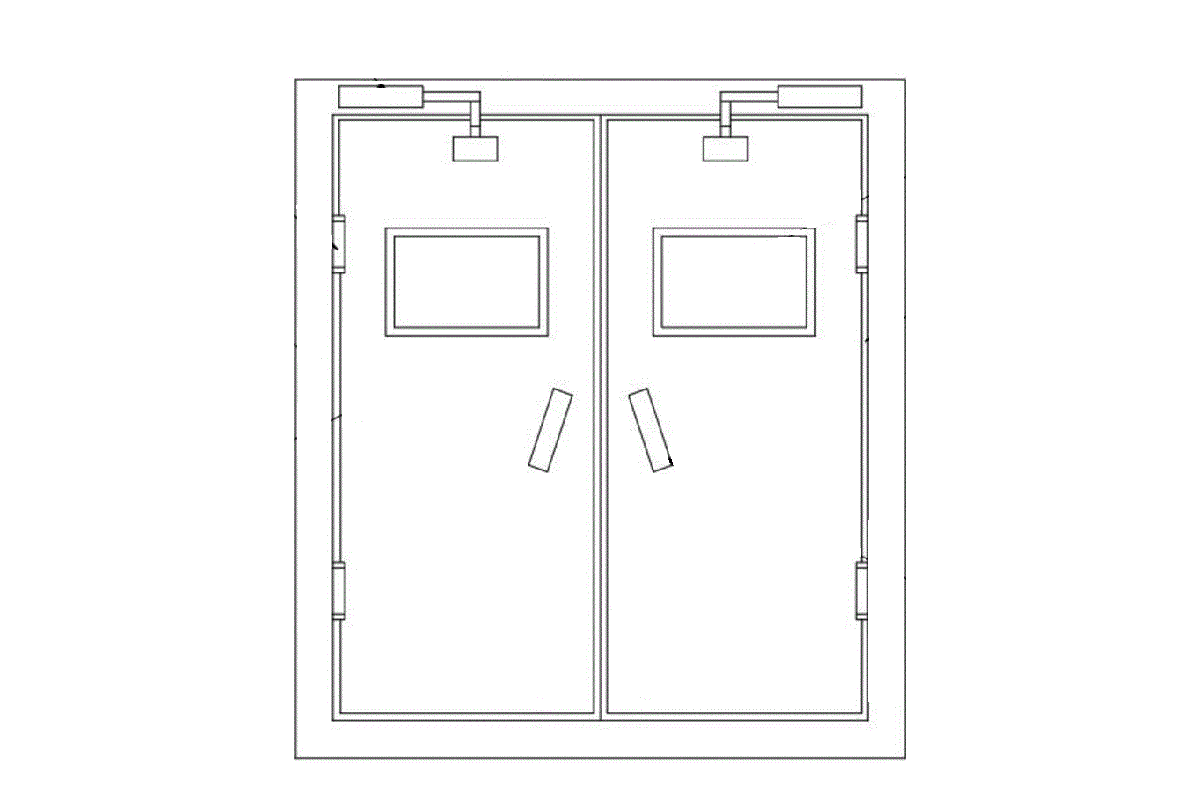
In our work with door factories and hardware buyers, I have learned that this decision is rarely only about style. The closer affects door preparation, production consistency, compliance review, installation labor, and future service. So I prefer to compare surface and concealed closers from a procurement and manufacturing point of view.
How should door manufacturers compare door closers for commercial fire doors?
A door factory can lose time and money when door closers for commercial fire doors are chosen too late. The problem starts with a small assumption. The team may select a closer by appearance, then discover that the door leaf, frame, or certificate does not support that installation method.
The best way to compare door closers for commercial fire doors is to check seven factors first: door width, door weight, opening frequency, door material, door thickness, fire-rating requirement, and whether the door leaf or frame can be cut without affecting approval.2
Start with the fire door, not the closer
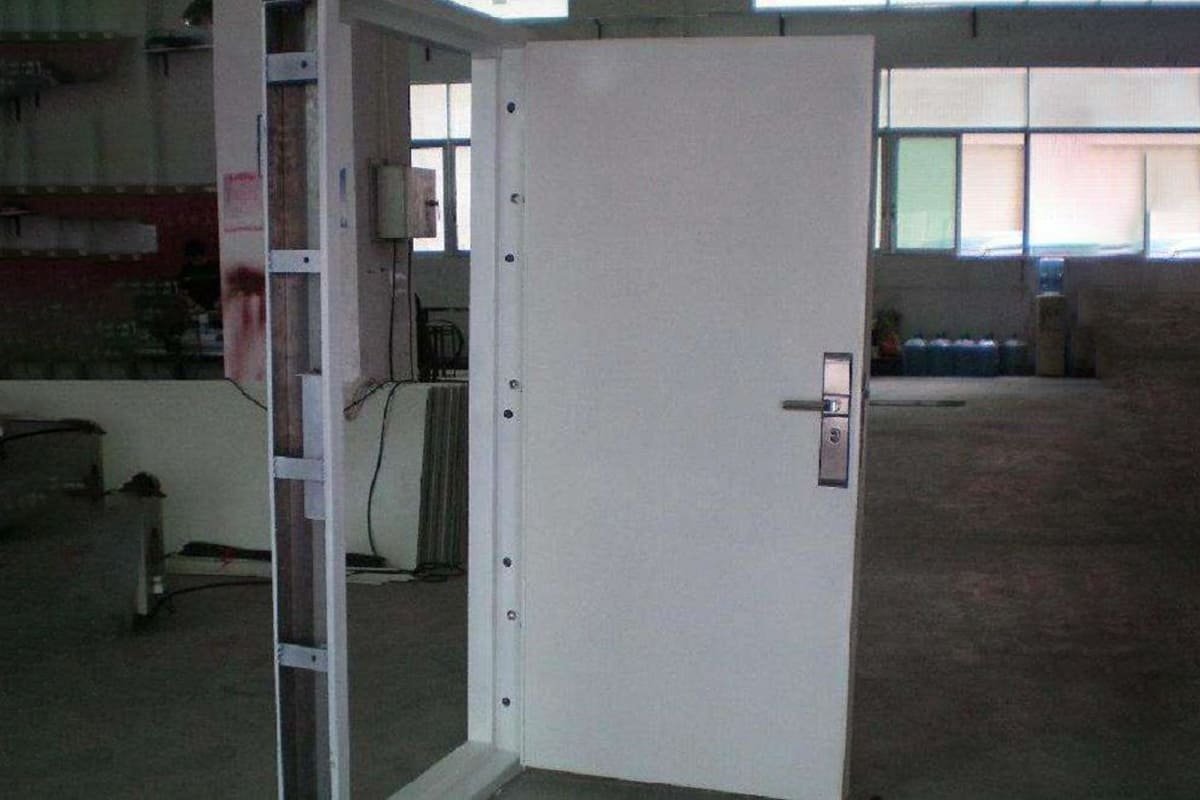
I always recommend starting with the full door set. A closer does not work alone. It works with the door leaf, frame, hinges, lock, latch, seals, coordinator, and sometimes panic exit hardware. For commercial fire doors, the closer also supports a critical function: the door must close and latch reliably after opening3.
That does not mean every strong closer is correct. A closer that is too weak may not close the door under air pressure.4 A closer that is too strong may make the door difficult to open, especially for public buildings that must consider accessibility.5 The right decision sits between closing force, user comfort, and compliance requirements.
In factory discussions, I usually ask these questions before talking about model numbers:
What is the door width?
Wider doors usually need stronger closer power or adjustable spring strength.6What is the door weight?
Heavy steel or acoustic fire doors may need a higher-grade closer than a light internal fire door.7What is the opening frequency?
A stairwell door in a hotel may cycle many more times per day than a plant room door.What is the door material?
Steel, timber, aluminum, and composite doors have different fixing and machining conditions.What is the door thickness?
Concealed closers often need enough internal depth, commonly around 40–45 mm or more, depending on the model and installation design.What fire-rating evidence is required?
CE documents, fire-rated certificates, 3C fire certification for China-market projects, or local project approvals should be checked based on the target market.8Can the door leaf or frame be cut?
Cutting a fire-rated door without approved details can create compliance risk.9
Surface vs. concealed comparison table
| Selection factor | Surface-mounted closer | Concealed closer | Fire door selection risk |
|---|---|---|---|
| Appearance | Visible on door or frame | Hidden inside door or frame | Appearance should not override approval requirements |
| Door preparation | Usually simpler drilling and fixing | Requires accurate slotting or recessing | Wrong machining can damage the fire door structure |
| Installation speed | Faster for batch production | Slower and more skilled | Batch inconsistency can increase defects |
| Adjustment access | Easier to access valves and arms | Harder to access after installation | Maintenance may take longer |
| Replacement | Usually straightforward | May require door removal or re-machining | After-sales cost can rise |
| Certification checking | Often easier to document | Must confirm concealed installation is covered | Buyers should verify documents before ordering |
| Cost impact | Usually more cost-effective | Usually higher product and processing cost | Budget must include labor and after-sales |
Why appearance alone is a risky starting point
A concealed closer can create a clean door face. I understand why architects and brand owners like that look. However, a commercial fire door is not a normal decorative door. The door has tested or approved construction details. If the closer requires a deep cut in the leaf or frame, the door manufacturer must confirm that this preparation does not conflict with the fire-rated design.
From a procurement point of view, the better question is not, “Which closer looks better?” The better question is:
“Which closer can I install consistently, document properly, and maintain safely across the whole project?”
This question protects the factory, the installer, the distributor, and the building owner. It also keeps the discussion practical. In my experience, when buyers ask this question early, they avoid many late-stage drawing revisions and sample-door corrections.
When are surface-mounted door closers for commercial fire doors the practical default?
A project team may want a clean door appearance, but commercial buildings often need stable production and easy service more urgently. Surface-mounted door closers for commercial fire doors solve this problem because they reduce machining complexity and allow simpler adjustment during installation and maintenance.
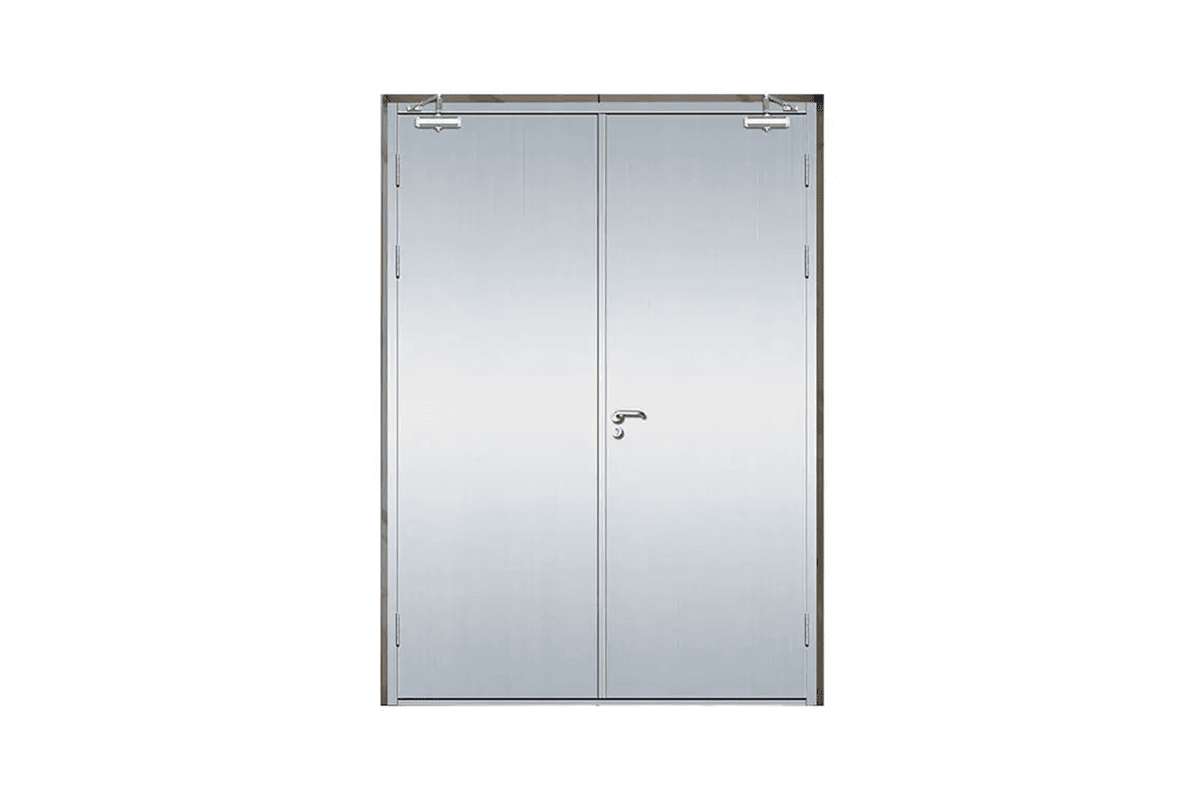
Surface-mounted door closers for commercial fire doors are usually the practical default for standard commercial projects because they fit many wood, steel, and fire-rated doors with fewer door-body modifications. They are also easier to inspect, adjust, replace, and manage in bulk orders.
Why surface closers are common in commercial fire door projects
I see surface closers used widely because they are forgiving in real production environments. Door factories must repeat the same preparation hundreds or thousands of times. Installers must work on site with limited time. Maintenance teams must adjust closing speed after handover. A visible surface closer makes these steps easier.
Surface-mounted closers usually need drilled fixing holes and an arm connection. They do not normally require a deep internal pocket inside the door leaf. This matters because many fire-rated door leaves have internal structures, insulation cores, reinforcement plates, and certified construction details. Less cutting usually means less uncertainty.
Surface closers also give the installer direct access to adjustment valves. The installer can fine-tune:
- Closing speed
- Latching speed
- Backcheck, if available
- Delayed action, if available
- Arm position
- Power setting, for adjustable models
For commercial fire doors, latching speed is especially important. The door must close far enough and with enough final force for the latch to engage. If the closer is hard to reach, adjustment becomes slower and less reliable.
Where surface-mounted closers perform well
Surface-mounted door closers for commercial fire doors are often a strong choice in these project types:
Hotels and apartment corridors
The doors need reliable closing, but maintenance teams also need fast access after occupancy.Office buildings
Door usage can vary by area. Adjustable surface closers help installers tune performance room by room.Schools and public buildings
High traffic requires easy inspection and replacement when hardware is damaged.Hospitals and service areas
Maintenance access and consistent closing performance are usually more important than hidden hardware.Warehouses and industrial buildings
Durability, cost control, and quick replacement often matter more than a concealed appearance.
Procurement advantages of surface closers
From a buyer’s side, surface-mounted closers have several practical advantages:
| Procurement point | Why it matters |
|---|---|
| Lower processing risk | Door preparation is simpler and easier to standardize |
| Easier supplier comparison | Buyers can compare size, power, functions, finish, and certificates more directly |
| Better spare-part planning | Replacement closers and arms can be stocked more easily |
| Lower installation training burden | Installers usually understand surface closer mounting better |
| Simpler after-sales handling | Maintenance teams can access adjustment points without opening the door structure |
What surface closers still require
I do not treat surface closers as “automatic approval.” Buyers still need to verify the exact closer model, mounting method, door type, and certificates. A closer may have fire-rated test evidence under certain conditions, but that does not mean every installation is covered.10
Before confirming surface-mounted door closers for commercial fire doors, I suggest checking:
- The closer’s fire-rated certificate or test report
- The applicable door material and rating duration
- The approved mounting position
- The maximum door size and weight
- The required fixing screws or reinforcement
- The target market’s code or project approval process
As a manufacturer, I can help buyers match hardware specifications and prepare product documents. However, I always recommend that buyers confirm final project compliance with the responsible test laboratory, certification body, local authority, or qualified fire-door consultant.
When do concealed door closers for commercial fire doors make sense?
Concealed hardware can create a premium visual result, but it can also hide technical problems until production starts. Concealed door closers for commercial fire doors make sense only when the door structure, machining accuracy, certification evidence, installation skill, and future maintenance plan all support the hidden closer design.
Concealed door closers for commercial fire doors are suitable for projects with strict appearance requirements, adequate door thickness, precise CNC or jig-controlled machining, and verified certification compatibility. They should not be selected only because they look cleaner.
What concealed closers actually solve
A concealed closer mainly solves an aesthetic problem. It keeps the door face cleaner because the closer body is hidden in the door leaf, frame, or floor area, depending on the design. For luxury hotels, high-end offices, and design-sensitive commercial interiors, this can be valuable.
However, a cleaner appearance does not automatically mean better performance. The closer still needs enough closing force. The installation still needs alignment. The door still needs to latch. The certification still needs verification.
In one project discussion, a buyer asked me for a concealed closer because the architect did not want visible arms on corridor doors. The first drawing looked simple. Then we checked the door thickness, internal reinforcement, fire-rating requirement, and installation access. The project team realized that the door factory needed more preparation time and more sample testing before mass production. That early check helped avoid a much more expensive problem later.
Main conditions for concealed closer use
Concealed door closers for commercial fire doors can be reasonable when these conditions are confirmed:
The door has enough thickness
Many concealed closers need a thicker door body. Around 40–45 mm is a common starting point for some designs, but the exact requirement depends on the closer model. Buyers must check the technical drawing.The door construction allows cutting
The required pocket or slot must not weaken the certified door structure. The factory should confirm this through approved details or test evidence.The factory can machine accurately
Hidden closers often require precise depth, length, and alignment. Small errors can affect operation.The frame and leaf are coordinated
The closer body, slide arm, pivot point, seals, and latch must not interfere with each other.The certificate covers the intended use
The fire-rated document should match the closer type, installation position, door material, and rating conditions as closely as the project requires.Maintenance access is realistic
If adjustment or replacement requires major disassembly, the building owner should understand that before purchase.
Hidden installation creates hidden risks
The biggest issue with concealed closers is that the risk is often invisible in the quotation stage. The product cost is only one part. The real cost includes machining, production control, installation training, rework risk, and after-sales service.
Here is a practical comparison:
| Cost and risk item | Surface closer | Concealed closer |
|---|---|---|
| Hardware price | Usually lower at comparable grade | Often higher |
| Door machining | Basic drilling and fixing | Precise pocketing or slotting |
| Installation labor | Usually faster | Usually slower |
| Quality inspection | Visual and functional checks are simple | Internal positioning may need more control |
| Adjustment after handover | Easy access | Access may be limited |
| Replacement | Usually simple | Can be complex |
When I would be cautious
I would be cautious about concealed closers in these cases:
- The door factory has not produced this preparation before.
- The project has a tight delivery schedule.
- The fire-rated door structure has not been checked for cutting.
- The buyer cannot provide target-market approval requirements.
- The building has high traffic and limited maintenance support.
- The project requires low-cost, fast replacement parts.
This does not mean concealed closers are wrong. It means they need more confirmation before mass production. For the right project, they can work well. For the wrong project, they can create avoidable complexity.
What procurement checks reduce risk before ordering door closers for commercial fire doors?
Many purchasing problems start because the buyer confirms the closer model before confirming the door data. Door closers for commercial fire doors should be ordered only after the factory reviews door size, door material, fire rating, installation drawings, certificates, packaging needs, and after-sales responsibilities.
The safest procurement process for door closers for commercial fire doors is to request technical drawings, certificates, sample confirmation, installation instructions, finish samples, and batch inspection standards before mass production. Buyers should also confirm whether the closer is surface-mounted or concealed in the approved fire door design.
A practical buyer checklist
When I help customers compare door closer options, I prefer to build the specification from the door data upward. This reduces misunderstanding between the buyer, factory, installer, and project consultant.
Before placing an order, I suggest confirming the following checklist:
1. Door and usage data
- Door width and height
- Door weight
- Door thickness
- Door material: steel, timber, aluminum, or composite
- Single or double leaf
- Opening angle requirement
- Indoor or semi-exposed environment
- Expected opening frequency
- Air pressure conditions, such as stairwells or HVAC zones
2. Closer performance data
- Power size or adjustable strength range
- Maximum door width and weight rating
- Closing speed adjustment
- Latching speed adjustment
- Backcheck function
- Delayed action function, if needed
- Hold-open function status
For fire doors, I am careful with hold-open features. In many applications, fire doors should not remain open unless they are connected to an approved electromagnetic release or fire alarm control system.11 Buyers should confirm this with project requirements and local regulations.
3. Certification and document review
For export and project supply, certification terms must be handled carefully. Buyers should not accept vague claims. They should request documents and verify whether those documents apply to the target market.
Common document checks include:
| Document type | What buyers should verify |
|---|---|
| CE documentation | Standard, product scope, manufacturer, and model coverage |
| Fire-rated certificate | Door type, duration, installation method, and hardware configuration |
| 3C fire certification | China-market relevance and exact product coverage |
| Test report | Laboratory, tested assembly, date, and limitations |
| Installation drawing | Whether the drawing matches the ordered product and door design |
At SDH Hardware, we work with CE and fire-rated documentation for core architectural hardware categories. Still, I tell buyers to treat certificates as documents to verify, not marketing phrases to trust blindly. The final decision should follow the project’s target market requirements and qualified professional review.
Surface and concealed closer procurement differences
The procurement process is different for surface and concealed models.
| Procurement issue | Surface-mounted closer | Concealed closer |
|---|---|---|
| Sample approval | Function and finish sample often enough | Function sample plus machining sample recommended |
| Drawing review | Mounting template is important | Full door and frame preparation drawing is critical |
| Factory preparation | Easier to adapt across door types | Requires precise machining capability |
| Batch inspection | Visual alignment and closing test | Hidden body position and operation must be checked |
| Spare parts | Arms and covers are easier to stock | Replacement units may need exact model continuity |
| After-sales | Faster adjustment on site | More planning needed for access and repair |
Why batch consistency matters
A single sample door can work well. A batch of 500 doors is a different test. Small machining errors can multiply. For concealed closers, a 1–2 mm deviation in pocket position may affect the arm movement, closing angle, or cover alignment. For surface closers, installation errors can also happen, but they are usually easier to see and correct.
For door manufacturers, I recommend these steps before mass production:
- Make one complete sample door
- Install the full hardware set
- Check closing and latching performance
- Review the preparation with production staff
- Confirm the inspection points
- Record the approved template
- Train the batch installation team
This process may look slow, but it saves time later. I have seen buyers spend more time solving after-sales complaints than they would have spent confirming a proper sample at the beginning.
Matching the closer to the full hardware set
A fire door closer should not be selected separately from the rest of the hardware. The closer must work with:
- Butt hinges or concealed hinges
- Mortise locks
- Euro cylinders
- Lever handles
- Panic exit devices, where required
- Door coordinators for double fire doors
- Flush bolts
- Smoke seals and intumescent seals
- Door stops
- Access control hardware
For example, a heavy fire-rated door with tight seals may need more closing force to latch properly. But stronger force may make the lever side harder to operate. So the buyer may need a closer with adjustable strength, correct hinge selection, and proper latch alignment. This is why I always prefer complete hardware matching instead of isolated product selection.
Frequently Asked Questions
Are surface-mounted door closers allowed on commercial fire doors?
Surface-mounted door closers are commonly used on commercial fire doors, but buyers must verify the exact closer model, mounting method, door type, and fire-rated documentation. The certificate or approval should match the target market and project requirements.
Are concealed door closers better than surface door closers?
Concealed door closers are not automatically better. They offer a cleaner appearance, but they need suitable door thickness, precise machining, verified fire-rating compatibility, and more careful maintenance planning. Surface closers are often more practical for standard commercial fire doors.
What door thickness is needed for concealed door closers?
Many concealed closers require around 40–45 mm door thickness, depending on the model and installation design. Buyers should always check the manufacturer’s technical drawing and confirm that the required cutting is acceptable for the fire-rated door construction.
What is the biggest mistake when selecting door closers for commercial fire doors?
The biggest mistake is choosing by appearance or closer strength alone. Buyers should first confirm door width, weight, material, thickness, usage frequency, fire-rating requirement, and whether the door leaf or frame can be modified without affecting compliance.
Should fire doors use hold-open door closers?
Fire doors usually should not be held open unless the hold-open function is connected to an approved release system, such as a fire alarm-controlled electromagnetic device. Buyers should confirm local code, project requirements, and certification conditions before specifying hold-open hardware.
Conclusion
Door closers for commercial fire doors should be selected by structure, certification fit, production process, usage load, cost, and maintenance access, not by appearance alone. Surface closers are usually the practical default because they are easier to install and service. Concealed closers can work well when the door design and documents support them. If you need help matching closers with locks, hinges, cylinders, and other fire door hardware, I can help you review the specification before production.
"How to Install a Commercial Door Closer? - SDH hardware", https://sdhhardware.com/2026/08/28/how-to-install-a-commercial-door-closer/. Institutional fire-door inspection guidance describes door closers as components requiring verification of closing, latching, and condition during maintenance, which contextually supports the practical advantage of accessible surface-mounted closers, although it does not by itself prove that surface-mounted closers are always the preferred default. Evidence role: general_support; source type: institution. Supports: A neutral source should support that fire door closers require inspection, adjustment, and maintenance access, making accessible mounted hardware practically easier to service.. Scope note: The support is contextual because inspection requirements do not directly compare all surface-mounted and concealed closer models. ↩
"How Should I Choose the Appropriate Hydraulic Door Closer for the ...", https://sdhhardware.com/2026/08/26/how-should-i-choose-the-appropriate-hydraulic-door-closer-for-the-door/. Door-closer standards such as EN 1154 and ANSI/BHMA A156.4 classify or test controlled door-closing devices by parameters including door size, mass, durability, and application, supporting the relevance of the listed selection factors while not establishing that the article’s seven-factor checklist is exhaustive. Evidence role: general_support; source type: institution. Supports: A standard or institutional guide should show that door closer selection depends on door size, mass, use category, and rated assembly constraints.. Scope note: The source would support the relevance of the factors, not necessarily the exact checklist wording or order. ↩
"Fire Rated Door Hardware Requirements for Hospitals and Medical ...", https://sdhhardware.com/2026/08/27/fire-rated-door-hardware-requirements-for-hospitals-and-medical-buildings/. NFPA 80 and model building-code provisions require fire door assemblies to be self-closing or automatic-closing and to latch when closed, directly supporting the statement that a commercial fire door must close and latch reliably after opening. Evidence role: expert_consensus; source type: institution. Supports: A fire-door code or standard should state that rated fire doors must be self-closing or automatic-closing and must latch.. ↩
"Smoke Management", https://www.nist.gov/el/beed/nist-multizone-modeling/applications/smoke-management. Research on building pressure differentials and stairwell pressurization shows that pressure across a door produces measurable forces on the door leaf, which contextually supports the claim that an undersized closer may fail to overcome adverse air pressure and latch the door. Evidence role: mechanism; source type: research. Supports: A building-science or fire-safety source should explain that pressure differentials across doors create forces that can affect opening, closing, or latching.. Scope note: The support is mechanistic and contextual; the exact closer force required depends on door size, leakage, latch condition, seals, and site pressure. ↩
"Chapter 4: Entrances, Doors, and Gates", https://www.access-board.gov/ada/guides/chapter-4-entrances-doors-and-gates/. The ADA Standards for Accessible Design limit the opening force for many interior hinged doors and thereby support the article’s point that an overly strong closer can make a door difficult to use in accessibility-sensitive public buildings. Evidence role: expert_consensus; source type: government. Supports: A government accessibility standard should define opening-force limits or accessibility considerations for doors.. ↩
"How Should I Choose the Appropriate Hydraulic Door Closer for the ...", https://sdhhardware.com/2026/08/26/how-should-i-choose-the-appropriate-hydraulic-door-closer-for-the-door/. EN 1154 classifies controlled door-closing devices by power size and associates those sizes with door leaf width and mass, supporting the statement that wider doors generally require greater or adjustable closing power. Evidence role: general_support; source type: institution. Supports: A recognized standard should show the relationship between door width and closer power size.. ↩
"How Should I Choose the Appropriate Hydraulic Door Closer for the ...", https://sdhhardware.com/2026/08/26/how-should-i-choose-the-appropriate-hydraulic-door-closer-for-the-door/. Door-closer standards classify devices by performance characteristics such as power size, door leaf mass, and durability testing, supporting the general claim that heavier fire doors may require a higher-capacity closer than lighter internal doors. Evidence role: general_support; source type: institution. Supports: A standard should support that door mass and closer grade or power size are related selection criteria.. Scope note: The source would support the principle; the exact closer grade still depends on the specific door assembly, traffic level, and manufacturer ratings. ↩
"What Should I Know About EN Standard Fire Door Hardware ...", https://sdhhardware.com/2026/08/14/what-should-i-know-about-en-standard-fire-door-hardware-regulations/. Official regulatory materials on the EU Construction Products Regulation and China Compulsory Certification show that conformity documentation is tied to defined product scopes and jurisdictions, supporting the article’s instruction to verify CE, fire-rated, 3C, or local approvals against the target market. Evidence role: historical_context; source type: government. Supports: Government or official regulatory sources should show that CE marking, CCC/3C certification, and local approvals apply in specific markets and product scopes.. Scope note: The source would establish the market-specific nature of certification, not verify any particular product certificate. ↩
"How to Install a Fire Door Lock Step by Step? - SDH hardware ...", https://sdhhardware.com/2026/06/23/how-to-install-a-fire-door-lock-step-by-step/. NFPA 80 limits job-site preparations and field modifications to fire door assemblies and generally requires modifications beyond permitted preparations to be evaluated or approved, directly supporting the warning that unapproved cutting can create compliance risk. Evidence role: expert_consensus; source type: institution. Supports: A fire-door standard should state that field modifications to rated assemblies are limited and may require approval or inspection.. ↩
"What Should I Know About EN Standard Fire Door Hardware ...", https://sdhhardware.com/2026/08/14/what-should-i-know-about-en-standard-fire-door-hardware-regulations/. Fire-door standards and listing practices treat fire doors as tested assemblies whose components must be installed within the scope of the listing or approval, supporting the statement that a closer’s fire-rated evidence under one configuration does not automatically cover every installation. Evidence role: expert_consensus; source type: institution. Supports: A certification or fire-door standard should explain that listed fire-door components must be installed according to their listing, test evidence, and approved assembly conditions.. ↩
"Door Hold Open Devices - Facilities and Operations", https://fo.umich.edu/fosg/door-hold-open-devices/. NFPA 80 and model fire-code provisions allow fire doors to be held open only by approved automatic-closing or release mechanisms that close the door upon fire alarm, smoke detection, or loss of power, supporting the article’s caution about hold-open closers. Evidence role: expert_consensus; source type: institution. Supports: A fire code or standard should support that fire doors may be held open only by approved automatic release devices that close the door upon alarm or detection.. ↩