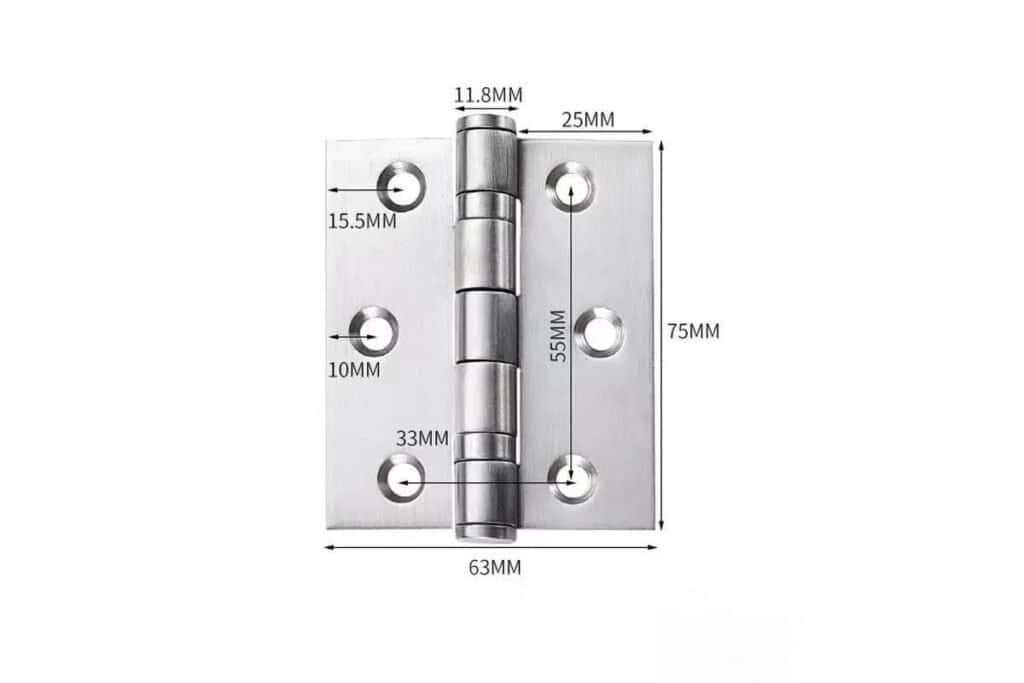
Door Hinges: What Is Hinge Radius and Why Does It Matter?
Hinge radius is a small specification that can create a big purchasing problem when it is missed. A buyer may confirm the hinge length, width, finish, and material, then still receive parts that do not fit the routed wooden door mortise. The solution is simple: confirm the radius before sample approval and bulk production.
Hinge radius is the radius of the rounded corners on a hinge leaf. It matters because wooden door and frame mortises are often routed with round cutting tools1, so the hinge corner radius should match the routed mortise shape. A wrong radius can cause poor fitment, extra chiseling, installation delays, or rework.2

In my work with door factories and hardware buyers, I often see hinge radius treated as a small detail. However, during sample matching and bulk order checks, this detail can decide whether a hinge drops into the door preparation smoothly or creates avoidable production trouble.
What Is Hinge Radius on Door Hinges?
Hinge specifications can look simple until the sample reaches the workshop. A hinge may have the correct length and width, but the corners may not match the door preparation. That mismatch causes confusion between purchasing, engineering, and installation teams. A clear definition prevents this problem early.
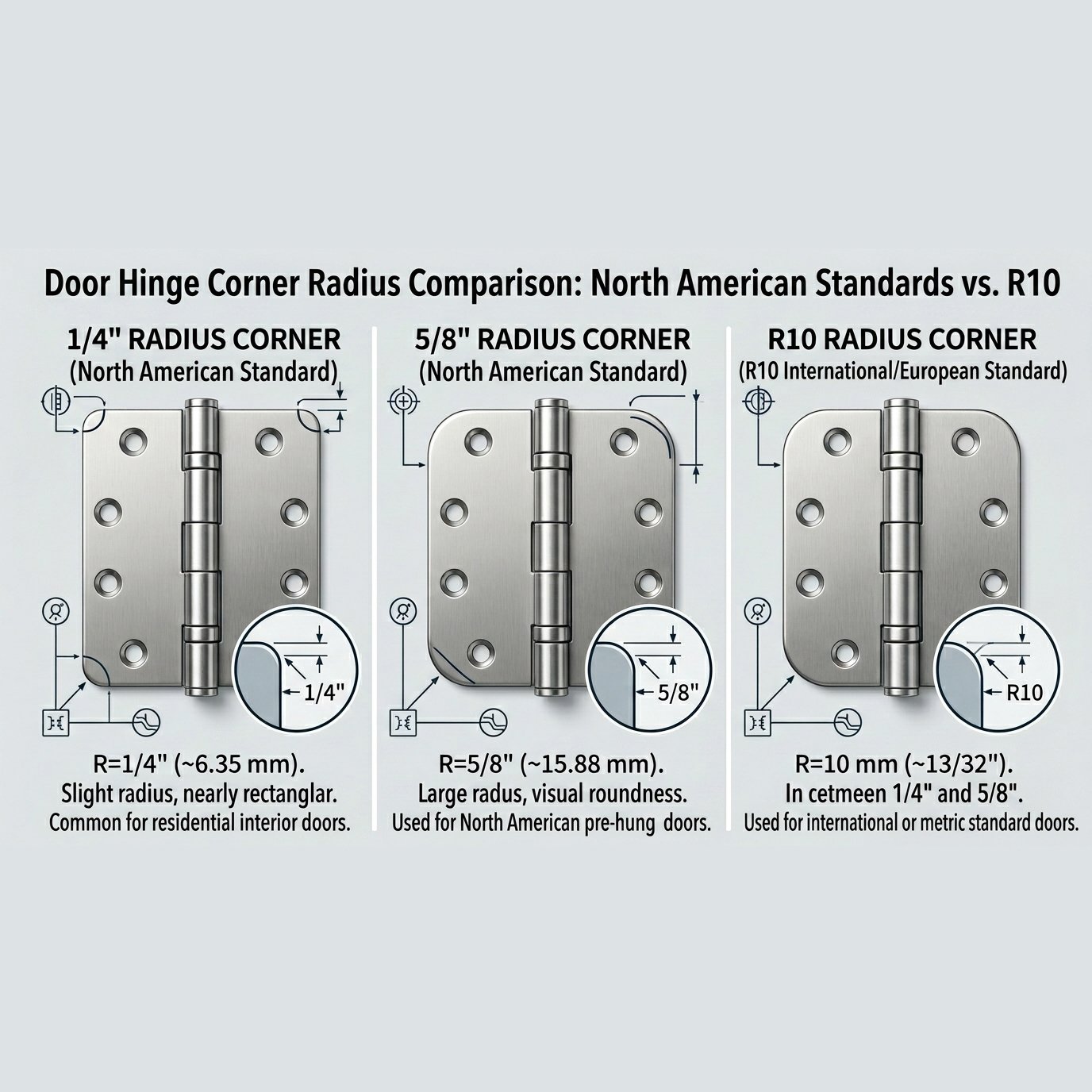
Hinge radius is the measured radius of the rounded corner on each hinge leaf.3 It identifies whether a hinge is a radius-corner hinge or a square-corner hinge. Commonly seen references include R10 in metric markets and 1/4″ or 5/8″ radius in imperial markets4, but each project should confirm drawings or samples.
The basic meaning of hinge radius
A door hinge leaf is the flat plate that is fixed to the door or frame. On some hinges, the four outer corners of the leaf are square. On others, the corners are rounded. Hinge radius describes that rounded corner curve.
For example:
- Square-corner hinge: The hinge leaf has 90-degree corners.
- Radius-corner hinge: The hinge leaf has rounded corners.
- R10 hinge: The rounded corner commonly refers to a 10 mm radius.
- 1/4″ radius hinge: The rounded corner commonly refers to a 1/4 inch radius.
- 5/8″ radius hinge: The rounded corner commonly refers to a 5/8 inch radius.
These examples are useful references, but I always advise buyers not to treat them as universal standards. A project drawing, door factory routing template, or approved sample should be the final confirmation basis.
Why the term causes confusion
Many buyers describe a hinge by only three visible details:
- Overall size
- Finish
- Material
For example, a buyer may say: “I need a 4″ stainless steel butt hinge in satin finish.” That description is useful, but it is not complete. The same hinge size may be available in several corner styles.5
| Specification item | Example | Why it matters |
|---|---|---|
| Hinge height | 4″ or 100 mm | Must match door and frame preparation |
| Hinge width | 3″, 3.5″, 4″ | Affects leaf coverage and mortise size |
| Thickness | 2.5 mm, 3 mm | Affects flush fit and door gap |
| Corner type | Square or radius | Must match mortise corner shape |
| Hinge radius | R10, 1/4″, 5/8″ | Determines rounded corner fitment |
| Hole pattern | Zigzag, straight, custom | Must match drilling or screw plan |
| Finish | SSS, PSS, black, brass color | Must match project or brand range |
Manufacturer-side advice
At SDH Hardware, I usually check hinge samples and drawings from three angles before confirming production:
- What is the hinge size?
- What is the corner shape and radius?
- What is the door or frame preparation?
This process is practical, not theoretical. If a wooden door factory already has routing templates, the hinge must match those templates. If the buyer is developing a new door series, then the hinge, routing cutter, and mortise drawing should be reviewed together.
A hinge with the correct size but the wrong corner radius is not a small cosmetic variation. It can become a fitment issue.
How to describe hinge radius clearly in an inquiry
When you send an inquiry to a hinge manufacturer, I recommend a clear specification format:
- Product: stainless steel butt hinge
- Size: 100 × 75 × 2.5 mm
- Corner: radius corner
- Hinge radius: R10, or as per sample
- Material: SS304, SS201, steel, or brass
- Finish: satin stainless steel, polished, black, etc.
- Hole pattern: as drawing or sample
- Screws: included or excluded
- Application: wooden door, interior door, hotel door, fire-rated door set, etc.
This kind of detail reduces back-and-forth communication. It also helps the manufacturer check whether existing tooling can support the requirement or whether a new stamping, machining, or finishing adjustment is needed.
Why Does Hinge Radius Matter for Wooden Door Mortises?
Wooden door production often depends on routing templates and repeated machining. If the hinge corner shape does not match the routed mortise, the door factory may need extra manual work. That extra step may look small per door, but it becomes expensive across hundreds or thousands of doors.
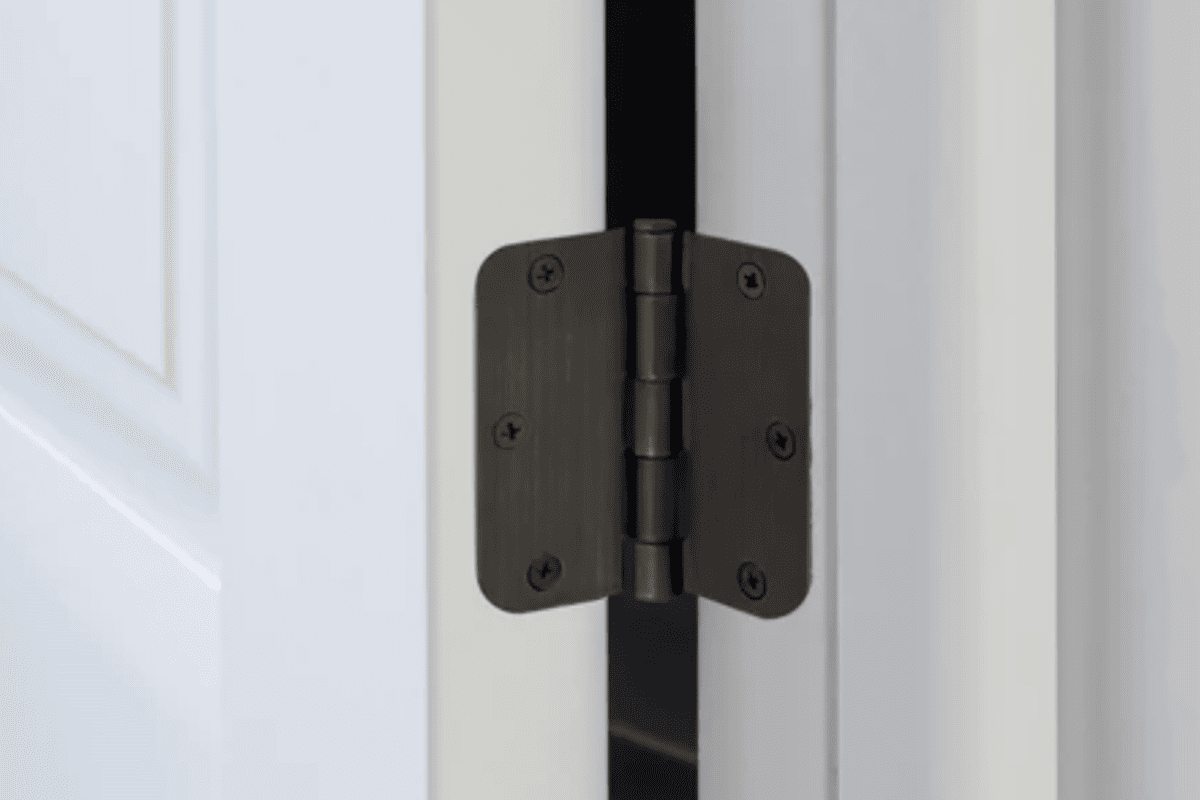
Hinge radius matters because routed mortises usually have rounded corners from the rotating router bit. A radius-corner hinge with the correct radius can fit directly into that mortise. If the radius is wrong, workers may need to re-cut, chisel, or adjust the mortise, which increases labor and rework risk.
The routing process creates rounded corners
In many wooden door factories, hinge mortises are made with a router, trimmer, CNC machine, or template-based cutting system. These tools use rotating bits. A rotating bit naturally leaves a rounded internal corner.6
This is the key reason hinge radius matters.
If the hinge leaf has the same rounded corner shape as the mortise, the hinge can sit into the recess more efficiently.7 If the hinge has square corners, the mortise corners may need to be cleaned manually. If the hinge has a different radius, the hinge may not sit fully into the mortise.
Common production problems caused by mismatch
A wrong radius can lead to several practical issues:
- The hinge does not drop into the mortise
- The hinge leaf sits proud of the door edge
- The installer forces the hinge into position
- The screw holes shift slightly
- The door gap changes
- The factory needs manual chiseling
- The finished door edge may be damaged
- Production speed becomes slower
I do not describe hinge radius as the main factor for load capacity or durability. Those depend more on hinge size, material, thickness, knuckle structure, pin design, screw fixing, door weight, and usage cycles. However, radius is very important for fitment accuracy and installation efficiency.
Why this matters in bulk supply
For one sample door, a technician may adjust the corner with a chisel. For a production batch, that same adjustment becomes a cost problem.
Let us consider a simple factory scenario. If one manual corner-cleaning step takes only 2 minutes per hinge position, and each door uses 3 hinges, then each door needs around 6 extra minutes. For 500 doors, that becomes 3,000 minutes, or 50 labor hours.
That is only a rough production example, not a universal calculation. But it shows why a small specification can affect factory efficiency.
| Batch size | Hinges per door | Extra time per hinge | Total extra time |
|---|---|---|---|
| 100 doors | 3 | 2 minutes | 600 minutes / 10 hours |
| 500 doors | 3 | 2 minutes | 3,000 minutes / 50 hours |
| 1,000 doors | 3 | 2 minutes | 6,000 minutes / 100 hours |
What buyers should confirm with the door factory
Before approving a hinge order, the buyer should ask the door factory or technical department several direct questions:
- Is the mortise corner square or rounded?
- If rounded, what is the radius?
- Was the mortise made by router, CNC, or another tool?
- Is there an existing hinge sample already used in production?
- Does the new hinge need to match an old template?
- Will the frame preparation use the same radius as the door leaf?
- Are drawings available for hinge leaf and mortise details?
In our factory communication, I prefer to receive either a technical drawing or a physical sample. A drawing is clean and fast when dimensions are complete. A sample is helpful when the buyer is replacing an existing hinge and the old specification is unclear.
Radius and door/frame preparation should be checked together
The hinge does not work alone. It sits between the door and the frame. So, hinge radius should be checked against both sides of the preparation.
A mismatch on the door side can affect hinge seating. A mismatch on the frame side can affect alignment. If both sides are prepared differently, the installation team may face inconsistent gaps or uneven hinge positioning.
For B2B wooden door production, I recommend treating the hinge and mortise as one combined system. The hinge supplier, door factory, and buyer should confirm the interface before bulk ordering.
How Do Radius-Corner Hinges Compare With Square-Corner Hinges?
Many buyers ask whether radius-corner hinges are “better” than square-corner hinges. That question can be misleading. The better hinge is the one that matches the door preparation, project requirement, and production method. A mismatch can cause more trouble than the corner style itself.
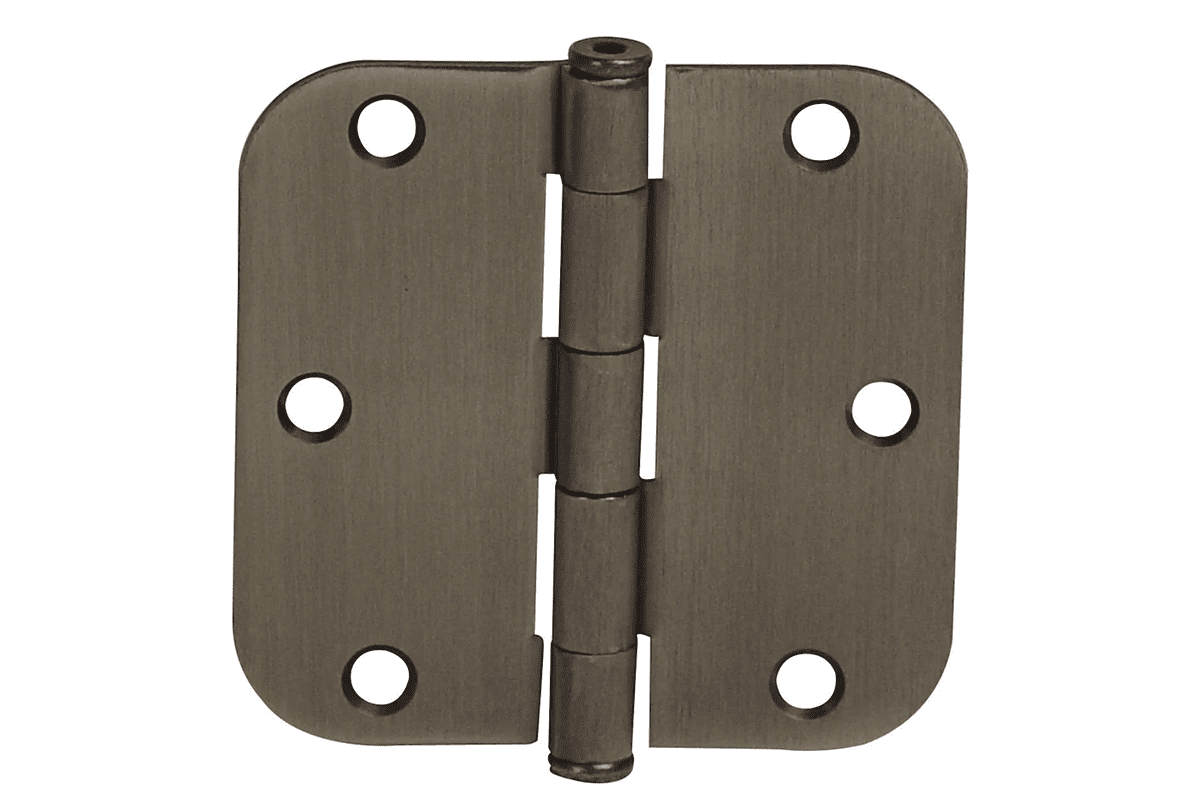
Radius-corner hinges usually fit routed mortises more efficiently because the rounded corners match the shape left by router bits. Square-corner hinges can be suitable when the mortise is prepared with square corners, but they often require additional chiseling after routing in wooden door production.8
Radius-corner hinges
Radius-corner hinges are common in modern wooden door production because they support efficient routing and template-based preparation.9 If the routing bit and hinge radius are aligned, the hinge leaf can sit neatly in the mortise with less manual correction.
Typical advantages include:
- Faster installation in routed mortises
- Less manual corner cleaning
- More consistent fit across repeated production
- Lower risk of damaging the mortise edge
- Good compatibility with template-based door factories
However, radius-corner hinges still require accurate specification. A 1/4″ radius is not the same as a 5/8″ radius. R10 is not automatically interchangeable with every metric routed corner. The detail must be confirmed.
Square-corner hinges
Square-corner hinges remain widely used in many markets and applications. They can be appropriate when the mortise is made with square corners or when project drawings specifically require square-corner leaves.
Typical considerations include:
- Clean traditional appearance
- Compatibility with square mortise preparation
- Possible need for chiseling after routing
- Greater manual skill requirement in some wooden door factories
- Higher rework risk if used with a rounded mortise without preparation adjustment
Square-corner hinges are not inferior by default. They simply need the correct door and frame preparation. If a factory already uses square-corner mortising equipment or accepts manual corner cleaning, then this hinge type may be suitable.
Comparison table for procurement evaluation
| Item | Radius-corner hinge | Square-corner hinge |
|---|---|---|
| Corner shape | Rounded leaf corners | 90-degree leaf corners |
| Mortise compatibility | Works well with routed rounded mortises | Works well with square mortises |
| Common production method | Router or CNC with matching bit radius | Routing plus corner chiseling, or square cutting |
| Installation efficiency | Often faster when radius matches | May need extra work if routed corners are round |
| Rework risk | Lower when correctly specified | Higher if mortise is not square |
| Best use case | Repeated wooden door production with templates | Projects requiring square-corner preparation |
| Buyer action | Confirm exact radius | Confirm square mortise capability |
The key is not style. The key is fitment.
When I review hinge inquiries, I try to move the discussion away from “Which hinge looks better?” and toward “Which hinge matches your door preparation?” This is especially important for OEM buyers, door factories, and hardware wholesalers who supply multiple markets.
A wholesaler may sell to different customers in Europe, the Middle East, and Southeast Asia. One customer may require R10 hinges for a metric wooden door range. Another may request 1/4″ radius hinges for an imperial system. Another may use square-corner hinges because their door factory has an existing preparation standard.
How wrong assumptions happen
Specification errors often happen because the buyer copies only part of an old order. For example:
- The buyer records “4 × 3 × 3 mm SS hinge.”
- The old sample had radius corners.
- The new purchase request does not mention the radius.
- The supplier quotes a square-corner version or a different radius.
- The sample arrives and does not fit the mortise.
This issue is preventable. The buyer should include hinge radius in the same level of detail as material, thickness, finish, and hole pattern.
My practical recommendation
For new product development, I recommend checking hinge samples with the door routing sample before final approval. For replacement orders, I recommend sending the old hinge sample or a clear corner photo with a ruler. For branded hardware programs, I recommend adding radius information to the product code or internal specification sheet.
A strong hinge specification should be repeatable. It should not depend on memory or informal messages.
How Should Buyers Confirm Hinge Radius Before Bulk Orders?
Bulk orders magnify small mistakes. A buyer may approve a hinge based on appearance, then discover during installation that the corner radius does not fit the mortise. This creates pressure on both supplier and buyer. A structured confirmation process reduces that risk.
Buyers should confirm hinge radius by checking the hinge drawing, physical sample, door mortise drawing, routing template, and production sample together. They should not approve bulk orders based only on hinge length and width. Radius, thickness, hole pattern, finish, material, and door/frame preparation should all be verified.

Step 1: Confirm the hinge leaf size and corner type
Start with the basic hinge dimensions:
- Height
- Open width
- Leaf width
- Thickness
- Knuckle diameter
- Pin type
- Corner type
- Hinge radius
The radius should be written clearly. If the buyer is unsure, then “as per sample” may be used temporarily, but the final purchase order should include a confirmed radius or approved drawing.
Step 2: Match the hinge with the mortise drawing
The mortise is the recessed pocket cut into the door and frame. The hinge should sit flush inside that pocket.
The buyer should compare:
| Hinge detail | Mortise detail to check |
|---|---|
| Hinge height | Mortise height |
| Hinge width | Mortise width |
| Hinge thickness | Mortise depth |
| Corner radius | Mortise corner radius |
| Hole pattern | Pilot hole position |
| Screw size | Door/frame material strength |
If the mortise is already fixed in a production line, the hinge must follow it. If the hinge is fixed first, then the door factory should prepare routing templates around the confirmed hinge drawing.
Step 3: Use drawings and samples together
In factory communication, drawings and samples each have value.
Drawings are good for:
- Exact dimensions
- Tolerance discussion
- Production records
- Purchase order confirmation
- Repeat orders
Samples are good for:
- Visual matching
- Corner shape verification
- Finish comparison
- Hole pattern checking
- Existing product replacement
I often prefer to use both. A drawing prevents vague interpretation. A sample shows real-world details that may not be obvious in a short message.
Step 4: Check common market references carefully
Some radius references are commonly seen, but they should not be treated as automatic rules.
| Market context | Commonly seen radius references | Important note |
|---|---|---|
| European / metric projects | R10 | Confirm against drawing or sample |
| North American / imperial projects | 1/4″ radius, 5/8″ radius | Confirm exact inch size |
| Mixed export projects | Metric or imperial conversion | Avoid approximate conversion errors |
| OEM customized projects | Customer-defined radius | Confirm tooling feasibility |
A 10 mm radius is close to some imperial values, but “close” is not always acceptable for a routed mortise.10 Door factories need practical fit, not just approximate conversion.
Step 5: Include radius in the purchase order
A complete hinge purchase order should include the radius directly. It should not be hidden in a photo or assumed from a previous order.
A practical specification may look like this:
Stainless steel butt hinge, 100 × 75 × 2.5 mm, radius corner R10, SS304, satin finish, 4BB, fixed pin, hole pattern as drawing, screws included, logo stamping required, packed in customer color box.
For OEM and ODM orders, the buyer should also confirm:
- Logo position
- Packaging artwork
- Salt spray requirement, if applicable
- Fire-rated certification documents, if required
- CE documentation, if required
- Inspection criteria
- Approved sample reference number
At SDH Hardware, we can support customized product specifications, surface treatments, accessory configurations, branding, drawings after order confirmation, and finished product inspection. However, I always remind buyers that certification documents and application-specific performance requirements should be verified for the target project and local market.
Step 6: Perform sample approval before mass production
Sample approval is one of the most important stages for hinge radius confirmation. The buyer should test the sample with the actual door or frame preparation.
A useful sample approval checklist includes:
- Does the hinge fit the mortise without forcing?
- Does the hinge sit flush with the door edge?
- Does the radius match all four corners?
- Do screw holes align with pilot holes or drilling plan?
- Does the door close with the expected gap?
- Does the finish match the approved color standard?
- Does the hinge thickness match the mortise depth?
- Does the packaging meet the buyer’s distribution needs?
This check is simple, but it protects the bulk order. I have seen many inquiries where the buyer initially focuses on price. Price matters, of course. But the cheapest hinge becomes expensive if it creates rework at the door factory.
What Other Hinge Specifications Should Be Confirmed Along With Hinge Radius?
Hinge radius is important, but it is only one part of the complete hinge specification. If buyers confirm the radius but ignore thickness, hole pattern, or material, the hinge may still create installation or quality problems. Procurement teams need a complete checklist.
Buyers should confirm hinge radius together with hinge size, leaf thickness, material grade, finish, bearing structure, pin type, screw specification, hole pattern, packaging, certification documents, and door/frame preparation. These items work together, so a correct radius alone does not guarantee that the hinge is suitable for the project.
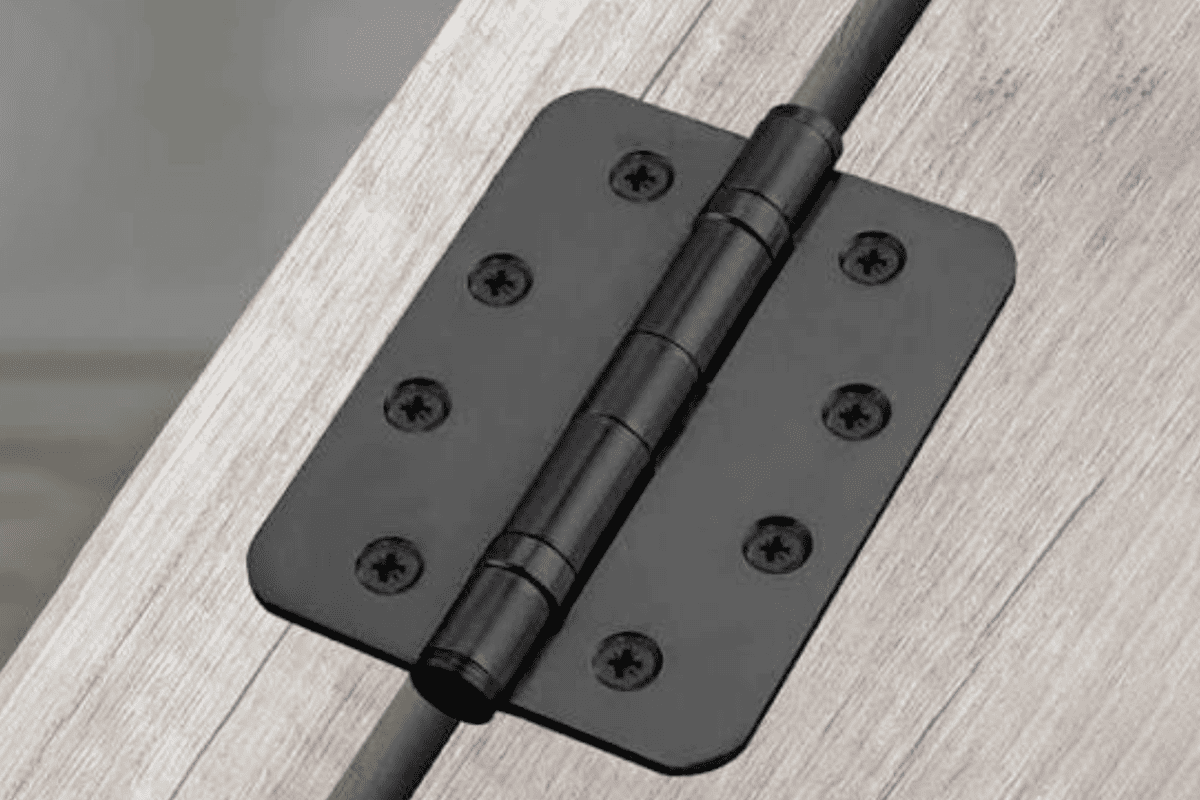
Key specifications to review
A hinge specification should be complete enough for manufacturing, inspection, and repeat purchasing. I recommend checking the following items before sample confirmation.
| Specification | What to confirm | Why it matters |
|---|---|---|
| Size | Height and width | Must match mortise and door design |
| Thickness | Leaf thickness | Affects flush installation and strength |
| Hinge radius | Corner radius | Must match routed mortise |
| Material | SS304, SS201, steel, brass | Affects corrosion resistance and market positioning |
| Finish | SSS, PSS, PVD, black, antique | Affects appearance and project matching |
| Bearing | Plain bearing, ball bearing | Affects operation feel and application choice |
| Pin type | Fixed, loose, non-removable | Affects security and maintenance |
| Hole pattern | Standard or customized | Must match drilling plan |
| Screw type | Size, head type, finish | Affects installation compatibility |
| Certification documents | CE, fire-rated documents where applicable | Buyers should verify project suitability |
| Packaging | Bulk, white box, color box | Affects wholesale and brand sales |
Material and finish should match the market
Different markets often prefer different materials and finishes. For example, stainless steel lever handles and hinges are common in many commercial and residential projects. Some buyers choose SS304 for better corrosion resistance.11 Others use SS201 or steel hinges for cost-sensitive interior applications.
The finish also matters. A satin stainless steel finish may be suitable for one brand range, while matte black may fit another. For bulk wholesalers, color consistency across repeat orders is often important.
At SDH Hardware, we produce a wide range of architectural door hardware, including Euro mortise locks, stainless steel lever handles, butt hinges, concealed door hinges, Euro brass cylinders, and door accessories. Because many customers buy full door hardware sets, I often check whether the hinge finish should match the lock faceplate, lever handle rose, cylinder escutcheon, and accessories.
Thickness and mortise depth must align
The hinge leaf thickness should match the mortise depth.12 If the hinge is thicker than expected, it may sit proud and affect the door gap. If it is thinner, it may sit too deep unless the door preparation is adjusted.
This point connects directly with hinge radius. A perfectly matched radius still cannot solve a wrong mortise depth. Buyers should check both details together.
Hole pattern affects replacement and OEM projects
Hole pattern is another detail that buyers sometimes underestimate. Two hinges may have the same size and radius but different screw hole positions. If the door factory has pre-drilled holes, the wrong pattern can create immediate installation problems.
For replacement orders, I recommend checking:
- Distance from hinge edge to screw center
- Distance between screw holes
- Number of holes per leaf
- Countersink angle
- Screw head size
- Left/right symmetry if applicable
For OEM branding, the buyer may also request a custom hole pattern. In that case, the supplier should confirm tooling and drawing approval before mass production.
Certification documents should be verified
Some projects require CE documentation or fire-rated certification documents. These documents should be reviewed carefully by the buyer, project consultant, or qualified professional. The hinge specification, door set, installation method, and local regulations can all affect suitability.
I avoid saying that a radius detail determines fire performance. It does not work that way. Fire-rated performance depends on tested assemblies and documented configurations. Hinge radius mainly relates to fitment with the mortise and installation efficiency.
Conclusion
Hinge radius is more than a small corner detail. It is a fitment specification that should match the routed mortise in the wooden door and frame. Buyers should confirm it together with hinge size, thickness, hole pattern, material, finish, screws, and door preparation. This simple step can reduce installation delays, manual chiseling, and bulk order rework. If you need factory support for butt hinges, concealed hinges, or complete architectural door hardware sets, I welcome you to contact SDH Hardware with your drawing or sample for specification confirmation.
"[PDF] woodworking safety manual and test - Cerritos College", https://www.cerritos.edu/academics/divisions/technology/woodworking/_includes/docs/Safety_Manual_2024_ua.pdf. A woodworking education source describes routers and routing templates as standard methods for cutting hinge mortises in wood doors, providing process-level support for the article’s discussion of routed door and frame preparations. Evidence role: mechanism; source type: education. Supports: A woodworking or architectural woodwork source should explain that hinge mortises can be cut with routers, templates, or CNC routing equipment.. Scope note: Such a source may describe common practice but may not quantify how often every wooden door factory uses routing. ↩
"How to Mortise Hinges With a Chisel",
. A door-installation or woodworking guide notes that hinge leaves should sit flush in the mortise and that mismatched or square corners after routing may require chiseling, supporting the article’s claim that incorrect radius selection can create fitment and rework issues. Evidence role: general_support; source type: education. Supports: A woodworking or door-installation source should explain that hinge leaves must fit the mortise and that corners may require chiseling when shapes do not match.. Scope note: The source would support the mechanism of added work, not the exact frequency or cost of delays in a particular factory. ↩"1/4 vs 5/8 Radius Hinge: How to Match Your Door Mortise", https://watersonusa.com/solutions/1-4-vs-5-8-radius-hinge. A door-hardware standards or technical specification source defines radius-corner hinges by the measured radius of the rounded corners of the hinge leaf, supporting the article’s use of “hinge radius” as a dimensional specification. Evidence role: definition; source type: institution. Supports: A technical or standards source should define hinge corner radius as the radius of the rounded corner on a hinge leaf.. ↩
"Matte Black Heavy Duty Door Hinge 4 X 4 Inch Ball ...", https://www.amazon.com/SORGMACH-Commercial-Interior-Exterior-Hardware/dp/B0C5J7JY8K. Door-hardware technical specifications list radius-corner hinge options such as 1/4 in. and 5/8 in., while metric specifications commonly express corner radii in millimetres such as R10; this supports the article’s examples of market terminology. Evidence role: general_support; source type: institution. Supports: A standards or technical specification source should show that 1/4-inch and 5/8-inch radius-corner hinges are recognized imperial references, and a metric source should document R10 usage.. Scope note: This evidence would establish that these references exist in specifications, not that they are dominant in every regional market. ↩
"Perfect Mortises for Round Corner Hinges",
. Door-hardware specification references distinguish hinge size from corner treatment, showing that nominally similar hinges may be specified with square or radius corners; this supports the article’s warning that length and width alone are incomplete identifiers. Evidence role: general_support; source type: institution. Supports: A door-hardware standard or technical catalog should show the same nominal hinge sizes offered or specified with different corner treatments.. Scope note: The evidence is contextual because availability still depends on a given manufacturer’s tooling and product range. ↩"Sharp Corners on CNC Machined Parts: The Impossible ...", https://www.modusadvanced.com/resources/blog/sharp-corners-on-cnc-machined-parts-the-impossible-feature-thats-killing-your-timeline. Manufacturing and woodworking references explain that rotary cutters such as end mills and router bits cannot create perfectly sharp internal corners and instead leave an inside radius related to the cutter size, supporting the article’s explanation of rounded routed mortise corners. Evidence role: mechanism; source type: education. Supports: A machining or woodworking source should explain that rotary cutters produce internal corner radii determined by cutter geometry.. ↩
"How to Install No-Mortise Hinges",
. A woodworking installation guide states that a hinge leaf should fit flush within its mortise and that corner preparation may be adjusted to match the hinge shape, supporting the article’s claim that matching rounded corners improves seating. Evidence role: mechanism; source type: education. Supports: A door-hanging or woodworking source should support that hinges are intended to sit flush in matching mortises and that corner preparation affects the fit.. Scope note: The source would support installation fit rather than measuring production efficiency across factories. ↩"Mortise for hinge with rounded corners : r/handtools", https://www.reddit.com/r/handtools/comments/1lyko7q/mortise_for_hinge_with_rounded_corners/. A door-hanging guide explains that square-corner hinges require square mortise corners and that rounded corners left by routing can be squared with a chisel, supporting the article’s comparison of square-corner hinges with routed mortises. Evidence role: mechanism; source type: education. Supports: A woodworking installation source should explain that square-corner hinges require square mortise corners and that routed rounded corners may need chiseling.. Scope note: The source may describe installer practice and may not prove that additional chiseling is required in all production settings. ↩
"Perfect Mortises for Round Corner Hinges",
. Architectural woodwork and door-preparation references describe routed or template-based hinge mortises with radiused corners, providing contextual support for the article’s statement that radius-corner hinges are compatible with modern repeated wooden-door production. Evidence role: general_support; source type: institution. Supports: An architectural woodwork or door-manufacturing source should connect routed/template mortising with radius-corner hinge preparations.. Scope note: The evidence would support compatibility and industry context, not establish a universal prevalence rate for radius-corner hinges. ↩"Design for tolerance of electro-mechanical assemblies", https://nvlpubs.nist.gov/nistpubs/Legacy/IR/nistir6223.pdf. A metrology or engineering-tolerance reference explains that assembled parts must meet specified dimensional tolerances rather than approximate nominal conversions, supporting the article’s caution that a near metric-imperial radius match may still be unacceptable in a routed mortise. Evidence role: general_support; source type: government. Supports: A metrology or engineering-tolerance source should support that dimensional fit depends on specified tolerances and that approximate conversions can be insufficient for assembly.. Scope note: The source would support the general tolerance principle, not a specific pass/fail threshold for hinge mortises. ↩
"18-8 Stainless Steel vs 201: Differences, Corrosion ...", https://www.ryerson.com/metal-resources/metal-market-intelligence/18-8-stainless-steel-vs-201. Materials science literature describes Type 304 stainless steel as an austenitic stainless steel with generally good corrosion resistance due to its chromium-nickel composition, supporting the article’s statement that buyers may select SS304 for corrosion-resistance reasons. Evidence role: expert_consensus; source type: paper. Supports: A materials science source should support that Type 304 stainless steel generally has good corrosion resistance, with performance depending on exposure conditions.. Scope note: The support is general because actual corrosion performance depends on environment, surface finish, maintenance, and comparison alloy. ↩
"How to Mortise Hinges With a Chisel",
. A carpentry installation reference states that the hinge mortise depth should correspond to the hinge leaf thickness so the leaf sits flush with the door edge or jamb, supporting the article’s guidance on thickness and mortise depth alignment. Evidence role: mechanism; source type: education. Supports: A carpentry or door-installation source should state that mortise depth is set to the hinge leaf thickness so the hinge sits flush.. ↩