
Stainless steel hinge magnetism: Why some 304 hinges are slightly magnetic
Stainless steel hinge magnetism can worry buyers when a magnet sticks lightly to a 304 hinge. The concern is easy to understand. If a customer believes “magnetic means fake stainless steel,” a normal inspection can become a dispute. The better solution is to understand manufacturing effects and verify material through proper evidence.
A slightly magnetic 304 stainless steel hinge is not automatically fake or defective. 304 stainless steel can show mild magnetism after stamping, bending, punching, or barrel forming because these processes deform the metal structure.1 Buyers should treat a magnet test as a rough screen, not as final proof of material grade.
I have seen this question many times when discussing hinge orders with door factories, hardware brands, and importers. A magnet test feels simple, but hinge production is not simple. So I will explain what causes the reaction, what it does not prove, and how I suggest buyers handle it.
Why does stainless steel hinge magnetism happen in 304 hinges?
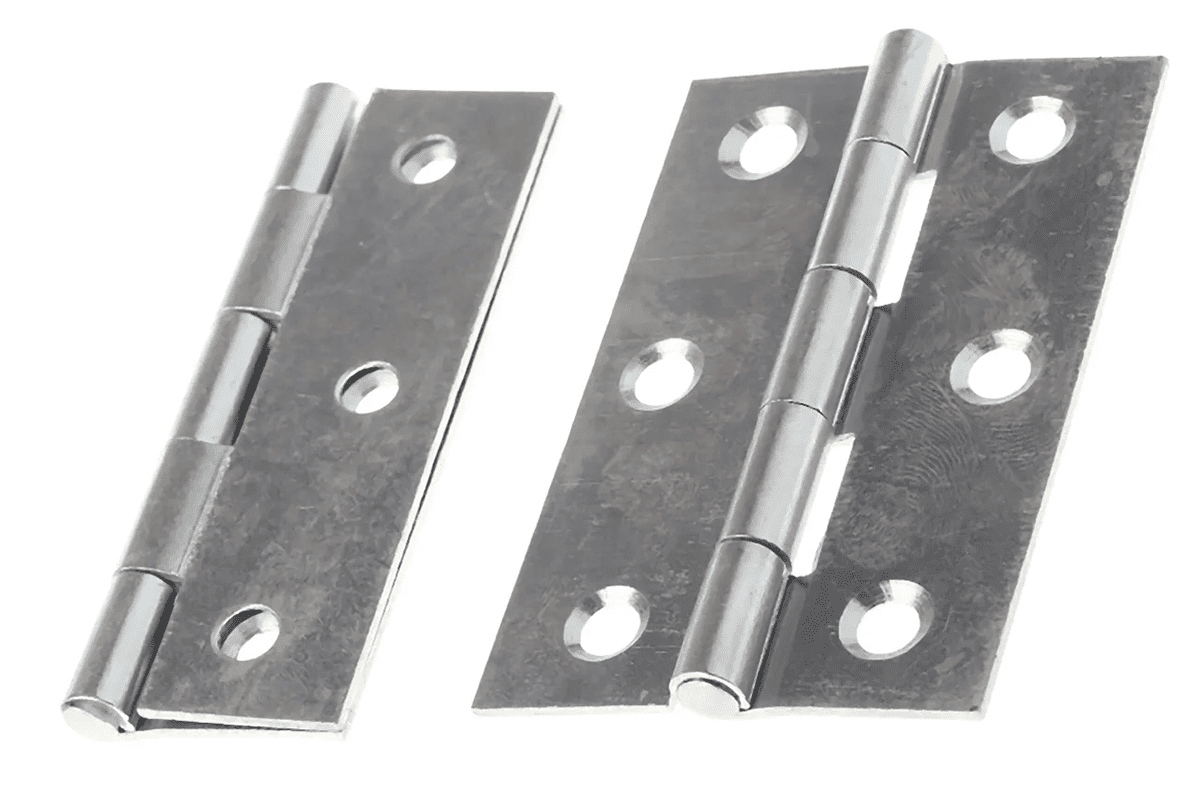
Stainless steel hinge magnetism often appears after a buyer checks a finished hinge, not a flat raw sheet. That difference matters. The hinge has gone through cutting, stamping, bending, knuckle rolling, and assembly. These steps create stress, and that stress can change how 304 stainless reacts to a magnet.
304 stainless steel is usually known as an austenitic stainless steel2, but it can become slightly magnetic after cold working. In hinge production, stressed areas such as bent leaves, punched holes, and rolled barrels may attract a magnet more clearly than flat, undeformed areas.3
The key point: the hinge is no longer “just a flat sheet”
When buyers ask me why a 304 hinge has a slight magnetic pull, I usually start with the production route. A hinge leaf may look simple, but it is made through several mechanical operations.
Common hinge manufacturing steps include:
Raw material preparation
Stainless steel coil or sheet is selected according to the order requirement.Cutting or blanking
The hinge leaf shape is formed from the sheet.Punching
Screw holes and countersunk areas are made.Bending and forming
The hinge knuckles or barrel areas are rolled.Pin assembly
The hinge pin and leaves are fitted together.Surface finishing and inspection
The hinge is cleaned, polished, brushed, or packed according to the order.
Each step can create local deformation. In simple terms, the steel is forced into a new shape. That mechanical stress can make some areas of 304 stainless steel show mild magnetic response.
A magnet may react more strongly near the hinge barrel than on a flat leaf because the barrel has been heavily formed.
Where magnetism usually appears
From a practical factory perspective, slight magnetism often appears in areas with more forming pressure.
| Hinge area | Manufacturing process | Possible magnetic response |
|---|---|---|
| Flat leaf surface | Cutting and light finishing | Usually lower |
| Screw holes | Punching and countersinking | May be slightly higher |
| Barrel / knuckle | Rolling and forming | Often more noticeable |
| Edges | Cutting and stress concentration | May vary |
| Welded or assembled parts, if applicable | Heat or assembly stress | Depends on design |
This does not mean every 304 hinge will react the same way. Material source, sheet thickness, forming pressure, hinge size, tooling condition, and surface treatment can all affect the result.4
Why this matters for procurement
For B2B buyers, stainless steel hinge magnetism should be treated as a technical inspection question, not an immediate accusation. If a shipment has slight magnetism, the first question should be:
- Is the magnetism light or strong?
- Is it local or uniform?
- Does it appear mainly in formed areas?
- Does the supplier’s documentation match the order?
- Is composition testing required for this project?
I tell customers that a magnet can start a conversation, but it should not finish the judgment. For door factories and hardware brands, the better approach is to define inspection standards before mass production. That avoids arguments after goods arrive.
Does stainless steel hinge magnetism mean the 304 material is fake?
Stainless steel hinge magnetism can create a serious trust problem. A buyer may worry that the supplier used 201, 430, or another material instead of 304. That concern is reasonable. However, the magnetic response alone cannot prove substitution, especially when the hinge has been cold worked.
Slight magnetism does not automatically mean a 304 stainless steel hinge is fake. A magnet test only shows magnetic response, not chemical composition.5 Buyers should verify the material through supplier records, material certificates, purchase specifications, and third-party composition testing when the project requires certainty.
The magnet test is only a rough check
A magnet test is popular because it is fast, cheap, and easy. I understand why buyers use it during warehouse inspection. However, it has clear limits.
A magnet test cannot reliably tell you:
- The chromium content
- The nickel content
- Whether the material meets a specific 304 composition range
- Whether the hinge was cold worked during production
- Whether surface finishing affected local response
- Whether the product matches the purchase order
It only tells you one thing: a magnet is attracted to some degree.
That information can be useful as an early warning signal, but it is not enough for a final claim. For example, ferritic stainless steels can be magnetic.6 Cold-worked 304 can also show slight magnetism. Some mixed-component products may include parts with different magnetic behavior. So the result needs context.
A practical comparison for buyers
| Inspection method | What it can show | What it cannot prove alone | Best use |
|---|---|---|---|
| Magnet test | Magnetic response | Exact stainless grade | Quick screening |
| Supplier material certificate | Declared material information | Actual composition of every piece unless traceability is strong | Document review |
| Purchase order records | Agreed material and specification | Physical material composition | Commercial verification |
| PMI / XRF testing7 | Elemental composition estimate | Full performance in every application | Material confirmation |
| Third-party lab test | More formal composition evidence | Long-term service behavior without application testing | Dispute resolution or critical orders |
| Salt spray test8 | Corrosion resistance under test condition | Exact material grade | Surface/process evaluation |
What I tell customers when they ask “Is it fake?”
I usually avoid a yes-or-no answer based only on magnetism. That would not be responsible. Instead, I suggest a step-by-step review.
Check the order requirement
The purchase order should clearly state 304 stainless steel, surface finish, hinge size, thickness, and any certification requirement.Check the supplier’s material record
The supplier should be able to provide material information that matches the production batch or purchase requirement.Check the hinge design
If magnetism appears mainly around the knuckle or punched areas, manufacturing stress may be the reason.Test if needed
For high-value projects, public projects, fire door packages, or brand-sensitive orders, buyers can arrange composition testing.Compare with retained samples
If both parties approved a pre-production sample, it should be used as a practical reference.
Material verification protects both sides
For SDH Hardware, I prefer early confirmation. If a buyer has strict requirements, I would rather discuss them before production than after shipment. That helps both sides avoid disputes.
For example, a hardware brand may need 304 stainless steel hinges for a specific market. The brand may also need packaging, logo marking, technical drawings, CE-related documents, or fire-rated documentation for project review. In that case, documents should be collected and checked as part of procurement control.
Buyers should also verify that certifications apply to the relevant product type, size, configuration, and intended use. A certificate is not just a decoration in a quotation file. It is a document that should be reviewed carefully.
How should buyers inspect 304 hinges beyond stainless steel hinge magnetism?
Stainless steel hinge magnetism is an easy first check, but it should not be the only inspection method. If a buyer depends only on a magnet, good products may be rejected unfairly, and unsuitable products may pass by chance. A stronger inspection plan protects quality, cost, and customer trust.
Buyers should inspect 304 stainless steel hinges by combining document review, visual inspection, dimensional checks, functional testing, packaging review, and material verification when required. A magnet test can be included, but it should be treated as a screening tool rather than final proof.
Start with procurement specifications
The best inspection starts before production. A buyer should not only say “304 hinge.” That is too broad for a serious B2B order.
A clear specification may include:
- Material grade: 304 stainless steel
- Hinge size: length, width, open width
- Leaf thickness
- Pin diameter and pin material
- Bearing type, if applicable
- Hole pattern and screw type
- Surface finish: satin, polished, brushed, PVD, painted, or other
- Packaging method
- Logo requirement
- Quantity tolerance
- Inspection standard
- Required documents
- Fire-rated or CE-related requirements, if applicable
When these details are confirmed early, stainless steel hinge magnetism becomes easier to interpret because everyone knows what the product was supposed to be.
Use a layered inspection method
For bulk orders, I like a layered inspection approach. It is practical and does not depend on one single test.
| Inspection layer | What to check | Why it matters |
|---|---|---|
| Document review | PO, invoice, material statement, certificate copies | Confirms commercial requirement |
| Appearance inspection | Scratches, stains, polishing marks, burrs | Protects brand presentation |
| Dimension check | Length, width, thickness, hole spacing | Ensures door compatibility |
| Functional check | Opening angle, movement, pin fit, noise | Confirms usability |
| Load-related review | Project requirement, hinge type, door weight | Avoids wrong product selection |
| Magnet screening | Local or strong attraction | Provides quick reference only |
| Material testing | PMI/XRF or lab testing when needed | Confirms composition more directly |
What I check in real production conversations
When a customer asks me about 304 stainless steel hinge magnetism, I often ask for photos or videos showing where the magnet sticks. I also ask how strong the attraction is. A large magnet pulling strongly across the entire hinge may need deeper review. A small magnet reacting lightly near the barrel is a different situation.
I also ask about the full order background:
- Was the hinge made from 304 sheet according to the order?
- Was the hinge heavily formed?
- Was the hinge polished or brushed after forming?
- Was the sample approved before production?
- Did the customer require a third-party test before shipment?
- Are there special market requirements?
This is not an attempt to avoid responsibility. It is a way to make the inspection fair and technical.
When third-party testing makes sense
Third-party testing is not always necessary for every hinge order. However, it is useful when the risk is high.
Buyers may consider third-party composition testing when:
- The project specification strictly requires verified 304 stainless steel.
- The customer or end user disputes the material.
- The order value is high.
- The product is used in a sensitive public or commercial project.
- The buyer has no previous relationship with the supplier.
- The supplier documentation is incomplete.
- The buyer needs evidence for internal quality records.
A qualified professional evaluator or test laboratory can provide more reliable information than a magnet alone.9 For application-specific decisions, such as fire door systems or high-corrosion environments, buyers should rely on qualified technical assessment and project standards.
Do not ignore normal hardware checks
Material grade is important, but it is not the only quality point. A genuine 304 hinge can still be a poor hinge if dimensions, forming, or assembly are weak.
For door manufacturers and wholesalers, I suggest checking:
- Leaf flatness
- Knuckle alignment
- Pin tightness
- Opening and closing smoothness
- Countersink consistency
- Surface finish uniformity
- Burr control
- Packaging protection
- Carton strength
- Label accuracy
A good supplier should control the full process, from raw material screening to production supervision and finished product inspection. At SDH Hardware, we see these steps as part of factory discipline, not as optional extras.
When is stainless steel hinge magnetism acceptable for bulk door hardware orders?
Stainless steel hinge magnetism becomes a commercial issue when buyers must decide whether to accept or reject goods. A rushed rejection can damage supply schedules. A careless acceptance can create downstream complaints. The practical answer depends on strength, location, documentation, order terms, and project requirements.
Slight local magnetism is often acceptable in 304 stainless steel hinges when documentation matches the order and other quality checks pass. Strong, uniform, unexplained, or inconsistent magnetic attraction should trigger further verification before acceptance, especially for brand, project, or regulated applications.
Build acceptance rules before shipment
The best time to define acceptance criteria is before mass production. I recommend that buyers and suppliers agree on inspection requirements during sample approval or order confirmation.
A practical acceptance rule can include:
- The approved material grade
- Required document list
- Approved sample reference
- Surface finish standard
- Dimensional tolerance
- Functional requirements
- Packaging requirements
- Whether magnet response is recorded
- Whether third-party testing is required
- Dispute resolution method
This keeps both sides aligned. If stainless steel hinge magnetism appears during receiving inspection, the buyer can compare the goods with agreed criteria instead of relying on emotion.
Light, local, and explainable vs. strong, broad, and unexplained
Not all magnetic reactions are equal.
| Magnet response | Typical interpretation | Suggested action |
|---|---|---|
| Light attraction near barrel or punched areas | May relate to cold working | Check documents and overall quality |
| Light attraction on some pieces only | May relate to process variation | Review sample range and records |
| Strong attraction across entire hinge | Needs deeper review | Request documentation and consider testing |
| Inconsistent response between batches | Traceability issue may exist | Compare batch records |
| Magnetism plus rust complaints | Requires separate corrosion review | Check surface, environment, and material |
| Magnetism plus missing documents | Higher procurement risk | Hold acceptance until verified |
Does magnetism mean poor rust resistance?
This is a common misunderstanding. Slight magnetism by itself does not directly prove poor rust resistance. Corrosion performance depends on several factors, including material composition, surface condition, environment, cleaning, installation, and exposure to chemicals or salt.10
For example, even stainless steel can stain or corrode in harsh environments if it is exposed to chloride, cement dust, acid cleaners, or poor maintenance.11 A hinge used near a coastal area needs different evaluation from a hinge used in an interior apartment door.
Buyers should separate two questions:
Is the material really 304 stainless steel?
This is a composition and documentation question.Will this hinge resist corrosion in the intended environment?
This is an application and performance question.
The second question may need salt spray testing, surface process review, or advice from a qualified professional, depending on the project. A magnet alone cannot answer it.
How suppliers can support buyer confidence
A professional supplier should not dismiss buyer concerns. If a customer asks about stainless steel hinge magnetism, the supplier should explain it clearly and provide practical support.
Useful supplier support may include:
- Clear product specification sheets
- Material declarations or certificates, when available
- Order and batch records
- Pre-production samples
- Product drawings after order confirmation
- Finished product inspection service
- Packaging and logo confirmation
- Third-party testing coordination, if required
At SDH Hardware, our role as a manufacturer is not only to make hinges. We also help buyers explain product details to their own customers. I have learned that a calm technical explanation often prevents a simple magnet test from becoming a serious trust issue.
When buyers should be stricter
Some orders need stricter control. I suggest stronger verification when hinges are used for:
- Hardware brands with strict market claims
- Large hotel or commercial projects
- Public buildings
- Fire-rated door packages
- Coastal or humid regions
- High-frequency doors
- Orders with legal or certification requirements
- New supplier qualification
For CE certification and fire-rated certification, buyers should verify that the documents are relevant to the product and application.12 They should also confirm whether the hinge is part of a tested door assembly or only a component with supporting documentation. Project-specific decisions should involve qualified professionals.
Frequently Asked Questions
Are all 304 stainless steel hinges non-magnetic?
No. 304 stainless steel is commonly described as non-magnetic in its annealed state, but finished hinges can show slight magnetism after cold working. Stamping, punching, bending, and barrel forming can make some areas react to a magnet.
Does a magnet sticking to a 304 hinge prove it is fake?
No. A magnet sticking lightly to a hinge does not prove the material is fake. It only shows magnetic response. Buyers should review supplier documents, order records, material certificates, and consider composition testing when stronger proof is needed.
Does slight magnetism mean the hinge will rust easily?
No. Slight magnetism alone does not prove poor corrosion resistance. Rust performance depends on material composition, surface condition, environment, maintenance, and exposure. Buyers should evaluate corrosion risk separately, especially for coastal, humid, or chemical environments.
What should I ask my supplier if my 304 hinges are magnetic?
You should ask for the material specification, purchase order confirmation, material certificate or declaration, batch traceability, and production explanation. If the project requires high certainty, you can request third-party PMI, XRF, or laboratory composition testing.
Should I reject a full shipment because of stainless steel hinge magnetism?
Not automatically. If magnetism is slight, local, and consistent with cold-worked 304 hinges, buyers should first check documents and overall quality. Strong, broad, or unexplained magnetism should trigger further verification before final acceptance.
Conclusion
Stainless steel hinge magnetism should be evaluated with context, not fear. A slightly magnetic 304 hinge is not automatically fake, defective, or poor in rust resistance. Hinge manufacturing processes such as stamping, punching, bending, and barrel forming can create local magnetic response. For bulk purchasing, I recommend using the magnet test only as a rough screen and confirming material through specifications, supplier records, certificates, and qualified testing when needed. If you need factory-direct 304 stainless steel hinges with clear documentation and OEM/ODM support, contact SDH Hardware for a practical procurement discussion.
"Formability of Type 304 Stainless Steel Sheet - Mines Files", https://wpfiles.mines.edu/wp-content/uploads/aspprc/ResearchMaterials/Publications/062-Coubrough.pdf. Metallurgical studies of AISI 304 report that cold plastic deformation can transform part of the austenitic structure into ferromagnetic martensite, providing a mechanism for mild magnetism after forming operations. Evidence role: mechanism; source type: paper. Supports: Plastic deformation of austenitic 304 stainless steel can induce martensitic transformation and increase magnetic response.. Scope note: The evidence supports the general metallurgical mechanism, not the magnetic behavior of a specific hinge batch. ↩
"SAE 304 stainless steel", https://en.wikipedia.org/wiki/SAE_304_stainless_steel. Reference sources classify Type 304 stainless steel as an austenitic chromium-nickel stainless steel, supporting the article’s description of its normal metallurgical category. Evidence role: definition; source type: encyclopedia. Supports: Type 304 is an austenitic stainless steel grade.. ↩
"Quantitative measurement of deformation-induced martensite ...", http://wpfiles.mines.edu/wp-content/uploads/aspprc/ResearchMaterials/Publications/235-De.pdf. Research on cold-deformed AISI 304 shows that increased strain can raise deformation-induced martensite content and magnetic permeability, which is consistent with stronger magnet response in heavily formed regions. Evidence role: mechanism; source type: paper. Supports: Greater cold deformation in 304 stainless steel can increase martensite content and magnetic permeability.. Scope note: The source would support strain-dependent magnetism in 304 generally; it may not test hinge leaves, punched holes, or barrels directly. ↩
"Ferromagnetic properties of cold rolled AISI 304L steel", https://www.academia.edu/20727275/Ferromagnetic_properties_of_cold_rolled_AISI_304L_steel. Materials research describes magnetic response in austenitic stainless steels as dependent on composition and processing history, especially the degree of cold deformation that can occur during forming. Evidence role: general_support; source type: research. Supports: Magnetic response in austenitic stainless steels depends on composition, processing history, and degree of cold work.. Scope note: This is contextual support for production variability and does not quantify the effect of each listed hinge-manufacturing variable. ↩
"News - How to Identify Stainless Steel", https://m.sakysteel.com/news/how-to-identify-stainless-steel. Educational materials on stainless steel identification note that magnetic attraction indicates magnetic behavior but does not measure alloy composition or establish a precise stainless steel grade. Evidence role: general_support; source type: education. Supports: Magnet attraction is not a chemical composition test and cannot by itself verify stainless steel grade.. ↩
"Stainless steel", https://en.wikipedia.org/wiki/Stainless_steel. Reference descriptions of stainless steel families identify ferritic stainless steels as body-centered-cubic alloys that are generally magnetic, unlike fully annealed austenitic grades. Evidence role: definition; source type: encyclopedia. Supports: Ferritic stainless steels have a ferritic microstructure and are generally magnetic.. ↩
"Positive Material Identification (PMI)", https://www.mistrasgroup.com/field-services/core-ndt-services/positive-material-identification/. Technical descriptions of positive material identification explain that X-ray fluorescence instruments estimate alloy chemistry by detecting elemental composition, making the method relevant to stainless steel grade verification. Evidence role: general_support; source type: institution. Supports: PMI methods using XRF identify or estimate alloy composition by measuring elements present in the material.. Scope note: XRF/PMI results are typically elemental estimates and may have limitations for light elements, surface contamination, calibration, and sampling representativeness. ↩
"Salt spray test", https://en.wikipedia.org/wiki/Salt_spray_test. Salt spray standards describe controlled chloride-fog exposure as a corrosion test method, supporting its use for evaluating corrosion performance under defined conditions rather than identifying alloy grade. Evidence role: definition; source type: institution. Supports: Salt spray tests expose specimens to a controlled corrosive atmosphere to compare corrosion behavior under test conditions.. Scope note: Salt spray results are condition-specific and do not necessarily predict long-term service performance in all real environments. ↩
"PMI Testing Services | On-Site & Lab Positive Material ...", https://verichek.net/services/pmi-testing/. Standards for testing laboratories and materials analysis establish controlled procedures, calibration, and documentation requirements, which make laboratory composition testing more reliable evidence than an informal magnet check. Evidence role: expert_consensus; source type: institution. Supports: Accredited laboratories and standardized analytical methods provide more defensible material evidence than informal magnet screening.. Scope note: The support is methodological; actual reliability still depends on sampling, method selection, calibration, and laboratory competence. ↩
"Examining the Relationship Between Post-Build ...", https://www.nist.gov/publications/examining-relationship-between-post-build-microstructure-and-corrosion-resistance. Corrosion references explain that stainless steel performance depends on the stability of its passive film, which is influenced by alloy composition, surface condition, environment, chlorides, and maintenance practices. Evidence role: mechanism; source type: research. Supports: Stainless steel corrosion resistance is affected by alloy chemistry, passive film condition, surface finish, environment, chloride exposure, and maintenance.. ↩
"Guide to the Selection and Use of High Performance ...", https://www.nrc.gov/docs/ML0334/ML033490048.pdf. Industry and corrosion guidance notes that stainless steel is corrosion-resistant rather than corrosion-proof and can stain or corrode when exposed to chlorides, aggressive chemicals, surface contamination, or inadequate maintenance. Evidence role: general_support; source type: institution. Supports: Stainless steel can suffer staining or corrosion in chloride-rich or chemically aggressive environments and requires appropriate cleaning and maintenance.. Scope note: The source would support the general risk conditions; the corrosion outcome for a hinge depends on the specific alloy, finish, exposure level, and maintenance history. ↩
"CE marking and Declaration of Performance and conformity (DoPC)", https://single-market-economy.ec.europa.eu/sectors/construction/construction-products-regulation-cpr/ce-marking-and-declaration-performance-and-conformity_en. Construction product and fire-door compliance frameworks tie documentation to specified products, declared uses, standards, and tested configurations, supporting the need to check whether certificates apply to the actual hinge and application. Evidence role: historical_context; source type: government. Supports: Regulatory documentation such as CE declarations or fire-test evidence is tied to defined products, intended uses, standards, and tested configurations.. Scope note: This is contextual compliance support; requirements vary by jurisdiction, product standard, and whether the hinge is assessed alone or as part of a tested door assembly. ↩
