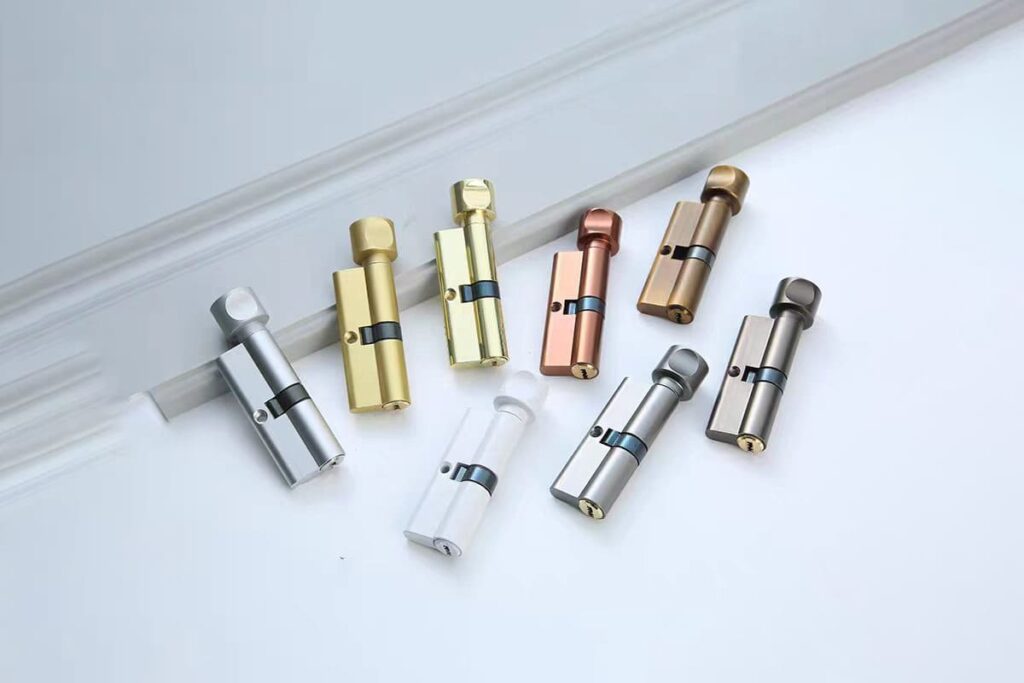
What components make up a door lock cylinder?
A cylinder can look simple outside, but one weak inner part can create turning trouble, key jams, and costly buyer complaints.
A door lock cylinder is made of a housing, plug, pins, springs, keyway, shear line, and cam or tailpiece.1 These parts work together so the correct key aligns the pins at the shear line, lets the plug rotate, and transfers movement to the lock body.

I often tell buyers that a cylinder is not only a brass or metal tube with a key hole. I see it as a small decision system. Each inner part decides if the key can turn smoothly, if the lock body can move, and if the product can stay stable in bulk use.
What does the housing do in a lock cylinder?
A poor housing can make a good-looking cylinder fail, because it holds the whole mechanism and controls the basic fit.
The housing is the outer body of the lock cylinder. It supports the plug, keeps the pin chambers in position, protects the inner parts, and gives the cylinder its outside shape for installation into the lock or door hardware system.2
I treat the housing as the frame of the cylinder. If this frame is not accurate, the rest of the mechanism cannot work well for long. The housing carries the plug inside it. It also contains the upper pin chambers, spring positions, screw holes, fixing points, and outside profile. In a euro profile cylinder, the housing shape must match the mortise lock and door preparation.3 In a rim or knob cylinder, the outside structure is different, but the logic is still similar.
I have seen buyers compare only the outside finish. I understand why they do that, because finish is easy to inspect. But I always look at the housing size, hole position, surface treatment, and machining consistency. These details affect installation and long-term turning feel.4
| Housing point I check | Why it matters in use | Buyer risk if ignored |
|---|---|---|
| Profile shape | It must match the lock body | The cylinder may not install |
| Pin chamber accuracy | It keeps pins moving straight | The key may feel rough |
| Wall strength | It supports the plug and cam area | The cylinder may deform |
| Finish consistency | It affects appearance and fitting | Bulk batches may look uneven |
I do not see the housing as a passive shell. I see it as the base that decides whether other parts can stay aligned. If a buyer is sourcing in bulk, I suggest asking for dimensional drawings, sample testing, and batch surface finish confirmation. Material is important, but housing precision is just as important.
Why is the plug the moving center of the cylinder?
A cylinder may look blocked when the key is wrong, but the real reason is that the plug cannot rotate freely.
The plug is the inner rotating core where the key is inserted.5 When the correct key lifts the pins to the right height, the plug can rotate inside the housing and start the lock opening or locking movement.
I see the plug as the moving heart of the cylinder. The key enters the plug through the keyway. The key blade pushes the lower pins upward. If the key cuts match the pin lengths, the split between the lower pins and upper pins lines up with the shear line.6 Then the plug can turn.
The plug must be machined with good accuracy. If the keyway is rough, the key may scrape.7 If the plug diameter is not stable, the turning feel may be loose or too tight. If the pin holes are not straight, pins may stick. These are small details, but they become large problems after a buyer sells thousands of pieces.
| Plug feature | My practical view | Effect on buyer experience |
|---|---|---|
| Keyway shape | It guides the key and limits key compatibility | It affects key insertion and market matching |
| Plug diameter | It controls fit inside housing | It affects smooth rotation |
| Pin hole accuracy | It supports correct pin movement | It affects key response |
| Surface finish | It reduces friction | It affects long-term feel |
I once checked a sample that looked clean from the outside. The key finish was good, and the plating looked acceptable. But the plug turned with uneven resistance. After opening the sample, I found that the inner fit was not stable enough. That moment is why I always explain plug quality to buyers. A cylinder is not judged only by appearance. It is judged by how the plug moves after the correct key enters.
How do pins, springs, and the shear line control rotation?
A key can enter a cylinder and still fail, because the pins may not align at the correct operating boundary.
Pins and springs control whether the plug can rotate.8 The correct key lifts each pin pair so their dividing points align with the shear line, which is the functional boundary between the plug and housing.
I explain this part slowly because it is the real working principle of a pin tumbler cylinder. The pin system usually includes lower pins, upper pins, and springs. The lower pins touch the key. The upper pins sit above them. The springs push the pin stack downward. When no key is inserted, some pins cross the boundary between the plug and housing. This blocks rotation.
The shear line is not a separate physical component.9 I describe it as the round boundary where the plug meets the housing. When the wrong key is inserted, at least one pin split stays above or below this boundary. The plug is still blocked. When the correct key is inserted, all pin splits align at this boundary. The plug can rotate.
| Part or concept | What I mean | What it does |
|---|---|---|
| Lower pin | The pin touched by the key | It rises according to key cut depth |
| Upper pin | The pin above the lower pin | It blocks rotation when misaligned |
| Spring | The small force part above pins | It pushes pins back down |
| Shear line | The boundary between plug and housing | It allows rotation only when pins align |
I also explain pin quantity with care. More pins usually create more key combinations.10 More pins can also make simple guessing or easy duplication harder in many common designs. But I do not say more pins always means a better cylinder. Security and stability also depend on keyway design, pin precision, spring quality, tolerance control, and full cylinder construction. If one pin chamber is poorly made, more pins may only create more friction. For B2B buyers, I suggest checking both configuration and actual sample operation.
How does the cam or tailpiece drive the lock body?
A cylinder may turn with the key, but the door will not lock well if the rear driving part does not match the lock.
The cam or tailpiece transfers plug rotation to the latch, deadbolt, or lock body.11 It is the connection between key movement and the mechanical locking action inside the door hardware system.
I see the cam or tailpiece as the part that connects the cylinder to the rest of the lock. In many euro profile cylinders, a cam sits in the middle. When the key turns the plug, the cam turns and moves the mortise lock mechanism. In some other cylinder types, a tailpiece extends from the back and connects to a latch or lock case.
This part must match the target lock system. A buyer may order a cylinder with correct length and finish, but the cam shape, cam angle, or tailpiece design may still be wrong. Then the lock body may not move correctly. I pay close attention to this in export supply, because different markets use different lock cases and installation habits.
| Drive part | Common position | Main role | Buyer check point |
|---|---|---|---|
| Cam | Often in euro profile cylinders | It drives the mortise lock body | Check cam shape and angle |
| Tailpiece | Often at the rear of some cylinders | It connects to latch or lock case | Check length and cut shape |
| Fixing screw area | Often through the cylinder body | It holds cylinder in the lock | Check screw hole position |
| Clutch or special drive option | Used in some designs | It changes operation behavior | Confirm the exact lock function |
I have handled inquiries where buyers sent only an outside photo. I always ask for more information. I may need the lock body model, cylinder length, cam type, key operation requirement, and door thickness. If the drive part is wrong, the cylinder may still look correct on the table. It may fail only during assembly. That failure costs more than a drawing check at the start.
How should buyers judge materials, pin quantity, and batch quality?
A buyer can lose margin when two similar cylinders look equal outside but perform very differently inside.
I judge a lock cylinder by material, machining precision, internal fit, spring and pin quality, finish consistency, and batch stability. Material matters, but it does not decide quality alone.
I often receive questions like, “Is brass better?” or “How many pins should I choose?” I understand these questions, because buyers need simple comparison points. But I also know that cylinder quality cannot be reduced to one material or one pin count. Common material options include stainless steel, brass, and aluminum in different cylinder or component designs. In many market discussions, buyers say “copper cylinder,” but I prefer to confirm whether they mean brass. The wording should be clear before quotation and production.
Material affects strength, machining, finish, cost, and market position.12 But machining precision affects the real turning feel. Internal fit affects service life. Pin and spring consistency affects key response. Finish control affects bulk appearance. Batch management affects whether the first sample and later shipment feel the same.
| Buyer question | My practical answer | What I suggest checking |
|---|---|---|
| Which material is best? | The best option depends on market and lock system | Confirm material grade, cost target, and use case |
| Are more pins always safer? | More pins can increase combinations, but not alone | Check keyway, pin accuracy, and spring quality |
| Is smooth turning enough? | Smooth turning is needed, but not enough | Test repeated use and sample consistency |
| Is the outside finish enough to approve? | It is only one inspection point | Check inside fit and dimensions too |
I also suggest that buyers compare suppliers through sample teardown when possible. I know every buyer cannot open each sample, but even a few checks can reveal much. I look at key insertion, plug rotation, pin response, finish uniformity, cam movement, and packaging protection. For door factories, I also suggest assembly testing with the real lock body. For lock brands, I suggest confirming key profile control and logo or key head needs. For wholesalers, I suggest stable SKU planning, because too many random configurations can make inventory hard to manage.
How do all cylinder parts work together during one key turn?
A buyer may know each part name and still miss the full action, because the cylinder works as one system.
During one correct key turn, the key enters the plug, lifts the pins, aligns the pin splits at the shear line, allows plug rotation, and turns the cam or tailpiece to operate the lock body.
I like to explain the full movement step by step. First, I insert the key into the keyway. The key blade moves under the lower pins. Each key cut has a different depth. Each depth lifts one lower pin to a set height. Second, the upper and lower pin divisions reach the shear line if the key is correct. Third, the plug is no longer blocked by pins crossing into the housing. Fourth, I turn the key, and the plug rotates inside the housing. Fifth, the cam or tailpiece turns with the plug. Sixth, the lock body moves the latch or bolt.
| Step | What happens | What can go wrong |
|---|---|---|
| Key insertion | The key enters the plug keyway | The keyway may be rough or mismatched |
| Pin lifting | The key raises lower pins | Pin sizes may be inaccurate |
| Shear line alignment | Pin divisions line up at the boundary | One pin may block rotation |
| Plug rotation | The plug turns inside housing | Fit may be too tight or loose |
| Drive transfer | Cam or tailpiece moves lock body | Drive part may not match the lock |
This is why I tell buyers not to separate “parts” from “function.” A cylinder is a chain of small actions. If one action is unstable, the full lock operation becomes unstable. A good supplier should understand both the component list and the working logic. A good buyer should ask questions that connect both sides. I believe this makes sourcing more practical and reduces after-sales pressure.
Conclusion
I judge a lock cylinder by how its housing, plug, pins, springs, shear line, and drive part work together in stable real use.
"Pin tumbler lock - Wikipedia", https://en.wikipedia.org/wiki/Pin_tumbler_lock. A technical reference on pin-tumbler locks describes the cylinder as including a shell or housing, rotating plug, keyway, pin stacks, springs, shear line, and a rear actuator such as a cam or tailpiece. Evidence role: definition; source type: encyclopedia. Supports: The source should define the main components of a pin-tumbler lock cylinder and identify parts such as the plug, shell or housing, pins, springs, keyway, shear line, and actuator.. Scope note: The source would support the general anatomy of common pin-tumbler cylinders, not every proprietary cylinder design. ↩
"Lock bumping - Wikipedia", https://en.wikipedia.org/wiki/Lock_bumping. A technical description of pin-tumbler construction identifies the shell or housing as the fixed outer body that contains the plug and pin chambers and provides the form by which the cylinder is installed in lock hardware. Evidence role: mechanism; source type: encyclopedia. Supports: The source should explain the function of the outer shell or housing in retaining the plug and pin chambers in a lock cylinder.. Scope note: The source may use the term shell rather than housing and may describe the function generally rather than addressing all installation formats. ↩
"EN1303 Euro Lock Cylinder Manufacturer - DIROCK Door Hardware", https://www.dirock.com/Lock-Cylinder.html. Standards and technical guidance for profile cylinders specify dimensional and installation interfaces intended to ensure compatibility between the cylinder, mortise lock case, and prepared door opening. Evidence role: general_support; source type: institution. Supports: The source should support that profile-cylinder dimensions and shapes are standardized or specified to fit compatible mortise locks and prepared doors.. Scope note: This would support the compatibility principle; exact dimensions vary by standard, region, and lock case design. ↩
"(PDF) Effect of Roughness and Interference on Torque Capacity of a ...", https://www.academia.edu/27249385/Effect_of_Roughness_and_Interference_on_Torque_Capacity_of_a_Shrink_Fitted_Assembly. Engineering literature on fits, tolerances, and surface roughness shows that dimensional variation and surface condition affect assembly fit, friction, wear, and the smoothness of rotating mechanical parts. Evidence role: mechanism; source type: paper. Supports: The source should support that dimensional tolerance, clearance, and surface finish influence friction, fit, wear, and rotational performance in mechanical assemblies.. Scope note: This evidence is contextual engineering support and may not directly test door lock cylinders. ↩
"Pin tumbler lock - Wikipedia", https://en.wikipedia.org/wiki/Pin_tumbler_lock. A technical reference on pin-tumbler locks defines the plug as the rotating inner element of the cylinder that contains the keyway into which the key is inserted. Evidence role: definition; source type: encyclopedia. Supports: The source should define the plug as the rotating part of a pin-tumbler cylinder that contains the keyway.. ↩
"13 Things - Brown University", https://webhelper.brown.edu/joukowsky/courses/13things/7641.html. Descriptions of pin-tumbler operation state that the correct key lifts each key pin so that the breaks between key pins and driver pins align with the shear line, permitting rotation of the plug. Evidence role: mechanism; source type: encyclopedia. Supports: The source should explain that the correct key positions the pin breaks at the shear line, allowing the plug to rotate.. ↩
"Friction Behavior of Rough Surfaces on the Basis of Contact ... - PMC", https://pmc.ncbi.nlm.nih.gov/articles/PMC9699358/. Tribology studies of sliding metal contacts show that surface roughness can increase friction and abrasive interaction, which provides a mechanical basis for rough keyways producing scraping during key insertion. Evidence role: mechanism; source type: paper. Supports: The source should support that rougher metal surfaces in sliding contact generally increase friction, abrasion, or tactile resistance.. Scope note: This is contextual support from general sliding-contact mechanics and may not directly measure keyway scraping in lock cylinders. ↩
"Wafer tumbler lock - Wikipedia", https://en.wikipedia.org/wiki/Wafer_tumbler_lock. Technical accounts of pin-tumbler locks explain that spring-loaded pin stacks normally obstruct the plug at the shear line and that rotation becomes possible only when the pins are positioned correctly. Evidence role: mechanism; source type: encyclopedia. Supports: The source should explain that spring-loaded pins cross the shear line to prevent plug rotation unless lifted correctly by the key.. ↩
"Pin tumbler lock - Wikipedia", https://en.wikipedia.org/wiki/Pin_tumbler_lock. Pin-tumbler lock references define the shear line as the circular interface between the plug and shell, rather than as a discrete component, and note that pin breaks must align there for rotation. Evidence role: definition; source type: encyclopedia. Supports: The source should define the shear line as the interface between the plug and shell where pin breaks must align.. ↩
"How many keys are possible for a given lock type? - Reddit", https://www.reddit.com/r/Locksmith/comments/3btwwb/how_many_keys_are_possible_for_a_given_lock_type/. Educational material on pin-tumbler keying explains that the number of possible key changes is a function of the number of pin chambers and available cut depths, so adding chambers can increase theoretical key combinations when other constraints remain constant. Evidence role: general_support; source type: education. Supports: The source should support that, all else equal, more pin chambers increase the theoretical number of possible bitting combinations in a pin-tumbler system.. Scope note: This supports the combinatorial principle but not the broader security of any specific cylinder, which also depends on tolerances, keyway control, and attack resistance. ↩
"Cams & Tailpieces - YouTube",
. Lock hardware references describe cams and tailpieces as actuator components that transmit rotation from the cylinder plug to the latch, deadbolt, or mortise lock mechanism. Evidence role: mechanism; source type: institution. Supports: The source should explain that cams or tailpieces are actuator elements connecting the rotating cylinder to the latch, deadbolt, or lock case.. Scope note: The exact actuator form differs among euro profile, rim, mortise, knob, and deadbolt cylinder designs. ↩"Material Selection for Manufacturability: Engineering Guidelines", https://www.modusadvanced.com/resources/blog/material-selection-for-manufacturability-engineering-guidelines. Engineering material-selection guidance treats strength, machinability, surface finish, corrosion performance, and cost as standard criteria when selecting metals for manufactured components. Evidence role: general_support; source type: education. Supports: The source should support that material selection involves tradeoffs among mechanical properties, manufacturability, surface finish, corrosion behavior, and cost.. Scope note: This supports the engineering tradeoff; it does not directly prove how material choice determines the market positioning of any particular lock cylinder. ↩