Basic Door Hardware Terminology Guide: What Should Buyers Confirm?
A door hardware terminology guide can save a buyer from costly sample mistakes, delayed projects, and unusable batch orders. The problem is that many terms sound simple until a supplier asks for exact dimensions. If the wrong word creates the wrong specification, the solution is to connect every term with a real order-confirmation checkpoint.
A basic door hardware terminology guide should help buyers understand how each term affects specification confirmation, component compatibility, and batch-order consistency. Key terms such as backset, C-C distance, forend, latch, spindle, escutcheon, strike plate, and hinge pin are not just vocabulary. They define whether locks, handles, cylinders, hinges, and frames will work together.
I have seen small wording errors become very real production problems. A buyer may approve a sample with one forend width, then place a bulk order using a different lock case. So, this guide focuses on the terms that affect purchasing, QC inspection, and supplier communication.
What Should a Door Hardware Terminology Guide Clarify Before Sourcing?
Many buyers know the product names but still struggle during specification confirmation. The risk grows when different markets use different standards, drawings, and size habits. A good door hardware terminology guide should reduce confusion before the first sample is made.
A door hardware terminology guide should clarify the purchasing function of each term. Buyers should know what the term means, which component it belongs to, which dimensions must be confirmed, and how it affects compatibility between the door leaf, lock body, handle, cylinder, hinge, and frame.
Terms Should Connect to Buying Decisions
I do not treat door hardware terminology like a dictionary in factory communication. I treat it like a checklist. Each word should answer a purchasing question:
- What part does this term describe?
- Which dimension or finish must I confirm?
- Which other component must match it?
- Which standard or market habit may affect it?
- What can go wrong in batch production if I ignore it?
For example, “forend” is easy to translate. It is the visible front plate of a mortise lock. But that definition alone does not help a buyer. The buyer must confirm the forend width, forend thickness, edge shape, finish, and screw hole position. Common forend thickness options may include 2.5 mm or 3 mm, while common widths may include 20 mm, 22 mm, or 24 mm. These are not universal sizes. They are examples that must be confirmed against the door design and market requirement.
A Simple Buyer-Focused Framework
| Term Type | Example Terms | What Buyers Should Confirm |
|---|---|---|
| Lock body terms | Backset, C-C distance, forend, latch, deadbolt | Size, function, standard, door preparation |
| Handle terms | Lever handle, spindle, rose, escutcheon | Hole matching, spindle size, shape, finish |
| Frame terms | Strike plate, dust box, keep | Bolt alignment, plate size, finish |
| Hinge terms | Butt hinge, concealed hinge, hinge pin | Load capacity, size, opening direction, finish |
| Order terms | Sample, batch order, finish code, packing | Consistency, inspection method, delivery standard |
Why This Matters in Real Orders
In our QC process, I often check whether the drawing, approved sample, and purchase order describe the same product. A small mismatch can create a large problem. For example:
- A buyer confirms a 45 mm backset sample but writes 50 mm backset on the bulk order.
- A project requires 72 mm C-C distance, but the handle plate is designed for another center distance.
- A lock uses a 24 mm forend, but the door edge preparation is made for 22 mm.
- A round escutcheon is approved, but the order sheet says square escutcheon.
- A strike plate is packed with the lock, but its holes do not align with the latch and deadbolt.
These issues do not only affect installation. They affect production scheduling, material planning, packaging, inspection, and after-sales costs. That is why I recommend using a door hardware terminology guide as a communication tool between buyer, supplier, engineer, and QC team.
How Do Mortise Lock Terms Affect Order Confirmation?
Mortise lock terms create many purchasing risks because the lock body sits inside the door. Once the door is cut, the buyer has little flexibility. If the backset, C-C distance, forend, latch, or cylinder hole is wrong, the sample or batch order may become unusable.
Mortise lock terminology affects order confirmation because each term controls door preparation and accessory compatibility. Buyers should confirm backset, C-C distance, forend size, latch direction, deadbolt type, cylinder hole, and strike plate alignment before approving samples or bulk production.
Backset
Backset means the distance from the center of the square spindle hole to the outer face of the forend.1 In purchasing communication, backset is not a rough description. It is a key dimension that decides where the handle operates the latch inside the door.
Common backset examples include:
- 20 mm
- 25 mm
- 30 mm
- 35 mm
- 45 mm
- 50 mm
- 55 mm
- 60 mm
Narrow lock cases may use smaller backsets such as 20/25/30/35 mm, while other mortise lock designs may use 45/50/55/60 mm. These options depend on the lock type, door profile, market standard, and customer drawing.
C-C Distance
C-C distance means the distance from the center of the spindle hole to the center of the cylinder hole.2 This term is critical when the handle set, lock body, and cylinder must match.
For example, DIN 18251 commonly specifies 72 mm for many project applications.3 However, 85 mm and 90 mm also exist in some markets and product ranges. I always treat DIN or other standards as project-dependent and market-dependent references. The buyer should verify the standard before confirming the order.
| Mortise Lock Term | Practical Meaning | Buyer Confirmation Point |
|---|---|---|
| Backset | Spindle hole center to forend face | Match door preparation and handle position |
| C-C distance | Spindle center to cylinder center | Match lock, handle plate, and cylinder position |
| Forend | Visible front plate on door edge | Confirm width, thickness, length, finish |
| Latch | Spring bolt driven by handle | Confirm direction, material, projection |
| Deadbolt | Locking bolt driven by key or thumbturn | Confirm throw, material, security function |
| Cylinder hole | Opening for profile cylinder | Confirm cylinder type and center position |
Latch, Deadbolt, and Locking Function
The latch is the upper spring bolt usually driven by the lever handle. It keeps the door closed, but it does not provide secure locking by itself.4 The deadbolt provides the main locking function when operated by a key or cylinder thumbturn.5
This distinction matters. I have seen buyers describe a lock as “with bolt” without specifying whether they mean latchbolt, deadbolt, or both. That unclear wording can lead to the wrong lock function.
Forend Details
The forend is the visible metal plate on the front edge of the mortise lock. Many buyers only confirm the finish, such as satin stainless steel or polished brass. However, the mechanical details matter just as much.
Buyers should confirm:
- Forend width, such as 20/22/24 mm as common examples
- Forend thickness, such as 2.5/3 mm as common examples
- Forend length
- Square or round end shape
- Screw hole distance
- Surface finish
- Fire-rated or CE-related requirement, if applicable
A good door hardware terminology guide should make these terms practical. The goal is not to memorize words. The goal is to avoid re-cutting doors, remaking samples, or rejecting finished goods during QC inspection.
Which Lever Handle and Accessory Terms Prevent Mismatched Hardware?
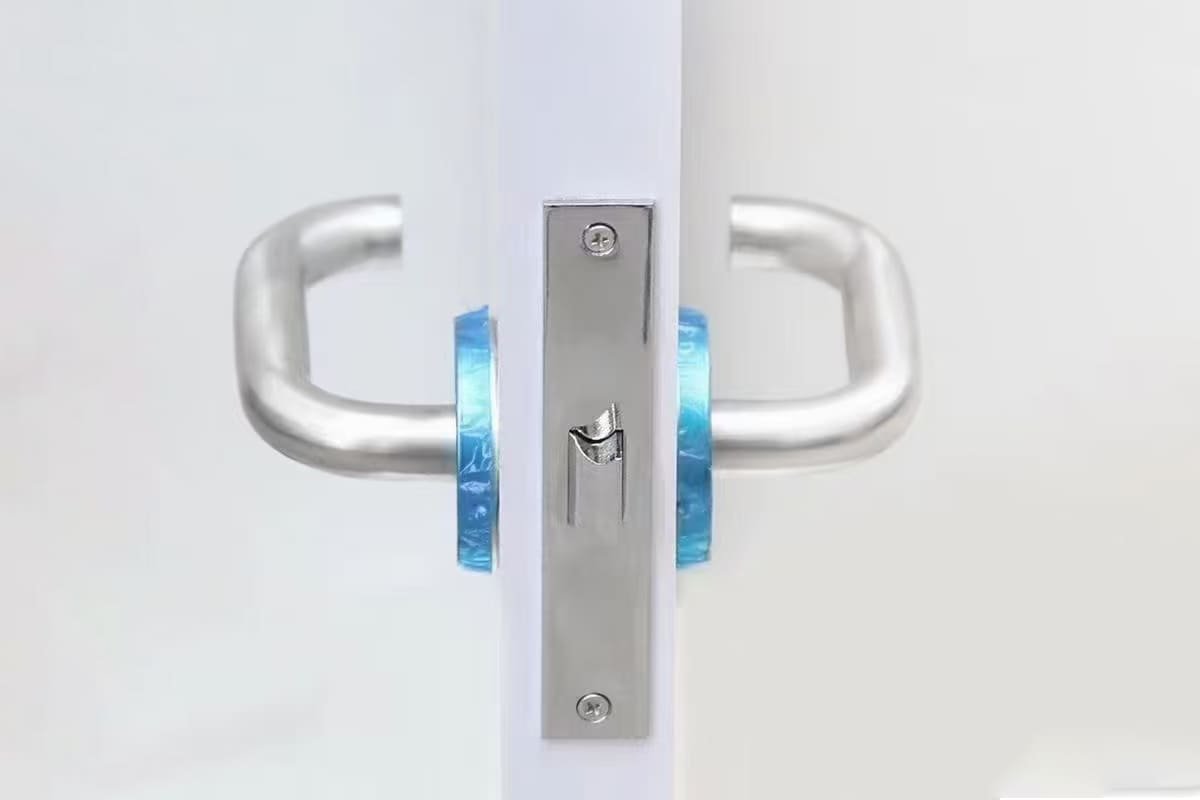
Lever handles look simple in a catalog, but they create many compatibility issues in real orders. A handle must match the lock body, spindle, escutcheon, door thickness, screw position, and finish requirement. If one accessory is wrong, the complete set may fail.
Lever handle and accessory terms prevent mismatched hardware by showing how visible parts connect with hidden mechanical parts. Buyers should confirm spindle size, screw fixing, escutcheon shape, rose design, door thickness range, and finish consistency before approving the sample.
Spindle
The spindle is the square bar that connects the handles on both sides of the door.6 When a user presses the lever handle, the spindle rotates and drives the latchbolt inside the mortise lock.7
This is a small component, but it is very important. If the spindle size or length is wrong, the handle may feel loose, fail to operate the latch, or not fit the door thickness.
Common confirmation points include:
- Spindle square size
- Spindle length
- Door thickness compatibility
- Material strength
- Fixing method
- Compatibility with the lock follower
Lever Handle
The lever handle is the part users press by hand. Buyers often focus on design and finish first. That is natural because the handle is visible. However, a product manager should also confirm structure and assembly.
Important handle details include:
| Handle Detail | Why It Matters |
|---|---|
| Material | Stainless steel, zinc alloy, aluminum, or brass affects cost and durability |
| Finish | Finish must remain consistent across batch orders |
| Rose or plate type | It must match screw holes and lock position |
| Spring structure | It affects handle return performance |
| Spindle fixing | It affects long-term stability |
| Door thickness range | It decides whether standard screws and spindle will fit |
Escutcheon
An escutcheon is a cover plate used around the keyhole, cylinder hole, or handle fixing area.8 It can cover screw holes and improve appearance. Escutcheons are usually square or round, and many common designs are around 8 mm high, depending on product style.
This term often causes confusion because buyers may use “cover,” “rose,” “plate,” and “escutcheon” differently. I recommend attaching a drawing or photo when confirming it.
Buyers should confirm:
- Shape: round, square, oval, or custom
- Height: common examples may be around 8 mm
- Outer size
- Hole type: cylinder hole, keyhole, privacy turn, or blind cover
- Finish
- Packing method
Finish Consistency
For hardware brand buyers and wholesalers, finish consistency can be more important than one sample’s appearance. A sample may look acceptable, but a bulk order needs stable color, texture, and surface quality.
I usually suggest that buyers confirm finish with:
- A finish code
- A physical color sample
- A surface treatment description
- A quality acceptance range
- A packing protection method
Common finishes may include satin stainless steel, polished stainless steel, satin nickel, polished chrome, black, antique brass, and other project finishes. The names can vary by supplier, so a written finish name alone is not enough.
A door hardware terminology guide should remind buyers that accessories are not minor details. The wrong escutcheon shape or spindle length can delay a complete shipment, even when the main lock and handle are correct.
How Should a Door Hardware Terminology Guide Explain Hinges and Strike Plates?
Hinges and strike plates are often treated as secondary products, but they decide whether the door opens, closes, and locks correctly. If the hinge structure or strike plate alignment is wrong, the user will feel the problem immediately.
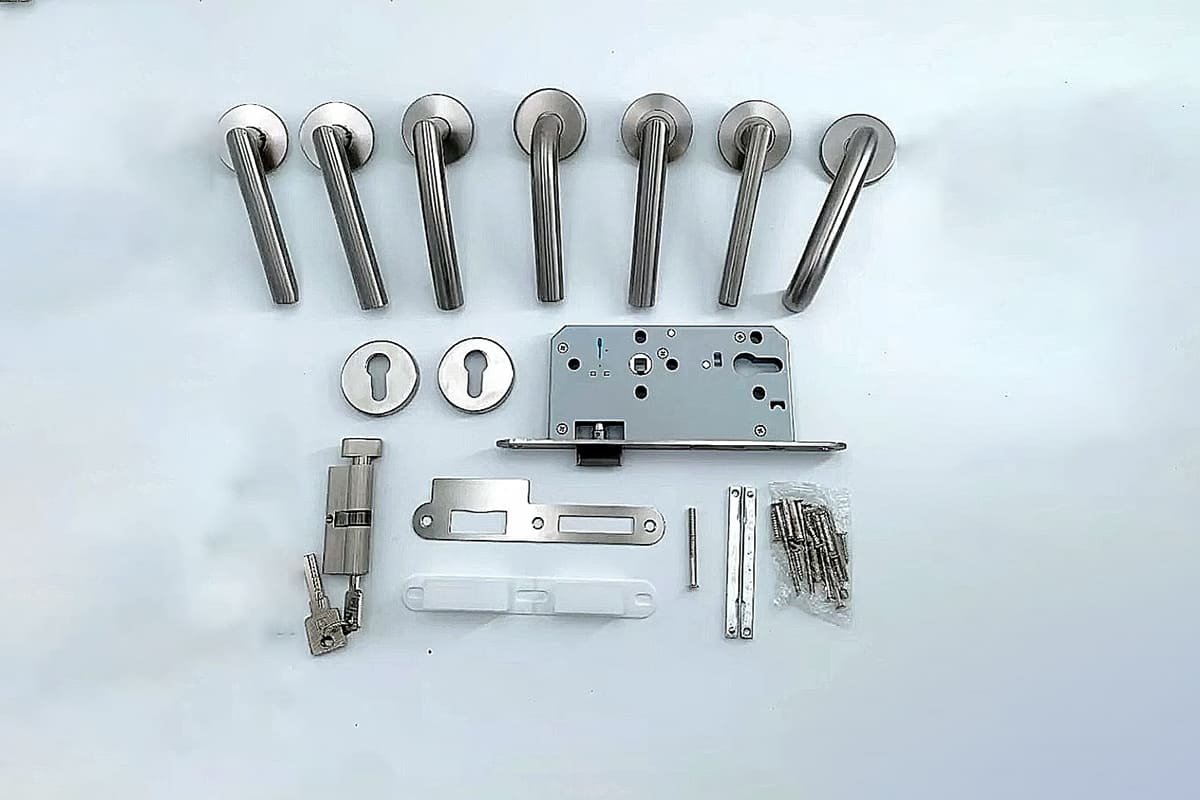
A door hardware terminology guide should explain hinges and strike plates as alignment components. Butt hinges support door movement, hinge pins form or support the hinge axis, and strike plates on the frame must align with the latch and deadbolt of the lock body.
Butt Hinge
A butt hinge is a common hinge type installed between the door leaf and door frame.9 It usually includes two leaves and a central knuckle structure. The hinge allows the door to rotate while supporting door weight.
When I discuss butt hinges with buyers, I do not stop at length and width. I also ask about:
- Material
- Thickness
- Bearing type
- Number of knuckles
- Screw hole pattern
- Pin structure
- Door weight
- Opening frequency
- Fire-rated requirement
- Finish
Hinge Pin
The hinge pin is the component used to close or support the hinge axis structure. In many butt hinge designs, the pin passes through the hinge knuckles and allows rotation around the axis.10
A hinge pin may seem like a small part, but it affects durability, noise, and service life. In some projects, buyers may need fixed pins, removable pins, security pins, or special structures. These options should be confirmed before sampling.
Strike Plate
The strike plate is installed on the door frame. It receives the latch and deadbolt when the door closes.11 If the strike plate does not align with the lock bolts, the door may not close smoothly or lock securely.
Buyers should confirm:
| Strike Plate Item | Confirmation Point |
|---|---|
| Plate length and width | Must match frame preparation |
| Thickness | Must suit frame and durability need |
| Latch opening | Must align with latchbolt |
| Deadbolt opening | Must align with deadbolt |
| Screw hole position | Must match installation requirement |
| Finish | Should match lock forend and other visible parts |
| Dust box | Confirm if required for frame protection |
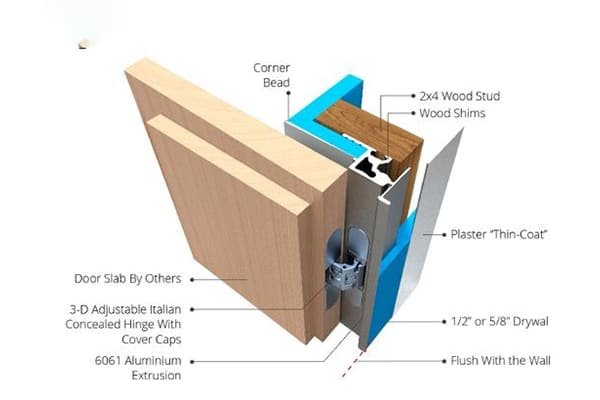
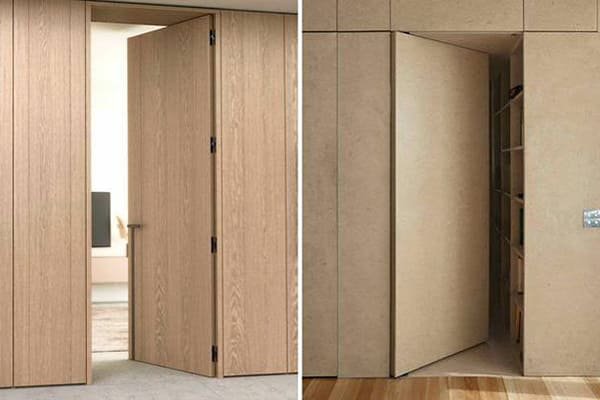
Concealed Hinges
[A concealed hinge is hidden when the door is closed.] It is often used for modern doors, flush doors, and higher-end projects. The terminology here may include opening angle, load capacity, 3D adjustment, body depth, and cover plate.
For concealed hinges, I usually ask buyers to confirm:
- Door thickness
- Door weight
- Opening angle
- Hinge body size
- Adjustment direction
- Installation depth
- Fire-rated requirement, if any
- Finish of visible cover parts
Why Alignment Terms Matter
Hinge and strike plate terms are about alignment. A door system works only when all parts share the same centerlines and positions. The lock body must match the door cutout. The strike plate must match the latch and deadbolt. The hinges must support the door without sagging. The handle must drive the latch smoothly through the spindle.
This is why I see hardware as a system, not as separate parts. A proper door hardware terminology guide should teach buyers to check relationships between parts. It should not only translate “hinge pin” or “strike plate.” It should explain why those terms affect real installation and long-term performance.
How Can Buyers Use a Door Hardware Terminology Guide for Samples and Batch Orders?
Sample approval can create a false sense of safety. A sample may work well, but a bulk order can still fail if the purchase order, drawing, finish sample, and inspection criteria do not use the same terms. Clear terminology protects order consistency.
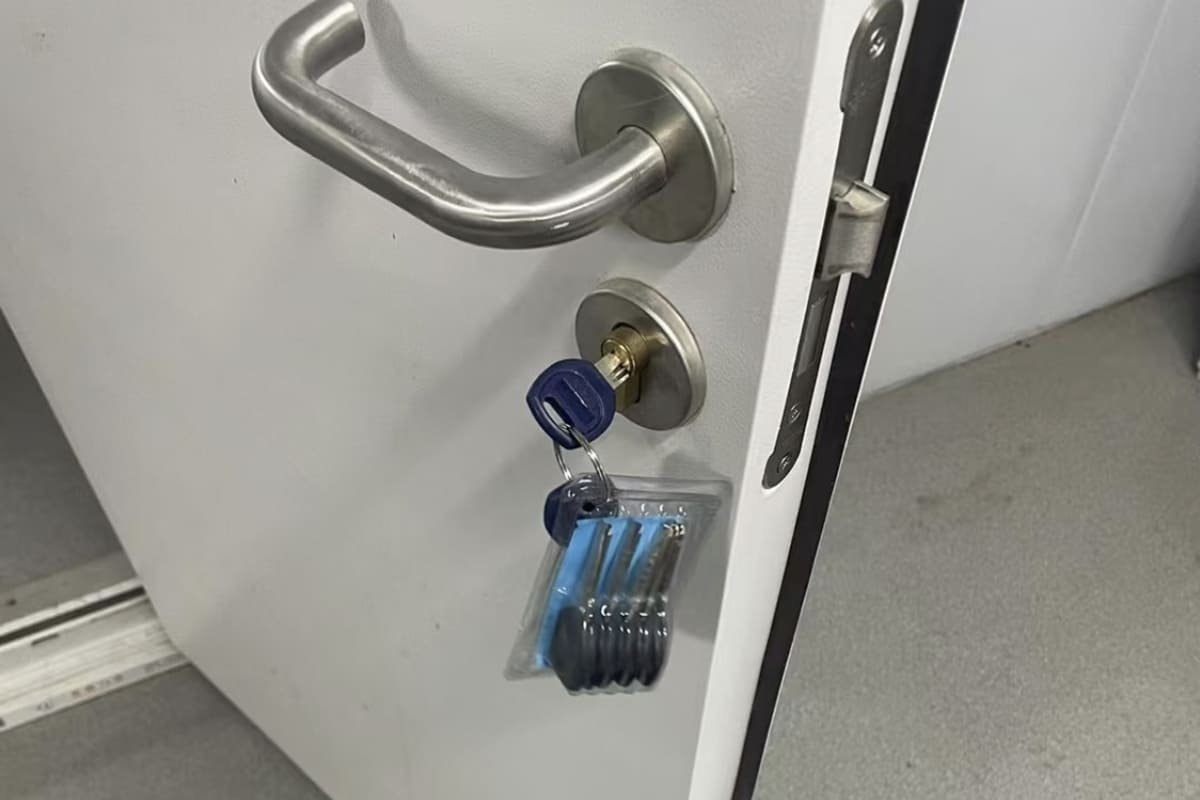
Buyers can use a door hardware terminology guide as a pre-production checklist. They should confirm dimensions, component relationships, finishes, standards, packaging, and inspection points in writing before sample approval and again before batch production starts.
Step 1: Confirm the Product Function
Before dimensions, the buyer should confirm the product function. A mortise lock for a bathroom door is different from a lock for an entrance door, a fire door, or a hotel room door.
Useful questions include:
- Does the door need a latch only or latch and deadbolt?
- Does the lock use a profile cylinder?
- Does the project require CE certification?
- Does the door require a fire-rated hardware set?
- Does the handle need a spring return structure?
- Does the hinge need a specific load capacity?
Step 2: Confirm Critical Dimensions
I recommend buyers create a critical-dimension table for each item. The table does not need to be complicated. It should simply list the dimensions that can make the product incompatible.
| Product | Critical Terms to Confirm |
|---|---|
| Mortise lock | Backset, C-C distance, forend width, forend thickness, latch direction |
| Lever handle | Spindle size, screw distance, rose or plate size, door thickness |
| Cylinder | Length, cam type, key type, finish, certification |
| Butt hinge | Size, thickness, pin type, bearing type, screw hole pattern |
| Strike plate | Opening position, plate size, screw holes, finish |
| Escutcheon | Shape, height, hole type, finish, packing |
Step 3: Match the Components
A complete door hardware set must work as a system. I like to check the relationship in this order:
- Door leaf and frame
- Mortise lock and door cutout
- Backset and handle position
- C-C distance and cylinder hole
- Spindle and lock follower
- Latch/deadbolt and strike plate
- Hinges and door weight
- Finish consistency across all visible parts
This process helps buyers avoid ordering correct individual parts that do not work together.
Step 4: Control Sample Approval
A sample should not be approved only by appearance. The buyer should record the approved sample details clearly.
The sample approval sheet should include:
- Product name
- Drawing number
- Material
- Finish
- Key dimensions
- Accessory list
- Packing method
- Certification requirement
- Testing requirement
- Approved sample photos
- Supplier and buyer signatures
In our factory, I have seen projects where the approved sample and the final purchase order used different accessory descriptions. One document said “round escutcheon,” while another said “square cover.” The product team assumed they meant the same thing. They did not. That kind of mistake can be avoided with one clear terminology sheet.
Step 5: Repeat Checks Before Mass Production
Before mass production, the buyer should ask the supplier to reconfirm:
- Final drawing
- Bill of materials
- Finish standard
- Packaging label
- Carton mark
- Inspection criteria
- Lead time
- Certification documents
- Spare parts and accessories
A door hardware terminology guide becomes most useful when it turns into a routine order process. It helps the buyer, supplier, factory engineer, QC inspector, and sales team use the same language.
Clear terminology does not slow purchasing down. It prevents expensive correction later.
Frequently Asked Questions
What is the most important term in mortise lock purchasing?
Backset and C-C distance are usually the most critical mortise lock terms. Backset affects handle position and lock case compatibility. C-C distance affects the match between the spindle hole, cylinder hole, handle plate, and lock body. Buyers should confirm both before sampling.
Is the latch the same as the deadbolt?
No, the latch is not the same as the deadbolt. The latch is the spring bolt driven by the handle, and it keeps the door closed. The deadbolt is the locking bolt operated by a key, cylinder, or thumbturn. Both functions should be confirmed separately.
Why does forend width matter in a mortise lock order?
Forend width matters because it must match the door edge preparation and visible appearance requirement. Common examples include 20 mm, 22 mm, and 24 mm, but no size is universal. Buyers should confirm width, thickness, length, end shape, and finish.
What should I confirm for lever handle accessories?
Buyers should confirm spindle size and length, escutcheon shape, rose or plate size, screw fixing, door thickness range, and finish. These details decide whether the handle operates the latch smoothly and whether the visible parts match the approved sample.
Does DIN 18251 mean every lock uses 72 mm C-C distance?
No, DIN 18251 commonly relates to 72 mm C-C distance in many applications, but project requirements and market standards can vary. Other distances such as 85 mm and 90 mm also exist. Buyers should verify the required standard before confirming the order.
Conclusion
A door hardware terminology guide should help buyers make better specification decisions, not just learn product names. Terms such as backset, C-C distance, forend, latch, spindle, escutcheon, strike plate, and hinge pin all affect compatibility and batch-order consistency. I always suggest confirming these points with drawings, samples, and written inspection criteria before mass production. If you need support with mortise locks, lever handles, cylinders, butt hinges, concealed hinges, or customized door hardware sets, SDH Hardware can help you review the specifications before your next order.
"Door Knobs & Backset Explained: Sizes & Measuring", https://www.suffolklatchcompany.com/blogs/news/door-knobs-and-backset-explained?srsltid=AfmBOopMH5WbTibQbLkdhywA-qOB7uXwGrgQSTaOqJfiAbRSwpICXxMs. A technical hardware glossary defines lock backset as the distance from the door edge or lock face to the centerline of the lock operating point, supporting the article’s use of backset as a critical dimensional term. Evidence role: definition; source type: institution. Supports: A neutral hardware glossary or standards body should define backset as a measured distance from the lock edge/forend to the spindle or keyhole centerline.. Scope note: Definitions may vary slightly by lock type, with some sources measuring to the keyhole or cylinder center rather than specifically to the spindle hole. ↩
"How to measure and choose the right mortise lock size", https://www.blue-id.com/en/blog/mortise-lock-mass. Technical references for mortise locks describe the center distance as the measured spacing between the handle follower or spindle center and the cylinder or keyhole center, supporting the article’s definition of C-C distance. Evidence role: definition; source type: institution. Supports: A standards or technical reference should identify the center distance between the follower/spindle and cylinder/keyhole as a lock specification dimension.. Scope note: Terminology may appear as center distance, centres, PZ distance, or C-C distance depending on market and standard. ↩
"How to measure and choose the right mortise lock size", https://www.blue-id.com/en/blog/mortise-lock-mass. DIN 18251 and related technical summaries describe dimensional requirements for mortise locks and provide context for the common 72 mm spindle-to-cylinder center distance used in many European project specifications. Evidence role: general_support; source type: institution. Supports: A standards source should support that DIN 18251 covers mortise locks and is associated with common center-distance dimensions such as 72 mm.. Scope note: This would provide contextual support for common practice, not proof that every DIN-related or European mortise lock uses a 72 mm center distance. ↩
"Deadbolt", https://en.wikipedia.org/wiki/Deadbolt. Door-hardware glossaries define a latchbolt as a spring-operated bolt that engages the strike to hold a door closed, supporting the article’s distinction between latching and secure deadlocking functions. Evidence role: definition; source type: institution. Supports: A hardware glossary should distinguish a spring latchbolt from a deadbolt and describe its role in retaining the door closed.. Scope note: The source would support the functional distinction, while the security performance of any specific latch depends on its design, installation, and rating. ↩
"Deadbolt", https://en.wikipedia.org/wiki/Deadbolt. Reference works describe a deadbolt as a locking bolt that is not spring-actuated and is typically operated by a key or thumbturn, supporting the article’s explanation of its primary locking role. Evidence role: definition; source type: encyclopedia. Supports: A neutral reference should define a deadbolt as a locking bolt distinct from a spring latch and commonly operated by a key or thumbturn.. Scope note: This supports the general definition, not the security rating or forced-entry resistance of any particular deadbolt. ↩
"Mortise lock", https://en.wikipedia.org/wiki/Mortise_lock. Educational door-hardware references define the spindle as the square bar that passes through the latch or lock mechanism and connects the handles, supporting the article’s component definition. Evidence role: definition; source type: education. Supports: A technical educational source should define a spindle as the square bar passing through the lock or latch to connect and operate handles.. Scope note: Some handle systems use split spindles or specialized spindle designs, so the statement is a general description of common lever-handle assemblies. ↩
"Door Handle Components - practical and expert guidance", https://www.doorhandlestore.com/blog/door-handle-components. Technical explanations of lever-handle locks describe the handle as rotating a spindle or follower that actuates the latchbolt, supporting the article’s account of the operating mechanism. Evidence role: mechanism; source type: education. Supports: A technical source should explain that lever movement turns the spindle or follower, retracting or operating the latchbolt.. Scope note: The exact internal linkage can differ among tubular latches, mortise locks, and specialty locksets. ↩
"Escutcheon (furniture)", https://en.wikipedia.org/wiki/Escutcheon_(furniture). Reference definitions describe an escutcheon as a protective or ornamental plate surrounding a keyhole, lock cylinder, or handle opening, supporting the article’s use of the term. Evidence role: definition; source type: encyclopedia. Supports: A neutral reference should define escutcheon as a protective or decorative plate around a keyhole, lock cylinder, or handle opening.. Scope note: The source would support the general meaning, while trade usage may distinguish escutcheons, roses, and backplates differently by market. ↩
"A guide to butt hinges", https://www.essentracomponents.com/en-us/news/solutions/access-hardware/a-guide-to-butt-hinges?srsltid=AfmBOoq8LmN7EasHrx2YNmp18q7tUlXvFzDxm0bKDxgmtHPHiEjpSn5O. Architectural-hardware glossaries define a butt hinge as a hinge with two leaves attached to the door and frame, supporting the article’s description of its placement and common door use. Evidence role: definition; source type: institution. Supports: A hardware glossary or standards body should define a butt hinge as a hinge with leaves mortised or fixed to the door and frame.. Scope note: The source would support the general category, not the suitability of a particular hinge size or grade for a specific door. ↩
"Types, Uses, Features and Benefits of Butt Hinges", https://www.iqsdirectory.com/articles/hinges/butt-hinges.html. Technical descriptions of hinge anatomy explain that the leaves form interlocking knuckles around a pin, creating the axis about which the hinge rotates, supporting the article’s mechanism statement. Evidence role: mechanism; source type: education. Supports: A technical source should explain that hinge knuckles interlock around a pin, forming the rotational axis of the hinge.. Scope note: This applies to conventional pinned butt hinges and may not describe concealed, continuous, or pivot-hinge designs. ↩
"Door Strike Plate: Types, Sizes, and How to Fix Common Problems", https://titanfloridadoors.com/blog/door-strike-plate-guide/. Door-hardware references define a strike plate as the frame-mounted plate or keeper into which the latchbolt or deadbolt engages, supporting the article’s explanation of its role. Evidence role: definition; source type: institution. Supports: A hardware glossary should define a strike plate as a frame-mounted plate or keeper that receives the latchbolt and/or deadbolt.. Scope note: The definition supports the general function, while exact strike geometry and reinforcement requirements depend on the lock type and door assembly. ↩