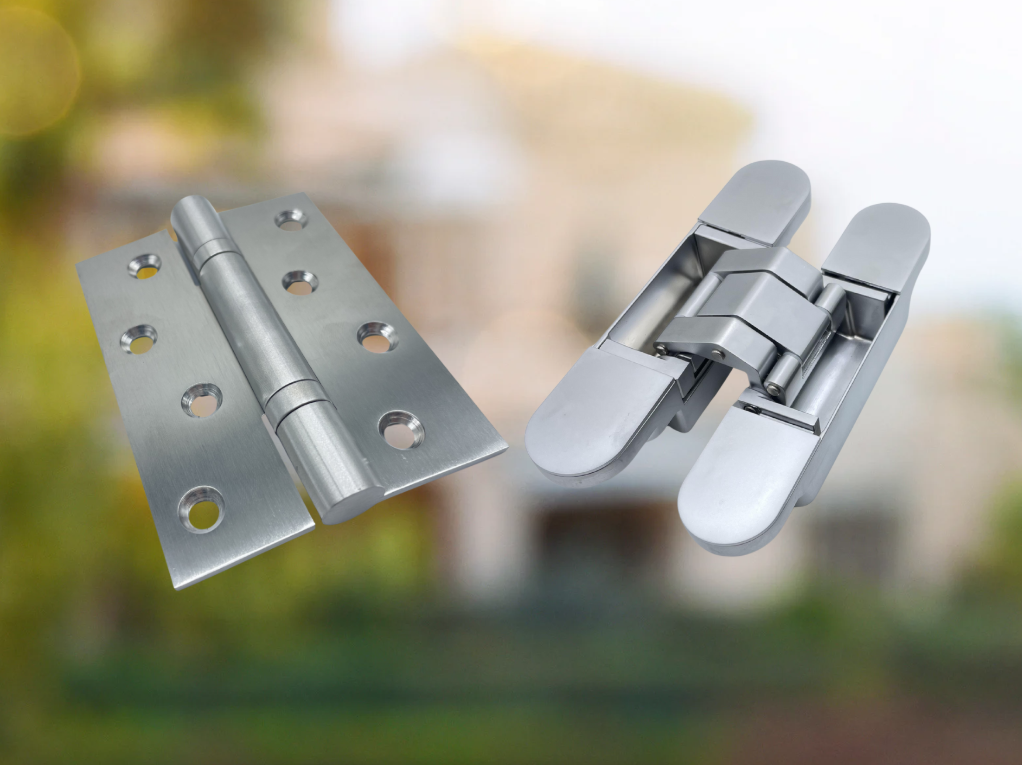
Concealed Hinges VS. Butt Hinges for Commercial Fire Door Applications?
Concealed hinges vs. butt hinges for commercial fire door applications is not a beauty contest; it is a compliance decision. Many projects start with a style preference, then stall when certification does not align with the door system. I see buyers waste time and budget here. The fix is simple: start with the tested configuration, not the hinge label.
Both hinge types can be used on commercial fire doors if, and only if, the specific product is tested and certified in the door configuration required.1 Stainless steel butt hinges commonly cover heavy-duty 60–120-minute doors. Concealed hinges appear more often on 30/60-minute interior timber doors.2 Always select by the documented fire standard, door type, and rating duration, then verify the certificate scope.

The quick answer tells only half the story. The details—test standards, door pairings, materials, installation conditions, and inspection expectations—decide real-world compliance and performance. Below I break down the choices the way I advise OEM door manufacturers, hardware brands, and wholesalers every week.
Which certifications decide concealed hinges vs. butt hinges for commercial fire door applications?
You want clear proof of fire performance. Yet certificates vary by standard, door material, and rating time. The wrong assumption can derail an approval late in a project. The solution is to map your door spec to a matching, third-party test for the exact hinge.
Match the hinge to the required fire standard (e.g., EN 1634-1, UL 10C), door type (timber or steel), and rating duration (30/60/90/120 minutes). Demand the full report or listing that shows the hinge installed in the tested configuration. Do not assume cross-compatibility beyond the documented scope.
Dive deeper
In practice, compliance hinges on the interplay of two document sets: the door fire test/listing and the hardware’s inclusion within that tested assembly.
- Common fire door test standards:
- Hinge performance standard (Europe): EN 1935 (single-axis hinges).6 Look for Grade 13+ for heavy commercial doors. CE marking is common, but CE alone does not prove fire resistance—it must be paired with the fire test evidence.7
Key procurement steps I recommend:
- Start with the door. Specify door type (timber or steel), leaf size/weight, and required rating (e.g., EI60/FD60). Identify the target market’s accepted standard.
- Request the hinge maker’s fire test report or listing that explicitly names:
- Door material and leaf dimensions
- Rating duration achieved
- Number of hinges and hardware set used
- Any intumescent components or special screws
- Check scope matching. A hinge tested on a 44 mm timber leaf for 30 minutes does not automatically cover 60 minutes or a thicker steel leaf.8 This is where many concealed hinge assumptions fail.
- Verify the organization. In Europe, credible notified bodies issue test reports; in North America, recognized labs issue UL listings. I always advise buyers to obtain a copy—not just a summary.
From our side as a manufacturer, we prepare a documentation pack: EN 1634-1 reports, EN 1935 classification, CE DoP (where applicable), and installation instructions matching the tested configuration. I still advise customers to have a qualified compliance consultant review documentation before final approvals.
Comparison snapshot (verify locally):
- Butt hinges: Frequently included in 60–120-minute certifications for timber and steel commercial doors, especially in stainless steel grades, with 3 hinges per leaf.
- Concealed hinges: More often included for 30/60-minute timber doors in interior applications, subject to precise mortising and sometimes intumescent liners. Less common for 90–120 minutes.
Do materials tilt the choice in concealed hinges vs. butt hinges for commercial fire door applications?
Material drives heat resistance and mechanical stability. The wrong substrate can soften or distort under fire. Buyers sometimes rely on aesthetics or catalog descriptions and miss the metal’s behavior at temperature. The fix is to align material and construction with proven ratings.
Stainless steel butt hinges typically maintain integrity for longer durations and heavier doors, often meeting 60–120-minute tests.9 Concealed hinges often use zinc alloy bodies, which can be suitable for 30/60-minute timber doors when tested; higher ratings or heavier doors demand extreme caution and explicit certification.10
Dive deeper
Hinge materials and internal construction respond differently to heat.
Stainless steel butt hinges
- Common grades: 304 for general use, 316 for corrosive environments. Pin and knuckle assemblies resist softening at elevated temperatures better than many zinc alloys.
- Construction features: Ball bearings or washer stacks distribute load and maintain operation after repeated cycles. For fire doors, the priority is integrity under heat, not just smoothness when cool.
- Typical usage: Heavy leaf sizes, higher door weights (e.g., 80–120 kg), and longer fire ratings (60–120 minutes), subject to test evidence.
Concealed hinges
- Body: Frequently die-cast zinc alloy (Zamak). Some designs integrate steel link arms and high-temperature bushings. The zinc body’s performance depends on geometry, wall thickness, and the surrounding timber substrate.
- Heat pathway: In concealed designs, the hinge sits in pockets within the door and frame. Timber charring and cavity shape can influence performance. Correct mortising and the presence of intumescent liners can be critical to test outcomes.
- Typical usage: 30/60-minute interior timber doors where a minimalist look is a priority and the certificate specifically covers the hinge-door pair.
Mechanical expectations also differ:
- EN 1935 Grade 13 butt hinges support doors up to roughly 120 kg with 200,000+ test cycles (check the manufacturer’s declaration). That alignment of mechanical durability and fire resistance is why butt hinges remain the mainstream choice in commercial fire doors.
- Many concealed hinges are optimized for aesthetic concealed mounting and controlled reveal. They can carry considerable loads in non-fire doors, but their fire-door use depends on the exact tested configuration. I often remind customers: it is not the “type,” it is the “test.”
When evaluating options, ask for:
- Material specification (SS 304/316 for butt hinges; alloy type and steel content for concealed)
- Pin diameter and leaf thickness (e.g., 4.0 mm leaf thickness, 14 mm pin for heavy-duty butt hinges)
- Bearing type and lubrication strategy (fire-safe, non-melting components)
- Declared mechanical grade (EN 1935 class) and fire test inclusion
In our production, we control base-material quality and heat treatment for pins and washers. For concealed hinges, we validate die-casting quality and bushing materials during incoming inspection. Still, I advise project buyers to rely on proven reports rather than assumptions about any alloy’s behavior under fire.
How do door type, leaf size, and fire duration influence the decision?
Door systems are not generic. Timber vs. steel, leaf thickness, glazing, and hardware sets all interact under fire. Teams sometimes copy a detail from a different door system and expect compliance. The solution is to align the hinge with the door’s tested assembly.
Timber doors with 30/60-minute ratings give more flexibility to concealed hinges when tested accordingly. Heavier, taller, or 90/120-minute doors usually favor stainless steel butt hinges with proven listings. Always match hinge count, screw type, and intumescent accessories to the tested door specification.
Dive deeper
Key variables to lock down early:
- Door material: Timber (engineered core, veneer) vs. steel (honeycomb or mineral core). Steel doors often pair with stainless butt hinges in listings for longer ratings.
- Size and mass: Larger leaves increase bending moments on hinge knuckles. Fire exposure exacerbates mechanical stress.
- Rating duration: 30/60/90/120 minutes require progressively higher integrity.
Practical design considerations:
- Hinge quantity and spacing
- Many 60–120-minute doors specify 3 butt hinges per leaf, sometimes 4 for tall or heavy doors. Spacing details appear in the test report.
- Concealed hinges may require a higher count to distribute load within timber pockets, subject to the tested installation.
- Fasteners
- Fire-rated assemblies often require stainless or hardened steel screws of defined length and thread. Avoid swapping screws without approval.
- Intumescent components
- Some test configurations include intumescent hinge pads or liners in the mortise to maintain door-to-frame integrity as temperatures rise. This is more common with concealed hinges but also appears with butt hinges in certain systems.
- Clearances and reveals
- Concealed hinges require precise mortising, milling tolerances, and keep-depth control. After a site paint or veneer change, I have seen reveals tighten and installation drift from the tested geometry. Inspection must verify millwork fidelity.
A simple decision framework:
- If your door is a heavy commercial leaf targeting EI90/EI120 (or FD90/FD120), start with stainless steel butt hinges that already appear in comparable listings.
- If your door is an interior timber leaf targeting EI30/EI60 (or FD30/FD60) with high aesthetic expectations, consider concealed hinges that have a documented fire test for your door build-up.
- For any deviation (leaf size change, glazing, different latch/closer), engage the certifying lab or a qualified fire consultant to determine if the change is within scope or requires an assessment.
I always tell customers: change one part, and you might change the whole rating. Keep the hinge decision tied to the tested door assembly, not just the catalog page.
How do installation, inspection, and maintenance differ between these hinge types?
Building inspectors want clarity. Butt hinges are visible, easy to verify, and familiar. Concealed hinges hide the mechanism, which pleases designers but can complicate checks and servicing. The solution is to plan for inspection and maintenance from day one.
Butt hinges are straightforward to inspect and replace, making them widely accepted in commercial fire doors. Concealed hinges require precise mortising, careful alignment, and more effort to verify against the tested configuration. Both must be installed per the certificate, with exact hinge count, spacing, and screws.
Dive deeper
Installation differences that matter in compliance and lifecycle cost:
- Tolerance sensitivity
- Butt hinges: Tolerate minor site variation better. Visual confirmation is simple: hinge size, CE/grade marks, screw pattern.
- Concealed hinges: Rely on pocket depth and position. Shifts in milling or joinery can change the hinge geometry from the tested state. Aesthetic flushness must not override the certified mortise spec.
- On-site verification
- Inspectors can read markings or match butt hinge models to schedules quickly.
- With concealed hinges, inspectors may need documentation showing the specific model and installation drawings. We provide drawing packs, but teams must keep them accessible.
- Replacement and servicing
- Butt hinges: Individual leaf replacement is usually simpler. Spare parts are readily stocked and interchangeable within a tested series.
- Concealed hinges: Replacement may require door removal and precise re-mortising or adjustment. Confirm the maintenance method within the tested guidance.
- Failure modes under stress
- Butt hinges: Overloads show as pin wear or leaf deformation—visible and often gradual.
- Concealed hinges: Wear may be less visible until misalignment appears. Heat events can affect the timber pocket or bushing integrity; post-incident replacement guidelines should be clear.
Training and documentation:
- Provide installers with the exact hinge layout from the fire test report. I insist on a one-page “do/don’t” sheet with photos.
- Include screw specifications and torque guidance. We specify stainless or hardened screws and advise against swapping for convenience.
- Record in the O&M manual: hinge model, quantity, fire report reference, and any intumescent pieces used. This helps inspectors and future maintenance teams.
In my experience, projects that favor inspection simplicity and rapid replacement lean toward butt hinges for busy commercial buildings. Projects driven by minimalist design can adopt concealed hinges, but they must budget extra time for joinery accuracy and documentation control.
How should buyers evaluate suppliers when choosing concealed hinges vs. butt hinges for commercial fire door applications?
Supply risk can erase the gains of a perfect spec. Some buyers compare only price and appearance, then discover gaps in certification or inconsistent quality. The fix is to audit documentation, production capability, and test coverage before committing volume.
Choose suppliers who provide verifiable fire test reports for the exact hinge-door configurations, stable in-house manufacturing, and full-process QC. Confirm CE (where applicable), EN 1935 grade, and fire listings. Prioritize partners who can customize within tested scope and support OEM documentation needs.
Dive deeper
From the factory floor, I have learned that consistent quality underpins compliance. A few procurement checkpoints make a big difference:
What to verify with any prospective supplier:
- Fire test evidence
- EN 1634-1/BS 476/UL 10C reports or listings naming the exact hinge model and door configuration.
- Rating durations covered (e.g., EI60 for timber single-acting door, 3 hinges, specified screws).
- Scope notes, including door leaf size/weight limits and any intumescent parts.
- Mechanical classification
- EN 1935 grade (e.g., Grade 13 or higher for heavy commercial). Cycle test results (e.g., 200,000 cycles).
- Material and construction
- Stainless steel grade for butt hinges (304/316), leaf thickness, pin diameter, bearing type.
- Alloy, arms, and bushing details for concealed hinges.
- Production capability
- In-house lines for stamping, machining, polishing, assembly, and testing. We run independent, complete production lines with full-process quality control.
- Inspection equipment and test rigs for function and final product testing.
- Customization support
- Ability to adjust sizes, finishes, and accessory sets while staying within certified scope.
- OEM/ODM services, drawings for approval, branded packaging, and post-production inspection services.
A quick comparison table you can adapt to your RFQ (illustrative; verify against your market and test reports):
| Factor | Stainless Steel Butt Hinges | Concealed Hinges |
|---|---|---|
| Typical fire ratings seen | 60–120 min (when tested) | 30–60 min (when tested) |
| Door compatibility | Timber and steel (common) | Mostly timber interior (common) |
| Inspection ease | High (visible marks) | Moderate (documentation-dependent) |
| Installation tolerance | More forgiving | Precise mortising required |
| Aesthetic | Visible hardware | Minimalist/hidden |
| Common standards | EN 1935 Grade 13+, EN 1634-1 inclusion | EN 1935 (if applicable), EN 1634-1 inclusion |
| Replacement | Straightforward | More involved |
As a B2B manufacturer, SDH Hardware supports:
- Factory-direct supply, OEM/ODM development
- One-stop sourcing across locks, levers, butt hinges, concealed hinges, cylinders, and accessories
- Flexible customization of specs, finishes, and accessory kits
- Branding services: logo stamping/laser, packaging, and detailed shop drawings
- Full-process QC with advanced testing machines But I always advise: treat every certificate as a document to verify against your specific door build and market standard. If in doubt, consult a qualified fire engineer.
Frequently Asked Questions
Are concealed hinges allowed on commercial fire doors?
Yes, if the specific concealed hinge is tested and certified in the target door configuration and rating duration. Many certificates cover 30/60-minute timber doors. Heavier doors or 90/120-minute ratings usually require stainless steel butt hinges. Always verify the test report scope and installation details.
How many hinges are required for a 60- or 120-minute fire door?
Most listings specify at least three butt hinges for 60–120-minute doors, with four on very tall or heavy leaves.11 Concealed hinge counts vary by model and door size. Follow the exact number and spacing stated in the fire test report or listing to maintain compliance.12
Do I need intumescent hinge pads?
Sometimes. Certain tested assemblies include intumescent liners or pads beneath hinges to help maintain integrity under heat. This is more common with concealed hinges but appears with butt hinges in some systems. Only use intumescent components when they are part of the certified configuration.
Does CE marking prove fire resistance?
No. CE on hinges (via EN 1935) indicates conformity to mechanical performance and other requirements. Fire resistance depends on EN 1634-1 (or regional equivalent) testing within a door assembly. Ask for the actual fire test report or listing that names the hinge and door configuration.
Can one hinge certificate cover timber and steel doors?
Usually not. Fire test evidence is specific to door material, construction, size, and rating. A hinge approved for a timber door may not automatically cover a steel door, and vice versa. Check the documentation for each door type and work with a qualified evaluator if you need cross-application evidence.
Conclusion
When you look closely at concealed hinges vs. butt hinges for commercial fire door applications, the safe choice is the one proven in the right test, not the one that “looks” more fireproof. Stainless steel butt hinges typically cover heavy-duty 60–120-minute doors, while concealed hinges can serve 30/60-minute timber doors when tested. If you need verifiable, project-ready options, contact SDH Hardware to review test reports, specifications, and samples tailored to your target markets.
"What Are the Fire Door Hinge Placement Requirements for ...", https://sdhhardware.com/2026/08/13/what-are-the-fire-door-hinge-placement-requirements-for-commercial-buildings/. NFPA 80 requires fire door hardware to be listed and installed as part of the tested and labeled assembly; similarly, UL listings and listing directories bind the hardware to the door configuration tested. This supports the claim that any hinge type is acceptable only when certified in the exact door assembly. Evidence role: general_support; source type: institution. Supports: That fire door hardware, including hinges, must be listed/tested for use with the specific fire door assembly and installed in the tested configuration.. Scope note: NFPA 80 and UL listing practices are North American; other regions use EN 1634-1 with national application and may require extended application (EXAP) assessments. ↩
"What Should I Know About Fire Door Hinge Standards? UL, CE, and ...", https://sdhhardware.com/2026/08/13/what-should-i-know-about-fire-door-hinge-standards-ul-ce-and-en-requirements-explained/. NFPA 80 prescribes hinges for fire doors to be of steel or other listed materials, and UL listings commonly show stainless/steel butt hinges on higher-duration door assemblies; this aligns with the observation that stainless butt hinges dominate at 60–120 minutes and concealed hinges are more frequently seen on lower-duration, timber door certifications. Evidence role: general_support; source type: institution. Supports: That fire door standards commonly require hinges to be of steel or stainless steel and that higher fire ratings frequently pair with butt hinges in listings, while concealed hinge use is more typical in lower-duration timber door certifications.. Scope note: This support reflects North American code/listing practice and does not quantify market share; specific product listings vary by manufacturer and region. ↩
"Influence of mechanical strength on the characteristics ... - PMC", https://pmc.ncbi.nlm.nih.gov/articles/PMC12615804/. European fire testing and classification practice uses EN 1634-1 for door assembly testing and EN 13501-2 for classification, in which EI ratings (e.g., EI30, EI60, EI90, EI120) denote integrity and insulation over the stated minutes. Evidence role: definition; source type: encyclopedia. Supports: That EN 1634-1 is the door assembly fire test in Europe and EI classifications (e.g., EI30–EI120) are defined for rating durations.. Scope note: Public summaries typically describe the scheme without reproducing full standard text; authoritative details reside in the standards documents. ↩
"Prerequisites for Fire-Rated Door Hardware", https://sdhhardware.com/2024/12/19/prerequisites-for-fire-rated-door-hardware/. BS 476-22 sets methods for determining the fire resistance of elements such as doors, and UK practice commonly denotes fire door ratings using FD labels (e.g., FD30, FD60) corresponding to 30 and 60 minutes. Evidence role: definition; source type: encyclopedia. Supports: That BS 476-22 addresses the fire resistance of building elements including doors and that FD30/FD60 denote 30-/60-minute fire door ratings in UK contexts.. Scope note: BS 476-22 usage has been superseded in many cases by EN standards; acceptance varies by jurisdiction and project specification. ↩
"What Should I Know About Fire Door Hinge Standards? UL, CE, and ...", https://sdhhardware.com/2026/08/13/what-should-i-know-about-fire-door-hinge-standards-ul-ce-and-en-requirements-explained/. NFPA 252 and UL 10C are established North American test methods for fire door assemblies, and UL’s certification listings document products and assemblies evaluated under these standards. Evidence role: definition; source type: institution. Supports: That UL 10C and NFPA 252 are recognized fire tests for door assemblies and that UL listings document compliant assemblies and components.. Scope note: Listings and acceptance criteria can vary by certification body and local authority having jurisdiction. ↩
"What Should I Know About Fire Door Hinge Standards? UL, CE, and ...", https://sdhhardware.com/2026/08/13/what-should-i-know-about-fire-door-hinge-standards-ul-ce-and-en-requirements-explained/. EN 1935 specifies performance requirements and classifications for single-axis hinges, including durability and load capacity categories used for door hardware in Europe. Evidence role: definition; source type: institution. Supports: That EN 1935 defines the performance classification and test requirements for single-axis hinges in Europe.. Scope note: The detailed classification tables and thresholds are contained within the standard text, which is paywalled. ↩
"What Should I Know About EN Standard Fire Door Hardware ...", https://sdhhardware.com/2026/08/14/what-should-i-know-about-en-standard-fire-door-hardware-regulations/. Under the EU Construction Products Regulation, CE marking attests to declared performance against a harmonized standard; it does not by itself substantiate a fire door assembly’s fire resistance, which must be demonstrated by relevant fire tests and classification reports. Evidence role: general_support; source type: government. Supports: That CE marking indicates conformity to declared performance under CPR, and that specific fire resistance claims require appropriate fire test evidence for the assembly.. Scope note: National implementation and acceptance of CE-marked data can vary, and some fire door assemblies are covered by separate harmonized standards. ↩
"EN 15269-2:2024 - Fire Resistance Extended Application ...", https://standards.iteh.ai/catalog/standards/cen/03aaee05-04aa-4fcc-8c06-dd99716bd6c0/en-15269-2-2024?srsltid=AfmBOorfHqFJjsI2tC8d5D2y67sLRVM5YuRX7h9UNCDfpQdk6Scb96Oe. The EN framework uses fields of application and extended application (EXAP) rules for fire resistance results (e.g., EN 15269 series), meaning evidence from a 30-minute timber doorset does not automatically extend to 60 minutes or to a steel doorset without assessment. Evidence role: general_support; source type: institution. Supports: That EN fire testing uses defined fields of application and extended application (EXAP) rules (e.g., EN 15269 series), which do not permit automatic transfer of results to different materials, thicknesses, or higher ratings without assessment.. Scope note: Specific applicability depends on the EXAP part and the exact parameter changes; North American listings follow analogous but distinct listing rules. ↩
"Zamak", https://en.wikipedia.org/wiki/Zamak. Materials references report stainless steels melting above approximately 1400°C, while die-cast zinc alloys (e.g., Zamak) melt around 380–420°C, which helps explain why stainless steel hinges are often used in higher-duration fire door assemblies. Evidence role: mechanism; source type: education. Supports: That stainless steels have melting/softening temperatures far above those of common zinc alloys, aligning with their use in higher-duration fire-rated assemblies.. Scope note: Melting point alone does not prove an assembly’s fire performance; only fire tests of the complete doorset establish rating compliance. ↩
"Zinc Alloy Lever Handles for Modern Homes: Are ... - SDH hardware", https://sdhhardware.com/2026/08/21/zinc-alloy-lever-handles-for-modern-homes-are-they-the-right-choice/. Reference works describe die-cast zinc alloys (such as Zamak) as common materials in hardware components, including hinges and fittings, underscoring that their use in fire doors must be validated by appropriate fire tests. Evidence role: general_support; source type: encyclopedia. Supports: That die-cast zinc alloys (e.g., Zamak) are widely used in hardware components such as concealed hinge bodies and that application suitability must be verified by testing.. Scope note: Material usage varies by manufacturer and model; only the specific hinge’s certification demonstrates suitability. ↩
"How Do I Know What Hinge Size I Need? - SDH hardware- China ...", https://sdhhardware.com/2026/08/12/how-do-i-know-what-hinge-size-i-need/. NFPA 80 sets minimum hinge counts by door height, which typically results in at least three hinges for taller fire doors, aligning with common listing practices for 60–120-minute assemblies. Evidence role: general_support; source type: institution. Supports: That NFPA 80 specifies hinge counts based on door height (e.g., two hinges up to a certain height, adding hinges as height increases), resulting in three or more hinges for taller/heavier doors.. Scope note: Exact thresholds and any additional hinges for weight or height are defined in the specific code edition and in individual product listings. ↩
"What Should I Know About Fire Door Hinge Standards? UL, CE, and ...", https://sdhhardware.com/2026/08/13/what-should-i-know-about-fire-door-hinge-standards-ul-ce-and-en-requirements-explained/. NFPA 80 requires fire doors to be installed in accordance with their listing and the manufacturer’s instructions, meaning hinge number and spacing from the test/listing must be followed to maintain compliance. Evidence role: general_support; source type: institution. Supports: That fire door assemblies must be installed per their listing and manufacturer’s instructions, including specified hardware quantity and placement.. Scope note: Jurisdictional enforcement and the exact language can vary by NFPA 80 edition and by authority having jurisdiction. ↩