When Do Fire Doors Need Intumescent Hinges?
Intumescent hinges become a concern when a fire door’s hinge area may be a weak point in the tested assembly1. Buyers often worry about smoke leakage, screw loosening, or mismatch with the fire-rated door set. The practical solution is to check whether the hinge position needs an intumescent kit under the door test evidence, specification, and local rules.
Fire doors need intumescent hinges when the tested fire door assembly, project specification, or local code requires added protection around the hinge cut-out. This is especially common on wooden fire doors2, where mortised hinge recesses create gaps that may allow heat, smoke, or flame movement during fire exposure.
In my work with fire door manufacturers and hardware buyers, I often see one problem: people focus on the hinge body, but they forget the cut-out around it. That small installation detail can decide whether the hardware package matches the certified door system.
What Are Intumescent Hinges on a Fire Door?
Intumescent hinges sound like special expanding metal hinges, but that idea causes confusion. Buyers may order the wrong item if the term is not clearly defined. The better starting point is simple: the protection usually comes from the intumescent kit or liner, not from the metal hinge leaf itself.
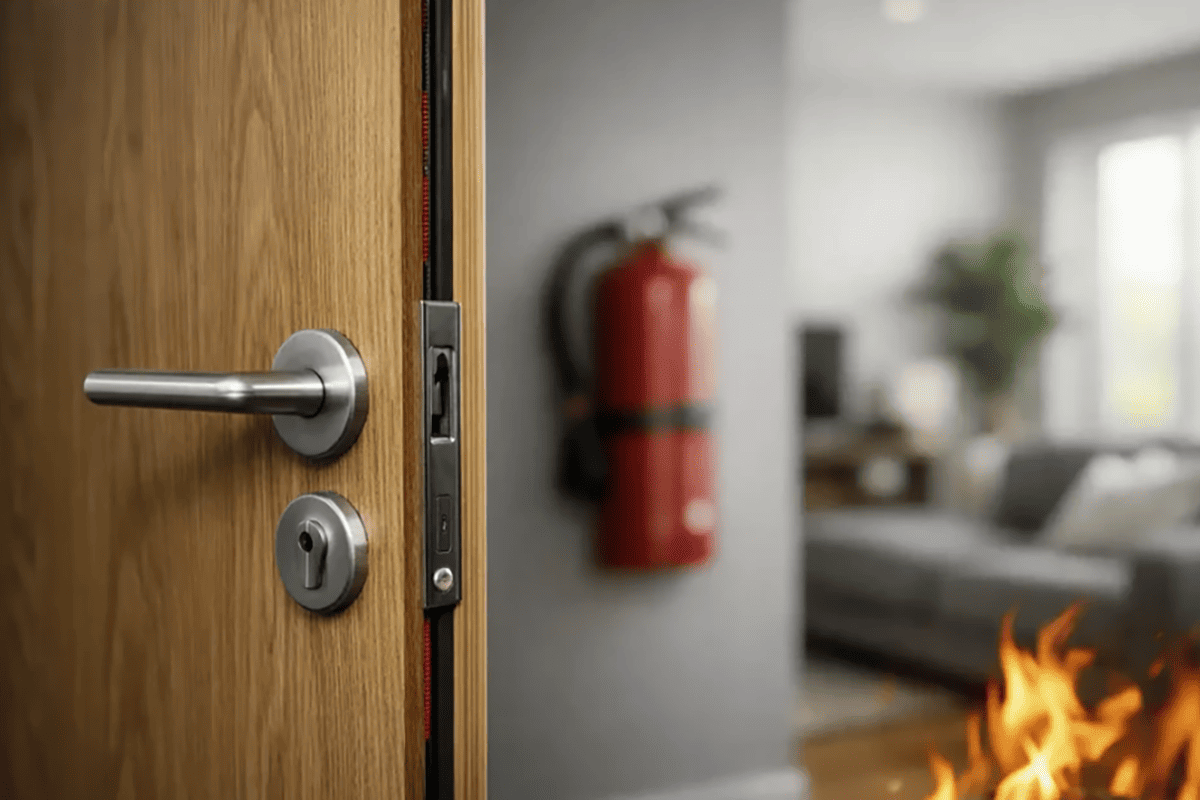
Intumescent hinges are fire door hinges fitted with an intumescent pad, liner, or kit around the hinge position. The hinge body provides mechanical support, while the heat-activated intumescent material expands3 during fire exposure to help seal local gaps and protect the hinge cut-out area.
Dive Deeper
In practical purchasing language, intumescent hinges usually means one of three things:
- A standard fire-rated hinge supplied with a separate intumescent pad
- A hinge set packed with pre-cut intumescent liners
- A hinge installation detail that includes intumescent material behind or around the hinge leaf
The hinge itself is normally stainless steel, steel, or another suitable metal. It does not swell like foam. The expansion comes from the intumescent material, which reacts when exposed to high temperature. Depending on the product design, this material may be graphite-based4 or made from another approved expanding compound.
From a supplier perspective, I like to separate the product into two functions:
| Component | Main Function | Buyer Should Check |
|---|---|---|
| Metal hinge body | Carries door weight and allows movement | Grade, load capacity, cycle testing, material, finish |
| Screws | Fix hinge to leaf and frame | Screw type, length, compatibility with door core and frame |
| Intumescent kit or liner | Expands under heat to help seal hinge gap | Thickness, size, position, test evidence |
| Door leaf and frame | Provide the rated fire barrier | Fire rating, material, tested assembly |
| Perimeter seals | Control smoke and flame spread around door edges | Seal type, location, certification |
This distinction matters because a buyer may ask, “Is this hinge fire rated?” That question is useful, but it is not enough. A hinge can have fire test documentation as a hardware component, while the complete door set still needs to match the tested fire door assembly.
In our factory discussions with door manufacturers, the real question is often more specific:
“Does this wooden fire door construction need an intumescent hinge pad behind each hinge leaf to match the tested configuration?”
That is a better procurement question. It connects the hinge, the door material, the frame, the fire rating, and the installation method.
Common Forms of Intumescent Hinge Protection
The most common forms include:
- Flat intumescent hinge pads placed behind the hinge leaf
- Pre-cut intumescent kits shaped to hinge dimensions
- Frame-side and leaf-side liners for mortised hinge pockets
- Custom-cut strips used for special hinge sizes or project specifications
For architectural door hardware buyers, I recommend confirming the following before bulk ordering:
- Hinge size, such as 4 inch, 4.5 inch, or 5 inch
- Hinge thickness and leaf width
- Number of hinges per door leaf
- Door fire rating, such as 30, 60, 90, or 120 minutes
- Door material, especially timber, mineral core, steel, or composite
- Required intumescent pad thickness
- Whether the pad is needed on the door side, frame side, or both
At SDH Hardware, I see many ODM and OEM orders where the hinge is correct mechanically, but the intumescent kit is not discussed until late. That creates avoidable delays. A complete fire-rated hardware package should include hinge size, screw type, surface finish, certification documents, and the correct intumescent kit configuration for the project.
Why Do Wooden Fire Doors Need Intumescent Hinges Around the Hinge Cut-Out?
Wooden fire doors create a special installation challenge. The hinge normally sits inside a mortised recess, and that recess removes material from the door edge and frame. If the hinge area is not sealed as required, the gap can become a weak point during fire exposure.
Wooden fire doors may need intumescent hinges because hinge mortising creates cut-outs, screw holes, and local gaps. During a fire, the intumescent liner expands to help close those gaps, reduce smoke movement, improve local insulation5, and support hardware retention around the hinge area.
Dive Deeper
A wooden fire door is not just a slab of timber. It is a tested system. The door leaf, core, lipping, frame, seals, lock, closer, hinges, and installation details all work together. When installers cut into the door edge for a hinge, they change the local protection at that point.
That is why intumescent hinges are often discussed most seriously in wooden fire door applications.
The Practical Risk: The Hinge Pocket
A hinge pocket can create several fire-performance risks:
- Reduced door edge material at the hinge position
- Small gaps behind the hinge leaf
- Screw holes that penetrate into the door structure
- Heat transfer through the metal hinge
- Possible smoke leakage around unsealed recesses
- Loss of screw holding strength if the surrounding material chars too early
The hinge area is also mechanically important. The whole door leaf depends on the hinge side for support. If the screws loosen or the hinge position fails too early, the door can drop, twist, or open gaps around the perimeter6. That can reduce the performance of the complete fire door set.
The intumescent kit helps by expanding under heat. It can fill local gaps around the hinge cut-out. It may also create pressure around the hinge and screws. This pressure can help reduce movement at the hinge position during the fire test period. However, I always describe this carefully: the kit supports the tested design, but it does not turn an unsuitable door into a compliant fire door.
Why the Hinge Area Is Different From a Flat Door Edge
A flat door edge can be protected with continuous intumescent strips7. A hinge position is interrupted by hardware. That interruption creates a more complex detail.
| Door Edge Area | Typical Protection | Main Concern |
|---|---|---|
| Lock edge | Perimeter intumescent strip and lock protection | Lock case cut-out and latch gap |
| Top edge | Continuous seal, depending on design | Smoke leakage and flame spread |
| Bottom edge | Threshold seal or project-specific detail | Smoke control and clearance |
| Hinge edge | Hinge pads, liners, and perimeter seals | Mortised cut-outs and hardware retention |
This is why door manufacturers often ask suppliers for hinge intumescent kits together with butt hinges, concealed hinges, or other fire-rated hinge products. The kit must match both the hardware and the door construction.
A Manufacturer-Side Example
I once worked on a hardware matching discussion for a wooden fire door project where the buyer selected stainless steel butt hinges based only on size and finish. The hinges looked suitable, and the load capacity was correct. But when the door factory reviewed the fire door evidence, the tested assembly included intumescent pads behind the hinge leaves.
The solution was not complicated. We matched the hinge size with pre-cut intumescent liners and updated the packing list. But the lesson was clear: the hinge pocket detail must be checked before mass production.
For procurement teams, this means the right question is not only, “Do you have fire-rated hinges?” The right question is:
“Can you supply the hinge with the intumescent kit required for my tested wooden fire door assembly?”
That question helps avoid rework, shipment delays, and compliance problems during project inspection.
When Should Buyers Specify Intumescent Hinges for a Project?
Buyers sometimes want a simple yes-or-no answer. I understand that. But fire door hardware selection is system-dependent. A hinge with an intumescent kit should be specified when the tested door assembly, project documents, or local compliance route requires that exact hinge-area protection.
Buyers should specify intumescent hinges when fire test evidence, door manufacturer instructions, project specifications, or local code requirements call for intumescent protection at the hinge position. They are especially relevant for wooden fire doors, higher-rated assemblies, smoke-control doors, and projects with strict hardware matching requirements.
Dive Deeper
I avoid saying that every fire door automatically needs intumescent hinges. That statement would be too broad. Some tested steel door assemblies may use different hinge protection details. Some door designs may have already passed testing with a specific hinge and seal arrangement. Other projects may require hinge pads because the certification evidence includes them.
The correct answer comes from the system.
Situations Where Intumescent Hinge Kits Are Commonly Required
Buyers should pay close attention in these situations:
Wooden fire doors with mortised butt hinges
The hinge recess removes material from the door edge and frame. A liner may be needed behind the hinge leaf.Fire-rated door sets with tested hinge pads
If the test report or approval document shows hinge pads, the supplied hardware should match that detail.Smoke-control fire doors8
Smoke leakage can be a major concern. Local sealing around hardware positions may be required.Higher fire ratings
A 60-minute or 90-minute assembly may have stricter hardware protection details9 than a lower-rated door.Doors with heavy leaves
Heavy doors place more demand on screw retention and hinge stability. The fire test evidence should be checked carefully.Hotel, hospital, school, and commercial projects
These projects often have detailed fire door schedules and inspection requirements.Export orders into regulated markets
Buyers in Europe, the Middle East, and Southeast Asia often need clear documentation for project approval.
A Simple Procurement Decision Table
The table below is not a legal rule. It is a practical evaluation guide for buyers.
| Project Condition | Intumescent Hinges Likely Needed? | What to Verify |
|---|---|---|
| Wooden fire door with mortised hinges | Often yes | Door test report and hinge pad detail |
| Steel fire door with welded hinge reinforcement | Depends | Tested assembly and frame design |
| 30-minute internal timber fire door | Depends | Door manufacturer instructions |
| 60-minute or 90-minute wooden fire door | Often yes | Seal design, hinge kit thickness, test evidence |
| Non-rated timber door | No upgrade by hinge alone10 | Door must be tested/rated as a system |
| Smoke-control door | Often specified | Smoke leakage requirements and seals |
| Custom OEM door construction | Must be evaluated | Application-specific testing or assessment |
Documents Buyers Should Request
When I support bulk hardware buyers, I usually suggest collecting documents before confirming the order. The exact document names vary by market, but the purpose is similar.
Useful documents may include:
- Fire test report or assessment for the door assembly
- Hardware schedule
- Door manufacturer installation instructions
- Hinge certificate or declaration, if available
- CE documentation where applicable
- Fire-rated certification documents for the product
- Technical drawing of hinge and intumescent kit
- Material and finish specification
- Packing list showing pads or liners included
A hinge certificate can be useful, but it is not the same as full fire door assembly compliance11. The final installed door set must match the tested or approved configuration. If the project has special requirements, a qualified fire door professional, certifier, or local authority should confirm the correct hardware package.
Why Early Specification Saves Money
Late changes are expensive in door hardware procurement. If the hinges ship without the required intumescent kits, the buyer may face:
- Repacking costs
- Air freight for missing kits
- Installation delays
- Site rejection
- Reinspection fees
- Brand reputation problems
For OEM and ODM orders, I prefer to confirm the intumescent hinge detail at the quotation stage. It helps us prepare the correct hinge, pad size, screw set, logo marking, packaging, and inspection checklist. It also helps the door manufacturer keep the certified construction consistent from prototype to mass production.
How Should You Evaluate Intumescent Hinges and Supplier Documentation?
Selecting intumescent hinges is not only about buying a hinge and a pad. Buyers must evaluate whether the complete hardware item fits the door rating, material, size, finish, and documentation route. A small mismatch can create a big approval problem later.
Buyers should evaluate intumescent hinges by checking hinge grade, material, load capacity, fire test evidence, intumescent kit size, screw compatibility, finish, and packing accuracy. They should also verify that supplier documents match the tested fire door assembly and project specification, not just the hinge product alone.

Dive Deeper
From a manufacturing and supply point of view, I look at intumescent hinges through two lenses: mechanical performance and fire door compatibility. Both matter. A hinge that survives fire exposure but cannot carry the door properly is not acceptable. A strong hinge without the correct intumescent liner may also fail the project requirements.
1. Check the Hinge Construction
Buyers should first review the physical hinge specification.
Important hinge details include:
- Material: stainless steel, steel, or other specified material
- Grade: durability and load grade based on relevant product standards
- Size: height, width, and thickness
- Knuckle design: bearing type, washer type, or plain bearing
- Pin design: fixed pin, loose pin, security pin, or ball bearing
- Screw holes: countersunk pattern and screw count
- Finish: satin stainless steel, polished stainless steel, PVD, powder coating, or custom finish
- Door weight capacity: based on number of hinges and door dimensions
At SDH Hardware, our main architectural hardware range includes stainless steel lever handles, Euro mortise locks, butt hinges, concealed hinges, Euro brass cylinders, and door accessories. When we support fire door manufacturers, we do not treat the hinge as an isolated part. We match it with the lock, cylinder, handle, closer, seals, and accessories where required.
2. Check the Intumescent Kit
The intumescent kit must fit the hinge and the installation detail.
Buyers should confirm:
- Pad length and width
- Pad thickness
- Cut-out shape
- Hole positions
- Quantity per hinge
- Whether pads go under one leaf or both leaves
- Whether the frame side also needs protection
- Temperature activation range, if specified
- Shelf life and storage conditions, if relevant
A common mistake is using a pad that is too large, too small, or too thick for the hinge recess. If the pad is too thick, the hinge may sit proud and affect door clearance. If it is too thin or missing, it may not match the tested design.
3. Check Fire-Rated Documentation
Good documentation helps procurement teams, door factories, and project inspectors. But buyers must understand what each document proves.
| Document | What It Helps Show | What It Does Not Prove Alone |
|---|---|---|
| Hinge test certificate | Hinge performance under stated conditions | Full door set compliance |
| Door assembly test report | Tested performance of the complete door set | Every possible hardware substitution |
| CE documentation | Declared conformity for applicable product scope | Automatic project approval |
| Fire-rated certificate | Product or system fire performance evidence | Suitability for all door designs |
| Technical drawing | Dimensions and installation detail | Fire compliance without test support |
| Inspection report | Shipment matches purchase order | Legal acceptance by local authority |
This is why I recommend verifying certificates as documents, not treating them as marketing claims. A buyer should check certificate number, issuing body, scope, product model, rating, test standard, and validity. If a project is safety-critical or highly regulated, a qualified professional should review the complete hardware schedule.
4. Check Supplier Quality Control
For bulk orders, consistency matters as much as the first sample. A good sample does not help if the final shipment contains mixed pad sizes or missing liners.
A practical quality checklist includes:
- Hinge dimension inspection
- Surface finish inspection
- Screw pack verification
- Intumescent pad quantity check
- Pad dimension measurement
- Carton label accuracy
- Batch traceability
- Random assembly fitting test
- Final product inspection report
In our own production process, we use full-process quality control: raw material screening, standardized production supervision, and finished product inspection. For fire-rated hardware matching, I also like to check the packing configuration carefully. The carton should make it clear whether the intumescent kit is included, separate, or pre-packed with each hinge set.
5. Ask Better Supplier Questions
Instead of asking only, “Do you have intumescent hinges?” buyers can ask:
- “Which hinge models can be supplied with intumescent kits?”
- “Can you provide drawings for the hinge and pad?”
- “Which fire-rated door applications has this hinge been used for?”
- “Can you match the hinge pad size required by our door test evidence?”
- “Can you support OEM packaging with clear pad identification?”
- “Can you provide inspection after order completion?”
- “Can you support stainless steel finish matching with our lock and handle set?”
These questions create a clearer buying process. They also help the supplier understand whether the buyer needs a standard product, a customized hardware set, or a project-specific configuration.
How Do Intumescent Hinges Fit Into a Complete Fire-Rated Hardware Package?
A fire door rarely fails or passes because of one item alone. Buyers may choose a strong hinge, but the door set still depends on locks, seals, closers, cylinders, handles, frames, and installation quality. Intumescent hinges must fit into the complete fire-rated hardware package.
Intumescent hinges fit into a fire-rated hardware package by protecting the hinge position while other components protect other weak points. The lock area, perimeter gaps, closer fixing points, frame connection, and threshold detail all need compatible fire-rated hardware and tested installation methods.
Dive Deeper
When buyers source fire door hardware, they often separate items by category: hinges from one supplier, locks from another, handles from another, and seals from another. That can work, but only if the final combination matches the door manufacturer’s tested or assessed design.
In my experience, problems happen when the hardware schedule is treated like a shopping list instead of a system.
Key Hardware Areas on a Fire Door
A complete fire-rated door hardware package may include:
- Butt hinges or concealed hinges
- Intumescent hinge kits
- Euro mortise locks
- Lock case intumescent kits
- Euro profile cylinders
- Lever handles or pull handles
- Door closers
- Panic exit devices, where needed
- Flush bolts, coordinators, or selectors for double doors
- Perimeter intumescent and smoke seals
- Door viewers, signage, and accessories
- Fixing screws and reinforcement plates
Each item affects the door in a different way. A mortise lock creates a large cut-out in the door edge. A closer adds fixing holes and load at the top of the door. A concealed hinge may require deeper routing than a butt hinge. These details must be checked against the fire door evidence.
Matching Hardware by Door Type
| Door Type | Hardware Concern | Hinge Protection Concern |
|---|---|---|
| Wooden single fire door | Mortised hardware cut-outs | Intumescent pads often required |
| Wooden double fire door | Meeting stile and leaf coordination | Hinge and seal system must align |
| Steel fire door | Reinforcement and fixing design | Depends on tested frame/leaf system |
| Hotel room fire door | Smoke control and frequent use | Durable hinge plus correct liner |
| Commercial escape door | Panic hardware and closer function | Hinge load and certified combination |
Conclusion
Fire doors need intumescent hinges when the hinge area requires added protection under the tested assembly, project specification, or local compliance route. The key issue is usually not the metal hinge alone. It is the mortised hinge cut-out, especially on wooden fire doors, where gaps can affect smoke control, insulation, and hardware retention. If you are sourcing fire-rated door hardware, SDH Hardware can help you match hinges, intumescent kits, locks, handles, cylinders, and accessories for your project requirements. Contact us to discuss your door type, rating, drawings, and hardware schedule.
"NSPIRE Standard - Door - Fire", https://www.hud.gov/sites/dfiles/PIH/documents/NSPIRE-Standard-Door-Fire-Labeled_20230811.pdf. General references on fire doors describe that doors are tested and certified as complete assemblies and that hardware and installation details are integral to their performance, implying localized features such as hinge preparations can influence integrity; the sources do not single out hinges as uniquely weak points. Evidence role: general_support; source type: encyclopedia. Supports: That fire door performance depends on the complete assembly and that hardware and installation details can influence integrity.. Scope note: Does not provide empirical data ranking hinge areas versus other weak points. ↩
"Fitting Fire Door Hinges: Positions, Markings and What I Check", https://www.firedoorassessment.co.uk/fitting-fire-door-hinges/. Industry guidance for timber fire doors notes that intumescent gaskets or liners are often required behind ironmongery, including hinges, to align with tested configurations for door integrity; this reflects common practice but may vary by doorset certification. Evidence role: expert_consensus; source type: institution. Supports: That guidance for timber fire doors often calls for intumescent gaskets or liners behind hardware such as hinges to maintain tested performance.. Scope note: Applies to timber doors generally and depends on specific doorset evidence rather than a universal rule. ↩
"Thermochemical characterization of intumescent materials ...", https://www.osti.gov/servlets/purl/1871622. Reference articles on intumescent materials explain that these compounds swell upon heating to many times their original volume and are used to maintain seals and compartmentation in fire scenarios; these explanations address the mechanism but not hinge-specific applications. Evidence role: mechanism; source type: encyclopedia. Supports: That intumescent materials swell when heated and are used to maintain seals for passive fire protection.. Scope note: Does not discuss hinge pads specifically. ↩
"Fireproof Intumescent Seal | Graphite-based", https://ressaseal.com/rpb-graphite-based-series-flexible-fireproof-intumescent-seal-what-are-the-specific-aspects-of-the-excellent-performance/. Reference materials on intumescents identify expandable graphite as a common constituent in seals and gaskets used for passive fire protection; these sources support typical compositions without specifying hinge kits. Evidence role: general_support; source type: encyclopedia. Supports: That expandable graphite is a common intumescent ingredient in passive fire protection products.. Scope note: Product formulations vary by manufacturer and certification. ↩
"(PDF) Modelling Smoke Leakage Through Fire Doors", https://www.academia.edu/7411003/Modelling_Smoke_Leakage_Through_Fire_Doors. Standards for smoke-control door assemblies (e.g., UL 1784 air leakage testing) evaluate total assembly leakage and underscore the need to limit leakage paths; while they do not prescribe hinge liners, they contextualize why localized sealing measures can influence smoke movement. Evidence role: general_support; source type: institution. Supports: That smoke-control door assemblies are evaluated for air leakage, highlighting the importance of limiting leakage paths which may include hardware locations.. Scope note: Does not directly test or quantify the effect of hinge liners on smoke or insulation. ↩
"Decoded: NFPA 80 Requirements for Hinges, Pivots, and ...", https://idighardware.com/2016/07/decoded-nfpa-80-requirements-for-hinges/. NFPA 80 requires hinges and their fastenings to be steel, appropriately sized, and installed in accordance with the listing to maintain the door assembly during fire exposure; the standard implies that hardware failure can compromise performance, although it does not catalog specific failure modes such as twisting. Evidence role: general_support; source type: institution. Supports: That maintaining the integrity and secure fastening of hinges is required to keep the fire door assembly in place during fire exposure.. Scope note: Does not provide experimental data on door displacement due to hinge failure. ↩
"Fire door", https://en.wikipedia.org/wiki/Fire_door. Descriptions of fire doors note that intumescent seals are typically installed along the door edge or frame so they expand in a fire to maintain compartmentation; these summaries do not address the special detailing at hinge positions. Evidence role: definition; source type: encyclopedia. Supports: That intumescent seals are commonly fitted in the edge of fire doors or frames to swell and maintain compartmentation.. Scope note: General description; not hinge-specific. ↩
"The need and availability of test methods for measuring the ...", https://www.govinfo.gov/content/pkg/GOVPUB-C13-be70d9d591baaa955b69db286db27453/pdf/GOVPUB-C13-be70d9d591baaa955b69db286db27453.pdf. EN 1634-3 specifies methods for determining the smoke control (air leakage) characteristics of door and shutter assemblies and assigns performance classes; the standard defines performance requirements but does not prescribe specific local sealing at hinges. Evidence role: definition; source type: institution. Supports: That smoke-control door assemblies are evaluated for air leakage performance under standards such as EN 1634-3 or UL 1784.. Scope note: Performance-based standard; does not mandate hinge-specific measures. ↩
"Panic and Fire Exit Hardware | Fire and Rescue", https://www.fairfaxcounty.gov/fire-ems/fire-marshal/panic-and-fire-exit-hardware. Overviews of fire door classifications explain that doors are rated for specified durations (e.g., 30/60/90 minutes), implying that assemblies intended for higher ratings are constructed to withstand more severe exposure; the sources do not enumerate specific hardware protection details. Evidence role: general_support; source type: encyclopedia. Supports: That fire door classifications (e.g., 30, 60, 90 minutes) reflect increasing demands on the door assembly to resist fire for longer durations.. Scope note: Does not prescribe hinge protection details for each rating. ↩
"Approved Document B: Fire safety - frequently asked ...", https://www.gov.uk/guidance/approved-document-b-fire-safety-frequently-asked-questions. UK building regulations guidance (Approved Document B) addresses fire-resisting doors as doorsets whose performance is demonstrated by testing to recognized standards, indicating that rating attaches to the complete assembly rather than to individual add-on components. Evidence role: definition; source type: government. Supports: That building regulations treat fire resistance of doors in terms of tested doorsets evaluated to recognized standards (e.g., EN 1634 or BS 476).. Scope note: Jurisdiction-specific phrasing and does not explicitly mention hinge pads. ↩
"Fire Doors", https://blink.ucsd.edu/safety/fire/requirements/doors.html. General references on fire doors state that they are tested and certified as complete assemblies and that altering components or using untested substitutions can invalidate the certification; accordingly, a component certificate (such as for a hinge) does not establish doorset compliance by itself. Evidence role: definition; source type: encyclopedia. Supports: That fire doors are evaluated and certified as complete assemblies and that untested substitutions can invalidate the rating.. Scope note: General guidance; project-specific certification rules govern allowable substitutions. ↩