Door Handing Made Simple: LH, RH, LHR, And RHR?
Door handing looks simple until a lock body, closer, hinge, or pivot arrives in the wrong version. That mistake can delay production, create rework, and confuse the door schedule. I use one practical rule: confirm LH, RH, LHR, and RHR from one agreed reference side before selecting hardware.
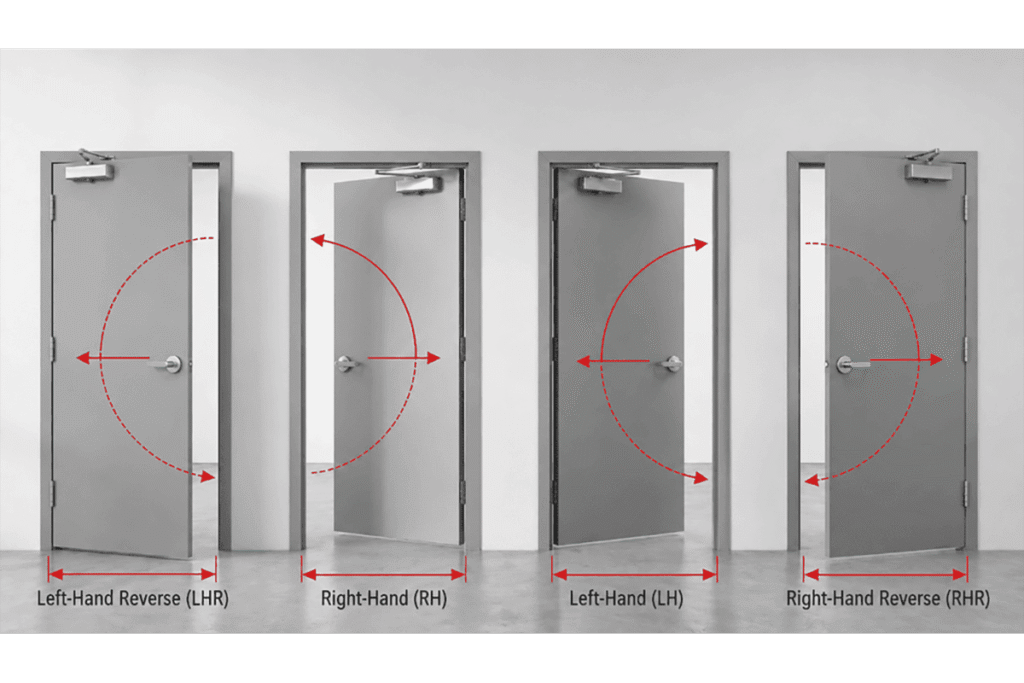
Door handing means identifying the hinge side and swing direction from a consistent viewing position.1 In this article, LH means left-side hinge with outward opening, RH means right-side hinge with outward opening, LHR means left-side hinge with inward opening, and RHR means right-side hinge with inward opening. Always confirm the project reference side first.
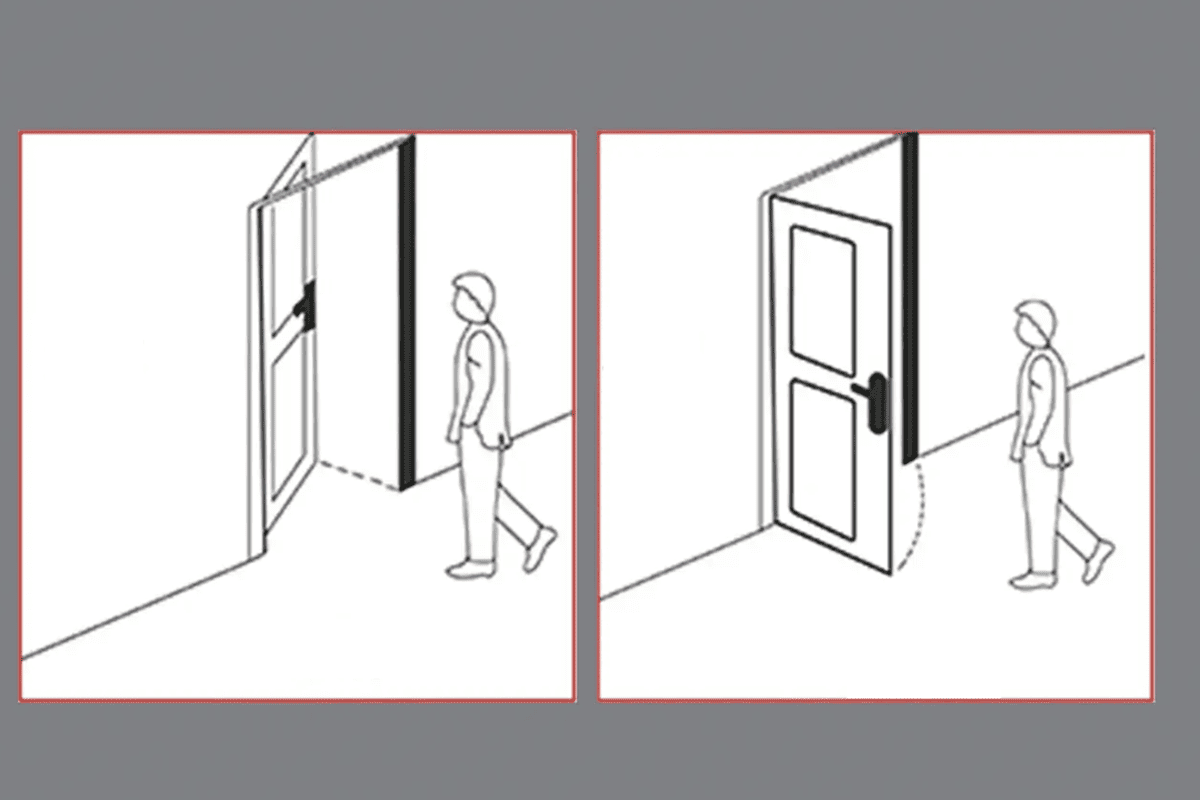
I have seen door factories send drawings, photos, and purchase orders that describe the same opening in three different ways. The real issue is not vocabulary. The real issue is whether the hardware supplier, door manufacturer, and project team are judging the opening from the same side.
Why Does Door Handing Matter Before Ordering Hardware?
Door handing creates problems when buyers treat it as a simple label instead of a hardware specification. A wrong label can affect mortise locks, closers, lift hinges, pivots, and some double-door accessories.2 That small error can become expensive after production starts.
Door handing matters because several architectural hardware products are directional3. The hinge side and swing direction can determine latch bevel direction, closer installation method, pivot configuration, and active-leaf hardware. Before ordering, I recommend confirming handing through drawings, door schedules, photos, and supplier review.

Door handing is a specification, not only a name
In B2B door hardware supply, I rarely see problems because a buyer does not know the words LH or RH. I see problems because different teams use those words from different viewing positions. One person stands on the corridor side. Another person stands inside the room. A third person reads the door schedule. Then the purchase order reaches the factory with a short description like “left hand lock.”
That is risky.
At SDH Hardware, I treat door handing as part of order confirmation. We manufacture and supply Euro mortise locks, lever handles, butt hinges, concealed hinges, cylinders, and door accessories for door factories and hardware brands. Some items are reversible or non-handed, but some are not. So I want the handing confirmed before production, packaging, or laser logo work begins.
Hardware commonly affected by handing
Not every hardware item needs a left or right version. However, several product categories often require careful checking.
| Hardware item | Handing impact | Buyer should confirm |
|---|---|---|
| Mortise lock body | Often affected | Latch bevel, latch direction, escape function, lock case version |
| Lever handle set | Sometimes affected | Handle design, rose/plate orientation, spring cassette direction |
| Door closer | Often affected by installation | Pull side, push side, standard arm, parallel arm, top-jamb mounting |
| Lift hinge | Often affected | Left/right lifting direction |
| Floor pivot / pivot set | Often affected | Pivot side, closer body position, door swing |
| Butt hinge | Usually non-handed, but check special types | Bearing type, template, lift-off design |
| Cylinder | Usually not handed | Cylinder length, cam type, key system |
| Flush bolt / coordinator | May be affected in double doors | Active/inactive leaf, meeting stile, opening sequence |
The procurement risk is larger than the word choice
A wrong door handing description can cause several practical issues:
The latch closes in the wrong direction.
The door may not latch smoothly, or the lock may require modification.The closer mounting is wrong.
A standard arm closer is typically used on the pull side, while top-jamb or parallel-arm applications are often used on the push side4, depending on the door and frame condition.Directional hinges or pivots cannot be installed.
Lift hinges, pivot sets, and some special hinges may need left/right confirmation.Double-door hardware becomes inconsistent.
The active leaf, inactive leaf, flush bolt, coordinator, and lock side must match the door schedule.
My practical view is simple: if the product can be affected by swing direction, I do not rely on only “LH” or “RH.” I ask for the opening drawing or a simple marked photo.
This is not about replacing project specifications or installation advice. It is about avoiding manufacturing and purchasing errors before the goods leave the factory.
How Do LH, RH, LHR, And RHR Work In Door Handing?
Door handing becomes clearer when I connect each term to two facts: hinge side and swing direction. The terms only make sense after the reference side is fixed. If the viewing position changes, the same physical door can be described differently.
In this guide, LH means the hinge is on the left and the door opens outward. RH means the hinge is on the right and the door opens outward. LHR means the hinge is on the left and the door opens inward. RHR means the hinge is on the right and the door opens inward.
First, fix the reference side
Before using LH, RH, LHR, or RHR, I ask one question:
From which side are we looking at the door?
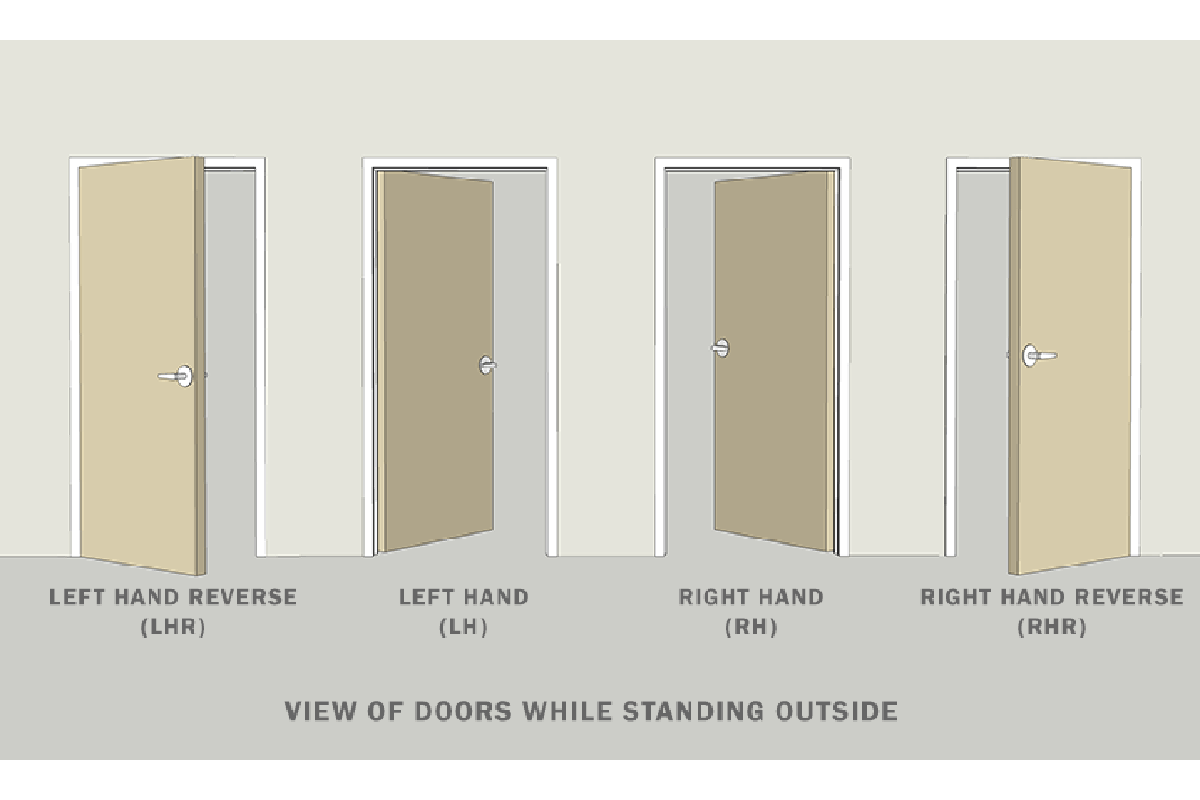
Some markets and project teams use different conventions.5 Some people describe the door from the pull side. Some use the secure side. Some use corridor side. Some use exterior side. Some use the side shown in the elevation drawing. Because of this, I avoid assuming that one global interpretation is always safe.
For a purchase order, the safest approach is to define the reference clearly. For example:
- “Viewed from corridor side”
- “Viewed from exterior side”
- “Viewed from pull side”
- “Viewed from the side shown in drawing A-301”
- “Viewed from the side of the marked photo”
Then the labels can be applied consistently.
Simple working definitions
For this article, I use the following door handing definitions:
| Term | Hinge side from agreed reference side | Swing direction from agreed reference side | Practical meaning |
|---|---|---|---|
| LH | Left side | Opens outward | Left hinge, outward swing |
| RH | Right side | Opens outward | Right hinge, outward swing |
| LHR | Left side | Opens inward | Left hinge, inward swing |
| RHR | Right side | Opens inward | Right hinge, inward swing |
These definitions are useful because they force the buyer to check both hinge position and swing direction. I never recommend using “left hand” alone without confirming whether the door opens inward or outward.
Why inward and outward need context
The words “inward” and “outward” can also create confusion. A door that opens “into the room” may open away from a corridor. The same door may be described as “outward” if the reference side is inside the room.
So I prefer to write a complete description:
- Viewed from corridor side: hinges left, door opens away from viewer
- Viewed from exterior side: hinges right, door opens toward viewer
- Active leaf viewed from public side: right hinge, outward opening
- Leaf B viewed from drawing side: left hinge, inward opening
This style may look longer, but it saves time. In manufacturing, clear descriptions are cheaper than rework.
A practical example from order confirmation
A door factory once sent us a door schedule that said “RH lock.” The attached drawing showed the hinge on the right from the corridor side, but the door opened into the room. The buyer had judged from the inside face, while the drawing was read from the corridor elevation.
Before producing the mortise lock configuration, we asked for confirmation. The buyer sent a marked photo with arrows. After that, we could confirm the latch direction and the closer recommendation more safely.
That experience is common in architectural hardware orders. Door handing is easy when everyone stands on the same side. It becomes risky when each department uses its own viewpoint.
What Is The Most Common Door Handing Mistake?
The most common door handing mistake is changing the viewing position during judgment. A buyer may call a door LH from the interior side, while the supplier reads the same opening from the exterior or drawing side. This reverses the result and creates mismatch.
The safest method is to choose one reference side and keep it for every opening. Then confirm hinge side, swing direction, active leaf, and hardware position from that side. For important orders, I recommend marking drawings or photos before production.
The mistake usually starts with “left” and “right”
Left and right seem obvious. But they are not fixed. They depend on where the viewer stands.
If I face a door from one side, the hinges may be on my left. If I walk to the other side and face the same door, the hinges may now appear on my right. The door did not change. My viewpoint changed.
This is why I dislike purchase descriptions such as:
- “Left lock”
- “Right opening”
- “Inside open”
- “Outside hinge”
- “Same as sample”
- “Normal European opening”
These phrases may be understood locally, but they are not always safe for cross-border manufacturing. SDH Hardware supplies customers in Europe, the Middle East, and Southeast Asia. In these markets, terminology and habits can vary by project, door type, and consultant preference.
How mismatches appear in real documents
A typical conflict may look like this:
| Document | Description | Possible problem |
|---|---|---|
| Door schedule | LH | No reference side shown |
| Elevation drawing | Hinge appears right | Drawing may be from opposite side |
| Purchase order | Left hand lock | Lock hand not tied to swing direction |
| Site photo | Door opens inward | Photo side may not match schedule side |
| Supplier quotation | RH mortise lock | Supplier interpreted from standard factory method |
When these documents disagree, I do not choose one at random. I ask the buyer to confirm the priority document and mark the opening direction.
My preferred confirmation method
I usually recommend a simple four-step check:
Choose the reference side.
Use corridor side, exterior side, pull side, or the drawing side. Do not switch later.Mark the hinge side.
Write “hinge left” or “hinge right” from that reference side.Mark the swing direction.
Write “opens toward viewer” or “opens away from viewer.” This is often clearer than “inward/outward.”Confirm hardware affected by direction.
Check mortise lock latch bevel, closer type, lift hinge, pivot, and double-door accessories.
Why photos help
A photo with arrows can prevent many disputes. It does not need to be beautiful. It only needs to show the door face, hinge side, and swing direction.
A good marked photo includes:
- Viewing side label
- Hinge location
- Door swing arrow
- Active leaf mark for double doors
- Lock side mark
- Frame or wall reference if relevant
For factory production, I prefer a marked drawing plus a photo when the order includes handed mortise locks, closers, or special hinges. This is especially important for ODM/OEM orders because packaging, stamping, and article numbers may be fixed before shipment.
Which Hardware Products Are Affected By Door Handing?
Door handing affects hardware when the part has a working direction, closing direction, or left/right installation geometry. Mortise locks, door closers, lift hinges, floor pivots, and some double-door components commonly need attention. Cylinders, many butt hinges, and many accessories may be reversible or non-handed.
Buyers should not assume every product is handed. Instead, buyers should review each hardware item against the door swing. The key question is whether the product’s function changes when the hinge side or swing direction changes.
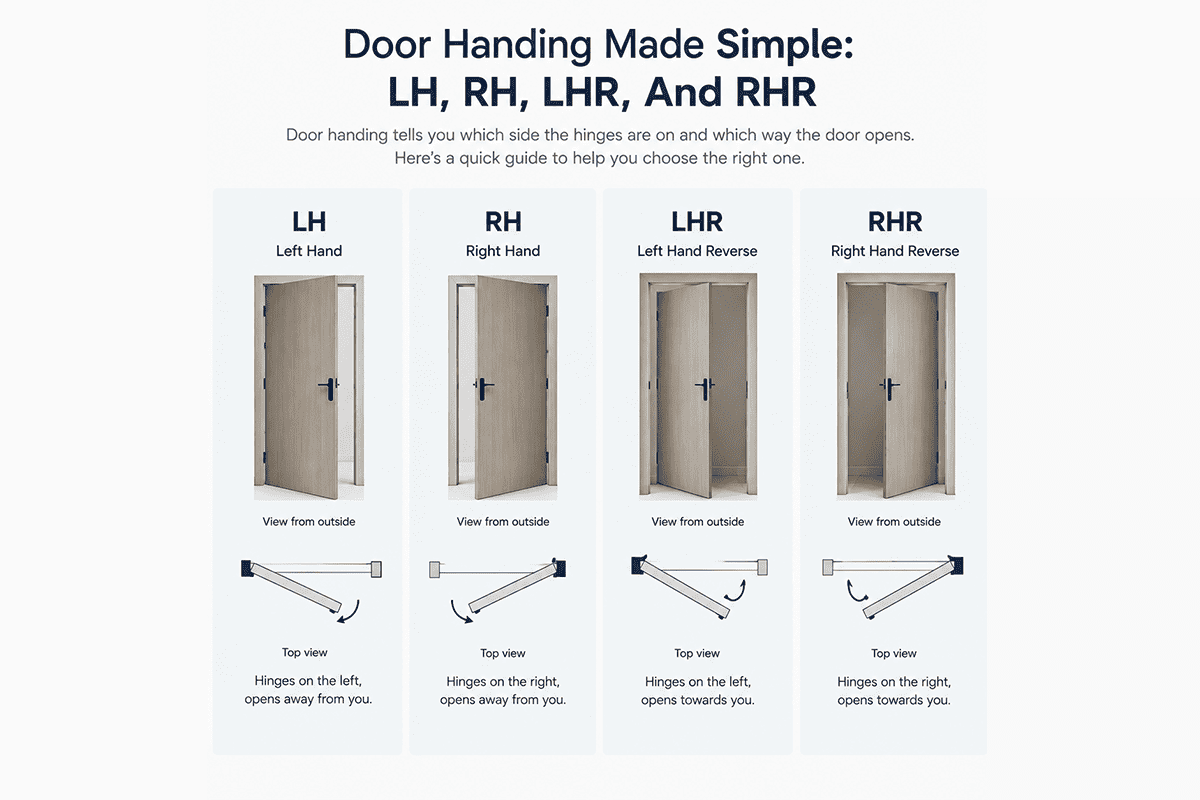
Mortise locks and latch bevel direction
Euro mortise locks are one of the most common products where door handing matters. The latch must meet the strike plate correctly when the door closes.6 Many latch bolts are reversible, but not all lock functions are the same.
Buyers should confirm:
- Latch bevel direction
- Deadbolt position
- Escape or panic function, if applicable
- Privacy, passage, classroom, or entrance function
- DIN left / DIN right references where used
- Door thickness and backset
- Strike plate type and frame material
Some lock bodies allow latch reversal on site. That can help distributors reduce inventory risk. However, a reversible latch does not automatically make every lock case universal.7 Special functions, anti-panic functions, electric functions, or project-specific configurations may still require detailed confirmation.
Door closers and mounting side
Door closers are another area where handing and swing direction matter. A surface-mounted closer can often be used on different hands, but the installation method changes.8
Common mounting options include:
| Closer mounting type | Typical side | Why handing still matters |
|---|---|---|
| Standard arm | Pull side | Arm geometry depends on swing side and frame clearance |
| Top-jamb | Push side | Body and arm position must match frame condition |
| Parallel arm | Push side | Bracket and arm setup must match opening direction |
| Concealed closer | Door/frame concealed | Pivot side and door preparation need careful checking |
| Floor spring / floor closer | Bottom pivot area | Left/right and hold-open direction may be project-specific |
I avoid saying one closer rule fits every site because installation depends on frame profile, stop condition, reveal depth, opening angle, fire-rating requirements, and project standards. For procurement, the important point is simple: the closer selection should be checked against the door handing and mounting condition before ordering.
Hinges, lift hinges, and pivots
Many standard butt hinges are non-handed.9 They can often be used on either left or right doors. But special hinge types may not be that simple.
Handing may matter for:
- Lift-off hinges
- Lift hinges
- Spring hinges
- Concealed hinges with asymmetric adjustment
- Pivot hinges
- Floor pivots
- Offset pivots
- Special fire-rated hinge systems
For example, a lift hinge may raise the door slightly during opening. The lift direction must match the opening direction. A floor pivot set may have a directional bottom component or a closer body orientation. A concealed hinge may require a specific drilling or routing pattern.
What I ask before confirming production
When a buyer requests hardware for a project, I prefer to collect the following information:
- Door type: timber, steel, aluminum, or fire-rated assembly
- Door size and weight
- Door thickness
- Frame type and material
- Hinge side from agreed reference side
- Swing direction from agreed reference side
- Active/inactive leaf for double doors
- Required certificates or test reports to verify
- Lock function and cylinder system
- Closer mounting method and opening angle
This information helps our engineering and sales teams recommend the correct article. It also helps buyers compare suppliers more fairly. A lower price is not useful if the hardware version does not match the door.
How Should Door Handing Be Checked For Double Doors?
Door handing for double doors should be checked leaf by leaf. A pair of doors is not one single handed unit. Each leaf needs its own hinge side, swing direction, active or inactive status, lock side, flush bolt position, and closer or coordinator requirement.
For double doors, identify the active leaf first, then check the handing of each leaf from the agreed reference side.10 Confirm which leaf carries the lock, which leaf carries flush bolts, how the doors close, and whether a coordinator, astragal, or panic device changes the hardware selection.
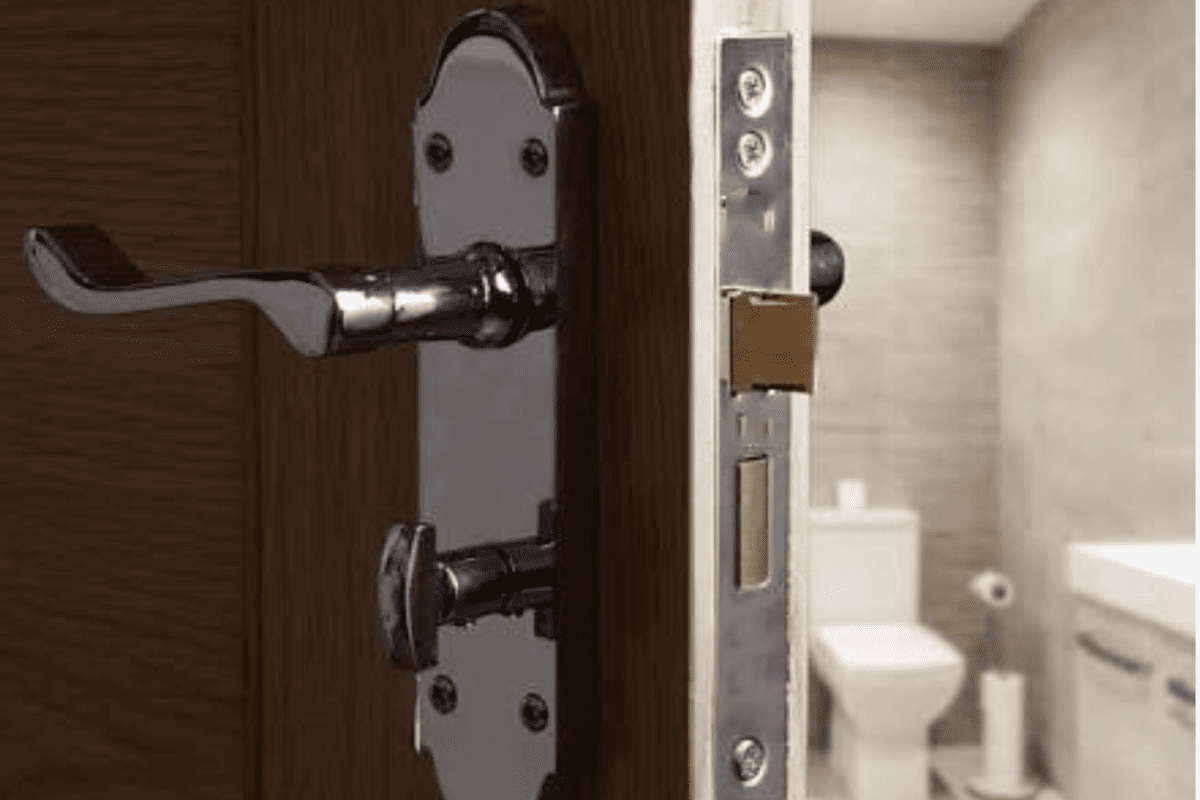
Why double doors create extra risk
Double-door openings create more confusion because people often describe the pair as a single item. A buyer may write “double door RH.” That is not enough for hardware production.
A double-door system may include:
- Active leaf
- Inactive leaf
- Mortise lock or panic lock
- Flush bolts
- Strike plate or dust-proof strike
- Astragal or meeting stile seal
- Door coordinator
- Door closers
- Floor springs or pivots
- Door selector
- Electric strike or access control parts
Each component depends on how the two leaves operate together.
Active leaf comes first
The active leaf is the leaf used for normal daily passage. It usually carries the main lock or latch. The inactive leaf may carry flush bolts, surface bolts, concealed bolts, or a strike preparation.
I recommend marking the active leaf before discussing LH, RH, LHR, or RHR. Without active-leaf confirmation, the supplier may place the lock case, strike, lever trim, or accessory set on the wrong side.
A clear double-door description may look like this:
“Viewed from corridor side: double door opens outward. Active leaf is right leaf. Right leaf has hinges on right and carries mortise lock. Left leaf is inactive and carries flush bolts.”
That statement is much safer than “double door RH.”
Check each leaf separately
A practical double-door checklist looks like this:
| Item | Active leaf | Inactive leaf |
|---|---|---|
| Hinge side | Confirm left/right | Confirm left/right |
| Swing direction | Confirm inward/outward | Confirm inward/outward |
| Lock or latch | Usually yes | Usually no, but may carry strike |
| Flush bolt | Usually no | Often yes |
| Closer | Often yes | Sometimes yes |
| Coordinator | May be required | May be required |
| Astragal | Depends on design | Depends on design |
| Panic device | Depends on egress plan | Depends on egress plan |
This table is not a code recommendation. It is a procurement checklist. For fire-rated doors, egress doors, and access-controlled openings, the project team should verify requirements with qualified professionals and the relevant project documents.
Door handing with closers on double doors
Closers on double doors need more than hand labels. They also need mounting side, arm type, opening angle, hold-open requirement, and closing sequence.
For example:
- A pair may need two closers if both leaves are used.
- A pair may need a coordinator if the inactive leaf must close before the active leaf11.
- A fire-rated pair may have stricter requirements for latching and closing.
- A concealed closer or floor spring may require different preparation for each leaf.
From a factory supply perspective, I want the door schedule to confirm the leaf relationship clearly. If the active leaf is wrong, the hardware package may still look complete, but it will not match the opening.
How Can Buyers Write A Clear Door Handing Specification?
Door handing specifications should be written with reference side, hinge side, swing direction, and hardware impact. A short label is helpful, but it should not be the only instruction. Clear wording reduces mistakes between drawings, purchase orders, quotations, and factory production.
A good specification states the viewing side, hinge side, swing direction, active leaf if applicable, and affected hardware. Buyers should also attach drawings or marked photos. For custom or project hardware, supplier review before production is the safest step.
Use complete wording, not only abbreviations
LH, RH, LHR, and RHR are useful shorthand. But shorthand should support clear communication, not replace it.
I prefer this format:
Single door format
- Project reference: viewed from corridor side
- Hinge side: left
- Swing: opens outward / away from viewer
- Handing label: LH
- Lock: latch bevel to match closing direction
- Closer: standard arm on pull side, or confirm mounting
- Notes: verify fire-rated certificate requirement before production
Double door format
- Project reference: viewed from exterior side
- Door pair: opens inward
- Active leaf: right leaf
- Active leaf handing: RHR, based on agreed reference
- Inactive leaf: left leaf with flush bolts
- Hardware: mortise lock on active leaf, strike/bolts on inactive leaf
- Notes: confirm coordinator and closer sequence
Add drawings and photos
For export hardware orders, I recommend sending at least one of these:
- Door schedule with opening numbers
- Elevation drawing with swing arrows
- Plan drawing with door arcs
- Marked photo or site sketch
- Hardware schedule
- Product function list
- Certificate requirements for CE or fire-rated documents to verify
At SDH Hardware, we can review project information from the viewpoint of hardware manufacturing and supplier selection. We do not replace the project architect, code consultant, or installer. However, we can help buyers identify unclear handing descriptions before production.
Use a confirmation table before mass production
For large orders, a table is often better than email text. It reduces interpretation errors and creates a record for both sides.
| Opening No. | Reference side | Hinge side | Swing direction | Handing label | Active leaf | Hardware affected | Supplier confirmation |
|---|---|---|---|---|---|---|---|
| D-101 | Corridor | Left | Outward | LH | N/A | Lock, closer | Pending |
| D-102 | Corridor | Right | Inward | RHR | N/A | Lock | Confirmed |
| D-201A | Exterior | Right | Outward | RH | Active | Lock, closer | Pending |
| D-201B | Exterior | Left | Outward | LH | Inactive | Flush bolt | Pending |
This type of table is simple, but it works. It also helps wholesalers and brand owners manage article numbers, packaging labels, and warehouse picking instructions.
Match the specification to supplier capability
When selecting a supplier, buyers should not only ask whether the supplier sells “left and right” hardware. Buyers should ask how the supplier confirms handed products before production.
Useful supplier questions include:
- Do you check door handing against drawings before production?
- Are the latch bolts reversible, or must the lock be ordered left/right?
- Which closers are non-handed, and which mounting kits are required?
- Do lift hinges or pivots require separate left/right article numbers?
- Can you provide product drawings after order confirmation?
- Can you support inspection after production?
- Which CE or fire-rated certificates apply to the exact product version?
For technical documents and certifications, buyers should verify that the supplied certificate, test report, or declaration matches the product, size, material, and project requirement. This is especially important for fire-rated door assemblies.12
Conclusion
Door handing is simple when everyone uses one reference side and checks both hinge side and swing direction. LH, RH, LHR, and RHR become risky only when drawings, photos, schedules, and purchase orders use different viewpoints. Before ordering locks, closers, lift hinges, pivots, or double-door hardware, I recommend confirming the details with your supplier. If you need factory-direct architectural hardware support, SDH Hardware can review your door schedule and help match the correct hardware specification before production.
"How to Determine Left Hand and Right Hand Doors for ANSI and EN ...", https://sdhhardware.com/2026/06/22/how-to-determine-left-hand-and-right-hand-doors-for-ansi-and-en-12209-mortise-lock-purchasing/. Architectural hardware references define door handing by the hinge side and the direction of swing as viewed from a specified side, supporting the need to identify a consistent reference position. Evidence role: definition; source type: institution. Supports: A technical source should define door handing in terms of hinge side and door swing from a specified side or face.. ↩
"SECTION 087111 - DOOR HARDWARE (SCHEDULED BY ...", https://fpm.usc.edu/wp-content/uploads/2021/11/087102-USC-HSC-door-hardware-Guide-Specification_1.pdf. Architectural hardware specification references list handing or swing direction as a selection factor for multiple products, including locks, closers, pivots, and paired-door accessories, supporting the risk of mismatched hardware when the label is wrong. Evidence role: general_support; source type: institution. Supports: A specification or standards source should connect door handing to product selection for locks, closers, pivots, hinges, and double-door hardware.. ↩
"SECTION 087111 - DOOR HARDWARE (SCHEDULED BY ...", https://fpm.usc.edu/wp-content/uploads/2021/11/087101-USC-UPC-door-hardware-Guide-Specification_1.pdf. Door-hardware technical references distinguish between handed and non-handed products and identify locks, closers, pivots, and some hinges as items whose application can depend on door swing or installation side. Evidence role: general_support; source type: institution. Supports: A door-hardware standards body or technical manual should explain that certain locks, closers, hinges, pivots, and accessories may be handed or installation-direction dependent.. ↩
"How to Install a Commercial Door Closer? - SDH hardware", https://sdhhardware.com/2026/08/28/how-to-install-a-commercial-door-closer/. Door-closer installation references commonly describe standard-arm mounting on the pull side and parallel-arm or top-jamb mounting on the push side, although final applicability depends on frame, reveal, stop, and opening conditions. Evidence role: mechanism; source type: institution. Supports: A technical installation reference should describe the common mounting locations for standard-arm, top-jamb, and parallel-arm door closers.. Scope note: Contextual support for common mounting configurations, not a universal rule for every closer model or site condition. ↩
"How to Determine Left Hand and Right Hand Doors for ANSI and EN ...", https://sdhhardware.com/2026/06/22/how-to-determine-left-hand-and-right-hand-doors-for-ansi-and-en-12209-mortise-lock-purchasing/. Comparative door-hardware standards and technical references show that regional systems use different handing terminology and reference conventions; this supports the article’s caution but does not prove every project team applies them consistently. Evidence role: historical_context; source type: institution. Supports: A standards or institutional source should show that door handing conventions differ between systems, such as DIN left/right and North American handing terms.. Scope note: Contextual support for variation in standards and terminology, not direct evidence about all market practices. ↩
"How Does a Mortise Lock Work Explained? - SDH hardware- China ...", https://sdhhardware.com/2026/08/04/how-does-a-mortise-lock-work-explained/. Door-lock installation references explain that the latch bolt engages the strike plate when the door closes, supporting the article’s statement that latch orientation and strike alignment are necessary for proper latching. Evidence role: mechanism; source type: institution. Supports: A door-lock installation or maintenance source should explain that the latch bolt engages the strike plate and that alignment/orientation affects latching.. ↩
"Euro Profile Mortise Lock: A Comprehensive Product Inspection ...", https://sdhhardware.com/2025/02/13/euro-profile-mortise-lock-a-comprehensive-product-inspection-guide-based-on-en12209-standards/. Technical lock references distinguish reversible latch bolts from the broader lock-case configuration, indicating that special functions or project-specific features may still require handed or function-specific selection. Evidence role: general_support; source type: institution. Supports: A technical hardware reference should show that latch bolts may be reversible while other lock functions, cases, or configurations can remain handed or application-specific.. Scope note: Contextual support; the exact degree of universality depends on the particular lock standard, manufacturer design, and function. ↩
"How to Install a Commercial Door Closer? - SDH hardware", https://sdhhardware.com/2026/08/28/how-to-install-a-commercial-door-closer/. Door-closer installation literature commonly treats many surface closers as non-handed but specifies different mounting arrangements, such as regular-arm, top-jamb, or parallel-arm applications, depending on the door and frame condition. Evidence role: mechanism; source type: institution. Supports: An installation reference should show that surface closers may be non-handed while requiring different arm or mounting configurations for pull-side and push-side applications.. Scope note: Contextual support; individual closer models and listings may impose additional restrictions. ↩
"6 Most Common Types of Hinges? - SDH hardware- China ...", https://sdhhardware.com/2026/07/01/6-most-common-types-of-hinges/. Architectural hardware references generally describe standard butt hinges as non-handed, while noting that special hinge types or features can create handed applications. Evidence role: definition; source type: institution. Supports: A hardware reference should define common butt hinges as generally non-handed or reversible unless a special feature makes them handed.. Scope note: Contextual support for standard butt hinges; special hinges such as lift-off, spring, or asymmetric designs may differ. ↩
"What Are the Essential Parts of a Door, and Why Do ... - SDH hardware", https://sdhhardware.com/2026/07/01/what-are-the-essential-parts-of-a-door-and-why-do-they-matter-for-hardware-sourcing/. Paired-door hardware references distinguish active and inactive leaves and tie those designations to locks, strikes, bolts, and closing hardware, supporting the practice of checking each leaf separately. Evidence role: general_support; source type: institution. Supports: A door-hardware specification source should define active and inactive leaves and connect them to lock, strike, flush-bolt, and closer selection.. ↩
"What Type of Fire Exit Hardware Do We Use on Fire Exits? - SDH ...", https://sdhhardware.com/2026/08/07/what-type-of-fire-exit-hardware-do-we-use-on-fire-exits/. Fire-door and architectural-hardware references describe door coordinators as devices that control the closing order of paired doors, typically ensuring that the inactive leaf closes before the active leaf when the assembly requires that sequence. Evidence role: mechanism; source type: institution. Supports: A fire-door or hardware reference should explain that coordinators control the closing sequence of paired doors so the inactive leaf closes before the active leaf where required.. ↩
"What Are the Fire Door Hinge Placement ... - SDH hardware", https://sdhhardware.com/2026/08/13/what-are-the-fire-door-hinge-placement-requirements-for-commercial-buildings/. Fire-door standards treat the door, frame, and hardware as a tested and labeled assembly, supporting the need to verify that certificates or test reports correspond to the specific product version, size, material, and application. Evidence role: expert_consensus; source type: institution. Supports: A fire-door standard or code source should state that fire-door assemblies and their hardware must be listed, labeled, or installed according to the applicable tested assembly and product limitations.. ↩